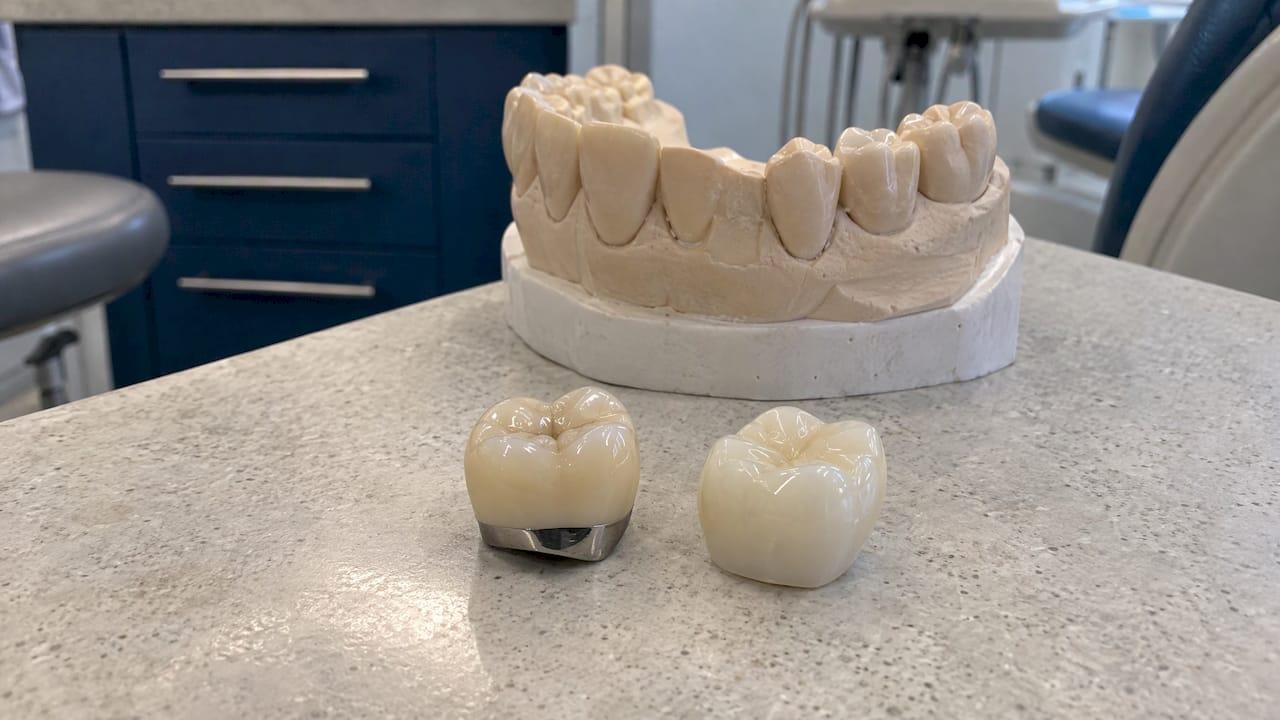
For most people choosing between the two, the answer comes down to where the tooth sits and how you bite. Zirconia is usually the stronger fit for back teeth, heavy grinders and anyone who wants no metal near the gums. A porcelain-fused-to-metal (PFM) crown still earns its place when a dentist wants a proven metal core under a tooth-colored surface. Lithium disilicate (often sold as e.max) tends to suit visible front teeth, and gold suits a back tooth where looks matter least. Your dentist should confirm all of this on your own tooth, with X-rays and a look at your bite. Here is how each material works, so you walk into the appointment knowing what to ask.
TL;DR
- Zirconia is a dense ceramic with no metal inside. It is the usual pick for molars, grinders and people with metal sensitivities, and modern shades look natural.
- PFM has a metal shell under a porcelain layer. It has a long track record, but the metal can show as a dark line at the gumline and the porcelain layer can chip.
- Lithium disilicate (e.max) is a glass-ceramic that tends to look the most lifelike, which makes it a common front-tooth choice. Gold is the most traditional back-tooth option and is kind to opposing teeth.
- The right material depends on the tooth, your bite, your gums and your budget. Ask for the reasoning in a written treatment plan.
Table of Contents
- What a crown does and why the material matters
- What is a PFM crown?
- What is a zirconia crown?
- PFM vs. zirconia: side-by-side
- Zirconia vs. lithium disilicate (e.max)
- Gold crown vs. porcelain or zirconia
- Best crown material by tooth
- Questions to settle before you choose
- What happens at your crown appointment
- Why having everything under one roof helps
- Your next step
- Our perspective
- FAQ
- Sources
What a crown does and why the material matters
A crown is a cap that covers a tooth that is cracked, heavily filled, worn down or has had a root canal. It restores shape, protects what is left of the tooth and lets you chew normally. If you want the full picture of the process, our page on dental crowns in Washington, DC walks through it.
The material you pick affects four things you will notice over the years:
- Strength. Can it take the force of a molar, or a night of grinding?
- Appearance. Does it blend with the neighboring teeth in different light?
- Gum health. Does the edge near the gum stay quiet and look natural?
- Cost. What you pay now, and what a replacement would cost later.
No single material wins all four on every tooth. That is why the comparison below is organized by tooth and by situation, not by a single winner.
What is a PFM crown?
PFM stands for porcelain fused to metal. The crown has a thin metal shell (the coping) that gives it strength. A layer of tooth-colored porcelain is baked onto the outside so it resembles a tooth. PFM has been used in dentistry for decades, which is the main reason dentists trust it.
Where PFM does well
- A long history of use in the mouth, including on bridges that span a gap.
- A strong metal base that holds up under chewing force.
- Often a lower price than newer all-ceramic options.
Where PFM can disappoint
- The metal under the porcelain can show as a thin dark line at the gumline, especially if the gums recede over time.
- Because the metal blocks light, the crown can look a little opaque next to natural teeth, which glow slightly as light passes through them.
- The porcelain layer can chip or crack away from the metal.
- Some people react to the metal alloy, with gum irritation or a metallic taste.
- The dentist usually has to remove a bit more tooth structure to make room for both metal and porcelain.
What is a zirconia crown?
Zirconia is a white, very hard ceramic, sometimes called "zirconia teeth" by patients. It contains no metal. Most zirconia crowns today are milled from a solid block of the material (called monolithic), which means there is no porcelain layer to chip off. Earlier versions were stark white, but newer, more translucent grades can be shaded to blend with natural teeth.
Where zirconia does well
- High strength, which suits molars and people who clench or grind.
- No metal, so no dark line at the gumline and no metal allergy concern.
- A natural look from newer shading and translucency.
- Can often be made thinner, so less of your tooth has to be reduced.
- Because it is milled from digital scans, it fits well with same-day crown technology. See what to expect from a same-day crown in one visit.
Where zirconia asks for care
Very high-strength zirconia is a little less see-through than glass-ceramics, so on the most visible front teeth, dentists weigh it against lithium disilicate. A skilled dentist also needs to adjust the bite carefully, because a hard crown should meet the opposing tooth evenly.
PFM vs. zirconia: side-by-side
| Factor | PFM | Zirconia |
|---|---|---|
| Core | Metal shell with porcelain on top | Solid ceramic, no metal |
| Strength | Strong metal base; porcelain layer can chip | Very strong; solid crowns have no veneer layer to chip |
| Appearance | Good, but can look opaque; dark line possible at gums | Natural look with modern shading; no dark line |
| Gum friendliness | Metal can irritate some patients | Ceramic is well tolerated by most patients |
| Tooth reduction | Typically more | Often less |
| Best for | Bridges, some back teeth, budget-conscious cases | Molars, grinders, metal-sensitive patients, many front teeth |
| Cost | Often lower | Often a little higher |
How long they last is the question people ask most. In a retrospective study of crowns placed in private practice, survival times and survival probabilities of zirconia-based crowns on back teeth did not differ from PFM crowns. Both are durable choices. The difference you feel day to day is more about looks, the gum line, chipping and comfort than about one failing early.
How long either crown lasts also depends on your habits: brushing, flossing, regular cleanings and whether you wear a night guard if you grind. The tooth underneath still needs protection from decay at the edge of the crown.
Zirconia vs. lithium disilicate (e.max)
This pairing comes up a lot. Both are metal-free, so you avoid the dark line that a PFM can cause. They differ in a few ways:
- Lithium disilicate is a glass-ceramic. It transmits light well, so it often gives the most lifelike look, which is why dentists often reach for it on front teeth and premolars.
- Zirconia is denser and generally stronger, so it is the usual pick for molars, long bridges and patients with heavy bites.
- Both can be shaded and polished to match neighboring teeth.
A simple rule of thumb: the more a tooth shows when you smile, the more a dentist leans toward lithium disilicate. The more force the tooth takes, the more the dentist leans toward zirconia. Your dentist makes the final call after seeing your bite.
Gold crown vs. porcelain or zirconia
Gold crowns are really gold alloys, mixed with other metals for hardness. They have been used in dentistry for a very long time. Dentists value them because the alloy can be made very thin at the edges, it wears at a rate similar to natural enamel, and it rarely cracks.
The obvious drawback is the color. For that reason gold is most often considered for a back molar that no one sees. If you want a white tooth, zirconia or lithium disilicate is the closer match. Comparing gold with zirconia mostly comes down to two things: do you mind a metal color on that tooth, and does your dentist think the tooth needs the gentlest option for the tooth it bites against?
If you are comparing gold with a PFM, gold has no porcelain layer to chip, while PFM looks like a natural tooth. Many people who ask about gold versus a "white crown" are weighing exactly this: durability and gentle wear against color.
Best crown material by tooth
Molars (the back teeth that do the heavy chewing). Zirconia is the most common choice because of its strength. Gold is a classic alternative if color does not matter. PFM is also used here, with the caveat that porcelain on the chewing surface can chip.
Premolars. These sit between visibility and force. Zirconia and lithium disilicate both work, and the choice comes down to how visible the tooth is and how you bite.
Front teeth. Looks matter most here. Lithium disilicate or a high-translucency zirconia can be shaded to blend in. If you are considering several front teeth, a cosmetic plan such as porcelain veneers or a smile makeover may be worth discussing instead of individual crowns.
Bridges. A bridge replaces a missing tooth by anchoring to the teeth on either side. PFM and zirconia have both been used. A single-tooth implant is another route, and the single tooth dental implants page explains how that compares.

If you grind or clench. Tell your dentist. A strong material and a night guard protect the crown and the teeth around it.
Questions to settle before you choose
- Which tooth is it, and how much of it shows when you smile? This is the biggest factor.
- Do you grind your teeth? Heavy bites push toward zirconia or gold.
- Do you have a known metal sensitivity? Then choose a metal-free crown.
- Are your gums receding? A metal edge is more likely to show.
- What does your insurance cover? Plans often cover a share of a crown and may pay the same amount whichever material you choose, leaving you the difference. Waiting periods can also apply. Our guide to dental insurance for crowns explains how it works.
- What is the total cost? Our write-up on what a dental crown costs covers the factors that move the price.
What happens at your crown appointment
A crown visit is more comfortable when you know the sequence:
- Exam and X-rays. The dentist checks the tooth's remaining structure, the roots and the bite. This imaging shapes the choice of material.
- Treatment plan. You should see in writing what is being recommended and why.
- Preparing the tooth. The dentist removes decay and shapes the tooth to hold the crown.
- Impression or digital scan. This is the blueprint for your crown.
- Temporary crown or same-day crown. If your crown is made later, a temporary protects the tooth. If you lose it, here is what to do when a temporary crown falls off.
- Fitting and bite check. The final crown is cemented after checking fit, color and how your teeth meet.
After placement, a little sensitivity to hot and cold is common at first. If it lingers, read crown sensitivity after two weeks. If a crown cracks, here is what to do right now.
Why having everything under one roof helps
Crown choices often connect to other care. A tooth may need a root canal first, a gum adjustment to expose enough tooth, an extraction or an implant. At DC Implant & Cosmetic Dentistry, every procedure from exams to surgical implants is performed in-house, which avoids referrals and hand-offs. Same-day appointments are available, and treatment plans are clear and in writing, backed by thorough imaging and up-front planning.
If a crown needs more tooth to hold onto, crown lengthening is an oral surgery service you can discuss in the same practice.
Your next step
If you have a tooth that needs a crown, or an old PFM that shows a dark line or has chipped, we can look at it, take the images and put a written plan in front of you. Our general dentistry team handles exams, X-rays, fillings, root canals and same-day crowns in one Washington, DC location. See the general dentistry services or book a visit and tell us the tooth that is bothering you. Financing options, including CareCredit and Lending Tree, are available for higher-cost treatment.
Our perspective
When someone asks us PFM or zirconia, we start with the tooth, not the material. A back molar under a grinder's bite is a different problem from a front tooth that shows in every photo.
What we want you to leave with is a clear plan. Dr. Kambez Shukoor, a U.S. Navy veteran, treats the whole mouth, so the crown decision fits with your gums, your bite and any other work you may need. Because exams, imaging and treatment all happen in one office, the plan you get in writing is the plan that gets carried out.
Ask us why a material is recommended for your tooth. A good answer names your bite, your smile line and your gums.
Jake
FAQ
Is zirconia better than PFM?
For many teeth, yes, especially molars, grinders and patients who want no metal near the gums. PFM remains a proven option and survived about as well as zirconia-based crowns in the private practice study cited above. Your tooth and bite decide.
What is the best crown material for a molar?
Zirconia is the most common choice for molars because it is a strong, metal-free ceramic. Gold is a classic alternative where color does not matter. Your dentist will recommend one after checking how much tooth remains and how you bite.
Is e.max stronger than zirconia?
Generally no. Lithium disilicate is prized for its lifelike look and is often used on front teeth, while zirconia is denser and tends to be chosen for back teeth under heavy force.
Does a PFM crown always show a dark line?
Not always, but the metal under the porcelain can become visible at the gumline, especially if the gums recede. A metal-free crown avoids that issue.