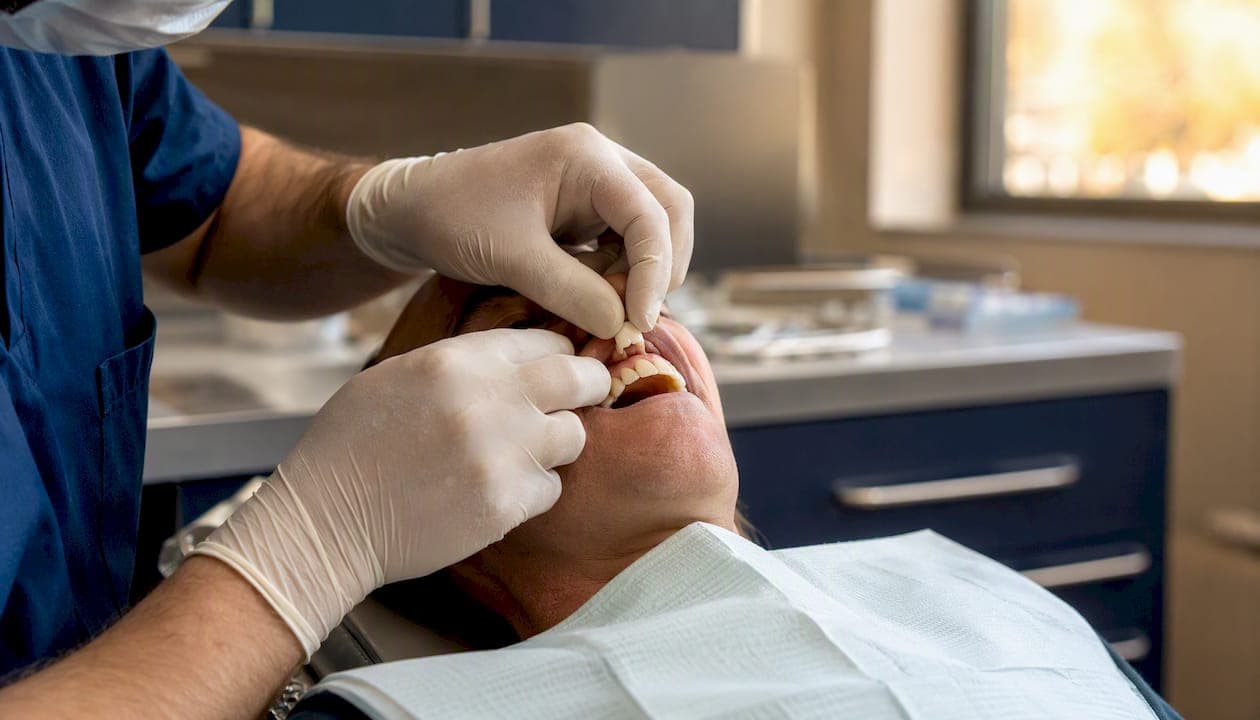
A single dental crown typically runs $800 to $2,500 in cash price for the crown itself, with most patients paying somewhere between $950 and $1,600 depending on material and location. If you have dental insurance, expect your out-of-pocket share to land closer to $400 to $900 once your plan pays its usual 50% of the allowed amount, though your deductible and annual maximum can push that number higher.
That quote almost never tells the whole story. Most treatment estimates cover the crown code alone and leave out core buildup, a post and core, or a root canal if your tooth needs one, and any of those can add several hundred dollars before you sit in the chair for the final fitting.
Before you commit to anything, ask your dentist for an itemized treatment plan with procedure codes attached, then take that plan to your insurer for a pre-treatment estimate. That one phone call tells you what you'll actually owe instead of what a website's average suggests.
- Typical cash price for one crown: $800 to $2,500, most commonly $950 to $1,600
- Typical insured out-of-pocket: roughly $400 to $900 after deductible and coverage
- Common add-ons not included in the base quote: core buildup, post and core, root canal, imaging
- Your next move: request an itemized plan and a pre-treatment insurance estimate before scheduling
Key Takeaways
Dental crown cost typically runs $800 to $2,500 in cash price, and insurance coverage under the major restorative category usually reimburses about 50% of the allowed amount after your deductible.
| Point | Details |
|---|---|
| Know your baseline | A single crown typically costs $800 to $2,500, with most cash quotes clustering around $950 to $1,600. |
| Expect the insurance gap | Plans classify crowns as major restorative and often pay only 50% of the allowed amount after deductible. |
| Watch for excluded add-ons | Core buildup, post and core, and root canal are usually billed separately and can double your total. |
| Use every savings lever | Dental schools, FSA/HSA funds, in-network providers, and CareCredit financing all reduce out-of-pocket cost. |
| Get it in writing first | Request an itemized treatment plan with procedure codes and a pre-treatment insurance estimate before scheduling. |
| Book with transparency in mind | DC Implant & Cosmetic Dentistry verifies insurance and itemizes crown costs upfront, with same-day appointments available. |
Table of Contents
- How Much Does a Dental Crown Cost Across the Country?
- What Actually Drives Your Crown's Price?
- Which Crown Material Is Right for Your Budget and Tooth?
- How Does Dental Insurance Actually Change the Price?
- How Can You Lower the Cost of a Crown?
- How Long Does a Crown Actually Last?
- What Happens During a Crown Appointment, Start to Finish?
- What Should You Look For in a Crown Provider?
- Why Transparent Pricing Matters More Than the Lowest Quote
- Ready to Get an Exact Quote for Your Crown?
- Where This Information Comes From
- Frequently Asked Questions
- Sources
How Much Does a Dental Crown Cost Across the Country?
Prices vary more by zip code than most people expect. National data puts the full per-tooth range at $800 to $3,000, with cash-paying patients most often landing between $1,000 and $2,500 depending on the material chosen and the practice's overhead.
Metro areas with higher rent and labor costs, think Washington, DC, New York, or San Francisco, tend to sit at the upper half of that range. Rural practices and smaller markets often quote toward the lower third, sometimes several hundred dollars less for the identical porcelain-fused-to-metal crown. Uninsured patients at private practices commonly report paying $1,000 to $1,800 for a straightforward molar crown, while dental schools in the same city can charge meaningfully less for comparable work.
- National full-tooth range: $800 to $3,000
- Common cash-pay cluster: $1,000 to $2,500
- Same-day CEREC crowns often price similarly to lab-made crowns, sometimes with a modest premium for the in-office milling equipment, though you save a second visit
Statistic callout: Averages across pooled cost data cluster tightly in the $950 to $1,600 range for the crown procedure alone, which is the number worth comparing your own quote against before you factor in extras.
What Actually Drives Your Crown's Price?
Two people can get the same tooth crowned in the same city and pay wildly different amounts. The gap almost always comes down to a handful of specific variables, not random pricing.
- Material: zirconia and all-ceramic crowns typically cost more upfront than porcelain-fused-to-metal or gold
- Tooth location: front teeth often carry a cosmetic premium for shading and translucency work; molars sometimes cost less because appearance matters less
- Lab complexity: custom shading, layered porcelain, and specialty labs add fees a basic monolithic zirconia crown skips
- Provider type: a general dentist and a prosthodontist may quote differently for the same material based on training and case complexity
- Preparatory work: a core buildup, post placement, or root canal adds separately billed procedures
- Imaging: standard X-rays are usually bundled in, but CBCT 3D imaging for complex cases is billed on top
- Crown lengthening: needed when too little tooth structure shows above the gumline, this is a separate oral surgery procedure with its own fee
- Geographic overhead: rent, staff wages, and local competition shift baseline pricing city to city
Pro Tip: A "lab fee" line on your estimate usually covers standard fabrication. A separate charge for "premium material upgrade" or a specific brand name milling block is where practices tack on real margin. Ask what the upgrade buys you in durability or appearance before agreeing to pay it.
When you call for a quote, ask three questions every time: What's the CDT procedure code? Does this price include the temporary crown? What happens if the lab crown doesn't fit and needs a remake? A practice that answers clearly and quickly is usually one that itemizes honestly.
Which Crown Material Is Right for Your Budget and Tooth?
Material choice is the single biggest lever you control, and it's where the classic debate lives: zirconia versus porcelain, or whether porcelain-fused-to-metal still makes sense in 2026.
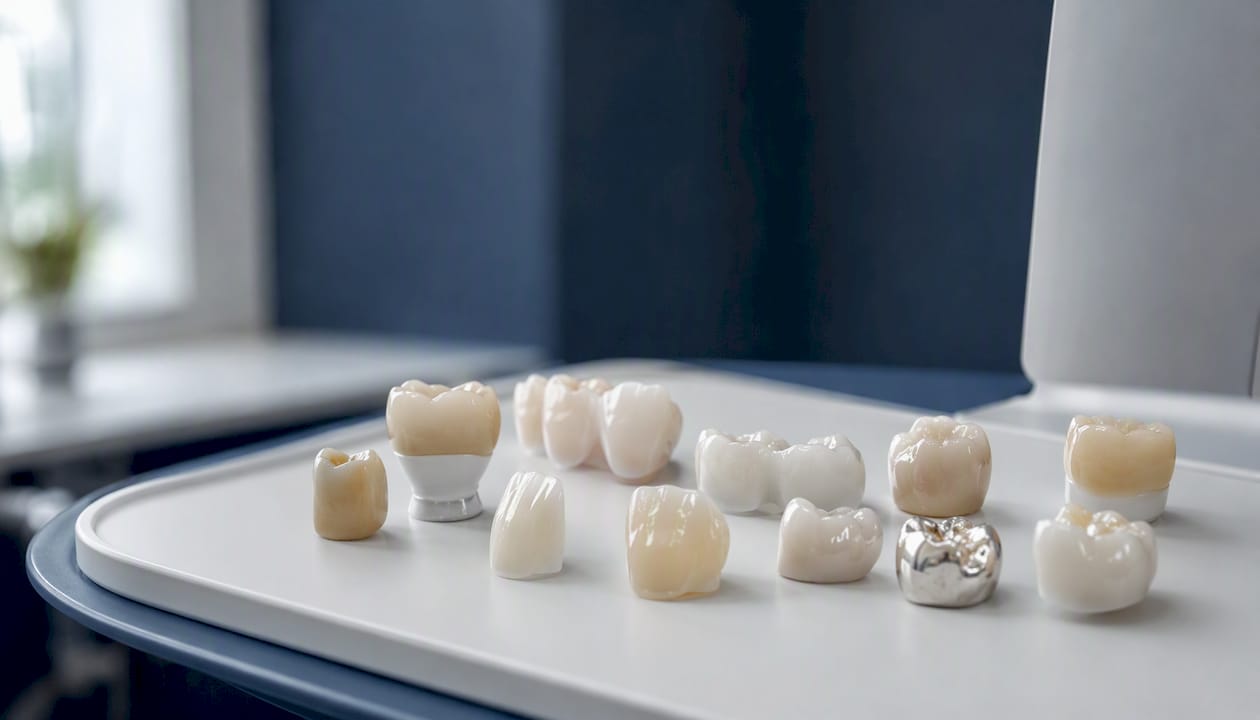
| Material | Typical cost range | Durability / lifespan | Aesthetics | Best use | Turnaround |
|---|---|---|---|---|---|
| Porcelain-fused-to-metal (PFM) | $900 to $1,800 | Strong, metal core resists fracture | Good, but metal margin can show at the gumline over time | Molars, patients wanting a durability-to-cost balance | Lab-made, 2 visits |
| All-ceramic / porcelain | $1,000 to $2,500 | Moderate, more prone to chipping under heavy bite force | Excellent, closest match to natural enamel translucency | Front teeth, visible smile zone | Lab-made, 2 visits |
| Zirconia | $1,000 to $2,500 | Very strong, high fracture resistance | Good to excellent with high-translucency zirconia | Molars and increasingly front teeth | Lab-made or same-day |
| Gold | $800 to $2,500 | Excellent, decades of wear resistance, gentle on opposing teeth | Poor, visibly metallic | Back molars where appearance doesn't matter | Lab-made, 2 visits |
| CEREC / same-day (CAD/CAM) | $1,000 to $2,500 | Comparable to lab zirconia or ceramic, depends on material milled | Good, limited to available milling blocks | Patients wanting one-visit convenience | Single visit |
So which is actually better, zirconia or porcelain? It depends on what you're solving for.
- Zirconia wins on strength and is now available in high-translucency formulations that close much of the old cosmetic gap, making it a sensible middle-ground choice for visible teeth that still need to survive a heavy bite.
- All-ceramic porcelain still edges out zirconia on pure light transmission, which matters most for a single front tooth next to natural teeth you're trying to match exactly.
- PFM remains a reasonable choice when budget matters more than a flawless cosmetic match, particularly for back teeth hidden from view.
- Gold is objectively the toughest material and the gentlest on the teeth it bites against, which is why some patients specifically request it for molars despite the metallic look.
How Does Dental Insurance Actually Change the Price?
Most dental plans file crowns under major restorative services, a category that typically gets reimbursed at around 50% of the plan's allowed amount, after you've met your deductible. That's a meaningfully lower reimbursement rate than the 70 to 100% many plans pay for a filling or cleaning.
Here's what that looks like with real numbers. Say your dentist charges $1,400 for a zirconia crown and your plan's allowed amount for that code is $1,200.
- Your plan pays 50% of $1,200, or $600.
- You owe the $200 difference between the dentist's fee and the allowed amount, since that gap isn't covered.
- You owe your $600 remaining share of the allowed amount.
- Total patient responsibility: roughly $800, assuming your deductible is already met and you haven't hit your annual maximum.
Statistic callout: Annual maximums on most plans run between $1,000 and $2,500 per year. If you've already used part of that maximum on other work this year, your crown reimbursement could be capped well below the standard 50%.
Watch for these plan clauses, because they change your final bill more than the sticker price does:
- Waiting periods: many plans won't cover major restorative work for 6 to 12 months after enrollment
- Replacement frequency limits: most plans won't pay again for a crown on the same tooth for 5 to 10 years, even if it fails early
- In-network versus out-of-network allowed amounts: an out-of-network dentist's "allowed amount" is often lower, leaving you responsible for a bigger gap
- Alternate benefit or downgrade clauses: if you choose zirconia but your plan only recognizes PFM as the "least expensive functional alternative," it may only reimburse at the PFM rate and you'll pay the difference yourself
- Medicare gap: original Medicare doesn't cover routine crowns at all, though some Medicare Advantage plans include limited dental benefits
Before you schedule, request a pre-treatment estimate from your insurer and ask specifically whether that tooth has a crown history that could trigger a replacement frequency denial.
How Can You Lower the Cost of a Crown?
You have more leverage here than most patients realize, and none of these options require settling for lower quality care.
- Stay in-network whenever possible; out-of-network allowed amounts are almost always lower, which increases your share of the bill
- Dental schools and university clinics frequently offer significant discounts on crowns because supervised students do the work under licensed faculty
- Community health centers often use sliding-scale fees tied to income
- Payment plans through CareCredit or a practice's in-house financing spread the cost over months, often interest free for a promotional period
- FSA or HSA funds cover crowns as a qualified medical expense, effectively giving you a tax discount on the procedure
- Choosing PFM or gold over premium ceramics can save several hundred dollars when the tooth isn't cosmetically visible
- Asking for lab-fee transparency upfront reveals whether you're being charged for a premium block or brand-name material you don't need
Pro Tip: A same-day CEREC crown often carries a modest premium over a lab-made crown, but it eliminates a second appointment and weeks of wearing a temporary. If your schedule is tight or you're traveling for treatment, that convenience is often worth paying for. If cost is your priority and you don't mind two visits, the lab-made route usually saves money.
Financing deserves its own quick comparison. CareCredit and similar medical credit cards offer promotional zero-interest windows, but the interest rate jumps sharply if the balance isn't paid off in time. In-house payment plans through the practice itself tend to be simpler with fewer surprises but may require a larger down payment. FSA/HSA funds are the cheapest option overall since you're using pretax dollars, but only if you've already set money aside for the plan year.
How Long Does a Crown Actually Last?
Most crowns last 5 to 15 years, and pooled clinical data shows five-year survival rates in the mid-90% range for mainstream materials when they're properly fitted and maintained.
Watch for these signs that a crown needs attention before it fails completely:
- A loose or shifting feeling when you bite down
- Sharp pain with hot or cold that wasn't there before
- Visible chipping or a rough edge you can feel with your tongue
- Recurrent decay at the margin where the crown meets the natural tooth
- Persistent bad breath or a bad taste localized to one tooth
Replacement pricing mirrors the original crown-only range, generally $800 to $2,500 depending on material, but the total often runs higher the second time around if the underlying tooth needs a new buildup or the old crown failed due to a cracked root that now needs an implant. If a crown fails inside your plan's replacement frequency window, insurance may deny the claim entirely, leaving you to cover the full replacement yourself.
What Happens During a Crown Appointment, Start to Finish?
The traditional lab-made crown takes two visits spaced one to three weeks apart. At the first visit, the dentist numbs the tooth, removes decay or old material, shapes the tooth, takes an impression or digital scan, and fits a temporary crown while the permanent one is milled at an outside lab. At the second visit, the temporary comes off and the permanent crown is cemented and adjusted for bite.
A same-day CEREC crown compresses that into a single visit. The tooth is prepped, scanned digitally, and the crown is designed and milled in-office while you wait, usually within one to two hours, then cemented the same day.
Your quoted crown fee usually covers:
- Tooth preparation and shaping
- The temporary crown
- The permanent crown fabrication (lab or same-day)
- Cementation and bite adjustment
It usually does not cover:
- Core buildup if the tooth has lost significant structure
- A post and core for a root-canaled tooth
- The root canal itself if the nerve is compromised
- Crown lengthening if there isn't enough tooth above the gumline
- Advanced imaging beyond standard X-rays
Ask for a written estimate that lists every procedure code separately, not just a bundled "crown" total, so you know exactly what you're paying for before the drill touches your tooth.
What Should You Look For in a Crown Provider?
Not every practice is equal here, and the differences show up in your wallet as much as your smile. Look for documented experience with restorative work specifically, not just general dentistry, along with clear relationships with the dental labs producing the actual crowns.
A practice worth trusting will give you an itemized estimate before you agree to anything, disclose whether they're in-network with your specific plan, and stand behind their work with some form of warranty on the crown itself. Dr. Kambez Shukoor, a U.S. Navy veteran leading DC Implant & Cosmetic Dentistry, built the practice around exactly that kind of transparency, pairing same-day appointment availability with in-house financing so patients aren't stuck guessing what a procedure will actually cost.
Statistic callout: The practice has accumulated over 200 five-star reviews, a volume of patient feedback that reflects consistency across many restorative cases, not just a handful of lucky outcomes.
When you call any office to book a crown, ask these questions upfront:
- What procedure code will you bill, and what's the estimated fee for that code specifically?
- Are you in-network with my specific insurance plan, not just the parent company?
- What add-ons are likely for my tooth based on the exam, and can I get a range before committing?
- Does the crown come with any warranty if it chips or fails within a certain period?
Why Transparent Pricing Matters More Than the Lowest Quote
The lowest quote you find is rarely the cheapest crown you'll actually pay for. A $900 estimate that excludes a needed buildup and root canal can end up costing more than a $1,400 quote that already accounts for everything your tooth needs. I've seen this pattern play out across cost data repeatedly: the sticker price on the crown code tells you almost nothing about your final bill until someone itemizes the full treatment stack.
Material choice follows the same logic. Choosing zirconia over PFM to save a few hundred dollars up front makes little sense if that tooth sits in the smile zone and you'll want to replace it in five years for cosmetic reasons anyway. The better question isn't "what's the cheapest crown," it's "what material and provider give me the best value over the 10 to 15 years I'll likely keep this crown." That reframing, value over lowest upfront fee, is the single biggest mindset shift that saves patients money and regret in equal measure.
Ready to Get an Exact Quote for Your Crown?
Every number in this guide is a range, because your actual price depends on your tooth, your material choice, and your insurance plan specifically. DC Implant & Cosmetic Dentistry closes that gap by checking your coverage and building an itemized treatment plan before any drilling starts, so the number you agree to is the number you actually pay.
The practice offers both traditional lab-made crowns and same-day CAD/CAM crowns, accepts major dental insurance, and verifies your benefits ahead of your appointment so there are no surprise denials later. If a full lab-made crown isn't the right fit and you're weighing a bigger restorative decision, the office also handles full mouth reconstruction and implant options for teeth that may need more than a crown can offer. Financing runs through CareCredit and in-house payment plans, so a needed crown doesn't have to wait for a full paycheck to clear. Call the office or book online, and ask for a pre-treatment estimate and an itemized plan at your first visit, same-day appointments are typically available for patients who need answers fast.
Where This Information Comes From
This guide draws on cost and coverage data from established dental and health authorities rather than anecdotal pricing.
- GoodRx dental crown cost guide: coverage percentages, annual maximums, and typical add-on costs
- Cleveland Clinic crown overview: clinical guidance on crown lifespan and material types
- Delta Dental treatment cost resource: insurer guidance on pre-treatment estimates and in-network benefits
- CDC/NCHS oral health data: public health context on dental care access and usage
- RealDentalCosts material pricing breakdown: per-material cost ranges and downgrade clause explanations
- PMC systematic review on crown survival: pooled five-year survival data across crown materials
For questions specific to your own coverage, deductible status, or annual maximum remaining, contact your insurer's member services line directly. General cost data can't account for what you've already used on your plan this year.
Frequently Asked Questions
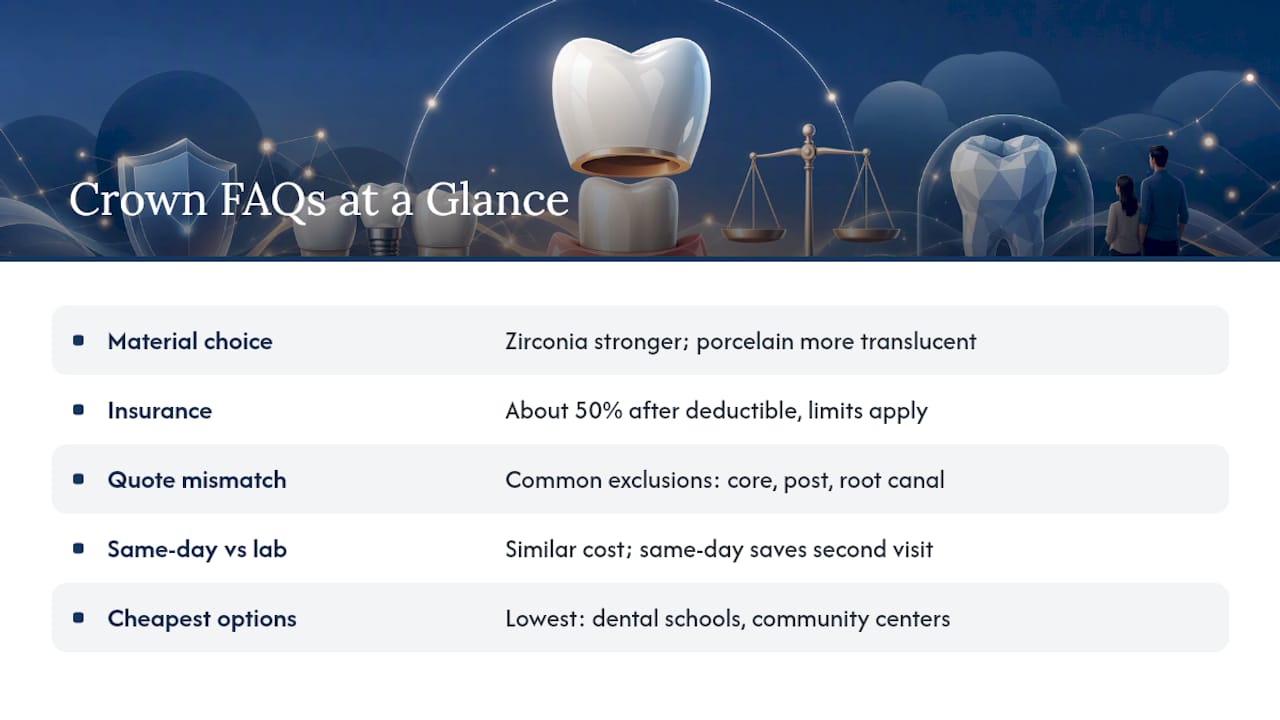
Is a zirconia crown better than a porcelain crown? Zirconia is stronger and more fracture-resistant, making it a solid choice for molars and increasingly for front teeth thanks to high-translucency versions. All-ceramic porcelain still offers marginally better light transmission for matching a single visible front tooth exactly.
Does insurance cover dental crowns? Most plans cover crowns under major restorative benefits, typically paying around 50% of the allowed amount after your deductible, subject to annual maximums and possible waiting periods.
Why did my crown quote not match my final bill? Base crown quotes usually exclude core buildup, post and core, or root canal treatment. Ask for an itemized plan with codes so you see the full stack before treatment begins.
How much does a same-day CEREC crown cost compared to a lab-made crown? Same-day crowns often price similarly to lab-made crowns, sometimes with a modest premium, but they eliminate the second visit and the temporary crown period entirely.
What's the cheapest way to get a dental crown without insurance? Dental schools and community health centers typically offer the lowest prices, followed by asking your dentist about in-house payment plans or using FSA/HSA funds if available.
This article is general information, not a substitute for advice from a qualified doctor. Consult a qualified healthcare professional about your own circumstances before acting on anything here.
Sources
- How Much Does a Dental Crown Cost? 2026 Prices by Material — RealDentalCosts
- Dental crowns — Cleveland Clinic
- Oral health — NCHS/CDC