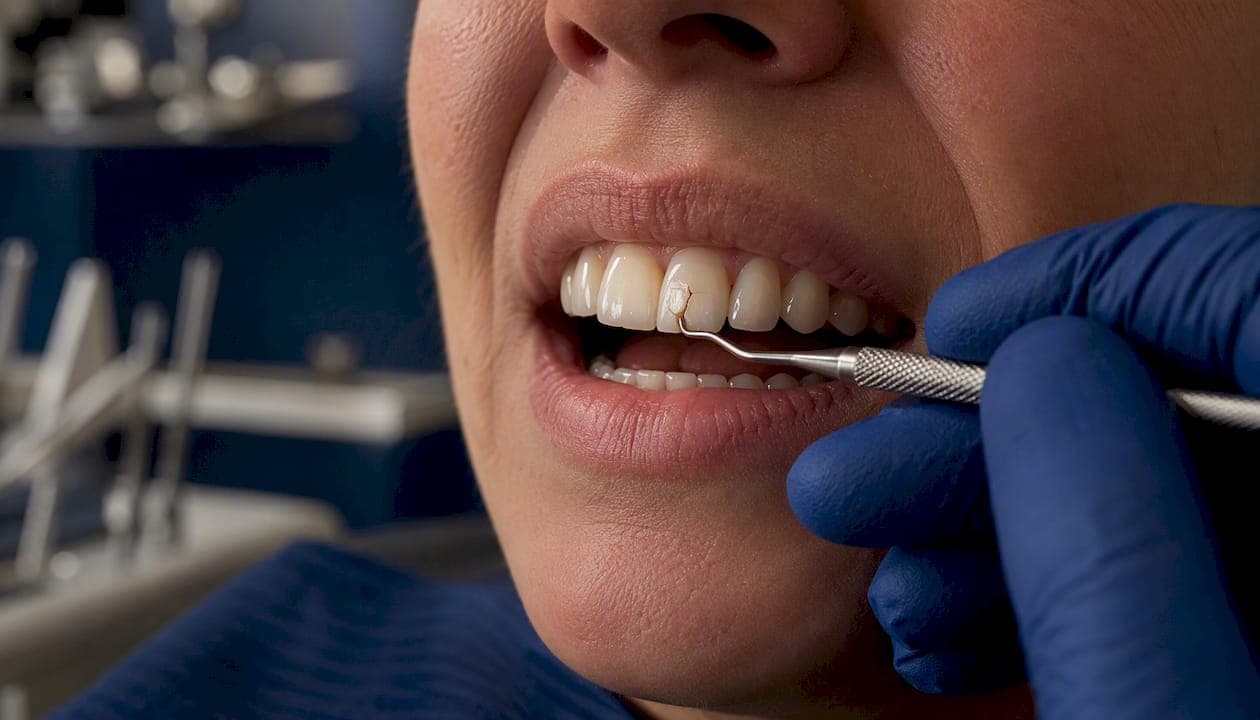
If your dental crown is cracked or broken, protect the tooth and contact your dentist promptly. Many cases can be repaired, but some require replacement or urgent care, and waiting increases the risk of infection or deeper damage.
Do this now:
- Save any fragments. Wrap them in a damp cloth or small container and bring them to your appointment.
- Rinse with warm salt water to reduce inflammation and clear debris.
- Avoid chewing on that side until you've been evaluated.
- Cover sharp edges with dental wax or sugar-free gum to protect your cheek and tongue.
- Take an over-the-counter pain reliever (ibuprofen or acetaminophen) as directed if you have discomfort.
- Call your dentist and describe your symptoms: pain level, whether the crown feels loose, any bleeding, and whether you have a fragment.
Table of Contents
- What is a dental crown and why does a crack matter?
- How crown material affects damage and repair options
- Why do dental crowns crack?
- What to do immediately: first aid and temporary fixes
- How dentists decide between repairing and replacing your crown
- Is a cracked crown a dental emergency?
- What does treatment cost, and how long does it take?
- How to prevent future crown damage
- How DC Implant & Cosmetic Dentistry evaluates and treats cracked crowns
- Key Takeaways
- A dentist's perspective on cracked crowns
- Dc-dentistry can see you today
- Useful sources and further reading
What is a dental crown and why does a crack matter?
A dental crown is a cap that fits over a damaged or weakened tooth, restoring its shape, strength, and chewing function. Dentists place crowns after large fillings, root canal therapy, or significant fractures because the underlying tooth can no longer hold up on its own. As the Cleveland Clinic notes, crowns can actually hold a fractured tooth together, which means a cracked crown isn't just a cosmetic problem. It may be the only thing keeping the tooth intact.
Crowns serve four main purposes:
- Protect a weakened tooth from further fracture or decay
- Restore the chewing surface so you can eat normally
- Preserve the remaining tooth structure rather than extracting it
- Improve appearance when the natural tooth is discolored or misshapen
Common crown materials include all-ceramic or porcelain, metal alloys (gold or base metal), and porcelain-fused-to-metal (PFM). Each behaves differently when it cracks.
How crown material affects damage and repair options
The material your crown is made from determines both how it fails and what your dentist can do about it.
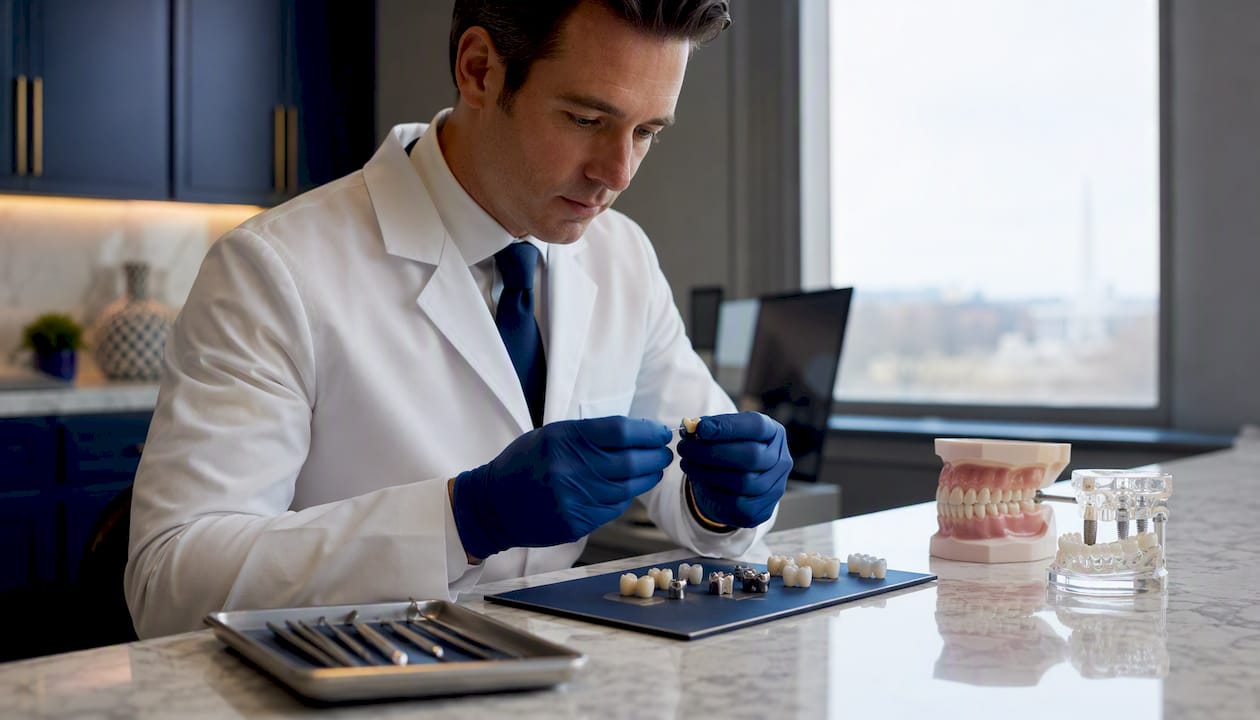
Porcelain and all-ceramic crowns are the most esthetic option and the most common choice for front teeth. The trade-off is brittleness: they can chip or fracture under sudden impact or heavy bite forces. Small surface chips are sometimes repairable with composite bonding, but a full-thickness fracture through a ceramic crown almost always means replacement.
Metal and alloy crowns are extremely durable and rarely crack outright. When they fail, it's usually through cement breakdown or decay underneath rather than the metal itself fracturing. They're not esthetic, so most patients have them on back molars where they're less visible.
Porcelain-fused-to-metal (PFM) crowns combine a metal substructure with a porcelain outer layer. The porcelain layer can chip away from the metal, leaving a rough edge or exposed metal. That porcelain layer is repairable in some cases, though Penn Dental Medicine points out that not every dental office stocks porcelain repair kits or has the expertise to perform in-office bonding. If repair is chosen, a dentist experienced in porcelain bonding produces better, longer-lasting results.
How to identify your crown material at home:
- Looks entirely tooth-colored with no metal visible: likely all-ceramic or porcelain
- Metal visible at the gumline or fully metallic: metal alloy crown
- Tooth-colored on the outside but metal showing at the edge: PFM crown
Pro Tip: Tell your dentist which material you think your crown is made from when you call. It helps them prepare the right repair materials before your appointment.
Why do dental crowns crack?
Crowns are durable, but they're not indestructible. Several factors can cause a crown to fracture, and understanding them helps you assess whether the underlying tooth might also be at risk.
- Bruxism (night grinding or clenching): This is one of the most common culprits. Grinding generates sustained, high bite forces that wear down cement seals and fatigue crown material over time. Authority Dental reports that bruxism can exert extremely high forces on crowns, making it a leading cause of crown failure.
- Biting hard or sticky foods: Ice, hard candy, popcorn kernels, and sticky caramel can crack or dislodge crowns, especially older ones.
- Trauma: A fall, sports injury, or blow to the face can fracture a crown outright.
- Long-term wear: Crowns don't last forever. Most crowns have a limited lifespan, after which the material thins and becomes more vulnerable.
- Cement failure: The bond between crown and tooth can weaken over time, allowing the crown to loosen before it visibly cracks.
- Decay beneath the crown: Bacteria can work their way under the crown margin and erode the tooth structure below. A tooth weakened by decay is far more likely to fracture under normal chewing forces.
Even minor fissures in porcelain can trap bacteria and plaque, accelerating decay and structural failure if left untreated. A hairline crack that looks minor today can become a full fracture within weeks.
What to do immediately: first aid and temporary fixes
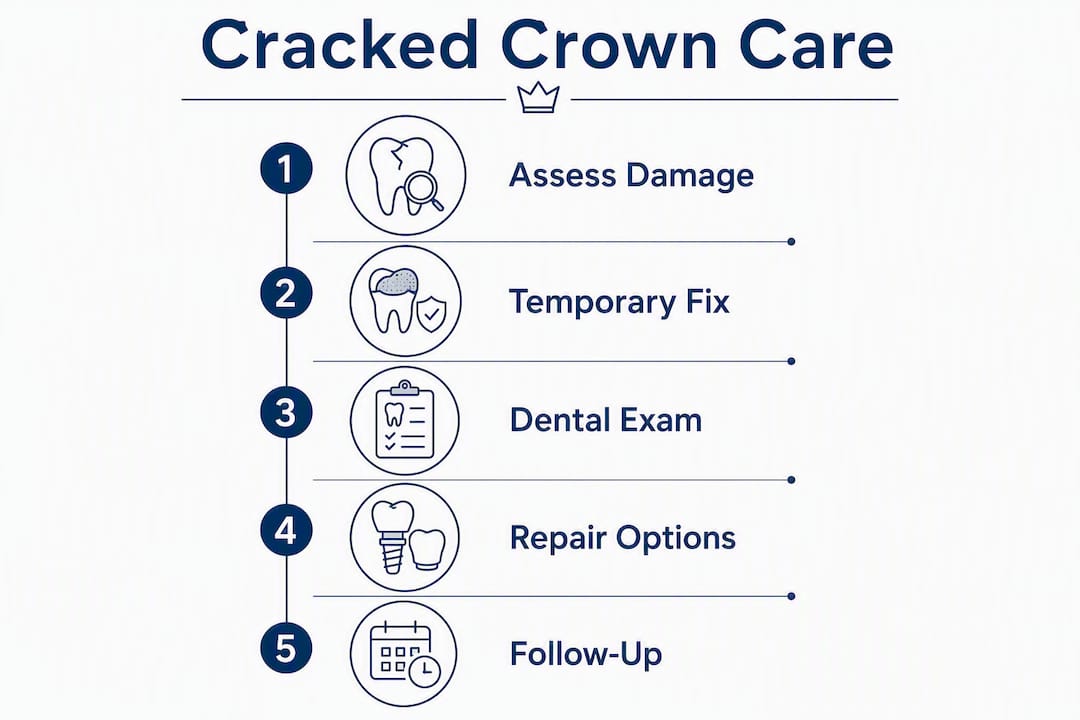
Once you've done the checklist at the top of this article, here's a more detailed sequence if you're dealing with pain, bleeding, or a loose crown:
- Cover sharp edges — Dental wax (available at most pharmacies) or a small piece of sugar-free gum pressed over the sharp edge protects your cheek and tongue until you're seen.
When to go to the ER instead of waiting for a dental appointment: Severe uncontrolled bleeding, facial swelling spreading toward your jaw or neck, fever, or difficulty swallowing are signs of a potentially serious infection. Those warrant an emergency room visit. A jagged fragment cutting into your cheek or tongue that you can't cover also justifies urgent care. For everything else, a dental office is the right call.
What NOT to do: Don't try to re-cement a loose crown at home with superglue or unknown adhesives. These can trap bacteria, damage the tooth surface, and make professional re-cementing much harder. Temporary OTC dental cement is a safer stopgap, but it's still just a bridge to professional care, not a fix.

Pro Tip: If your crown has come off completely and you can't get to a dentist the same day, temporary dental cement from a pharmacy (brands like Dentemp) can hold the crown in place overnight. Clean the inside of the crown and the tooth surface gently before applying.
How dentists decide between repairing and replacing your crown
The treatment path depends on several factors your dentist will assess during the exam. Here's how the decision typically unfolds.
Key decision factors:
- Location and extent of the crack: A small chip on the outer porcelain layer is very different from a fracture that runs through the full crown thickness.
- Condition of the underlying tooth: Decay, a large existing filling, or a previously root-canal-treated tooth all affect whether the tooth can support a new crown.
- Gumline involvement: Cracks that extend below the gumline are harder to treat and may require crown lengthening before a new crown can be placed.
- Whether the crown is still sealed: A loose crown that's otherwise intact is a very different problem from a fractured one.
- Patient symptoms: Pain, sensitivity to temperature, or signs of infection point toward pulp involvement and may indicate a root canal is needed.
As Elite Endodontics of NH explains, a cracked tooth under a crown is often impossible to detect without removing the crown entirely. X-rays help, but they frequently miss cracks hidden beneath the prosthesis. The dentist may need to take the crown off to directly inspect the tooth and assess pulp status before deciding on a treatment path.
Treatment options at a glance:
| Treatment | When it's used | Pros | Cons |
|---|---|---|---|
| Smoothing or bonding | Small chip, no structural compromise | Quick, low cost, same visit | Not permanent; may not match perfectly |
| Re-cementing | Crown intact but loose | Fast, preserves existing crown | Doesn't address underlying decay or fracture |
| Full crown replacement | Fractured crown or altered tooth | Restores full function and esthetics | Two visits, lab time, higher cost |
| Root canal + new crown | Crack has reached the pulp | Saves the tooth | Adds cost and treatment time |
| Extraction + implant | Tooth is non-restorable | Permanent, long-lasting replacement | Longest timeline, highest cost |
Whether a cracked dental crown can be repaired depends heavily on severity. Minor surface chips that don't compromise the tooth beneath may be smoothed or bonded. Extensive fractures, decay under the crown, or cracks below the gumline usually require full replacement.
The clinical process typically goes: exam and X-rays, crown removal if needed to assess the tooth, repair or temporary crown placement, then either in-office repair or scheduling for a lab-fabricated replacement.
Is a cracked crown a dental emergency?
Penn Dental Medicine is clear on this: a chipped or broken crown is generally not an ER-level emergency unless it causes severe pain, uncontrolled bleeding, or jagged fragments cutting tissue. That said, "not an emergency" doesn't mean "wait two weeks."
Emergency (same day, ER or urgent dental care):
- Severe uncontrolled bleeding
- Facial swelling, fever, or difficulty swallowing
- Jagged fragments lacerating soft tissue
Urgent (within 24–48 hours):
- New, persistent pain or sensitivity that doesn't resolve
- A loose crown that exposes tooth structure
- Visible crack with no pain but signs of infection (swelling, bad taste)
Routine (within 1–2 weeks):
- Minor chip with no pain, no infection signs, and no sharp edges
What to tell the scheduler when you call:
- Pain level on a scale of 1–10
- Whether the crown is loose or has come off
- Whether you have a fragment
- Any bleeding, swelling, or changes in your bite
- How long ago it happened
This information helps the front desk triage your appointment correctly and prepare the right materials.
What does treatment cost, and how long does it take?
Costs vary significantly depending on what the tooth needs. Here's a realistic picture:
- Full crown replacement: Higher cost, reflecting lab fees, materials, and two appointments. Some practices offer same-day crown technology (CAD/CAM milling) that compresses this into one visit, but most traditional lab-fabricated crowns take 1–3 weeks between prep and placement.
- Extraction and dental implant: — The highest-cost, longest-timeline option. The implant process from extraction to final crown can take several months.
Insurance and financing: Most dental plans cover a portion of crown replacement, though coverage varies by plan and how recently the original crown was placed. Repair procedures like bonding may be covered under restorative benefits. For larger procedures, financing through CareCredit or similar third-party lenders is widely available and can spread costs over time.
How to prevent future crown damage
Once your crown is repaired or replaced, a few habits make a real difference in how long it lasts.
- Wear a custom nightguard if you grind or clench. Over-the-counter guards offer some protection, but a custom-fitted guard from your dentist distributes bite forces more evenly and is far more comfortable to wear consistently.
- Avoid hard and sticky foods: Ice chewing, hard candies, popcorn kernels, and sticky caramel are the most common dietary culprits for crown damage.
- Keep up with oral hygiene: Decay under a crown is a leading cause of crown failure. Brush twice daily, floss around the crown margin, and consider an antibacterial rinse if your dentist recommends it.
- Use a mouthguard for contact sports. A single impact can fracture a crown that would otherwise last years.
- Schedule regular checkups. Your dentist can spot early cement failure, micro-cracks, or decay under the crown before they become bigger problems.
How DC Implant & Cosmetic Dentistry evaluates and treats cracked crowns
At DC Implant & Cosmetic Dentistry in Washington, DC, the process starts before you arrive. When you call to describe your symptoms, the team triages your situation and, when indicated, schedules a same-day exam. Dr. Kambez Shukoor, a U.S. Navy veteran with extensive restorative experience, leads the clinical evaluation.
The in-office workflow for a cracked crown typically includes:
- Digital X-rays to assess the tooth root, bone, and any visible decay beneath the crown
- Crown removal when necessary to directly inspect the tooth structure and pulp, since X-rays alone often miss hidden cracks
- In-office repair for minor chips or loose crowns that can be re-cemented or bonded the same day
- Scheduling for crown replacement with a temporary crown placed to protect the tooth in the interim
- Root canal therapy, extractions, or dental implants when the underlying tooth is compromised beyond repair
The practice handles the full range of crown-related problems: re-cementing, composite and porcelain repairs, new dental crowns, root canal therapy, extractions, and implant-supported replacements. Financing through CareCredit and Lending Tree is available for larger procedures. With over 200 five-star reviews, the practice has a documented track record of patient satisfaction across both routine and complex cases.
Key Takeaways
A cracked or broken dental crown needs prompt dental evaluation: protect the tooth, save any fragments, avoid chewing on that side, and call your dentist to describe your symptoms and get triaged correctly.
| Point | Details |
|---|---|
| Act quickly, not frantically | Most cracked crowns aren't ER emergencies, but waiting more than 48 hours risks infection and deeper damage. |
| Small chips may be repairable | Minor porcelain chips can often be bonded; full fractures or decay underneath usually require a full replacement. |
| Material matters | Porcelain and ceramic crowns chip; metal crowns rarely fracture but can loosen; PFM crowns can lose their porcelain layer. |
| Prevention is straightforward | A custom nightguard, avoiding hard foods, and regular checkups are the three most effective ways to extend crown life. |
| Dc-dentistry offers same-day care | DC Implant & Cosmetic Dentistry provides same-day exams, in-office repairs, crown replacement, root canals, and implants in Washington, DC. |
A dentist's perspective on cracked crowns
The patients who do best after a crown problem are almost always the ones who called the same day. Not because every cracked crown is an emergency, but because early evaluation gives you options. A small chip caught at the right moment can be bonded in a single visit. The same chip ignored for three weeks can become a fractured tooth that needs a root canal, or worse, an extraction.
What surprises most patients is how often the real problem isn't the crown itself. The crown is the signal. Underneath it, there may be decay that's been quietly progressing for months, or a crack in the natural tooth that the crown was masking. That's why removing the crown to inspect the tooth directly is sometimes the most important diagnostic step, not just a formality before replacement.
The other thing worth saying plainly: grinding is underestimated as a risk factor. Many patients don't know they grind at night until a crown fractures or a filling cracks. If you've had more than one crown fail, or if you wake up with jaw soreness, ask about a nightguard at your next visit. It's a small investment compared to repeated crown replacements.
Dc-dentistry can see you today
A cracked crown doesn't have to mean weeks of waiting and uncertainty. DC Implant & Cosmetic Dentistry in Washington, DC offers same-day appointments for crown emergencies and urgent dental concerns, so you get a clear diagnosis and a treatment plan without delay.

The practice handles everything from a quick re-cementing to full crown replacement, root canal therapy, and dental implant placement when a tooth can't be saved. Dr. Kambez Shukoor and the team work with most major insurance plans and offer financing through CareCredit and Lending Tree for larger procedures. Call the office or book online to schedule your evaluation. Same-day availability means you don't have to spend another night wondering whether that crack is getting worse.
Useful sources and further reading
The following authoritative sources informed this article and are recommended for further reading:
- Can a chipped crown be repaired? | Penn Dental Medicine
- Cracked tooth (fractured tooth) | Cleveland Clinic
- Broken Crown Repair: What to Do & When to See a Dentist | Authority Dental
- DC Implant & Cosmetic Dentistry | Washington, DC
This article provides general dental health information and is not a substitute for professional dental advice. If you are experiencing severe pain, swelling, or bleeding, contact a dental professional or seek urgent care promptly.