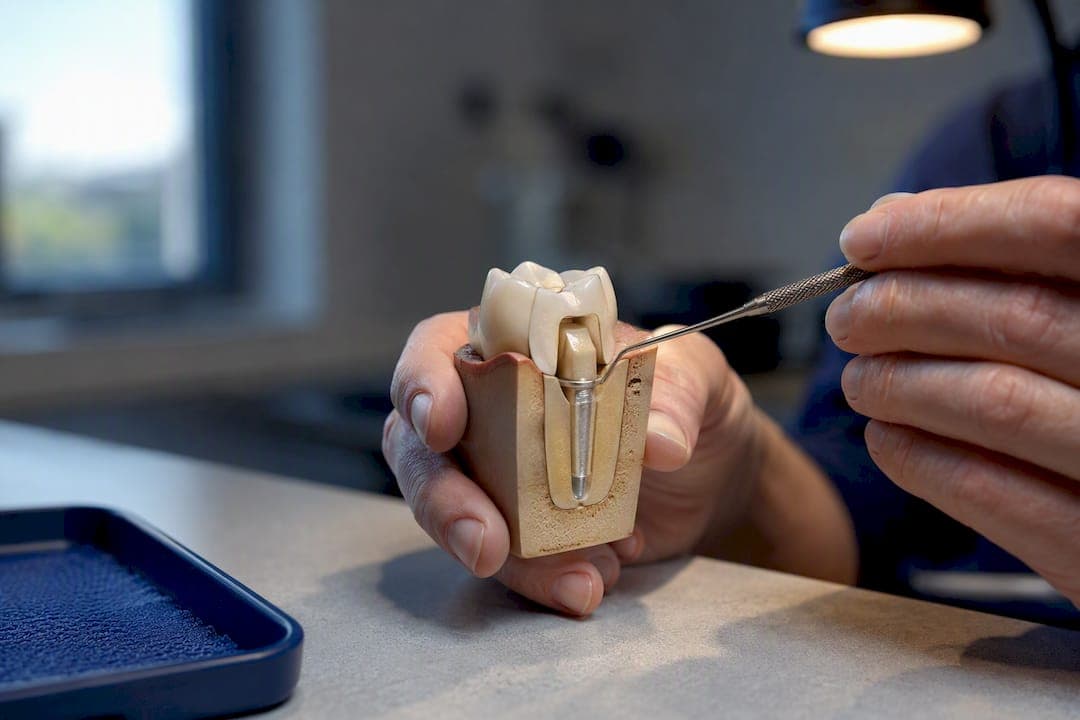
A post-and-core crown rebuilds a root canal treated tooth that can't hold a regular crown by placing a post into the canal and building a core to support a crown. Dentists reach for this restoration when decay, an old filling, or the root canal access itself has removed so much of the tooth that a crown alone would have nothing solid to grip. It's a conservative move: instead of pulling the tooth, the dentist reinforces what's left and gives it a new working surface.
TL;DR:
- A post and core are essential only when a tooth has severe structural loss, such as less than half the crown remaining or extensive decay compromising multiple walls.
- Fiber posts are the preferred choice because they flex with the tooth and are easier to remove if retreatment is needed, unlike rigid metal or ceramic posts.
- Maintaining at least 1.5 millimeters of ferrule around the tooth is crucial for preventing failure, regardless of post material or technique used.
- The longevity of a post and core depends on proper material selection, preservation of tooth structure, and avoiding habits that weaken the restoration, with no fixed lifespan.
- Sometimes, alternative procedures like crown lengthening or extraction with implant are better options if the tooth lacks sufficient structure or is unlikely to succeed with a post-and-core.
Table of Contents
- What Is a Post and Core, and When Do You Actually Need One?
- Fiber, Metal, or Cast: Comparing Post and Core Materials
- The Post and Core Procedure, Step by Step
- Why Ferrule Matters More Than the Post Itself
- What Can Go Wrong, and How Long Does It Actually Last?
- Recovering From a Post and Core: What the First Few Weeks Look Like
- When a Post and Core Isn't the Right Call
- How DC Implant & Cosmetic Dentistry Approaches These Cases
- A Note on Balancing Tooth Conservation and Predictability
- Ready to Find Out if Your Tooth Can Be Saved?
- Sources
- FAQ
What Is a Post and Core, and When Do You Actually Need One?
A dental post and core is a two-part foundation. The post is a thin rod, usually fiber or metal, cemented into the empty root canal space left after root canal therapy. The core is the buildup material packed on top of the post, shaped to mimic a natural tooth stump. Together they give a crown something to hold onto once the tooth's own structure won't cut it.
Not every root canal treated tooth needs this. A tooth with three or four solid walls remaining, and enough coronal structure above the gumline, usually just gets a direct filling or a crown placed straight over the existing tooth. The post-and-core procedure becomes necessary in more specific situations:
- Severe coronal loss where less than half the natural crown structure survives
- Large old fillings or extensive decay that already compromised multiple walls
- Root canal access cavities that ate into the roof or floor of the tooth
- Front teeth needing esthetic support where a thin remaining shell can't hold a veneer-style crown alone
- Back teeth where cusps have fractured off, leaving no retentive walls for a crown to seat against
The decision comes down to a hands-on exam plus x-rays. A dentist checks how many walls remain, how thick they are, whether the root canal filling still seals well apically, and whether the tooth is even worth restoring. A tooth split down to the bone or with a cracked root usually fails that last test, and extraction followed by an implant becomes the more realistic path.
Fiber, Metal, or Cast: Comparing Post and Core Materials
Material choice shapes both how the tooth behaves under bite forces and how easy the restoration is to repair or remove later.
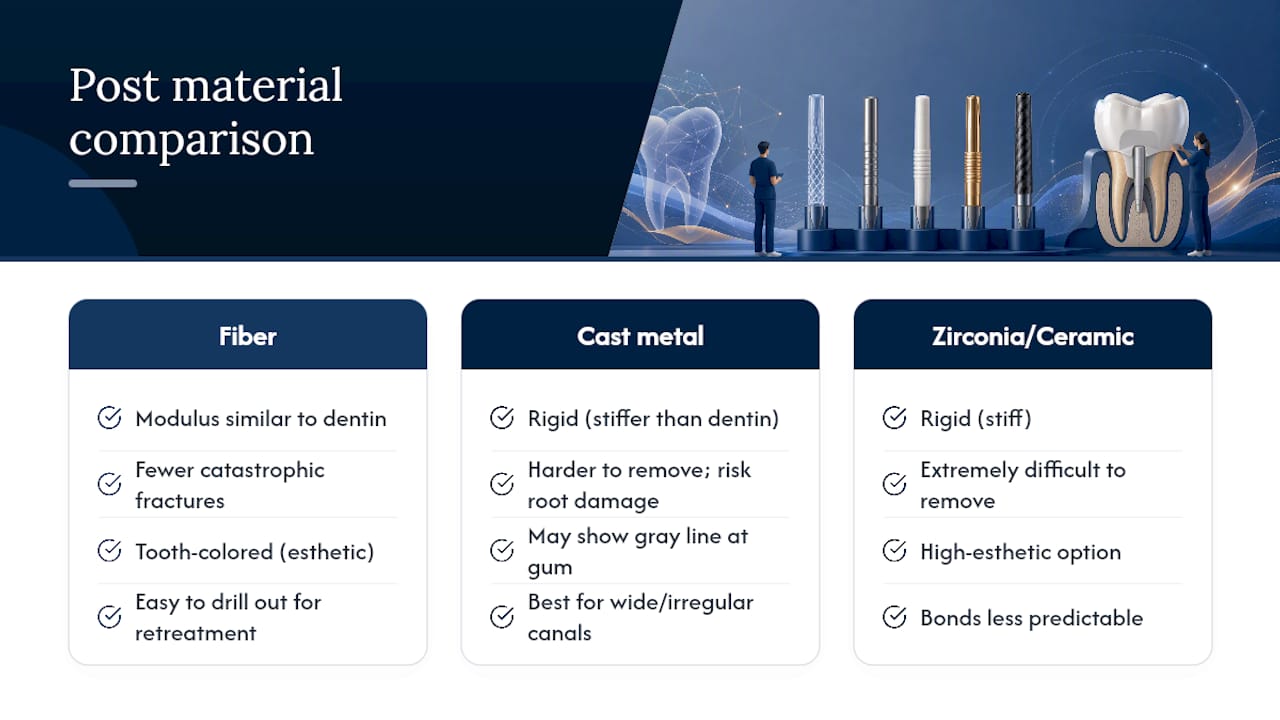
Prefabricated fiber posts have become the default choice in a lot of practices, and for good reason. Their elastic modulus sits close to natural dentin, which means the post flexes with the tooth instead of acting like a rigid rod inside a softer structure. That similarity to dentin is linked to fewer catastrophic root fractures and more predictable long-term behavior in clinical evidence on fiber-reinforced posts. Fiber posts are also tooth-colored, which matters under thin porcelain on front teeth, and they're far easier to drill out if the tooth ever needs retreatment.
Cast metal posts and cores haven't disappeared. When a canal is unusually wide, oval, or irregularly shaped, a custom-cast post fabricated from an impression still fits better than any prefabricated post on the shelf. A prosthetically guided cast post-and-core technique remains a standard option for severely broken-down teeth where off-the-shelf posts don't seat well. The tradeoff: metal is rigid, harder to remove without risking root damage, and can show a gray line at the gum on thin tissue.
Zirconia and ceramic posts show up occasionally for high-esthetic cases, but they bond less predictably and are extremely difficult to remove if something goes wrong, which limits how often dentists reach for them.
For the core itself, composite resin dominates because it bonds chemically and sets fast, though some dentists still use amalgam or a lab-cast core when a case calls for extra bulk strength.
The Post and Core Procedure, Step by Step
Once a tooth has finished root canal therapy and the dentist confirms it's a candidate for a post crown, the actual build usually happens in one visit, sometimes split into two if a lab-fabricated crown is involved.
The clinician starts by removing a controlled amount of the gutta-percha filling from the coronal portion of the canal, creating space for the post while leaving the apical seal untouched. This is the step where technique really matters. Removing too much gutta-percha risks reinfection at the root tip; removing too little leaves no room for adequate post length.
- Post-space preparation. Using slow-speed drills sized to the canal, the dentist opens space for the post while preserving 4 to 5 millimeters of gutta-percha at the apex to protect the seal.
- Try-in and passive fit check. The post is test-fitted without cement to confirm it seats fully without binding or rocking. Southard's technique guidance for post-space work emphasizes modifying the post to fit the canal rather than reshaping the canal around the post, which avoids unnecessary loss of root structure.
- Cementation. The post is bonded in place with resin cement under strict moisture control.
- Core buildup. Composite or another core material is packed and shaped around the cemented post to recreate a tooth-like stump.
- Crown preparation and impression or scan. Once the core sets, the dentist shapes it into a proper crown prep and captures an impression or digital scan.
- Final crown cementation. The finished crown, made from porcelain, zirconia, or a similar material, is cemented over the completed post and core.
Some practices can complete steps 4 through 6 in a single visit using a same-day crown workflow, milling the crown chairside instead of sending an impression to an outside lab. Others still send cases out, which means wearing a temporary crown for one to two weeks.
Because the tooth is already non-vital after root canal treatment, most patients feel very little during post placement itself. Local anesthesia handles any residual sensitivity in the surrounding gum and bone, and the nerve that would normally register pain inside the tooth is already gone.
Why Ferrule Matters More Than the Post Itself
Ferrule is the band of natural tooth structure that rises above the gumline and gets fully encircled by the crown, like a metal hoop reinforcing the top of a wooden barrel. That structure is what actually resists the sideways and rotational forces that crack teeth, not the post sitting inside the canal.
The number that decides a lot of treatment plans: clinical guidance calls for roughly 1.5 millimeters of continuous ferrule around the entire circumference of the tooth. Below that, failure rates climb regardless of how good the post and core underneath look.
Reviews of post-and-core mechanics consistently point out that a post does not strengthen a tooth; it retains the core. Ferrule is the real load-bearing factor. When a tooth breaks off below the gumline and there's no ferrule to work with, the dentist has two paths: gain ferrule surgically through crown lengthening or orthodontic extrusion, or restore the tooth anyway and accept a less favorable long-term outlook. Crown lengthening carries its own math: biologic width needs about 3 millimeters of healthy attachment, so combined with the 1.5 millimeter ferrule requirement, a tooth sometimes needs 4.5 millimeters of sound structure above the bone before a crown can be placed predictably.
On the canal side, the working rule is to let the post occupy roughly two-thirds of the root length for retention while keeping 4 to 5 millimeters of gutta-percha untouched at the apex, protecting the seal that keeps bacteria out of the surrounding bone.
What Can Go Wrong, and How Long Does It Actually Last?
No dentist can hand a patient a universal percentage for how long a post-and-core crown lasts. It depends on too many variables specific to that tooth. What research and clinical practice agree on is which factors move the needle:
- Perforation. Drilling the post space slightly off-axis can punch through the side of the root, usually in curved canals, and this often requires additional surgical repair.
- Root fracture. The most serious failure mode, frequently tied to inadequate ferrule or an oversized, overly rigid post.
- Loss of retention. The crown or the core itself can debond, especially if bonding wasn't done under clean, dry conditions.
- Recurrent infection. If the apical seal was disturbed during post placement or cement leaked over time, bacteria can reinfect the root.
Remaining tooth wall thickness, adequate ferrule, an intact root canal seal, and the right material choice for that specific canal shape all stack together to determine outcome. A tooth with generous ferrule and a fiber post bonded under a rubber dam behaves very differently from a thin-walled molar restored under rushed, contaminated conditions. Chewing on ice or hard candy, skipping regular checkups, and grinding at night all shorten the odds regardless of how well the initial procedure went.
Recovering From a Post and Core: What the First Few Weeks Look Like
Mild soreness around the gum for two to three days is normal, and over-the-counter ibuprofen or acetaminophen usually handles it. Because the tooth itself has no nerve left, most of what patients feel is tissue irritation from the dental dam clamp or injection site, not the tooth.
If you're waiting on a lab-made crown, you'll go home with a temporary crown over the new core. Treat it gently: skip sticky candy, chew on the opposite side when possible, and call the office right away if it feels loose or falls off before your next visit.
Call your dentist if you notice any of these:
- Pain that gets worse after the third or fourth day instead of easing up
- Visible swelling in the gum or face
- A temporary or final crown that feels high, loose, or shifts when you bite
- Persistent bad taste or drainage near the tooth
Once the final crown is seated, ordinary brushing, flossing, and care to whiten teeth safely at home are what protect your investment over the years.
When a Post and Core Isn't the Right Call
Sometimes the honest answer is that a post and core won't hold up, and a different plan serves the patient better.
- Crown lengthening or extrusion makes sense when the tooth has decent root length but not enough ferrule above the gumline.
- Extraction followed by an implant or a fixed bridge becomes the better route when the root is cracked, badly resorbed, or too short to support meaningful post length.
- A direct coronal buildup without any post (sometimes called a Nayyar-style buildup) works well on molars with multiple canal orifices, where the pulp chamber itself provides plenty of retention and a post would add fracture risk for no real benefit.
Choosing between these options comes down to weighing invasiveness against how long the restoration is expected to last, plus cost and how many appointments a patient wants to sit through.
How DC Implant & Cosmetic Dentistry Approaches These Cases
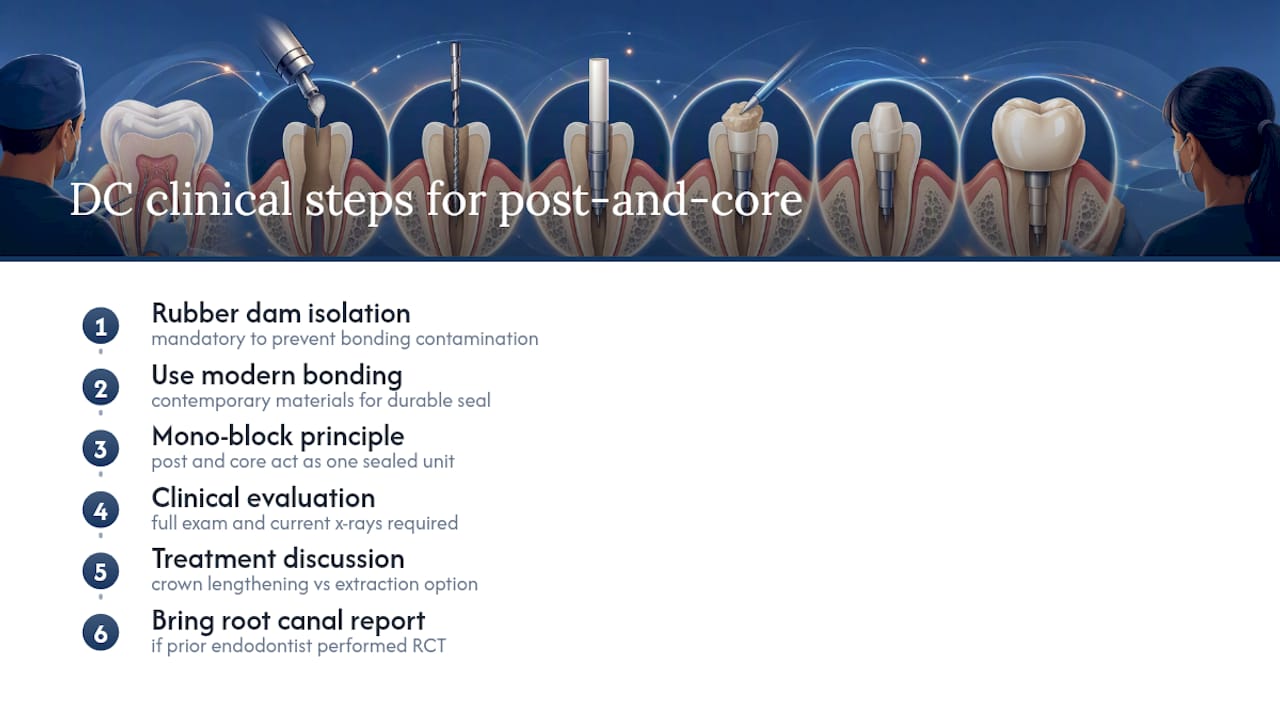
Dr. Kambez Shukoor, a U.S. Navy veteran, treats post-and-core cases with rubber dam isolation and modern bonding materials, following the mono-block principle where the post and core act as a single sealed unit. That isolation step is not optional. Contamination during bonding is one of the most common technical reasons a mono-block restoration fails. Patients considering this restoration can expect a full exam, current x-rays, and an honest conversation about whether crown lengthening or extraction makes more sense for their specific tooth. Bring your root canal report if another dentist performed that treatment.
A Note on Balancing Tooth Conservation and Predictability
Saving a natural tooth is almost always worth attempting when the ferrule and root health support it, but forcing a post-and-core onto a tooth that doesn't have enough structure left just delays a harder decision. Every case gets planned individually, with the patient in the conversation the whole way.
— Jake
Ready to Find Out if Your Tooth Can Be Saved?
If a cracked filling or an old root canal has you wondering whether your tooth is salvageable, an in-person exam can give you a direct answer instead of months of guessing between appointments. Unlike general online guides, an in-person exam and x-ray can tell you within one visit whether a post-and-core crown, crown lengthening, or an implant is the realistic path for that specific tooth, sometimes backed by same-day crown capability when the tooth qualifies.

Bring your root canal report and any recent x-rays to your consult so Dr. Shukoor can assess remaining tooth structure and ferrule right away. If the tooth isn't restorable, the practice also walks patients through dental implant options so you're never stuck without a plan. Call the office or book online to schedule an evaluation and get a clear answer on your tooth's best path forward.
This article is general information, not a substitute for advice from a qualified doctor. Consult a qualified healthcare professional about your own circumstances before acting on anything here.
Sources
- Post and core build-ups in crown and bridge abutments: Bio-mechanical advantages and disadvantages (PMC5483411)
- Evidence on fiber-reinforced posts (PubMed 30600326)
- Immediate Core Buildup of Endodontically Treated Teeth: The Rest of the Seal (Southard PDF)
FAQ
What Is the Success Rate of Post-Core Crowns?
There's no single universal percentage, since outcomes depend heavily on remaining ferrule, root health, and material choice, but cases with adequate ferrule and a well-sealed root canal consistently show better long-term survival than cases without ferrule.
How Painful Is a Post-and-Core Procedure?
Most patients feel minimal discomfort during the procedure because the tooth is already non-vital after root canal therapy, and local anesthesia manages any sensitivity in the surrounding gum tissue.
How Long Will a Post and Crown Last?
Longevity varies by case rather than following a fixed timeline, but teeth with sufficient ferrule, a fiber post, and good oral hygiene tend to hold up well for many years compared with teeth lacking ferrule.
How Long Does a Post and Core Last?
The post and core itself typically lasts as long as the crown it supports and the seal underneath stays intact, which depends on bonding quality, ferrule, and how well the patient avoids habits like chewing ice or grinding.
Do I Need a Post if I Had a Root Canal?
Not always. Teeth with enough remaining walls after root canal treatment often go straight to a crown or filling, while a post-and-core only comes into play when structural loss is significant.