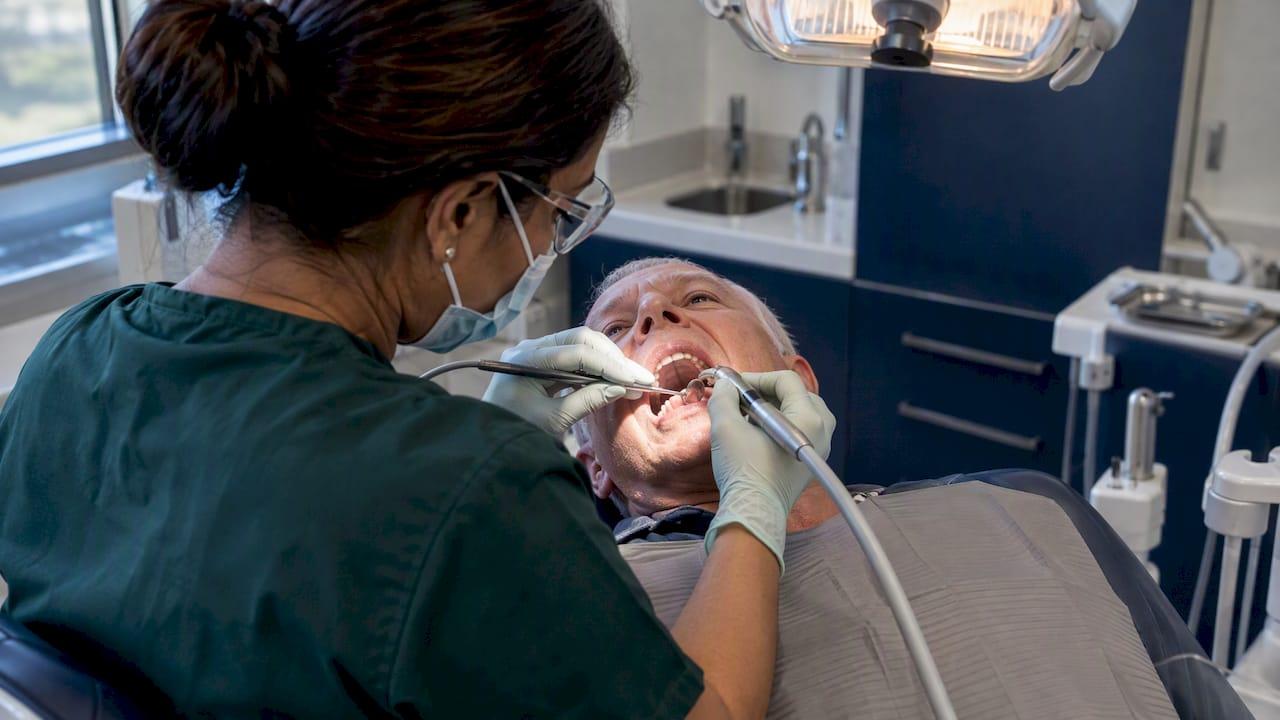
Immediate implant placement means your dentist removes a failing tooth and puts the titanium implant into the empty socket during the same procedure. You skip the months of waiting that a traditional approach needs. It only works when the bone and gums around the tooth are in good shape, and your dentist has to confirm that with 3D imaging first. This guide explains who qualifies, what happens step by step, what can go wrong and how healing works.
TL;DR
- Immediate placement puts the implant in the extraction socket at the same visit. It is not the same thing as immediate loading, which is attaching a temporary tooth.
- Good candidates usually have an intact facial bone wall, healthy thick gums, no active infection and enough bone to hold the implant firmly.
- Benefits include fewer surgeries and a shorter treatment time. The trade-off is a higher risk of complications, so case selection and surgical skill matter.
- Bone still needs several months to bond with the implant, even when a temporary tooth goes in the same week.
- A cone beam CT scan before surgery decides whether the same-day route is safe for you.
Table of Contents
- What immediate implant placement actually means
- Who is a good candidate
- How the procedure works, step by step
- Benefits compared with waiting
- Risks and downsides
- Is it painful? What recovery feels like
- Healing: temporary teeth now, final teeth later
- Our perspective
- See if same-day placement fits your case
- FAQ
- Sources
What immediate implant placement actually means
The term describes timing. According to a narrative review of the 7th ITI Consensus Conference, immediate placement is putting an implant into a fresh extraction socket on the day of extraction, in the same procedure.
That is different from the other protocols you may hear about:
- Delayed placement: the tooth comes out, the socket heals, and the implant goes in months later.
- Early placement: the implant goes in after the soft tissue has started to heal but before the bone has fully filled in.
- Immediate loading: a prosthesis is connected to the implant within one week of placement, per the same ITI review.
Combine immediate placement with immediate loading and you get what the consensus calls a Type 1a protocol. That is what most patients mean when they say "same day implant" or "teeth in a day." The review describes Type 1a as a clinically and scientifically validated option, with case selection fundamental to success.
The two ideas can be separated. You can have an implant placed immediately and left to heal under the gum with no tooth on top. You can also have a temporary tooth attached only when the implant is stable enough to carry it.
Who is a good candidate
Not every extraction site is suitable. A 2025 review of placement timing and loading protocols lists the favorable conditions:
- an intact facial bony wall thicker than 1 mm
- a thick gingival phenotype, meaning thicker gum tissue
- no inflammatory factors at the site
- adequate primary stability, meaning the implant grips the bone firmly at placement
The same paper notes that thick gum tissue lowers the risk of soft tissue problems such as gum recession.
Situations that usually point to a different timing
A missing or thin facial bone wall, an active infection around the tooth, or too little bone below the root to anchor the implant usually pushes the plan toward a staged approach. That might mean extracting, grafting the socket and waiting. Our guide on socket preservation explains how that works, and our page on bone grafting before an implant shows what CBCT findings lead to a graft.
This is a judgment call your dentist makes from your scan and an examination. If you have gum disease, smoke, or have a medical condition that affects healing, tell the dentist before the plan is made, because these can change which timing is safe.
How the procedure works, step by step
1. Imaging and planning
Planning starts with a cone beam CT scan. The ITI review explains that this 3D imaging lets the dentist evaluate bone anatomy and make sure the tooth sits within the bone envelope. It also says digital technologies for data acquisition and interpretation are highly recommended for this protocol.
Many teams plan the implant position on the computer and then use a printed surgical guide. An EAO position paper on immediate placement describes the approach as sophisticated, needing advanced surgical skill, and favors guided surgery over free-hand placement for precise implant orientation. If you want to understand guides, see our article on guided implant surgery.
2. Atraumatic extraction
The tooth is removed gently to protect the socket walls and surrounding gum. The 2025 review calls atraumatic extraction fundamental to preserving the socket and limiting tissue trauma, which supports better long-term esthetic and functional results.
3. Implant placement
The implant is placed in the socket, positioned according to the plan. One published success-factors article suggests keeping the implant at least 1.5 mm away from the facial bone plate as a guide, but the exact position is a decision for your surgeon and your anatomy.
4. Grafting and temporary tooth
If the implant reaches enough primary stability, the ITI review gives a torque range of about 25 to 40 Ncm as an example. A provisional prosthesis can then be connected. The gap between the implant and the bone wall is often filled with graft material. If stability is not reached, a good surgeon will not force the temporary tooth. The implant is covered and left to heal, and you get a different temporary solution, such as a removable one.

Benefits compared with waiting
The 2025 review summarizes the advantages as reduced surgical intervention, less pain and a shorter treatment duration. In practical terms:
- Fewer procedures. One surgery covers extraction and implant, instead of two separate ones.
- Shorter overall timeline. You are not waiting for the socket to heal before starting.
- Gum contour support. Placing the implant right away helps the dentist maintain the natural contours of the gum tissue, which matters most for front teeth.
- A tooth sooner. In a Type 1a case, a temporary tooth can be in place within a week.
The ITI blog on esthetic-zone implants says Type 1a can be considered when patients have esthetic needs or want reduced morbidity, provided several conditions before and during surgery are met. The key phrase is "provided conditions are met."
If you want a closer look at our approach to this, we cover same-day implants in DC in a separate article.
Risks and downsides
The honest answer to "is it better?" is that it depends. The 2025 review states that immediate placement carries an increased risk of complications compared with early or delayed placement, and it needs ideal conditions, meticulous diagnosis and surgical expertise. The risks it names include gum recession and exposure of part of the implant.
Bone changes matter too. A systematic review of immediate implants in molar sockets found high survival and success rates in selected scenarios, but about 0.31 mm more marginal bone loss than implants placed in healed sites. That is small, yet it shows why selection counts.
What that means for you:
- Choose a dentist who explains why your case does or does not fit this route.
- Expect the plan to be conservative. Sometimes the right answer is to wait.
- Ask what happens if the implant is not stable on the day.
Is it painful? What recovery feels like
The extraction and placement are done under local anesthesia, so you should feel pressure, not sharp pain, during surgery. Sedation can be added for anxious patients. Afterward, soreness, swelling and some bruising are normal for the first few days, and most people manage with the pain relief their dentist recommends. Because everyone's healing differs, follow the written instructions you are given and call the office if pain grows after the first few days or swelling keeps increasing.
For a day-by-day picture, see our dental implant recovery guide, which covers returning to work and the longer bone-healing phase. Our article on extraction healing and implant timing covers the socket itself.
Healing: temporary teeth now, final teeth later
A temporary tooth does not mean the process is finished. The ITI review says osseointegration, the bonding of bone to the implant, typically takes several months. Temporary teeth in a Type 1a case go on within one week. Final teeth are generally delivered after the implant has integrated and soft tissue healing is confirmed, based on your dentist's assessment of your own progress.
During that period:
- Keep chewing pressure off the temporary tooth as instructed.
- Keep the area clean with the method your dentist shows you.
- Attend every check-up, because that is when the integration is judged.
For a broader picture of the stages, read our dental implant timeline. If your tooth was extracted some time ago and you are wondering whether you have missed the window, how long after an extraction you can get an implant answers it.
Our perspective
We see immediate placement as a tool, not a promise. The appeal of a single visit is real, and when the bone, gums and scan line up, it can spare a patient months of waiting and an extra surgery. But the scan decides, not the schedule. We would rather tell a patient to graft and wait than place an implant in a socket that cannot hold it.

What makes the same-day route workable for us is that the whole sequence happens in one office: exam, imaging, planning, extraction, surgery and restoration. Nothing is handed off to another practice, so the person who planned your case is the person who treats it. Dr. Kambez Shukoor, a U.S. Navy veteran, leads that planning, and we put the treatment plan in writing so you know what we recommend and why before anything starts.
If you are comparing offices, ask each one how they decide between immediate and delayed placement, what imaging they use, and what the backup plan is on the day. A clear answer to those three questions tells you more than any claim about speed.
— Jake
See if same-day placement fits your case
If you have a tooth that cannot be saved and want to know whether an implant can go in at the same visit, we can look at it with you. We offer implant care in Washington, DC, from extraction and bone grafting to the final tooth, with same-day appointments available and financing options for higher-cost treatment.
Learn about our dental implants in Washington, DC, or if you need to replace several teeth or a full arch, look at teeth in a day. Our offer pages do not list set prices, because the cost depends on your plan. We give you a written treatment plan after your exam and imaging.
FAQ
Is immediate implant placement better than waiting?
Not automatically. It can reduce the number of surgeries and the total treatment time, but it needs ideal conditions and carries a higher complication risk than delayed placement, according to a 2025 review. If your bone and gums are healthy, it is often a good choice. If not, waiting and grafting may give a more predictable result.
What are the requirements for immediate implant placement?
The favorable conditions are an intact facial bone wall thicker than 1 mm, thick gums, no active infection at the site and enough primary stability. Your dentist confirms these with a CBCT scan and an exam. If one is missing, a staged plan is usually safer.
Is immediate placement the same as getting teeth in a day?
No. Immediate placement is about when the implant goes in. Teeth in a day usually combine it with immediate loading, a temporary prosthesis attached within a week. You can have the first without the second.
How painful is the surgery?
You are numbed for the procedure, so you should feel pressure rather than pain. Soreness and swelling afterward are common for a few days and are usually controlled with the medication your dentist advises. Contact the office if pain or swelling gets worse instead of better.
Sources
- Implant placement and loading protocols at the 7th ITI Consensus Conference (Forum Implantologicum, ITI)
- Optimizing Implant Placement Timing and Loading Protocols (PMC)
- EAO Position Paper: Immediate Implant Placement (PubMed)
- Immediate implant placement in molar extraction sockets: systematic review and meta-analysis