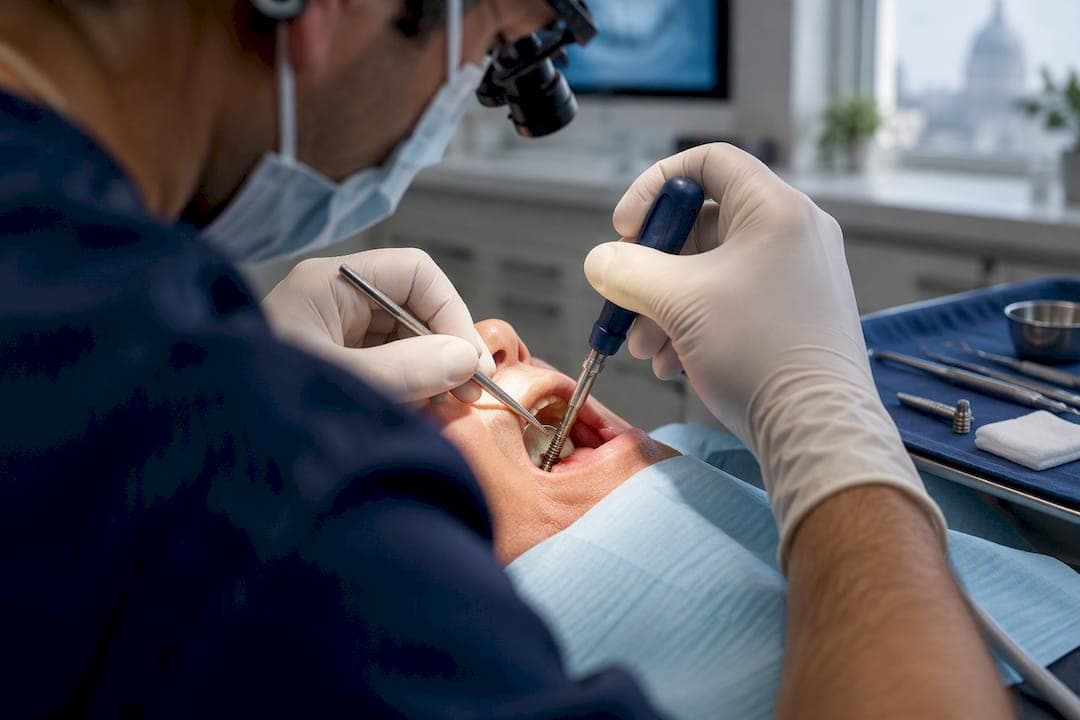
Yes, same-day implants are a real, evidence-based option for properly selected patients. The tooth you walk out with is almost always a provisional, not the final crown, and how well it holds up depends on your bone quality, the implant's initial stability, and the clinician's hands. This isn't a gimmick, but it's also not for everyone.
TL;DR:
- Success rates for well-selected cases of immediate implant placement with loading reach near 98%, matching traditional staged procedures.
- Adequate bone density, absence of infection, controlled health conditions, and stable implant torque are critical factors for immediate loading success.
- The entire procedure typically takes one to two hours for a single tooth, with provisional restorations being adjustable chairside immediately afterward.
- Healing and osseointegration require six to eight weeks, with final crowns usually placed between two and six months, depending on individual healing.
- Proper planning with in-house imaging and expert clinicians is essential, and not all patients are suitable candidates for same-day loading.
Table of Contents
- What Same Day Implants Actually Mean (And What They Don't)
- The Real Benefits of Getting It Done in One Visit
- Who Actually Qualifies for Immediate Loading
- Step by Step: What Happens During a Same-Day Implant Visit
- Healing, Follow-Up, and When You Get the Final Crown
- Why Clinician Skill Is the Real Deciding Factor
- Speed Is Tempting. Long-Term Integration Should Still Win the Argument
- Getting Same-Day Treatment Done Right in Washington, DC
- Sources
- FAQ
What Same Day Implants Actually Mean (And What They Don't)
"Same day implants" is the phrase people search for, but the accurate clinical term is immediate implant placement combined with immediate loading. Immediate placement means the implant goes directly into a fresh extraction socket instead of waiting months for the bone to heal. Immediate loading means you leave that same appointment with a functional temporary tooth attached, rather than a healing cap buried under the gum.
The International Team for Implantology treatment guide breaks this into Type 1A, 1B, and 1C protocols based on how soon loading happens after placement, and the distinction matters because rushing a poorly stabilized implant into function is how failures happen.
Before any of this gets decided, your dentist runs diagnostics:
- A CBCT scan to map bone volume, density, and nerve position in three dimensions
- A clinical exam checking gum health, bite, and adjacent teeth
- Insertion torque and ISQ (implant stability quotient) readings taken during surgery itself
Only after those numbers come back favorable does immediate loading stay on the table.
The Real Benefits of Getting It Done in One Visit
The appeal is obvious once you've worn a temporary partial denture. Same-day protocols compress what's traditionally a two-surgery, months-long process into one visit, meaning fewer appointments, less time off work, and no gap where you're missing a visible tooth.
Full-arch same-day strategies, often built around splinting multiple implants together, can sometimes avoid separate bone grafting procedures that would otherwise add months to treatment. Patients report a real quality-of-life difference from skipping removable temporaries altogether.
Pro Tip: Ask specifically whether your case qualifies for immediate loading or just immediate placement with a delayed temporary. They get marketed interchangeably, but they're different promises.
The numbers back the approach when candidacy is right. Clinical studies report survival rates near 98% for immediate placement with immediate restoration in well-selected cases, on par with traditional staged implants.
- Fewer surgical visits and less total treatment time
- No removable temporary denture during healing
- Immediate esthetics for front-tooth cases
- Possible avoidance of a separate grafting procedure in some full-arch plans
Who Actually Qualifies for Immediate Loading
Not every extraction site is a good candidate for same-day treatment, and this is where a lot of marketing glosses over the fine print. The review of critical aspects in immediate loading points to a handful of factors that consistently separate success from failure.
- Bone quantity and density. Dense, sufficient bone lets the implant achieve high insertion torque right away. Soft or thin bone often can't hold that stability.
- No active infection at the site. A socket with lingering abscess or chronic periodontal disease is a poor candidate for same-day loading regardless of bone volume.
- Controlled systemic health. Uncontrolled diabetes or autoimmune conditions that slow healing raise the risk of early failure.
- Smoking status. Smoking is tied to higher marginal bone loss risk, and heavy smokers are frequently steered toward delayed loading instead.
- Single tooth versus splinted implants. A lone front-tooth implant carries more risk under immediate load than a full-arch case where several implants are splinted together, distributing the biting force.
When facial bone is thin, there's a large defect, grafting is needed, or insertion torque comes in low during surgery, most experienced clinicians will pivot to a delayed protocol on the spot. That's not a failure. It's the plan working correctly.
Step by Step: What Happens During a Same-Day Implant Visit
The visit itself moves through distinct phases, and knowing them ahead of time takes a lot of the anxiety out of the chair.
- Pre-op planning. This happens before you're ever numbed. A CBCT scan and, often, digital surgical guide planning let the dentist map exactly where the implant will sit relative to nerves, sinuses, and adjacent roots. Informed consent covers what happens if primary stability isn't achieved.
- Extraction, if needed. A damaged or infected tooth comes out first, with care taken to preserve the surrounding bone walls.
- Implant placement and stability check. The implant goes into the socket or prepared site. Insertion torque and ISQ readings are taken immediately, and these figures determine whether immediate loading proceeds that day.
- Tissue management. Sutures close the surgical site, sometimes with a small graft material to support the gum contour.
- Provisional delivery. A temporary crown or bridge is fabricated or adjusted chairside and attached, with the bite carefully checked to eliminate side-to-side contact that could rock the implant during healing.
Total chair time for a single-tooth case typically runs one to two hours; full-arch cases run longer. The provisional will feel slightly different from a natural tooth at first, and that's expected.
Pro Tip: A provisional that feels "loose" in the sense of slight give against firm pressure is often intentional; a provisional that rocks or clicks when you bite normally is not. Call the office if it's the second one.
Healing, Follow-Up, and When You Get the Final Crown
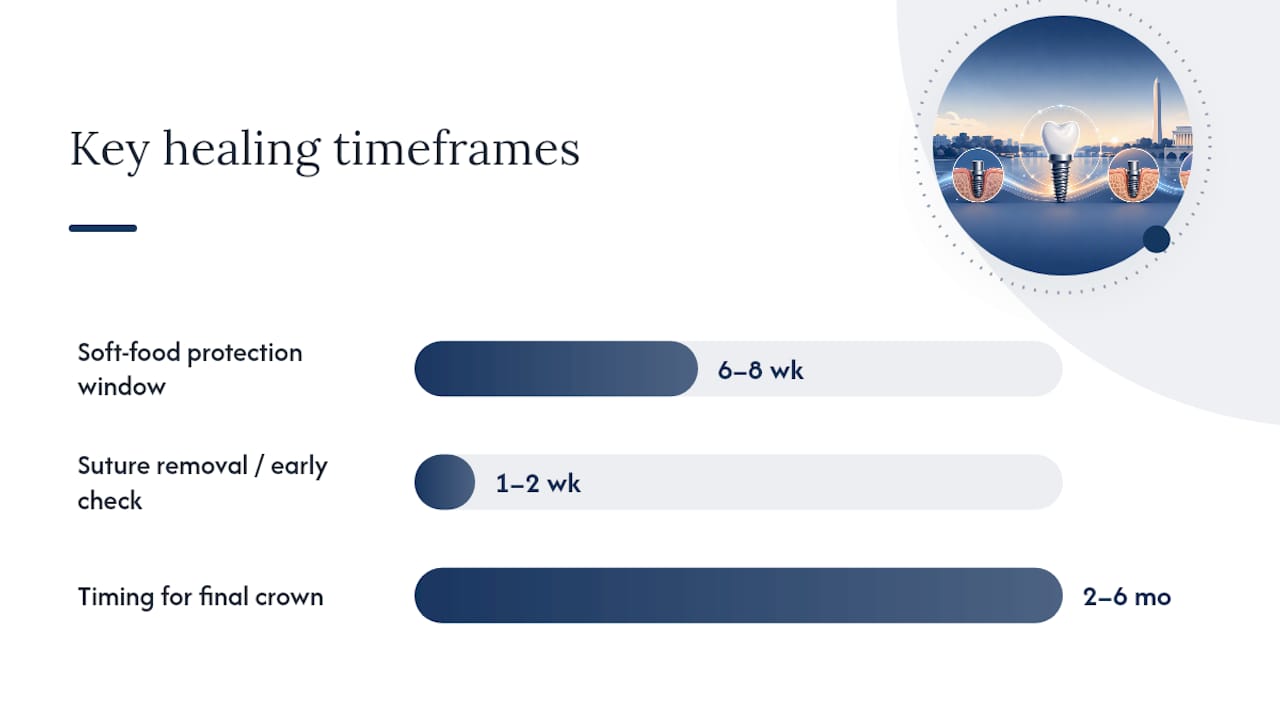
The first six to eight weeks are about protecting the implant from micromotion while the bone fuses to its surface, a process called osseointegration. A soft-food diet during that window isn't a suggestion. Chewing on anything firm on that side risks disrupting the bond before it sets, which is one of the more common causes of early implant failure that has nothing to do with surgical skill.
Follow-up typically includes:
- Suture removal or a healing check around one to two weeks out
- A midpoint visit to assess tissue healing and confirm no drainage or mobility
- ISQ or radiograph checks before proceeding to the final crown, confirming the implant has fully integrated
Watch for increasing pain (rather than pain that steadily improves), swelling that worsens after the first few days, or persistent drainage. Any of those warrants a call to your dentist, not a wait-and-see approach. Once integration is confirmed, the definitive crown usually goes on somewhere between two and six months later, depending on the site and how healing progressed. That range matters because rushing the final restoration onto a not-quite-integrated implant defeats the purpose of doing this carefully in the first place.
Why Clinician Skill Is the Real Deciding Factor
The clinical literature is fairly consistent on one point: immediate loading works when the biology cooperates and the clinician respects it. A randomized clinical trial with 5-year follow-up found 100% implant survival with immediate loading versus 95.8% with delayed loading in selected single-tooth cases, essentially proving the two approaches can perform equally well when candidacy is right.
Immediate functional loading is predictable when implant systems and prosthetic technique are specifically chosen for that purpose, and when the clinicians performing it are trained in the biomechanics involved. Primary stability and prosthetic control, not speed alone, are what drive the outcome.
That's the core finding from the 3rd Consensus Document on Immediate Loading of Jaw Implants, and it's why the diagnostic imaging and torque measurements described earlier aren't optional steps. At DC Implant & Cosmetic Dentistry, that translates into CBCT-based planning done in-house before any drill touches bone, with Dr. Kambez Shukoor overseeing both the surgical placement and the prosthetic side of same-day cases rather than handing patients off between specialists.
Speed Is Tempting. Long-Term Integration Should Still Win the Argument
Wanting to walk out with a tooth the same day you lose one makes complete sense. But the patients who end up happiest five years later are the ones whose clinician was willing to say "let's wait" when the numbers didn't support loading immediately. Ask to see real before-and-after cases, ask how many immediate-loading cases your clinician has actually placed, and don't treat a same-day timeline as the primary success metric. If your case sits anywhere near a borderline call, book a consultation and let imaging settle the question instead of guessing.
— Jake
Getting Same-Day Treatment Done Right in Washington, DC
Same-day implants only work when the planning behind them is airtight, and that's the piece DC Implant & Cosmetic Dentistry builds its Teeth in a Day service around: every case starts with in-house CBCT imaging and surgical planning, not a referral to three different offices.

Patients get the surgical placement, stability assessment, and provisional fabrication handled by the same team in one location, with Dr. Kambez Shukoor drawing on Navy medical experience to manage both the implant surgery and the prosthetic work directly. The practice has built up more than 200 five-star reviews on that same-day, in-house model, and for full-arch cases, the full mouth reconstruction option covers splinted-implant strategies that improve predictability in higher-risk sites. If you've lost a tooth or you're facing an extraction and want to know whether you qualify for immediate loading, schedule a consultation with DC Implant & Cosmetic Dentistry and get a CBCT-based answer instead of a guess.
This article is general information, not a substitute for advice from a qualified doctor. Consult a qualified healthcare professional about your own circumstances before acting on anything here.
Sources
- Immediate implant placement and restoration outcomes (PubMed entry)
- Immediate loading implants: review of critical aspects (PMC)
- ITI Treatment Guide: Implant placement and loading protocols (consensus statement)
- A Randomized Clinical Trial Comparing Immediate Loading and Delayed Loading of Single-Tooth Implants: 5-Year Results
FAQ
Can implants be placed the same day a tooth is pulled?
Yes, in properly selected cases the implant goes directly into the extraction socket during the same visit, a protocol called immediate placement. Whether it also gets immediately loaded with a temporary crown depends on the insertion torque and stability achieved during surgery.
Is it really possible to get a full set of teeth in one day?
For full-arch cases, splinting several implants together during a single surgery can support a provisional bridge the same day, which is how "teeth in a day" protocols work. The final, permanent bridge still comes later, typically after a few months of healing.
How much do same-day implants cost?
Pricing depends heavily on how many implants are placed, whether extractions or grafting are needed, and whether it's a single tooth or full arch. DC Implant & Cosmetic Dentistry doesn't publish a flat rate online; current pricing is available directly through the practice's implant services page after a consultation and imaging.
Can dental implants really be completed in 24 hours?
The surgical placement and a temporary provisional tooth can happen within hours on the same day, but the case is not finished at that point. Osseointegration still takes weeks, and the final crown isn't placed until imaging confirms the implant has fully integrated, usually two to six months out.