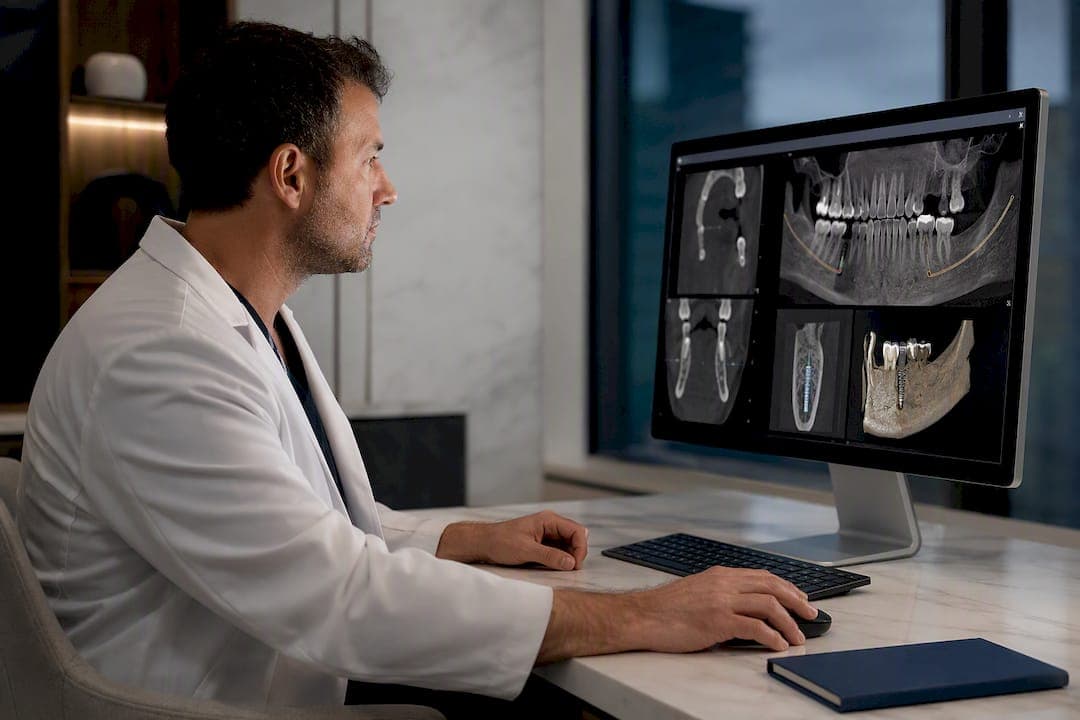
If your jaw lacks enough bone on a CBCT scan, you'll likely need a bone graft before an implant, since implants generally need at least 10 mm of height and 3 to 4 mm of width to anchor properly. Larger grafts typically take several months to mature enough for implant placement. The next step is simple. Schedule a 3D imaging scan and a consult so a dentist can measure your actual bone volume rather than guess from a panoramic X-ray.
TL;DR:
- Bone grafting is required if your jaw has less than 10 mm of height or 3 to 4 mm of width, as implants need sufficient volume to secure properly.
- The healing process can take from 4 weeks for small socket grafts up to 12 months for dense block grafts, especially in the upper jaw's sinus lift procedures.
- Using your own bone (autograft) offers the most biological growth potential but involves a second surgery, while synthetic or donor bones vary in resorption rates and strength.
- Graft success depends on proper patient health, such as not smoking or having uncontrolled diabetes, and is confirmed via follow-up imaging and clinical exams.
- Most graft procedures are manageable, with discomfort comparable to a tooth extraction, and they provide a permanent foundation for long-term implant stability.
Table of Contents
- What Is a Dental Bone Graft and How Do Dentists Decide You Need One?
- Bone Graft Materials: Autograft, Allograft, Xenograft, and Synthetic Options
- What Happens During Bone Graft Surgery for an Implant?
- How Long Does a Bone Graft Take to Heal Before an Implant?
- What Are the Risks and Success Rates of Bone Grafts?
- Recovery Timeline and Aftercare After a Bone Graft
- A Clinical Perspective on Bone Grafting Before Implants
- Ready to Find Out If You Need a Bone Graft?
- Sources
- FAQ
What Is a Dental Bone Graft and How Do Dentists Decide You Need One?
A dental bone graft rebuilds lost volume and density in the jaw so it can physically support an implant post. Without enough bone, an implant has nothing solid to fuse into, and it can loosen or fail months after placement.
Dentists don't eyeball this decision. Cone beam CT (CBCT) imaging gives a 3D map of your jaw, and clinicians compare that map against established minimums. Research on implant site requirements points to roughly 10 mm of bone height, 3 to 4 mm of diameter at the implant site, and about 1.5 to 2 mm of bone surrounding the implant once it's placed. Fall short on any of those numbers, and grafting usually enters the conversation.
Bone loss in the jaw comes from a handful of common causes:
- Tooth extraction, especially when the socket is left to heal on its own
- Long-term denture wear, which doesn't stimulate bone the way a tooth root does
- Periodontal disease that has eaten away at the supporting bone
- Trauma or a dental abscess that destroyed bone locally
Socket preservation, a graft placed into the socket at the same time a tooth is pulled, is the cheapest insurance against this problem. Preserving the socket early often avoids the need for a bigger, more invasive graft later.
Bone Graft Materials: Autograft, Allograft, Xenograft, and Synthetic Options
Not all grafting material comes from the same place, and the source changes both how well it works and what the surgery involves.
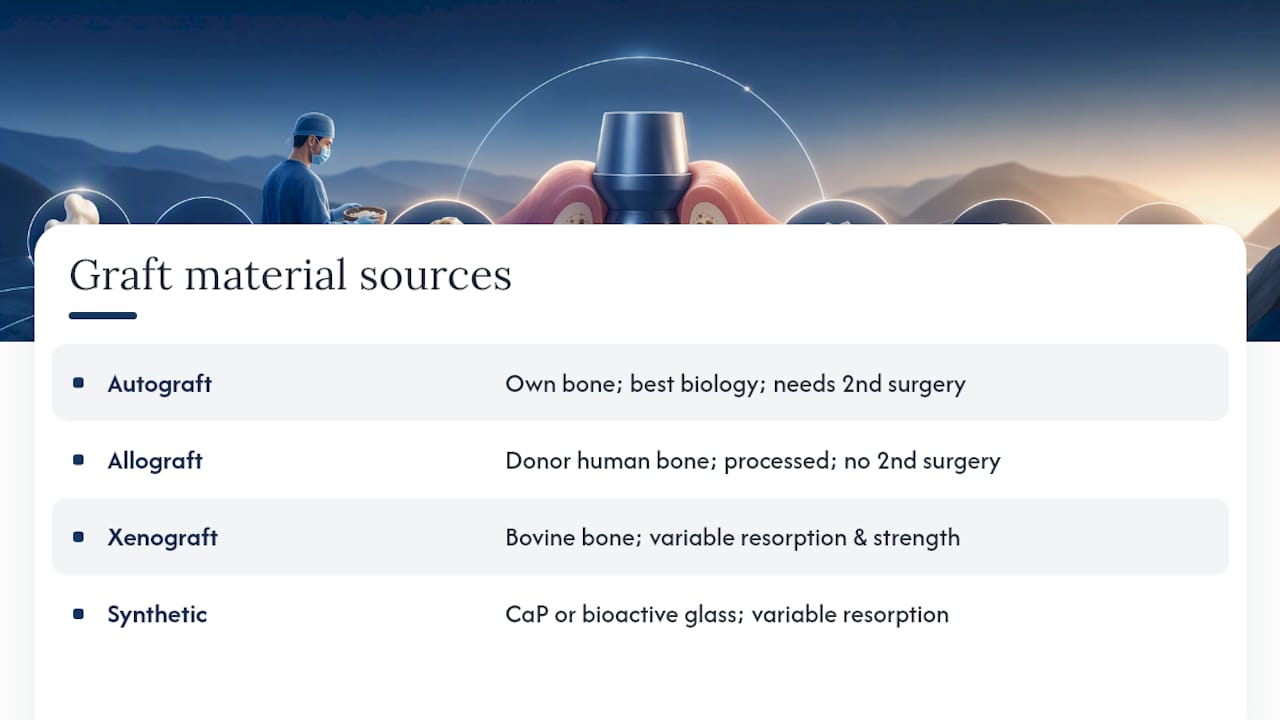
Autografts use your own bone, usually harvested from the chin, jaw ramps, or hip. Literature on bone grafting calls autografts the gold standard because they carry osteogenic, osteoinductive, and osteoconductive properties all at once, meaning the graft actively grows new bone rather than just holding space. The trade-off is a second surgical site and the pain that comes with it.
Allografts come from processed human donor bone, screened and treated to remove disease risk. Demineralized bone matrix (DBM), a processed allograft form, is often layered into smaller defects where structural strength matters less than biological signaling.
Xenografts, typically bovine bone, and synthetic grafts made from calcium phosphate or bioactive glass are both widely used alternatives that skip the second surgery entirely. They resorb at different rates and vary in mechanical strength, so a dentist picks based on the defect's size and location.
Growth factors and bone marrow aspirate, sometimes grouped under "orthobiologics," get added when a case needs an extra push toward faster bone formation, usually in larger or compromised defects.
Pro Tip: Ask which material your dentist plans to use and why. A synthetic graft for a small socket and an autograft block for a severely resorbed ridge are two very different procedures with different recovery timelines.
What Happens During Bone Graft Surgery for an Implant?
The procedure you undergo depends entirely on how much bone you're missing and where.
- Socket preservation happens immediately after a tooth extraction. Graft material fills the empty socket before it's stitched closed, usually under local anesthesia alone.
- Ridge augmentation rebuilds a jaw that has already lost width or height over time. This is typically staged separately from implant placement and may require a membrane to hold the graft in place while it integrates.
- Block grafting uses a solid piece of bone, often autograft, screwed into place to rebuild a severely deficient ridge. Combining cancellous and cortical bone gives block grafts both biological activity and structural rigidity. Fixation adds surgical complexity.
- Sinus lifts address the upper back jaw, where the sinus floor often sits too close to usable bone. Lateral window and transcrestal techniques are both used depending on how much lift the site needs.
Most socket and ridge grafts are done under local anesthesia with optional sedation. Block grafts and sinus lifts, being more involved, often call for IV sedation. Expect swelling and mild discomfort for a few days afterward, manageable with over-the-counter or prescribed pain relievers.
How Long Does a Bone Graft Take to Heal Before an Implant?
Healing time depends almost entirely on graft size, and rushing this step is the most common mistake patients want to make.
A small socket graft reaches enough stability for light use in about 4 to 6 weeks, though full maturation continues for months. Larger ridge grafts generally need 4 to 6 months. Block grafts, being denser and requiring vascular integration through solid bone, often take 6 to 12 months before they're ready to support an implant.
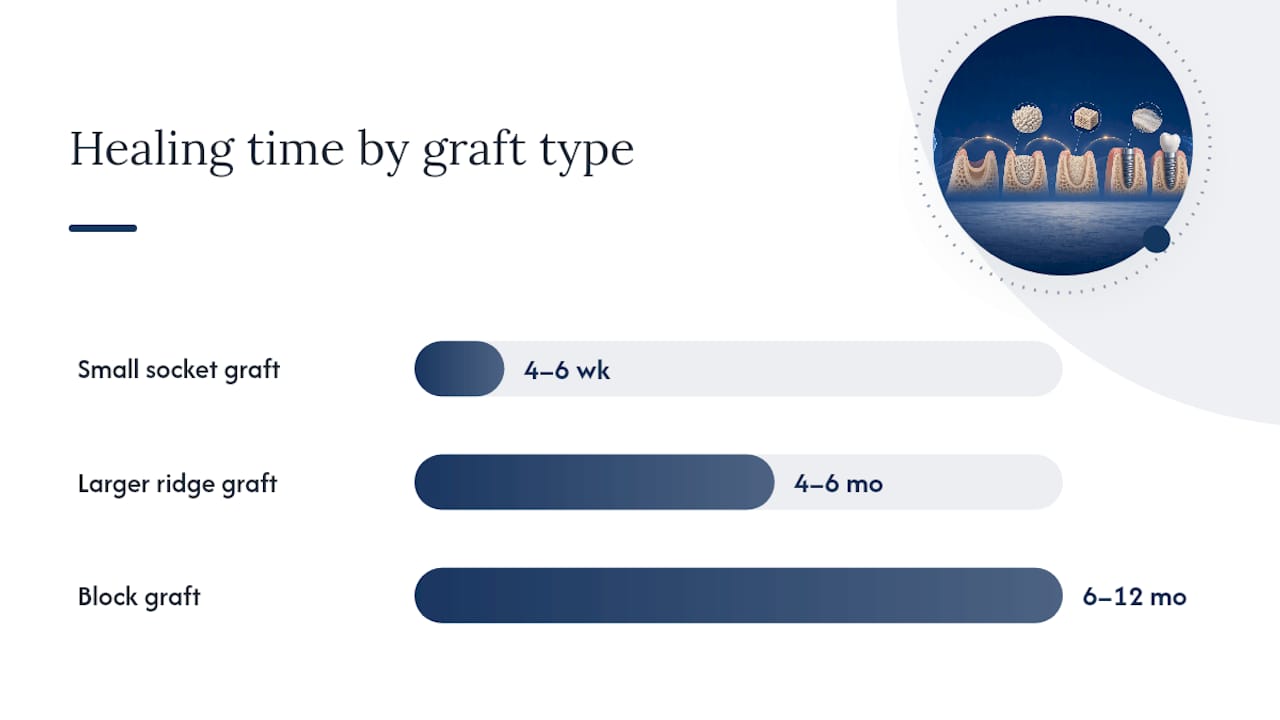
Cleveland Clinic notes that initial healing often begins within about a week, but full graft maturation can stretch close to a year. That's why implant placement after a larger graft is commonly scheduled within a 6 to 12 month window rather than sooner.
Waiting too long carries its own risk. Once a graft has matured, delaying implant placement lets the augmented bone gradually shrink from disuse, undoing some of the gain the surgery achieved.
Several factors slow healing beyond the typical range:
- Smoking, which restricts blood flow to the healing site
- Uncontrolled diabetes, which impairs bone remodeling
- Certain medications, including bisphosphonates and some immunosuppressants
- Poor oral hygiene that introduces infection risk during healing
Dentists confirm readiness with follow-up CBCT imaging and a clinical exam checking for firm, stable tissue rather than relying on the calendar alone.
What Are the Risks and Success Rates of Bone Grafts?
Bone grafting is a routine part of implant dentistry. Estimates suggest that up to roughly half of all dental implant procedures involve some form of grafting, which tells you how far from experimental this has become.
Complications exist, but most are manageable:
- Infection at the graft site, usually treatable with antibiotics if caught early
- Graft exposure, where the gum tissue separates and exposes the material underneath
- Donor-site pain, relevant only to autograft harvesting
- Partial graft resorption, where the body absorbs more of the material than expected
Success rates in the literature are generally favorable, though outcomes vary by graft type, site, and patient health, and no source guarantees a universal number. When grafts integrate well, they don't just enable implant placement. They improve long-term implant stability and let the prosthetic tooth sit in a more natural position instead of being angled to avoid a bone deficiency.
Persistent swelling past a week, fever, pus, or a graft that feels loose are red flags that need urgent attention, not a wait-and-see approach.
Recovery Timeline and Aftercare After a Bone Graft
The first week matters most. Expect swelling, mild bruising, and some discomfort that peaks around day two or three before easing off.
- Take prescribed or over-the-counter pain medication on schedule rather than waiting for pain to build.
- Use antiseptic mouth rinses as directed to reduce infection risk without disturbing the graft site.
- Stick to soft, cool foods for the first few days, then progress gradually as swelling subsides.
- Avoid strenuous exercise for about a week, since elevated blood pressure can increase bleeding at the site.
- Brush gently around the area and keep scheduled follow-up visits, where your dentist checks healing with periodic imaging.
Lifestyle changes matter as much as the medication. Quitting smoking, keeping blood sugar controlled, and reviewing any medications that interfere with bone healing all improve your odds of a smooth graft.
Pro Tip: Some patients look into non-surgical bone-support habits alongside clinical care. Osteogenic loading approaches are worth discussing with your dentist, but they're a supplement to professional treatment, never a replacement for it.
A Clinical Perspective on Bone Grafting Before Implants
Dr. Kambez Shukoor, a U.S. Navy veteran and the clinical lead at Dc-dentistry, approaches every graft decision the same way: with imaging before opinion. No two jaws lose bone the same way, so grafting recommendations get built around what the CBCT scan actually shows, not a standard protocol applied to everyone who walks in.
The practice offers same-day appointments for patients who don't want to wait weeks just to find out whether grafting applies to their case, and it has received numerous positive reviews from patients who underwent implant and grafting work. Material selection, whether that means a synthetic graft for a small socket or a staged ridge augmentation, gets matched to the defect and coordinated against a realistic implant timeline rather than a one-size answer.
— Jake
Ready to Find Out If You Need a Bone Graft?
If you're staring down a missing tooth and wondering whether your jaw can handle an implant, guessing isn't a strategy. The practice starts every implant case with CBCT imaging, so patients get a precise picture of bone volume instead of a rough estimate, and a graft plan built around what the scan actually shows rather than a generic protocol.

The practice handles the full range of what that plan might require: socket preservation at extraction, ridge augmentation for wider defects, and staged bone grafting before implant placement, with financing options available through CareCredit and Lending Tree for patients who need to spread out the cost. Bring a list of current medications and any prior dental imaging you have to your first visit; it speeds up planning considerably.
If you're ready to move forward, schedule a consult and 3D imaging appointment through the dental implants page to get a personalized graft and implant plan built around your actual bone structure.
This article is general information, not a substitute for advice from a qualified doctor. Consult a qualified healthcare professional about your own circumstances before acting on anything here.
Sources
- Implant site dimensional requirements (ScienceDirect abstract)
- Bone grafts in trauma and orthopaedics (literature review)
- Dental bone graft: Process, purpose & healing (Cleveland Clinic)
FAQ
How Painful Are Bone Grafts for Implants?
Most patients report manageable discomfort similar to a tooth extraction, controlled with over-the-counter or prescribed pain medication for a few days. Autograft procedures with a donor site, like the chin or hip, tend to cause more soreness than allograft or synthetic grafts.
How Much Does Bone Grafting Cost for an Implant?
Cost varies widely based on graft material, the size of the defect, and whether sedation is required, and it isn't listed as a fixed nationwide figure anywhere reliable. Financing options are available to help spread the cost of grafting and implant treatment.
How Long Do Bone Grafts Last for Dental Implants?
A successfully integrated bone graft becomes a permanent part of your jaw structure and doesn't wear out the way a filling or crown might. Once fused, it functions as your own bone and supports the implant for the long term.
Is a Bone Graft Necessary for an Implant?
Not always. Grafting depends on whether your CBCT scan shows enough bone height and width, roughly 10 mm of height and 3 to 4 mm of diameter, to support an implant without one. Many patients with well-preserved jaw bone, particularly those who had socket preservation after extraction, can proceed straight to implant placement.