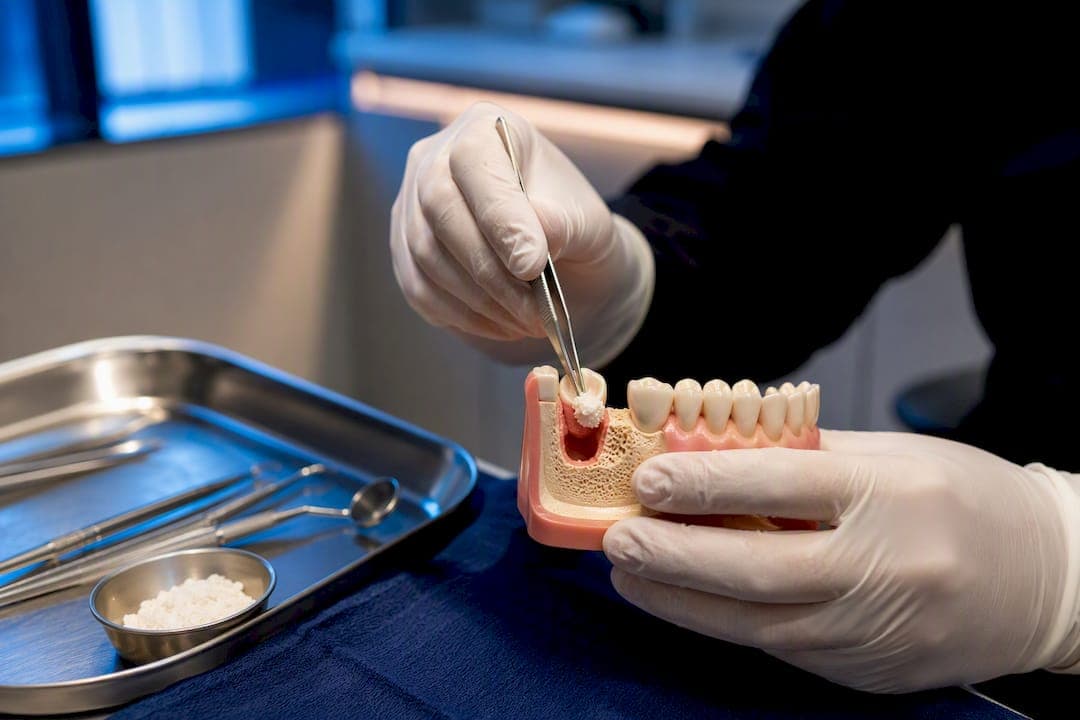
Socket preservation (also called alveolar ridge preservation) is a procedure done at the time of extraction to reduce bone loss and protect future implant or prosthetic outcomes. It's recommended when a dental implant is planned down the road, especially in the aesthetic zone or when the outer wall of bone is thin. Skipping it in those cases often means more bone grafting later, at a higher cost and with a longer wait.
TL;DR:
- Socket preservation significantly reduces horizontal ridge loss, cutting volumetric bone resorption by about half compared to unassisted healing.
- Candidates are primarily those with thin buccal walls under 1 millimeter thick, especially in the aesthetic zone or when multiple teeth are being extracted simultaneously.
- The healing timeline for implant readiness typically spans 3 to 6 months, with slow resorption in cases involving delayed or compromised healing factors.
- Graft material choice varies widely but generally includes autografts, allografts, xenografts, or synthetics, with no single option outperforming others across all scenarios.
- Preoperative assessment of buccal bone thickness and appropriate case planning can optimize outcomes and reduce the likelihood of additional bone grafting after extraction.
Table of Contents
- What Socket Preservation Actually Does to Your Healing Bone
- Who Actually Needs Socket Preservation?
- Choosing a Graft Material: Why There's No Single "Best" Option
- What Happens During the Procedure
- How Long Does Healing Take Before an Implant Goes In?
- What the Research Actually Shows About Outcomes
- Risks, Complications, and What Socket Preservation Costs
- Getting Ready for the Procedure and What Comes After
- How DC Implant & Cosmetic Dentistry Approaches Socket Preservation
- The Real Gap Between What Socket Preservation Promises and What It Delivers
- Ready to Talk About Socket Preservation? Here's the Next Step
- Sources
What Socket Preservation Actually Does to Your Healing Bone
When a tooth comes out and nothing else is done, the socket doesn't just heal. It shrinks. The bundle bone that once held the tooth's ligament resorbs, and the ridge narrows and flattens as it fills in with soft tissue instead of solid bone. Studies tracking this unassisted healing report notable average horizontal ridge loss in the months following extraction. That's often enough width lost to make implant placement impossible without a separate grafting procedure later.
Socket preservation interrupts that shrinkage. Filling the socket with graft material at the time of extraction, often with a covering membrane, substantially reduces horizontal loss in many otherwise intact sockets. A randomized controlled trial comparing extraction alone to ridge preservation found volumetric bone loss of 15.83% in the unassisted group versus 8.36% in the preserved group over 14 weeks. Roughly half the loss.
What that means for you in practical terms:
- Fewer separate bone grafting appointments before an implant can go in
- Better width and height of bone for the implant to anchor into
- More natural gum contour around the eventual crown, especially visible in the front teeth
- Shorter overall timeline to a finished implant in many cases, since you skip a second augmentation stage
None of this guarantees a simpler path. But it stacks the odds in your favor, particularly if you already know an implant is somewhere in your future.
Who Actually Needs Socket Preservation?
Not every extraction calls for it. Reviews and consensus statements point to specific situations where the benefit clearly outweighs the extra time and cost.
You're likely a good candidate if:
- Your buccal (outer) bone plate is thin, generally under 1 to 2 mm, which research consistently identifies as the strongest predictor of aggressive resorption
- The tooth sits in the aesthetic zone, meaning it shows when you smile
- You're planning an implant but not ready for one immediately
- Multiple adjacent teeth are coming out at once, which tends to accelerate ridge collapse
Socket preservation carries more risk, or may not be recommended, if you have:
- An active infection at the extraction site that hasn't been controlled first
- A compromised immune system that slows healing and raises infection risk
- A history of bisphosphonate or denosumab therapy, which is linked to impaired bone turnover and, rarely, medication-related osteonecrosis of the jaw
- A heavy smoking habit, which measurably reduces graft success and delays healing
One clinical figure worth knowing: buccal plate thickness under roughly 1 mm is one of the most reliable single predictors that a socket will resorb significantly without intervention. It's also one of the easiest things a clinician can check.
Your dentist typically assesses candidacy with a combination of a CBCT scan to measure bone thickness and volume, periodontal probing around the tooth, and a review of your medical history and current medications. That combination tells them whether preservation is worth doing and which technique fits your anatomy.
Choosing a Graft Material: Why There's No Single "Best" Option
Ask five clinicians which graft material is best for socket preservation, and you'll likely get five slightly different answers, all defensible. That's because systematic reviews have found no single material or technique consistently outperforms the others across every clinical scenario. The right choice depends on socket size, remaining bone walls, and what the case ultimately needs to support, as no single material consistently outperforms the others.
The main categories:
- Autograft (your own bone, harvested from another site): biologically the gold standard, since it carries living cells that actively form new bone. The trade-off is a second surgical site and limited volume, which is why it's used less often for routine socket preservation.
- Allograft (processed human donor bone): widely used, avoids a second surgical site, and integrates well in most sockets.
- Xenograft (commonly bovine-derived, like DBBM): slower to resorb than allograft, which some clinicians favor for longer-term volume stability in areas that will wait months before an implant goes in.
- Alloplast (synthetic bone substitute): consistent and infection-free by nature, though it lacks the biologic signaling of natural bone.
Membranes layer on top of that choice. Some clinicians use an open technique, leaving the graft exposed to the oral environment under a collagen plug or dressing. Others prefer full soft-tissue closure over the graft. Evidence comparing the two suggests closed techniques add surgical complexity without a meaningful edge in final ridge dimensions, which is why open approaches remain common for straightforward cases.
Socket sealing is a related but distinct decision, particularly for compromised sockets with a damaged or missing buccal wall. Options include a free gingival graft, a collagen matrix xenograft, or dense PTFE membrane placed directly over the graft material. A pilot randomized study found that sockets grafted with demineralized bovine bone and sealed with either a free gingival graft or a collagen matrix reached implant readiness at four months without needing additional guided bone regeneration.
Pro Tip: Don't fixate on the material name your dentist mentions. Ask instead what the socket looked like after extraction, since the condition of the buccal wall matters more to your outcome than which brand of graft fills the space. If your case involves significant bone loss already, ask about bone grafting options beyond standard socket preservation.
What Happens During the Procedure
A socket preservation procedure typically adds only 15 to 30 minutes to a standard extraction visit, and most patients go home the same day. Here's the general sequence:
- Anesthesia and atraumatic extraction. The dentist numbs the area, then removes the tooth using techniques designed to disturb the surrounding bone and soft tissue as little as possible. Preserving the buccal wall during removal matters just as much as anything done afterward.
- Socket cleaning and evaluation. Any infected or granulation tissue is removed, and the socket walls are inspected to confirm how much bone remains intact.
- Graft placement. The chosen material, whether allograft, xenograft, or another option, is packed into the socket to fill the space left by the root.
- Membrane or sealing application. A resorbable membrane, collagen plug, or soft-tissue graft is placed over the graft material depending on socket condition and clinician preference.
- Suturing. Sutures stabilize the graft and membrane, either with a simple cross stitch over an open socket or a more involved closure if soft-tissue coverage was used.
- Immediate aftercare instructions. You'll typically get gauze to bite on for bleeding control, guidance on ice application, and a prescription or recommendation for pain management before you leave.
Most patients describe the recovery from this first 48 to 72 hours as comparable to a routine extraction, maybe slightly more swelling given the added graft material. A related resource on tooth extraction procedures covers what to expect from the extraction portion itself in more detail.
How Long Does Healing Take Before an Implant Goes In?
Healing after socket preservation moves through recognizable phases, though the exact pace depends on your health, the graft material used, and how compromised the socket was to begin with.
The first 0 to 4 weeks focus on soft-tissue closure. The gum over the graft site seals, swelling resolves, and any sutures either dissolve or get removed. The graft material itself is still immature at this stage, nowhere near ready to support an implant.
From roughly 1 to 3 months, the graft undergoes active remodeling. Your own bone cells gradually replace or integrate with the graft material, building density and vascularity. This is the stage where patience matters most, since the site can look healed on the surface while the bone underneath is still converting.
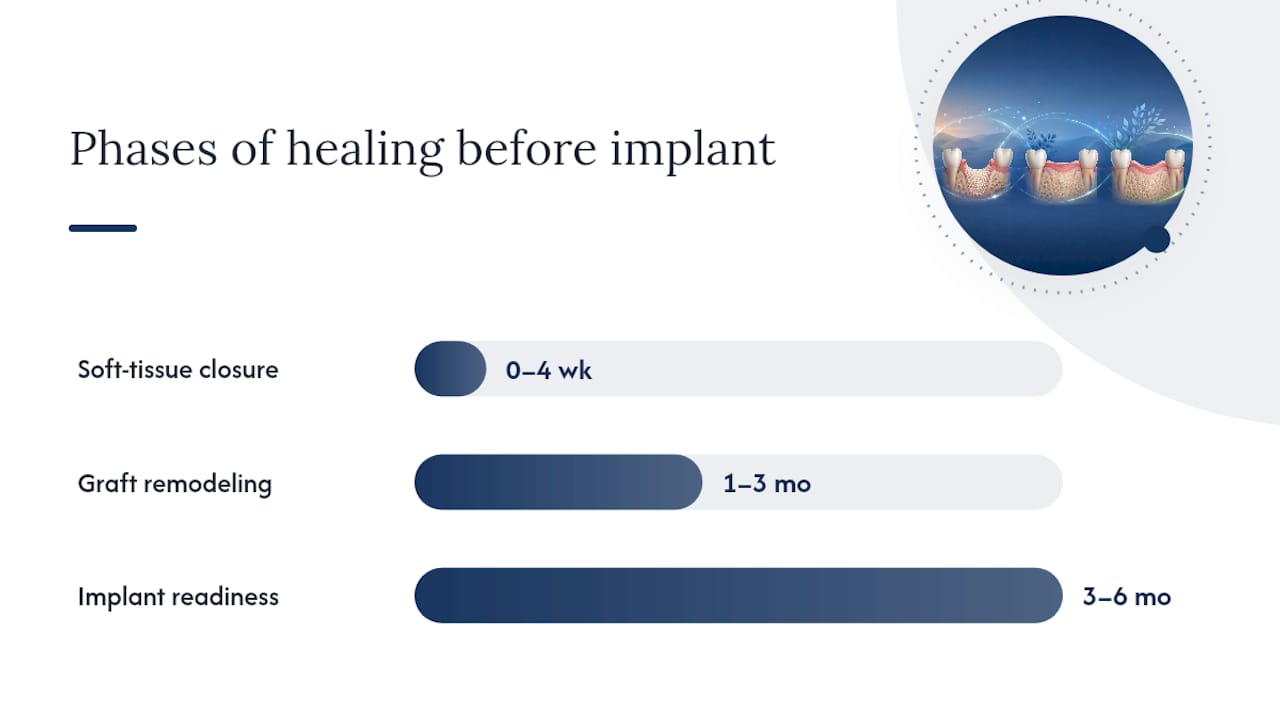
By 3 to 6 months, most sockets have matured enough for imaging to confirm implant readiness. Clinical guidance commonly points to a 3 to 4 month minimum wait for straightforward cases, extending toward 6 months for sites with more significant bone loss or slower-healing patients.
What speeds things up or slows them down:
- Xenografts tend to resorb slower than allografts, sometimes extending the practical wait time even as they improve long-term volume stability
- Smoking, uncontrolled diabetes, and certain medications measurably delay bone remodeling
- Larger or multi-tooth extraction sites generally need the longer end of the healing window
- Younger, systemically healthy patients often heal toward the faster end
A number worth remembering: most consensus reports and clinical trials place the healing window for implant readiness at 3 to 6 months, with 3 to 4 months being the common target for uncomplicated sockets. Rushing past that window is one of the more preventable causes of implant complications.
What the Research Actually Shows About Outcomes
The clinical evidence behind socket preservation is stronger than most patients realize, and also more limited than marketing language sometimes suggests. Both things are true at once.
On the positive side, randomized controlled trials and meta-analyses consistently report less volumetric bone loss with socket preservation compared to unassisted healing, along with a lower rate of needing additional augmentation at the time of implant placement. Similar reductions show up across multiple studies using different graft materials, which is part of why the procedure has become a default recommendation in implant-focused dentistry rather than an upsell.
Ridge preservation reduces the need for later guided bone regeneration but doesn't eliminate that need entirely in a minority of compromised sockets. Patients should expect their clinician to plan contingently rather than promise a guaranteed shortcut.
That's the honest limit of the procedure. Socket preservation slows and reduces resorption. It doesn't stop it completely, and it doesn't guarantee an implant will succeed on its own. Implant success also depends on factors socket preservation can't touch directly:
- Overall bone quality and density at the eventual implant site
- Gum health and the presence or absence of periodontal disease
- Systemic conditions like uncontrolled diabetes
- The precision of implant placement itself and the prosthetic work that follows
If a socket comes out severely compromised, with most of the buccal wall gone, preservation alone sometimes isn't enough, and a separate ridge augmentation procedure may still be needed before an implant can go in. That's not a failure of socket preservation. It's a reflection of how much damage existed before treatment even started.
Risks, Complications, and What Socket Preservation Costs
Socket preservation is a low-risk procedure overall, but it's still surgery, and a few complications show up more than others.
Complications to know about:
- Infection at the graft site, more common in smokers and patients with uncontrolled diabetes
- Graft exposure or partial loss if the covering membrane detaches early
- Delayed healing in patients on bisphosphonate or denosumab therapy
- Minor discomfort or swelling beyond what a standard extraction produces
Reducing your risk mostly comes down to disclosing your full medication list before the procedure, quitting or pausing smoking around the surgical window, and following aftercare instructions closely, particularly around avoiding pressure on the site.
Cost varies widely by graft material, socket complexity, and geographic location, generally landing somewhere between routine extraction pricing and a full bone grafting fee. Dental insurance sometimes covers a portion when tied to a planned implant, though coverage rules differ by plan. Financing options through providers like CareCredit can bridge the gap for patients paying out of pocket.
Getting Ready for the Procedure and What Comes After
Preparation matters almost as much as the procedure itself. A rushed pre-op conversation or sloppy aftercare routine can undercut even a well-executed graft.
Before your appointment:
- Disclose every medication and supplement you take, especially bisphosphonates, denosumab, or blood thinners
- Stop or significantly reduce smoking in the days before and after surgery
- Arrange a ride home if you're receiving sedation beyond local anesthesia
- Bring a list of questions about graft material choice and expected healing time specific to your case
After the procedure:
- Manage pain with the prescribed or recommended medication on schedule, not just when discomfort peaks
- Stick to soft, cool foods for the first few days, gradually reintroducing normal textures over one to two weeks
- Modify your oral hygiene routine, gently rinsing rather than brushing directly over the site until cleared
- Watch for warning signs: increasing pain past day three, persistent bad taste, visible graft exposure, or fever, and call your dentist if any appear
Expect at least one follow-up visit to check healing progress, and imaging, usually a CBCT scan, before your dentist confirms the site is ready for an implant.
Pro Tip: Take a photo of the extraction site on day one and again at each follow-up. Most patients can't judge their own healing progress accurately by feel alone, and a simple photo timeline gives your dentist something concrete to compare.
How DC Implant & Cosmetic Dentistry Approaches Socket Preservation
At DC Implant & Cosmetic Dentistry in Washington, DC, socket preservation starts with a straightforward evaluation: a CBCT scan and clinical exam to check buccal wall thickness and confirm whether grafting will meaningfully change your outcome. From there, the decision is a shared one. You'll hear the trade-offs between graft materials and sealing approaches specific to your socket, not a one-size-fits-all recommendation.
The practice is led by Dr. Kambez Shukoor, a U.S. Navy veteran with a track record backed by more than 200 five-star patient reviews. Appointments can often be scheduled promptly for patients who need an extraction and preservation planning.
If you're heading into a consultation, bring your current medication list, any prior dental imaging you have, and a clear sense of your timeline for getting an implant. That last detail helps determine which graft material and sealing method fits your case best, since some materials suit a faster turnaround and others favor patients willing to wait longer for maximum bone volume.
The Real Gap Between What Socket Preservation Promises and What It Delivers
Most articles on this topic oversell certainty. They'll tell you socket preservation "preserves your bone" as if it's a light switch, on or off. The actual evidence supports something more modest and, frankly, more useful: it cuts expected bone loss roughly in half in many cases, not to zero.
That distinction should change how you make the decision. If your buccal wall is already thin and you know an implant is coming, the math favors doing it almost every time, since the alternative is often a second surgery later at greater expense. But if you're not planning an implant, or your extraction site has healthy thick bone on all sides, the case weakens considerably. Conventional advice tends to treat socket preservation as automatic for every extraction, which isn't what the research actually supports.
What I'd prioritize first, if I were sitting in the consultation chair, is getting a real answer on buccal wall thickness before agreeing to anything. That single number tells you more about your likely outcome than any graft material brochure will.
— Jake
Ready to Talk About Socket Preservation? Here's the Next Step
If you're facing an extraction and wondering whether socket preservation makes sense for your situation, the honest answer depends on details only an exam can reveal, your buccal bone thickness, your implant timeline, and how the tooth sits relative to your smile line. That's a conversation worth having before the extraction, not after.
DC Implant & Cosmetic Dentistry evaluates each socket individually rather than defaulting to one graft material for every patient, and same-day appointments mean you don't have to wait weeks just to get answers about your specific case. Dr. Kambez Shukoor's background, backed by over 200 five-star patient reviews, means you're getting a clinician who has planned this exact decision many times over, not a generic protocol pulled from a brochure.
If an implant is somewhere in your future, the best time to plan for it is at the extraction, not months later when the bone has already changed shape. Schedule a consultation for dental implants in Washington, DC, and get a straight answer on whether socket preservation fits your case before your extraction date is even set.
This article is general information, not a substitute for advice from a qualified doctor. Consult a qualified healthcare professional about your own circumstances before acting on anything here.
Sources
- Efficacy of Alveolar Ridge Preservation: A Randomized Controlled Trial
- Alveolar ridge preservation review (PMC10474543)