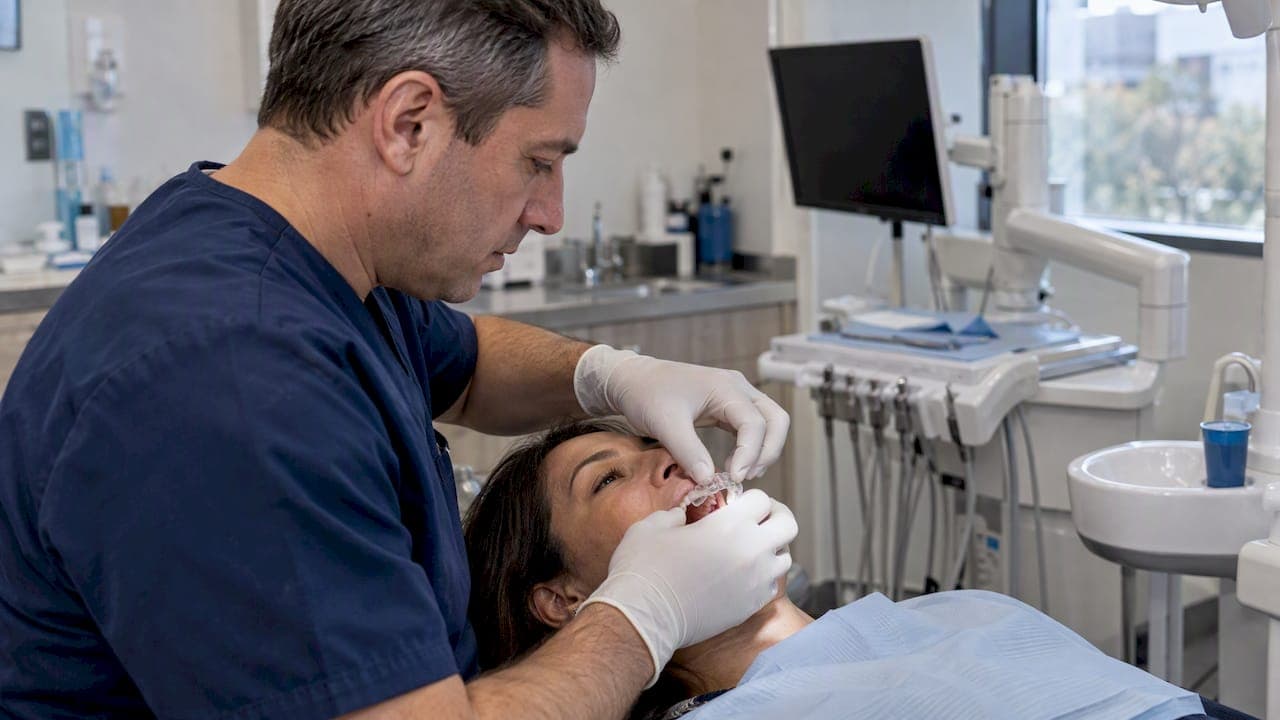
Guided implant surgery uses digital planning and a patient-specific surgical guide or navigation system to place implants more precisely than freehand placement. It helps protect nerves, sinuses, and adjacent teeth while supporting a prosthetically driven result. Whether it suits you depends on your anatomy, bone quality, and overall health, which is why a full exam and scan come before any guide is designed.
TL;DR:
- Reviews report deviations of 2.0 to 5.6 degrees and 0.3 to 2.3 millimeters at the implant tip; guide type and surgeon experience affect results.
- Tooth supported guides fit securely when natural teeth remain; bone supported guides resist movement better than gum supported ones, while limited opening may prevent placement.
- Uncontrolled systemic disease and active infection can rule out surgery; smoking, uncontrolled diabetes, and long term antiresorptive medication raise healing or jaw complication risks.
- Bone integration takes three to four months in the lower jaw and five to six months in the upper; grafting can extend healing.
- Guided surgery costs more upfront, especially for single implants without high anatomic risk; request an itemized written plan because prices are not published online.
Table of Contents
- What static and dynamic guided surgery actually mean
- [How it works: from consultation to the dental implant stages](#how-it-works-from-consultation-to-the-dental-implant-stageshttpsmaxcaredentalconzblogsdental-implant-stages)
- Comparing guide types and what they mean for your case
- How accurate is guided implant surgery?
- Who benefits most from guided implant surgery
- Risks and contraindications to discuss before surgery
- What to expect: surgery day and healing timeline
- Why choose DC Implant & Cosmetic Dentistry for guided implant surgery
- Caring for your implant site after guided surgery
- What guided implant surgery typically costs
- Questions worth asking your surgeon about guided planning
- Schedule a consultation at DC Implant & Cosmetic Dentistry
- FAQ
- Sources
What static and dynamic guided surgery actually mean
Static guided surgery uses a 3D-printed template that fits over your teeth, gums, or jawbone and holds the drill at a fixed angle and depth during surgery. Dynamic guided surgery instead relies on a navigation system that tracks the handpiece in real time on a screen, letting the surgeon adjust the path as they work. Both methods rely on the same pre-surgical scan and plan, and both still depend on the surgeon's hands and judgment rather than running on their own.
Guides are also classified by what they rest on:
- Tooth-supported guides seat against remaining teeth for a stable, repeatable fit.
- Mucosa-supported guides rest on the gum tissue, common in fully edentulous arches.
- Bone-supported guides attach directly to exposed bone, often pinned for rigidity in complex full-arch cases.
How it works: from consultation to the dental implant stages
Every guided case follows roughly the same sequence, starting with information gathering and ending at the surgical chair.
- A clinical exam, CBCT scan, and intraoral digital scan capture your bone volume, nerve position, and tooth shape.
- The surgical team builds a virtual plan, working backward from where the final crown should sit so implant position serves the prosthetic outcome, not just the available bone.
- A guide is designed on that plan and produced by 3D printing or sent to a dental lab for fabrication.
- On surgery day, the guide is seated and checked for fit before the osteotomy and implant placement follow the planned path, with a post-op check before you leave.
This workflow, sometimes called guided dental procedures, is what separates guided cases from freehand placement, where the surgeon relies on visual landmarks and experience alone during surgery.
Comparing guide types and what they mean for your case
The type of guide used affects stability, cost, and how well it suits your mouth. Tooth-supported guides tend to offer the highest stability when enough natural teeth remain to anchor them. Mucosa-supported and bone-supported guides serve patients with reduced teeth or fully edentulous arches, but they differ in rigidity: bone-supported, pinned guides generally resist movement better than mucosa-supported ones, which can shift slightly on soft tissue.
- Static guides give a fixed, pre-planned path and work well for most single or multiple implant cases.
- Dynamic navigation allows mid-surgery adjustments, which some surgeons prefer for anatomically tight spaces.
- Limited mouth opening can restrict guide placement, since the sleeve and drill need vertical clearance.
Pro Tip: Ask whether your case calls for a tooth-, mucosa-, or bone-supported guide, since the answer affects both fit and the quoted fee.
How accurate is guided implant surgery?
A systematic review found typical angular deviations of roughly 2.0 degrees to 5.6 degrees and linear apical deviations commonly between 0.3 millimeters and 2.3 millimeters for guided implant placement, meaning the planned and actual implant positions are usually close but rarely identical. These figures vary by guide support type and by how each study measured deviation.
Specific protocols can do better. A retrospective study of bone-supported stackable guides reported mean angular deviation around 1.25 degrees and mean global linear deviation near 0.96 to 1.07 millimeters in carefully controlled full-arch cases, showing that rigid bone fixation can tighten accuracy further. Measurement method, CBCT image artifacts, and the surgeon's experience with the specific guide system all influence the numbers, so results from one study don't automatically transfer to every case.

Who benefits most from guided implant surgery
Guided planning helps most when precision carries the highest stakes. It protects the inferior alveolar nerve and sinus floor by keeping the drill within a planned safety margin, and a randomized clinical trial found guided systems generally outperform freehand or pilot-drill approaches in accuracy, especially with rigid tooth or bone support.
- Complex anatomy near nerves or sinuses benefits from the added positional control.
- Full-arch and All-on-4 or All-on-6 cases rely on guided placement to keep multiple implants aligned for a shared prosthesis.
- Immediate restoration plans depend on precise placement to support a same-day crown or bridge.
Guided workflows add planning time and sometimes added cost upfront, a trade-off worth weighing against the reduced chair time and fewer surprises during surgery.
Risks and contraindications to discuss before surgery
Guided surgery lowers certain risks but doesn't remove the need for medical screening. Clinical guidance on implant risk factors lists absolute contraindications such as uncontrolled systemic disease and active infection, along with relative risk factors that raise complication risk without ruling out treatment entirely.
- Smoking and uncontrolled diabetes slow healing and raise failure risk.
- Long-term or high-dose antiresorptive medications, like certain bisphosphonates, carry a risk of medication-related osteonecrosis of the jaw (MRONJ).
- A poorly fitting guide, limited mouth opening, or higher upfront cost can make guided surgery impractical for some cases.
Medical clearance and an honest conversation about alternatives are worth having before committing to any surgical date.
What to expect: surgery day and healing timeline
The appointment itself usually requires less time than freehand surgery because the guide reduces intraoperative guesswork.
- The guide is seated and verified for fit, then local anesthesia is given.
- The osteotomy is drilled through the guide's sleeves, followed by implant placement at the planned depth and angle.
- A healing cap or temporary restoration is placed, and you're given aftercare instructions before leaving.
- Follow-up visits track healing, with the implant timeline typically showing osseointegration in about 3 to 4 months for the lower jaw and 5 to 6 months for the upper jaw, longer when bone grafting is involved.
Report any unusual swelling, pain that worsens after the first few days, or signs of infection promptly to your dental team.
Why choose DC Implant & Cosmetic Dentistry for guided implant surgery
We perform exams, imaging, and surgical implant placement in-house, so your care doesn't pass between separate offices. We offer dental implants, All-on-4 and All-on-6 full-arch treatment, and implant-supported dentures for patients needing partial or full-arch replacement. Our treatment planning is led by an experienced clinician, with same-day appointment availability, and the practice has earned numerous positive reviews from patients across Washington, DC.
Caring for your implant site after guided surgery
Aftercare following guided implant surgery follows the same core principles as any implant procedure, though the smaller incisions common with guided techniques often mean a gentler recovery. In the first 24 to 48 hours, cold compresses on the cheek help limit swelling, and a soft diet avoids pressure on the healing site. Most patients can return to light activity within a day or two, though strenuous exercise is usually held off for about a week.
Keeping the surgical site clean matters as much as resting it. Gentle rinsing with a prescribed or salt-water rinse, avoiding brushing directly over the implant for the first few days, and skipping straws or smoking (which both create suction that can dislodge a healing clot) all support stable healing. Our recovery guidance outlines a general pattern of returning to work within 1 to 3 days and reaching solid bone integration by 3 to 6 months, though guided cases with rigid guide support sometimes show less post-surgical swelling due to reduced tissue disruption.
Follow-up visits check the healing cap or temporary crown, confirm the gum tissue is closing properly, and monitor for any shifting before the final restoration is placed. Skipping these visits is one of the more common reasons minor issues go unnoticed until they become bigger ones. If you notice persistent numbness, a loose healing cap, or discharge from the site, contact your dental team rather than waiting for the next scheduled visit.

What guided implant surgery typically costs
Guided implant surgery generally costs more upfront than freehand placement because the fee covers the CBCT scan, digital planning software time, and the physical guide itself, on top of the surgery and implant components. Practical reviews of guided surgery limitations note that this added planning cost is one of the most common trade-offs patients weigh against the precision benefit, particularly for single-implant cases where the anatomy isn't especially risky.
The total cost depends on several variables: how many implants are being placed, whether bone grafting is needed, the guide support type chosen, and whether the case involves a full-arch solution like All-on-4 or All-on-6 rather than a single tooth replacement. Cases needing bone grafting or implant repair typically carry a higher total cost than straightforward single-site placements.
We don't publish flat prices for dental implants or guided surgery online, since the right plan depends on your scan results and treatment goals. During your consultation, we build a written, itemized treatment plan so you know the full cost before agreeing to anything, and we offer financing options through CareCredit and Lending Tree for patients who prefer to spread out payment. Insurance may offset part of the cost depending on your plan and whether the procedure is classified as medically necessary, which is worth confirming with your provider before scheduling.
Questions worth asking your surgeon about guided planning
Guided surgery is only as good as the plan behind it. Ask who builds your prosthetic-driven plan, what happens if the guide doesn't seat properly on surgery day, and what imaging was used to map nerves and sinuses. A second opinion is reasonable if any answer feels vague.
— Jake
Schedule a consultation at DC Implant & Cosmetic Dentistry

If the accuracy numbers above have you thinking guided placement might be right for your case, the next step is a scan and a conversation, not a guess. At DC Implant & Cosmetic Dentistry, we build your treatment plan from your own CBCT and digital scan, then handle planning, guide coordination, and surgical placement in one Washington, DC office.
| What you get | Why it matters |
|---|---|
| In-house exam, imaging, and surgery | No referrals or hand-offs between offices |
| Written treatment plan before surgery | Know the cost and steps ahead of time |
| Same-day appointment availability | Faster path from consultation to care |
Visit our dental implants page to see your options and book a consultation.
This article is general information, not a substitute for advice from a qualified doctor. Consult a qualified healthcare professional about your own circumstances before acting on anything here.
FAQ
What is the downside of a tooth implant?
Dental implants carry risks common to any oral surgery, including infection, prolonged healing, or, in rare cases, implant failure if osseointegration doesn't occur properly. Relative risk factors like smoking or uncontrolled diabetes raise these risks, which is why a medical history review happens before treatment is planned.
What is a surgical guide?
A surgical guide is a custom-made template, usually 3D-printed from a digital plan, that fits over your teeth, gums, or bone to direct the drill at a precise angle and depth during implant placement. It's built from your CBCT scan and intraoral scan so the implant position matches the planned restoration.
How is implant surgery done?
Implant surgery starts with local anesthesia, followed by drilling the implant site, either freehand or through a surgical guide, and placing the titanium implant into the jawbone. A healing cap or temporary crown is attached, and the site is left to heal for several months before the final restoration goes on, per guidance on implant protocols.
How long does it take for a guided implant to heal before the final crown?
Healing time, called osseointegration, typically takes about 3 to 4 months in the lower jaw and 5 to 6 months in the upper jaw, longer if bone grafting was needed, according to implant timing guidance. Your surgeon confirms readiness for the final crown with follow-up exams rather than a fixed calendar date.
Sources
- Accuracy of Different Systems of Guided Implant Surgery and Methods for Quantification: A Systematic Review
- Article summarizing contraindications and risk considerations for dental implants
- Dental Implants - StatPearls / J Clin Med systematic review references