
A dental implant replaces a missing tooth root with a titanium post, then builds a crown on top of it. The full sequence, from your first consultation to a finished tooth, runs roughly 3 to 9 months for most people. Extractions, bone grafting, or immediate loading can shift that window in either direction, which is why a good clinician gives you a written plan with conditional timeframes rather than a single fixed date.
TL;DR:
- The overall implant process ranges from 3 to 9 months, highly dependent on whether bone grafting, sinus lifts, or extractions are needed.
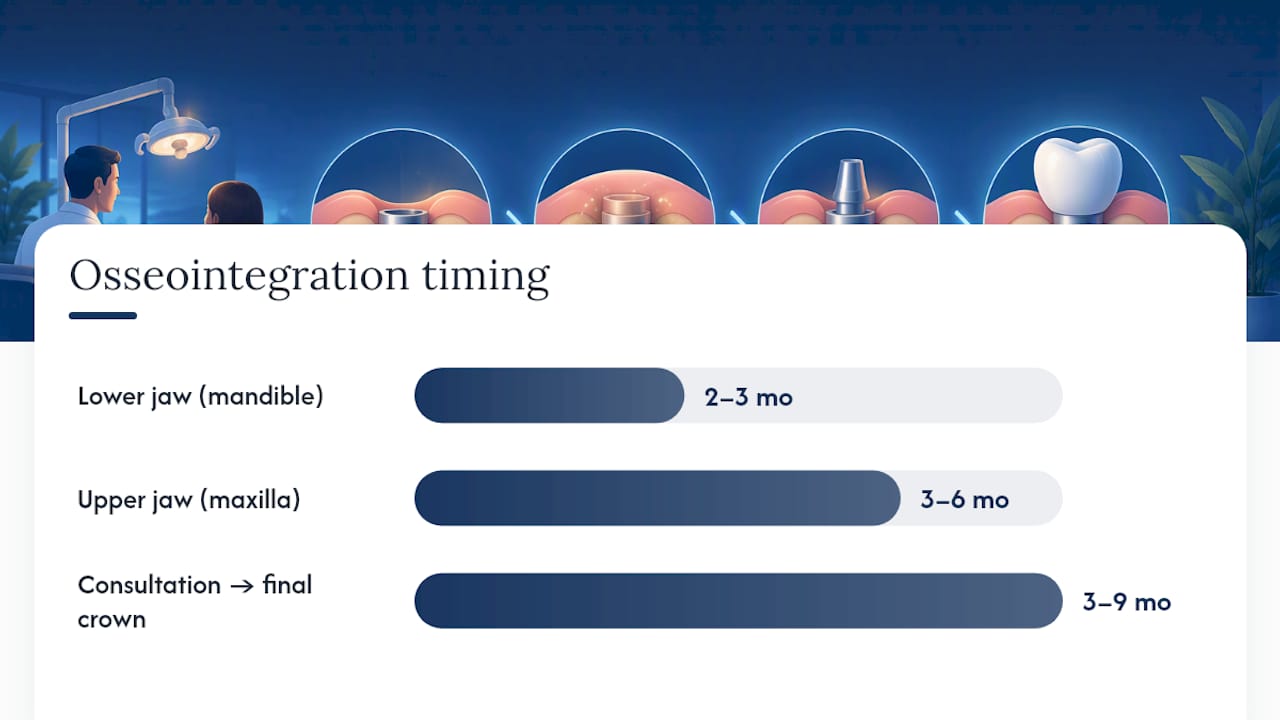
- Healing time for osseointegration varies: two to three months for the lower jaw and three to six months for the upper jaw.
- A comprehensive, written treatment plan with conditional time ranges is essential, as appointment counts and timing differ case by case.
- Underlying conditions like smoking, diabetes, or recent extractions can significantly extend the timeline and impact success rates.
- Most recovery discomfort peaks within 48 to 72 hours, and long-term success relies on strict oral hygiene and following post-operative care instructions.
Table of Contents
- What Are the Stages of the Dental Implant Process?
- What Happens at the Dental Implant Consultation?
- How Does Dental Implant Surgery Work?
- How Long Does Osseointegration Take?
- What Happens During Abutment Placement and the Final Crown?
- What Adds Time to the Dental Implant Timeline?
- What Should You Expect During Recovery?
- What Are the Risks and Warning Signs to Watch For?
- What Should You Ask Before Starting Treatment?
- How Dc-dentistry Applies These Steps in Practice
- Why the "Standard Timeline" Advice Usually Falls Short
- Ready to Start Your Implant Consultation?
- Sources
- FAQ
What Are the Stages of the Dental Implant Process?
Every implant case moves through the same basic sequence, even though the pacing and combinations vary from patient to patient. Understanding the order helps you follow along at each visit instead of feeling like you're catching up.
- Consultation and treatment planning. Your dentist reviews your health history, takes imaging, and maps out where each implant needs to sit based on the final tooth or bridge design.
- Preparatory work (if needed). Extractions, bone grafting, or a sinus lift happen here, sometimes on the same day as implant placement and sometimes months ahead of it.
- Surgical placement. The implant body goes into the jawbone under local anesthesia or sedation.
- Healing and osseointegration. The bone fuses to the implant surface over a period of months.
- Abutment placement and final restoration. A connector piece attaches to the implant, then a crown, bridge, or denture is fitted on top.
Extraction and grafting are often skipped entirely for patients with healthy bone and no failing teeth in the area, which shortens the timeline considerably. Two-stage cases add a short second surgery to expose the implant before restoration begins. The number of office visits isn't fixed by how many teeth you're replacing. It's set by how your particular case gets staged, so two people missing the same tooth can end up with very different appointment counts.
What Happens at the Dental Implant Consultation?
The first visit is mostly information gathering, and what you bring to it shapes how efficient the rest of your treatment will be. Your dentist needs a full picture of your medical and dental history: current medications, chronic conditions like diabetes, and whether you smoke. The FDA specifically recommends disclosing smoking status and medical history during planning, since both affect healing and long-term implant success.
Imaging comes next. A panoramic X-ray gives a flat overview of your jaw, but most implant cases now rely on cone beam computed tomography (CBCT), which builds a three-dimensional map of bone density, nerve position, and sinus location. That level of detail lets the surgeon plan implant angle and depth before ever picking up a drill.
Planning also works backward from the finished tooth. Clinicians typically design the restoration first, then decide implant number and position to support it, rather than placing implants and figuring out the crown later.
Before you leave, bring:
- A current medication and medical condition list
- Recent dental X-rays if you have them
- Insurance or financing questions written down
Pro Tip: Ask specifically for the brand and model of the implant system being proposed. The FDA treats implants as medical devices with distinct components, and having that record matters if you ever need follow-up care elsewhere.
How Does Dental Implant Surgery Work?
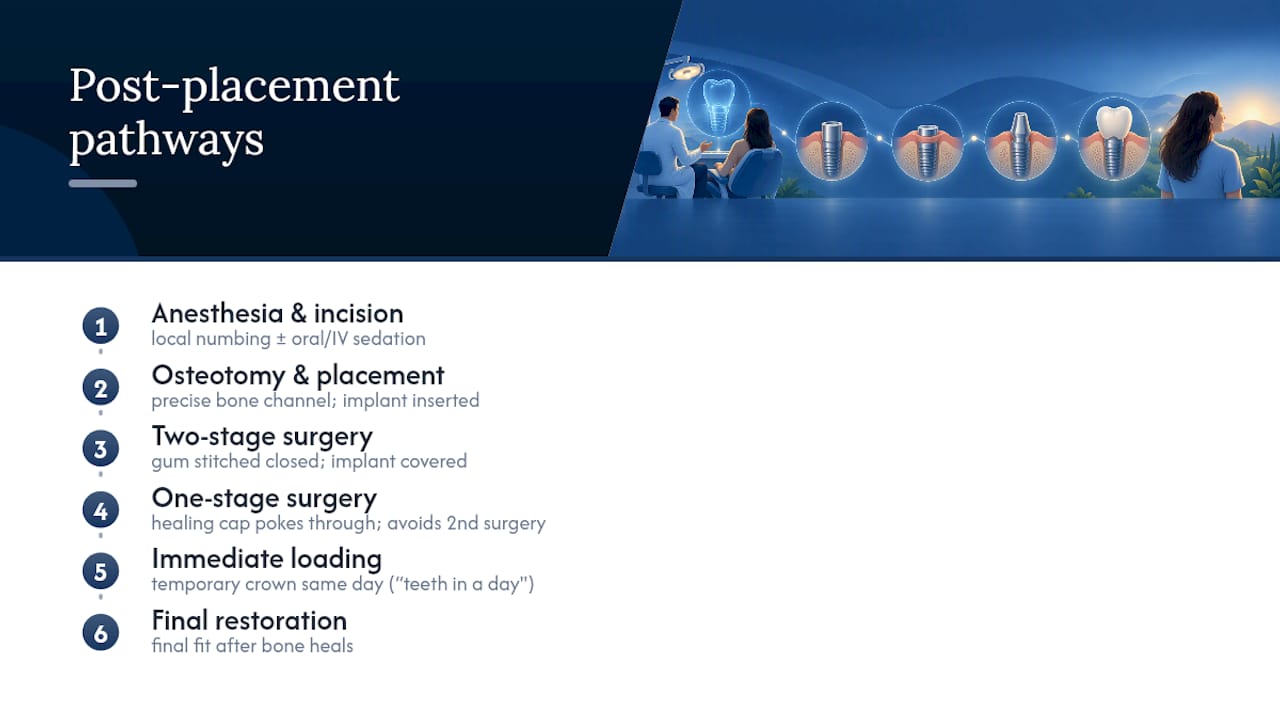
Surgery day starts with anesthesia, usually local numbing combined with oral or IV sedation depending on your comfort level and case complexity. The surgeon makes a small incision in the gum, prepares a precise channel in the bone called an osteotomy, and inserts the implant body. What happens next depends on which surgical approach your case calls for.
In a two-stage approach, the gum is stitched closed over the implant, which stays fully covered while it integrates with bone. A second minor procedure later exposes it. In a one-stage approach, a healing cap or connector pokes through the gum immediately, avoiding that second surgical step. Immediate-loading protocols go a step further, attaching a temporary crown the same day as placement, sometimes marketed as "teeth in a day." That phrase refers to a temporary tooth, not the finished restoration. Final fitting still waits for the bone to heal, according to Cleveland Clinic.
Guided surgery, planned from CBCT scans, lets the surgeon avoid the inferior alveolar nerve in the lower jaw and the maxillary sinus in the upper jaw. That precision is a large part of why three-dimensional imaging has become close to standard for implant cases rather than a premium add-on. The European Federation of Periodontology notes that neither one-stage nor two-stage surgery is universally "better." The right choice depends on your anatomy and what the restoration ultimately requires.
How Long Does Osseointegration Take?
Osseointegration is the biological process where bone cells grow directly onto the implant's titanium surface, locking it in place well beyond what stitches or healing caps alone could manage. It's the foundation the entire restoration depends on, and it can't be rushed with willpower or good hygiene alone.
Timelines vary by jaw. Lower jaw (mandible) placements commonly integrate in about two to three months, while upper jaw (maxilla) placements, where bone tends to be softer, often need three to six months. Combined with any preparatory grafting, the overall span from consultation to final crown often runs 3 to 9 months, and your specific numbers should come from your own clinician rather than a generic average.
Mayo Clinic frames this wait as biologically necessary, not administrative. The implant needs that time to physically fuse with bone before it can safely bear chewing forces.
Your dentist confirms readiness with a clinical exam checking for mobility or tenderness, plus follow-up X-rays showing bone density around the implant. Here's the detail most people miss: feeling fine after a week doesn't mean the bone is done healing. Soft-tissue comfort returns fast. Hard-tissue fusion takes months, and loading the implant too early is one of the more preventable causes of failure.
What Happens During Abutment Placement and the Final Crown?
Once integration checks out, the abutment goes in. This is a small connector piece that links the implant to the visible crown. In one-stage cases it may already be in place from surgery day. In two-stage cases, uncovering the implant and healing the surrounding gum tissue typically takes four to six weeks before the abutment and final restoration are ready.
Next comes an impression or digital scan of the abutment and surrounding teeth, sent to a dental lab to fabricate the crown, bridge, or denture attachment. Turnaround usually runs one to three weeks depending on the lab and case complexity.
At the final appointment, the restoration is seated and checked for fit, contact with neighboring teeth, and bite alignment. Placing the abutment and completing the fitting typically takes about an hour of chair time. Minor adjustments to the bite are common in the days that follow as you get used to chewing on the new tooth.
What Adds Time to the Dental Implant Timeline?
Several conditions push the timeline past the typical range, and knowing them ahead of time keeps expectations realistic.
- Bone grafting. Minor grafts sometimes happen at the same time as implant placement, but larger grafts often need several months to heal before implants can go in. Insufficient bone density and volume are common reasons a graft gets added to the plan, as detailed in this breakdown of graft indications.
- Sinus lifts. Needed when the upper jaw lacks enough bone height near the sinus floor, typically adding several months of healing before placement.
- Recent extractions. Sockets need time to heal before some implants can be placed, covered in detail in this guide on extraction healing and implant timing.
- Smoking, diabetes, and certain medications slow healing and lower success rates across the board.
Ask your provider for a written, conditional plan spelling out extra time for each of these if they apply to you.
What Should You Expect During Recovery?
The first week is the roughest stretch, and most patients feel substantially better by the end of it, even though bone healing continues far longer beneath the surface. Swelling and soreness typically peak in the first 48 to 72 hours, then taper off.
Over-the-counter pain relievers handle most discomfort; some patients get a short prescription for stronger medication after more involved surgery. Contact your dentist promptly if you notice increasing pain after day three, fever, pus, or a implant that feels loose. Those are signs worth checking rather than waiting out.
Stick to soft foods for the first several days and avoid chewing directly on the surgical site. Gentle rinsing with salt water, careful brushing around the area, and skipping vigorous swishing all protect the healing tissue. Long-term, the implant needs the same brushing, flossing, and professional cleanings every six months that your natural teeth do. Skipping maintenance is one of the more common paths to late implant failure.
What Are the Risks and Warning Signs to Watch For?
Most implants succeed, but a short list of complications accounts for nearly all the failures worth knowing about ahead of time.
- Failed osseointegration, where the bone never properly fuses to the implant
- Infection around the implant site (peri-implantitis)
- Nerve injury causing numbness or tingling in the lip, chin, or tongue
- Sinus complications when upper implants intrude into the sinus cavity
- Incision reopening before healing is complete
If an implant fails to integrate, the typical response is removing it, letting the site heal, and retrying later once conditions improve. Smoking and uncontrolled diabetes raise the odds of these problems, which is exactly why disclosing them at consultation matters as much as the imaging does.
What Should You Ask Before Starting Treatment?
Walk into your consultation with these questions, and you'll leave with a far clearer picture of your actual timeline:
- What implant brand and model do you use?
- How many total visits will this take, start to finish?
- Will you place the implant, or will a specialist?
- How likely am I to need a bone graft or sinus lift?
- What's your estimated timeline for my specific case?
- Will I have a temporary tooth during healing?
- What's the total cost, and what financing options exist?
- What imaging will you use to plan this?
- Who do I contact after hours if something feels wrong?
- Can I get this sequence in writing?
Bring your medication list, prior X-rays, and insurance details to make the visit count.
Pro Tip: Ask for a written sequence with conditional time ranges attached to each step. The number of appointments can't be predicted from the number of missing teeth alone, since staging varies case by case.
How Dc-dentistry Applies These Steps in Practice
Dc-dentistry, DC Implant & Cosmetic Dentistry in Washington, DC, handles the full implant sequence in-house under Dr. Kambez Shukoor, a U.S. Navy veteran with over 200 five-star patient reviews behind the practice. Same-day appointments and full imaging workflows mean fewer outside referrals and fewer surprises mid-treatment. The practice's habit of issuing a written treatment plan before surgery, including full-mouth reconstruction cases, reflects the same conditional-sequence approach outlined above: patients see the steps and rough timing before committing to any of them.
Why the "Standard Timeline" Advice Usually Falls Short
Most articles on this topic hand you a single number, "three to six months," and call it done. That number is almost meaningless on its own. The real driver isn't the implant itself; it's how many conditional steps get stacked in front of it. A patient with healthy bone and no extraction needed might finish in ten weeks. Someone needing a sinus lift and a large graft could be looking at close to a year, and neither timeline says anything bad about the implant's chances of success.
The advice I'd push back on hardest is treating the consultation as a formality before "the real treatment starts." It's the opposite. The consultation is where your entire timeline gets decided, based on your bone volume, your health history, and how your final tooth needs to be positioned. If you leave that visit without a written, conditional plan, you don't actually know what you signed up for yet. Prioritize getting that document over anything else on this list. Everything downstream, healing time, visit count, even the total cost, flows from decisions made in that first hour.
— Jake
Ready to Start Your Implant Consultation?
Dc-dentistry runs the entire implant process in-house, from imaging and grafting through the final crown, so you're not bounced between a surgeon's office and a separate restorative dentist for the same tooth. That matters most when your case turns out to need a graft or sinus lift partway through: one team, one written plan, one place to call with questions.

The practice offers dental implants and full-arch All-on-4 and All-on-6 options, along with bone grafting, tooth extractions, and implant repair under the same roof. Same-day appointments are available for patients who need to get imaging started quickly, and financing options help spread out the cost of more involved cases, detailed further in this guide to implant financing. If you're weighing a full-mouth rebuild, the full mouth reconstruction page walks through what that scope of treatment involves. Request a consultation to get your own written, conditional timeline instead of a generic estimate.
Sources
Claims in this article draw on FDA patient guidance on dental implants, Mayo Clinic's overview of implant surgery, Cleveland Clinic's implant guide, the NCBI clinical review of dental implants, and Harvard Health's patient guide to tooth replacement. Readers wanting a more technical international comparison can also review this step-by-step clinical breakdown from Lucilla Dental Clinic.
This article is general information, not a substitute for advice from a qualified doctor. Consult a qualified healthcare professional about your own circumstances before acting on anything here.
- Dental implants: What you should know | FDA
- Dental Implants: Types, Purpose & Benefits | Cleveland Clinic
- Dental implant surgery | Mayo Clinic
- Dental Implants clinical review | NCBI Bookshelf
FAQ
How Painful Is Getting a Dental Implant?
The surgery itself is done under anesthesia, so you shouldn't feel pain during placement. Afterward, most patients describe manageable soreness and swelling that improves substantially within about a week, controlled with over-the-counter or short-term prescribed pain relievers.
What Should You Know Before Getting Dental Implants?
Know that the timeline depends heavily on whether you need grafting or extractions first, not just on the implant surgery itself. Also ask specifically for your implant brand and model and request a written plan with conditional time ranges, since verbal estimates tend to shift once treatment begins.
How Many Days Should You Rest After a Dental Implant?
Most patients take it easy for two to three days, avoiding strenuous exercise and sticking to soft foods, then return to normal light activity. Full comfort typically arrives within about a week, though the bone underneath keeps healing for months afterward.
What's the Hardest Part of Getting a Tooth Implant?
For most patients it's the waiting during osseointegration, not the surgery itself, since it can run two to six months depending on which jaw is involved. The uncertainty around exact timing bothers people more than any single appointment does.
Does Dc-dentistry Offer Financing for Dental Implants?
Dc-dentistry offers financing options for implant treatment alongside its in-house implant services, though pricing for dental implants is available directly from the practice rather than published online. Details on financing structures are outlined in this implant financing guide.