
Most people feel back to normal within a few days, and the socket surface typically closes over within a couple of weeks, while the bone underneath keeps rebuilding for an extended period. The single biggest factor in how smoothly that goes is protecting the blood clot that forms in the socket: skip straws, spitting, and smoking, follow your gauze instructions, and call your dentist if bleeding won't stop or a fever sets in.
TL;DR:
- Protecting the blood clot in the socket by avoiding straws, spitting, and smoking during the first 24 hours is crucial to prevent dry socket.
- The surface tissue of the socket typically seals over within two weeks, but underlying bone remodeling continues for several months.
- Smoking, poor nutrition, and certain medications can delay healing and increase the risk of complications such as dry socket or slow bone growth.
- Long-term bone loss after extraction can shrink the ridge by up to 63%, making socket preservation or implant planning important within the first few months.
- Most complications, including dry socket and infection, are easily managed if symptoms are recognized early and addressed promptly.
Table of Contents
- What Does the Tooth Extraction Healing Timeline Look Like?
- Why Does Socket Healing Take So Long Beneath the Surface?
- What Should You Do (and Avoid) in the First Two Weeks?
- When Are Symptoms a Sign of a Problem?
- What Happens to Your Jawbone Long After the Socket Closes?
- Why the First Week Gets More Attention Than It Deserves
- Healing Support and What Comes Next for Your Smile
- Sources
What Does the Tooth Extraction Healing Timeline Look Like?
Recovery isn't one long blur. It moves through distinct, predictable phases, and knowing which phase you're in tells you whether what you're feeling is normal or worth a phone call.
- Hour 0 to 24: clot formation. A dark red clot fills the socket within minutes and becomes the foundation for everything that follows. You'll likely go home biting on gauze, and some numbness from the anesthetic can linger for a few hours. Minor oozing is normal; a mouthful of fresh blood is not.
- Day 1: protect what just formed. No rinsing, no straws, no spitting for the first 24 hours, per standard postoperative guidance. Stick to soft, cool foods, ice your cheek in 20 minute intervals, and keep brushing your other teeth gently.
- Days 2 to 3: the peak. Swelling and pain usually crest around two to three days, mainly because the anesthetic has fully worn off right as inflammation is at its height. This is the window where most people underestimate how much pain relief they'll need, so don't wait until it's unmanageable to take something.
- Days 4 to 7: the turning point. Pain drops off noticeably, swelling recedes, and you can usually start easing back toward normal food texture. Dissolving sutures, if you have them, tend to fall out or dissolve somewhere in this window.
- Week 2: surface closure. The socket surface often seals over within one to two weeks, and chewing near the site starts feeling less foreign.
- Weeks 3 to 4: functional recovery. Most residual tenderness fades. If you're still getting sharp pain at this stage, that's worth mentioning to your dentist rather than waiting it out.
- Months 2 to 6: the bone catches up. This is the invisible part of tooth extraction recovery. The socket keeps filling with new bone and remodeling for months after the surface looks fine, which is exactly why implant timing and grafting decisions get made on a much longer clock than the two weeks it takes to feel okay.
Pro Tip: Set a phone reminder for day 3, not day 1. That's when most people either overreact to normal peak swelling or underreact to something that's actually starting to look like an infection. Knowing which day you're on changes how you should interpret the symptom.
Why Does Socket Healing Take So Long Beneath the Surface?
The visible healing you feel is only the first act. Underneath, the socket is running through a sequence of biological stages that explain both why the first few days matter so much and why full bone healing takes months, not weeks.
- Clot and hemostasis: the initial blood clot isn't just a bandage. It's a scaffold that everything else builds on, and it's fragile enough that a straw's suction or a hard rinse can dislodge it in the first few days.
- Inflammation and granulation tissue: your body sends in a flood of repair cells, and this often shows up as a white or yellowish film in the socket. That film is granulation tissue, not pus, and mistaking it for infection is one of the most common reasons people panic unnecessarily during this stage.
- Epithelial migration: skin-like tissue creeps across the socket opening from the edges inward, which is the process behind that one to two week surface closure.
- Woven bone, then remodeling: the body first lays down a rough, disorganized "woven" bone, then slowly converts it into denser, organized lamellar bone. Full mineralized sealing often lands around 12 weeks, with remodeling continuing well beyond that.
- What slows this down: smoking, uncontrolled diabetes, certain medications, and poor nutrition all interfere with this sequence at different points, which is part of why the same procedure heals differently from one patient to the next.
What Should You Do (and Avoid) in the First Two Weeks?
Aftercare isn't complicated, but the order and timing of what you do matters more than people expect.
Bleeding control: bite on gauze with steady pressure for about 30 minutes, then reassess. If oozing continues, a fresh, dampened piece of gauze folded thick over the site usually resolves it. A moistened tea bag, thanks to the tannic acid, works well when standard gauze isn't cutting it.
Swelling management: ice in 20 minute cycles for the first 24 to 48 hours, then switch to warm compresses if any residual puffiness lingers past day 3.
Pain relief after tooth extraction: over-the-counter options like ibuprofen or acetaminophen handle most cases, alternating them if your dentist approves. Skip aspirin unless it's specifically cleared, since it thins blood and can provoke bleeding. Prescription pain medication is reserved for surgical extractions or cases with more tissue involvement.
Diet after extraction: think mashed potatoes, yogurt, scrambled eggs, and smoothies (eaten with a spoon, never sipped through a straw) for the first few days, then gradually reintroduce texture by day 5 to 7. Avoid anything hard, crunchy, sticky, or served piping hot.
Oral hygiene: hold off on rinsing for the first 24 hours, then begin gentle warm salt water rinses starting day 2 or 3, tapering pressure near the socket while brushing everything else as usual.
- Do not use straws for at least a week.
- Do not smoke or vape. It measurably raises your dry socket risk and is best avoided for a full 72 hours minimum, ideally longer.
- Do not exercise strenuously for the first 72 hours.
Pro Tip: If you smoke, treat the first week post-extraction like a forced quit attempt rather than a temporary inconvenience. The risk window for dry socket overlaps almost exactly with the days people are most tempted to sneak a cigarette.
When Are Symptoms a Sign of a Problem?
Most complications announce themselves clearly if you know what to look for.
- Dry socket: the clot dislodges or dissolves too early, exposing bone and nerve endings. It typically shows up 2 to 5 days after extraction as a sharp, radiating pain, sometimes with a bad taste or odor. Your dentist treats it in-office with a medicated dressing, and it's not an emergency, just an uncomfortable one that needs a same-day visit.
- Infection: watch for a fever above 100.4°F (38°C), swelling that spreads rather than shrinks, or actual pus rather than the normal white granulation film. This usually calls for antibiotics.
- Excessive bleeding: firm, steady gauze pressure for 30 minutes should control it. If blood is still pooling after a second and third attempt, call your dentist immediately.
- Nerve symptoms: persistent numbness or tingling in the lip, chin, or tongue beyond the expected first few hours deserves a prompt evaluation, especially after lower wisdom tooth removal.
- True emergencies: difficulty breathing or swallowing, uncontrolled bleeding, or a high fever mean you go to the emergency room, not the dentist's voicemail.
What Happens to Your Jawbone Long After the Socket Closes?
The part nobody warns you about is that the jawbone keeps shrinking for months after the gum tissue looks completely healed.
Bone loss is fastest in the first three months and tends to hit the outer (buccal) side of the ridge hardest, sometimes shrinking that width by 29 to 63% within six months when nothing is done to preserve it. That's a meaningful amount of bone to lose if you're planning a dental implant down the line.
- Socket preservation (grafting material placed at the time of extraction) limits this shrinkage and keeps the ridge more implant-ready.
- Immediate implant placement works for select cases with strong bone at the time of extraction.
- Delayed placement, often three to six months out, is more common when extra healing or grafting is needed first.
- Getting good nutrition and bone health support in the months after extraction, potentially including natural bone density strategies, can complement what your dentist is doing clinically.
If an implant is somewhere on your radar, that conversation belongs at the extraction appointment, not six months later once the bone has already changed shape.
Why the First Week Gets More Attention Than It Deserves
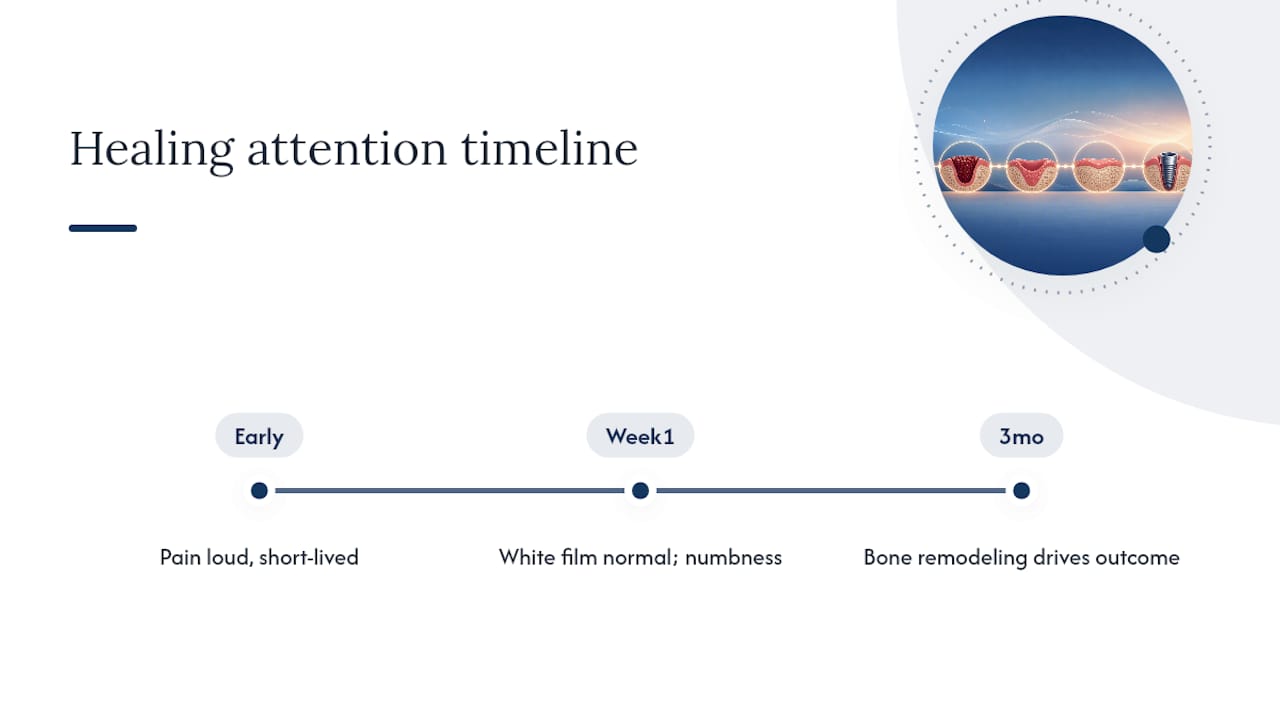
People fixate on days 1 through 3 because that's when the pain is loudest, but the more consequential window for long-term outcomes is actually the first three months, when the bone is doing its most dramatic remodeling. I've found the smartest patients are the ones who ask about socket preservation before the extraction, not after they've already lost ridge width they can't easily get back.
Two things patients ask about constantly: the white film in the socket isn't infection, it's normal tissue repair, and mild numbness that fades within a few hours is expected, not a nerve injury. Dr. Kambez Shukoor, a U.S. Navy veteran with over 200 five-star reviews behind his practice, sees same-day cases for exactly this kind of uncertainty, and follow-up visits are built around confirming the socket is tracking on schedule.
— Jake
Healing Support and What Comes Next for Your Smile
This dental practice is built for exactly the moments this article covers: the follow-up visit when something looks off, the same-day appointment when pain spikes on day 3, and the longer conversation about what replaces the tooth once healing is done.

Beyond extractions themselves, dental care often includes socket preservation, emergency evaluations, and full implant planning offered under one roof, with same-day appointment availability and positive patient reviews. If you're a few weeks past an extraction and starting to think about what fills that gap permanently, a consultation on dental implants in Washington DC is the natural next step, since implant candidacy is easiest to plan for while your bone is still close to its post-extraction shape. Call or book online to get a same-day evaluation.
Sources
This guide draws on clinical aftercare standards from the Cleveland Clinic, MedlinePlus, URMC's postoperative protocols, and a peer-reviewed narrative review of socket healing. Always check with your own dentist for advice specific to your case.
This article is general information, not a substitute for advice from a qualified doctor. Consult a qualified healthcare professional about your own circumstances before acting on anything here.
- Tooth Extraction: Surgery & Healing — Cleveland Clinic
- Current knowledge on the healing of the extraction socket: a narrative review — PMC
- Pulling a tooth; Tooth removal — MedlinePlus
- Postoperative instructions following dental extraction surgery — URMC