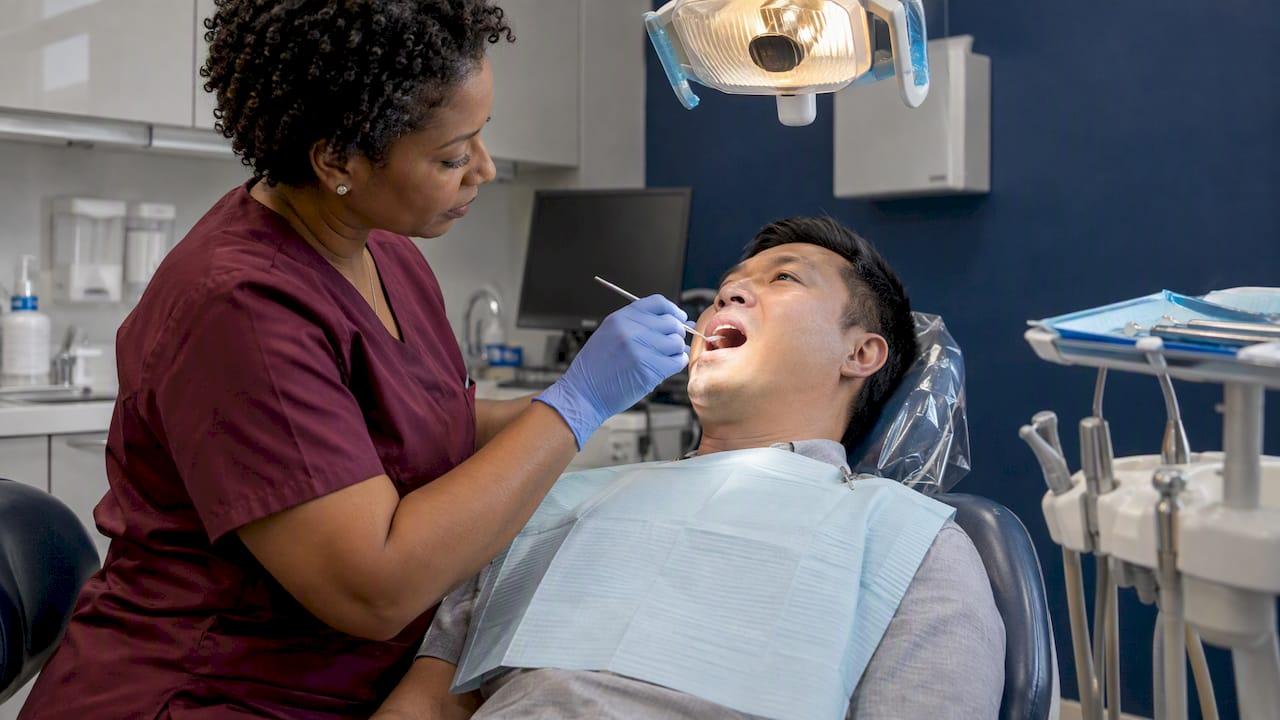
A dental checkup is a cleaning by a hygienist followed by an exam by the dentist, with X-rays on some visits. Most visits include a health history review, a look at your teeth, gums and mouth, a plan for anything found, and a recommendation for when to come back. Nothing about it needs special preparation, and most of it is painless. Here is the whole process in the order it usually happens, with what each step is for.
TL;DR
- A checkup has two parts: a professional cleaning (scaling, polishing, flossing) and an exam of your teeth, gums, mouth and bite.
- X-rays are taken on certain visits, not every one. Your dentist decides based on your oral health history.
- The exam includes an oral cancer screening, and any problem found leads to a discussed plan, usually with a separate visit for treatment.
- Plan on roughly an hour for a visit with both an exam and a cleaning. Many offices block 45 to 60 minutes.
- How often you return depends on your risk, from every few months to every couple of years.
Table of Contents
- The dental checkup process at a glance
- Before you sit down: check-in and health history
- Do you need to prepare?
- X-rays: when they are taken and why
- The professional cleaning, step by step
- The exam: what the dentist looks for
- Is a checkup different from a dental exam?
- How long does a dental checkup take?
- What happens if the dentist finds a problem
- How often should you go?
- How to get more out of every visit
- Our perspective
- Book a checkup in Washington, DC
- FAQ
- Sources
The dental checkup process at a glance
| Step | What happens | Who does it | Typical purpose |
|---|---|---|---|
| 1. Check-in | Update medical history, medications, concerns | Front desk and clinical team | Safe, personalized care |
| 2. X-rays (some visits) | Images of teeth, roots and bone | Hygienist or assistant | See what the eye cannot |
| 3. Cleaning | Scaling, polishing, flossing, rinsing | Hygienist | Remove plaque and tartar |
| 4. Exam | Teeth, gums, bite, jaw, soft tissues, oral cancer screening | Dentist | Find problems early |
| 5. Discussion | Findings, options, written plan | Dentist | Decide what to do and when |
| 6. Scheduling | Next visit and any treatment | Front desk | Keep your care on track |
The order varies by office. At some practices the dentist examines first and the hygienist cleans after. MedlinePlus describes the common sequence as a hygienist cleaning your teeth, then the dentist examining your mouth, and notes that X-rays happen at certain visits.
Before you sit down: check-in and health history
The visit starts with paperwork or a screen. You confirm your contact details, insurance, medications, allergies and any change in your health since last time. This is not a formality. The American Dental Association's consumer site MouthHealthy points out that many medical conditions affect dental health, so your dentist needs to know about changes in your overall health.
Tell the team about:
- New diagnoses, such as diabetes, heart conditions or pregnancy
- Any new medication, including over-the-counter products and supplements
- Pain, sensitivity, bleeding gums, a sore that has not healed, or a chipped filling
- Anything about your smile you want to change
If you are nervous, say so at this point. MedlinePlus notes that people who feel anxious should tell their dentist, and a good team will slow down, explain each step and agree on a signal to pause.
Do you need to prepare?
For most people, no. MedlinePlus says no special physical preparation is needed. There is one exception worth knowing: people with certain health or heart conditions may need to take antibiotics before dental work. If that applies to you, ask your dentist or physician before the appointment, not in the chair.
A few practical habits help:
- Bring your insurance card, photo ID and a list of medications.
- Brush and floss as usual. You do not need to scrub harder to impress anyone; the hygienist has seen it all.
- Write down questions, such as the tooth that twinges with cold drinks.
- Arrive a few minutes early if you are a new patient, so records and X-ray requests from your previous office are sorted.
X-rays: when they are taken and why
X-rays are not a fixed part of every checkup. The Canadian Dental Association explains that a healthy adult without recent problems does not need them at every visit, while someone whose situation is being monitored may need them more often. A new patient usually gets a baseline set so the dentist can see your starting point.
The reason is simple. MedlinePlus lists what X-rays can reveal that a visual exam cannot: deep decay, bone loss, abscesses, impacted teeth and jaw abnormalities. A cavity between two teeth or an infection at a root tip can sit quietly for months before it hurts.

On safety, dental X-rays involve very low radiation. MedlinePlus says a lead apron can be used, and that pregnant women should not have X-rays unless necessary. If you are pregnant or think you might be, tell the team before any images are taken. For more on frequency, pregnancy and what modern digital sensors change, see our guides on dental X-ray safety and digital X-rays and lead aprons. The kinds of images, such as panoramic and bitewing, are explained on our exams and X-rays page.
Some situations call for 3D imaging. Our article on when a dental CBCT scan is worth it covers the questions to ask, and it matters most for implants, impacted teeth and complex root work.
The professional cleaning, step by step
The cleaning is what most people picture first. According to MedlinePlus, it has three core parts:
- Scaling. The hygienist uses hand instruments or an ultrasonic scaler to remove plaque and hardened tartar (calculus) from the tooth surfaces and along the gumline. Tartar cannot be brushed off at home once it forms.
- Polishing. A slightly gritty paste is applied with a small rotating cup to smooth the surfaces and lift light stains.
- Flossing. The hygienist cleans between the teeth, which also shows whether any areas bleed.
After that you rinse to clear leftover particles. Some offices finish with a fluoride treatment, which strengthens enamel. Ask whether it is recommended for you rather than assuming it is automatic.
During scaling the hygienist often measures the small gap between your gum and each tooth with a thin probe. Shallow, steady readings suggest healthy gums. Deeper pockets and bleeding are early signs of gum disease, which is why this measurement is worth paying attention to. If gum disease is found, the plan may involve a deeper cleaning; our article on the 90 day recheck for scaling and root planing explains how that decision is made. You can also read about our dental cleanings and get home care tips on our oral hygiene page.
The exam: what the dentist looks for
The exam is the part that makes it a checkup rather than just a cleaning. MedlinePlus says the dentist inspects your teeth, gums and mouth for signs of decay, oral cancer and bite problems. In practice this covers:
- Teeth: cavities, cracks, worn enamel, old fillings or crowns that are failing, and teeth that have shifted
- Gums: color, swelling, bleeding, recession and pocket depth
- Bite and jaw: how your teeth meet, whether the jaw joint clicks or hurts, and signs of clenching or grinding such as flattened tips
- Soft tissues: tongue, cheeks, floor of the mouth, palate, throat and neck
- Existing dental work: fit and condition of crowns, bridges, implants, dentures and aligner retainers
Jaw soreness and worn teeth often go together. If your dentist mentions grinding, a primer on teeth grinding and jaw pain covers what helps and which kinds of professionals to see alongside your dentist.
Oral cancer screening
The exam includes a screening for oral cancer, as MouthHealthy notes. It takes a couple of minutes: the dentist looks at and feels the tissues of your mouth, tongue, lips, neck and jaw for lumps, white or red patches and sores that do not heal. It is quick, painless and one of the strongest reasons to keep regular visits even when nothing hurts. Read more about how we do it on our oral cancer screening page.
Is a checkup different from a dental exam?
Not meaningfully. MedlinePlus lists "dental checkup" and "oral exam" among the other names for a dental exam. In everyday use, "checkup" tends to mean the whole visit (cleaning plus exam), while "exam" points to the dentist's evaluation. If you are booking, it is worth asking whether the appointment includes the cleaning, X-rays and an exam, so you know what to expect on the bill and on the calendar.
How long does a dental checkup take?
A visit with both exam and cleaning is commonly scheduled for 45 to 60 minutes, and a new-patient visit with a full set of X-rays and a longer conversation can run longer. A cleaning-only or exam-only visit is shorter. If you have a lot of tartar, gum concerns or several questions, ask the office to book extra time.
What happens if the dentist finds a problem
This is the part people worry about most. MedlinePlus explains that if a problem turns up, the dentist discusses your treatment options, and you will likely need a separate follow-up appointment for the care itself. You are not expected to decide in a rush.
A good conversation covers:
- What was found and where. Ideally shown to you on an X-ray or intraoral camera image.
- How urgent it is. Some issues can be watched, others should be treated soon.
- Your options. For example, a filling versus a crown, or a bridge versus an implant.
- Cost and insurance. Ask for the treatment plan in writing, with the procedures listed, so you can check coverage and compare.
- Sequence. Which treatment comes first, and how long it will take.
Treatment plans in a written format are a patient protection in other systems too. In England, the NHS says patients should receive a written treatment plan with the treatment and cost for Band 2 and Band 3 care, to agree to before it starts. US rules differ, but asking for the same clarity from any practice is reasonable.
How often should you go?
There is no single schedule for everyone. The NHS in England states that the gap between checkups can range from 3 months to 2 years, depending on how healthy your teeth and gums are and your risk of future problems. The principle carries over: people with gum disease, frequent cavities, dry mouth, smoking habits or diabetes are generally seen more often, and people with excellent oral health less often. Ask your dentist what interval fits you and why. Our guide to 3, 6, 9 or 12 month cleaning intervals walks through the risk factors in detail.
How to get more out of every visit
- Ask to see your X-rays or photos. Understanding your own mouth makes the plan easier to trust.
- Mention small things. A tooth that is sensitive to cold or a gum that bleeds when you floss is useful information.
- Ask about your risk. Which teeth are most likely to need attention next, and what could you change at home?
- Request the plan in writing. Especially for anything beyond a routine filling.
- Book the next visit before you leave. It is the easiest way to avoid drifting from six months to three years.
Our perspective
A checkup should leave you knowing three things: what is healthy, what is not, and what happens next. Too many patients walk out with a clean mouth but no clear picture.
At our practice we try to close that gap. Exams and cleanings, imaging, fillings, crowns, root canals and implants are all performed in-house, so you are not handed from office to office when something turns up. We put thorough imaging and up-front treatment planning first, and we give you a clear, written plan so you can decide with the facts in front of you.
Dr. Kambez Shukoor is a U.S. Navy veteran, and military medical experience shapes how we work: careful screening, clear communication and no surprises. Same-day appointments are available, so a problem found or felt does not have to wait weeks.
Our view is simple. The best time to deal with a problem is when it is small, and a thorough checkup is how it gets found.
Jake
Book a checkup in Washington, DC
If you are due for a visit or have a tooth that is bothering you, we can see you for an exam, X-rays if needed, a cleaning and a written plan for anything we find. Same-day appointments are available. See our general dentistry services to learn what is covered and schedule your visit.

If the exam shows you are considering changes such as a brighter smile or replacing a missing tooth, we can talk through options like teeth whitening or dental implants at the same visit.
FAQ
What is done during a dental checkup?
You typically have your health history reviewed, a cleaning with scaling, polishing and flossing, and an exam of your teeth, gums, jaw and soft tissues, including an oral cancer screening. X-rays are added on certain visits. The visit ends with a discussion of findings and next steps.
Does a dental checkup hurt?
Most people feel pressure and some scraping sounds, but not pain. Sensitive teeth or inflamed gums can make the cleaning uncomfortable, so tell the hygienist and they can adjust their technique or pace. Anxious patients should mention it at check-in.
Are X-rays taken at every checkup?
No. For a healthy adult without recent problems they are not needed every time, according to the Canadian Dental Association, and your dentist sets the schedule based on your oral health. New patients often have a baseline set taken.
Can I get treatment the same day if something is found?
It depends on the problem and the office. MedlinePlus notes you will likely need a separate appointment for treatment. At our practice, same-day appointments are available, and we will tell you what can be done right away and what needs its own visit.
What should I tell my dentist before a checkup?
Share any changes in your health, new medications, pregnancy, and any pain, bleeding or sores. Mention if you need antibiotics before dental work because of a heart or other health condition, and say so if you feel anxious.
Sources
- Dental Exam: MedlinePlus Medical Test
- Dental x-rays: MedlinePlus Medical Encyclopedia
- Your Top 9 Questions About Going to the Dentist, MouthHealthy
- Regular dental checkups, Canadian Dental Association
- Dental check-ups, NHS
- What happens when you visit an NHS dentist, NHS
- Teeth grinding and jaw pain: what helps and who to see