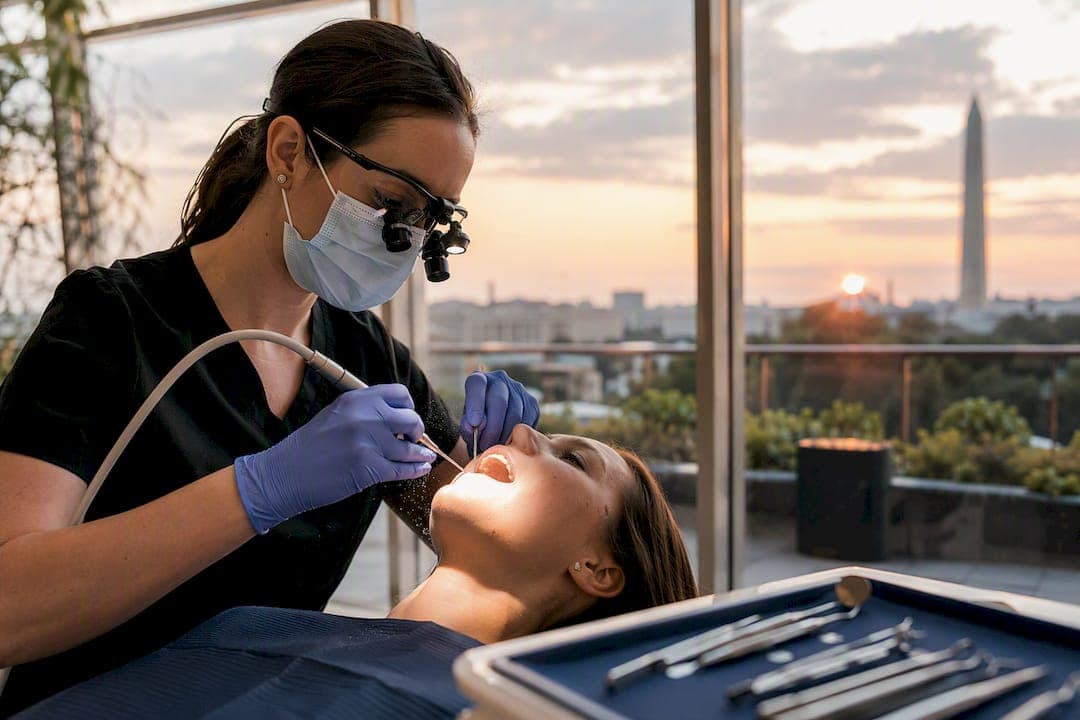
Most adults should get a professional cleaning on a roughly six-month schedule, but that number is a starting point, not a rule. If you have gum disease, diabetes, smoke, or build up plaque quickly, your dentist may move you to a three-month schedule. If your gums are healthy and your home care is solid, you might safely stretch to nine or twelve months.
TL;DR:
- Patients with gum disease, diabetes, smoking habits, or calculus buildup should undergo professional cleanings every three months, not six.
- For healthy gums and good home care, extending cleaning intervals to nine or twelve months can be safe and effective.
- Deep cleaning procedures target advanced periodontal pockets and are followed by supportive therapy scheduling based on tissue stability, often starting at three months.
- Dentists decide recall intervals using clinical measures like pocket depths, bleeding, bone loss, and individual risk factors such as lifestyle and medical history.
- Evidence suggests that for low-risk adults, six-month cleanings offer minimal gum health benefits over annual or twelve-month intervals.
Table of Contents
- What happens during a routine six-month cleaning
- Who needs more frequent cleanings?
- Routine cleaning versus deep cleaning: what's the difference?
- How dentists actually decide your recall interval
- What does the research actually say about fixed schedules?
- Your practical checklist between visits
- When should you call your dentist sooner?
- How a Washington, DC practice personalizes cleaning frequency
- Schedule your next cleaning with DC Implant & Cosmetic Dentistry
- Where this guidance comes from
- Sources
What happens during a routine six-month cleaning
A standard cleaning visit covers a few distinct steps. The dentist or hygienist examines your teeth and gums, then scales away plaque and tartar buildup, especially below the gumline where a toothbrush cannot reach. Polishing follows to smooth the tooth surface and remove surface stains. You'll typically get oral hygiene guidance tailored to whatever trouble spots showed up, and x-rays when the exam suggests something below the surface, like a cavity between teeth or bone changes near the roots.
The "twice a year" cadence isn't an arbitrary number pulled from thin air. It grew out of decades of common clinical practice as a reasonable interval for catching problems before they become expensive ones. For the general population, twice yearly remains the traditional standard, and it works well for a lot of people. It just was never designed as a one-size-fits-all mandate. It's a default, and defaults get adjusted once your dentist actually looks in your mouth.
Who needs more frequent cleanings?
Certain patients need shorter intervals because their mouths simply change faster than average. Gum disease is the biggest driver. Once periodontitis takes hold, bacteria repopulate below the gumline quickly enough that six months between cleanings gives them plenty of time to cause damage.
You likely fall into a higher-risk category if you have:
- A history of periodontitis or active gingivitis
- Diabetes, particularly if blood sugar is poorly controlled
- A smoking habit
- A weakened immune system from medication or illness
- Dental implants that need monitoring around the abutment
- A tendency to build calculus quickly regardless of how well you brush
Patients who've completed active periodontal treatment usually move into periodontal maintenance, also called supportive periodontal therapy (SPT). These visits commonly start at three-month intervals because that's roughly how long it takes for periodontal bacteria to recolonize deep pockets after a deep cleaning. The interval can lengthen later, but only once the gums show sustained stability.
Pro Tip: If your dentist mentions "pocket depths" or "bleeding on probing" during your exam, ask what the numbers were. Those two measurements drive most recall-interval decisions, and knowing your own baseline helps you track whether you're improving.
Routine cleaning versus deep cleaning: what's the difference?
A routine prophylaxis cleaning is for patients with healthy or mildly inflamed gums. It removes surface plaque and tartar above and just below the gumline, and it's the visit most people picture when they think "dental cleaning."
Scaling and root planing is a different procedure entirely. It targets deeper pockets where periodontitis has taken hold, cleaning tartar off the tooth root itself and smoothing the surface so gum tissue can reattach. This is active treatment, not maintenance.
Once that treatment is done, patients transition into SPT on a schedule tailored to how well their gums respond, often starting at three months and adjusting from there based on tissue stability.
How dentists actually decide your recall interval
Your dentist isn't guessing when they tell you to come back in three, six, or twelve months. They're weighing a specific set of clinical measures against your medical history and habits.
Clinical signals include:
- Pocket depths around each tooth
- Bleeding on probing during the exam
- Bone loss visible on x-rays
- Active decay or new cavities since the last visit
Medical and lifestyle factors matter just as much: how well-controlled your diabetes is, whether you smoke, medications that cause dry mouth, and how consistent your home care has been. Insurance plans often cap coverage at two cleanings per year, but that's a billing limit, not a clinical guideline. If your mouth needs a third visit, coverage shouldn't be the deciding factor.
What does the research actually say about fixed schedules?
The evidence on universal six-month cleanings is more mixed than most people assume. Large trials, including the IQuaD trial reviewed alongside other studies, found little meaningful difference in gum inflammation between low-risk adults cleaned every six months versus every twelve. For regular attenders with healthy gums, routine scale-and-polish reduced visible tartar but didn't move the needle much on actual gum health over several years.
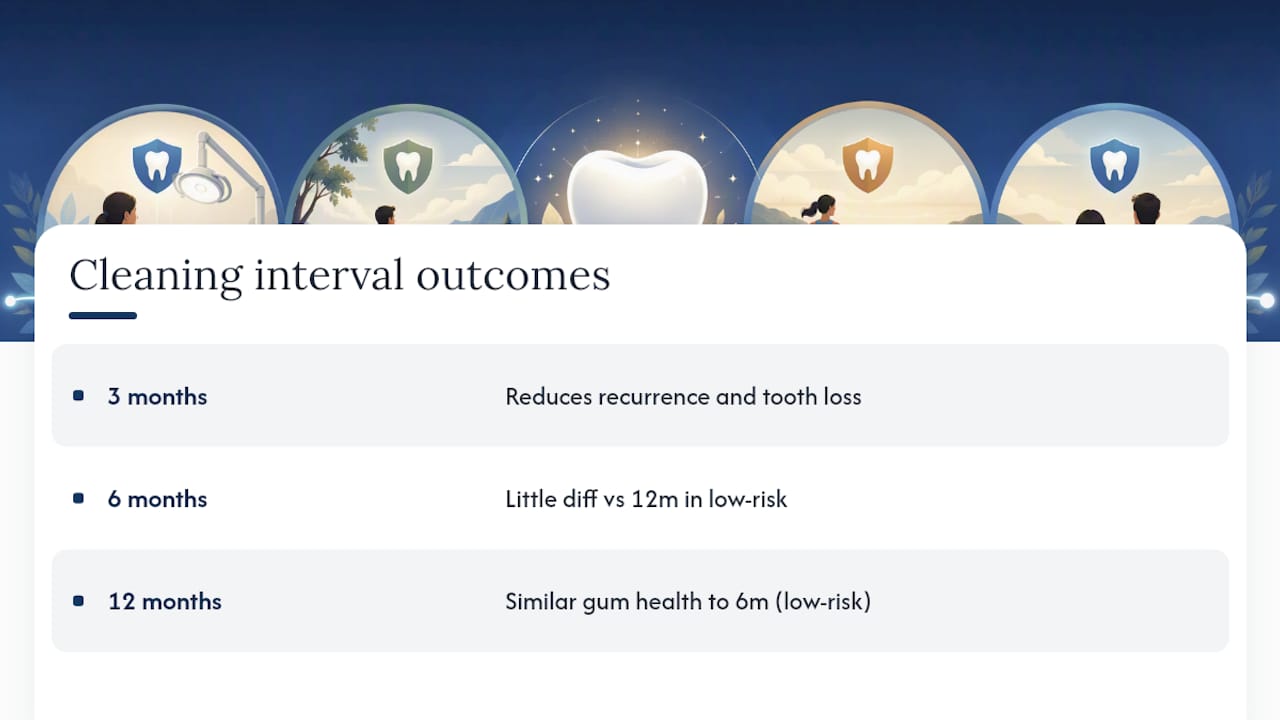
The picture flips entirely for periodontitis patients. There, three-month SPT after active treatment shows strong, consistent support for reducing disease recurrence and preventing tooth loss. The takeaway isn't "cleanings don't matter." It's that the interval should track your actual risk, not a calendar habit everyone follows regardless of their gum health.
Your practical checklist between visits
What you do at home shapes how often you need professional care. The CDC's daily oral care guidance boils down to a few habits that make a real difference:
- Brush twice daily for two full minutes, not a quick 30-second pass.
- Clean between your teeth once a day, with floss or an interdental brush.
- Skip tobacco products entirely.
- Cut back on sugary snacks and drinks between meals.
Before your visit, jot down any medications you're taking, note whether you've noticed bleeding or sensitivity, and mention if your diabetes control has shifted since your last checkup.
Pro Tip: Ask your dentist directly: "Based on today's exam, how often should I actually come back, and why?" A specific answer tied to your own numbers beats a generic six-month reminder card every time.
When should you call your dentist sooner?
Some signs shouldn't wait for your next scheduled visit. Contact your dentist promptly if you notice:
- Gums that bleed persistently, not just occasionally
- Swelling, pus, or other signs of infection
- Sudden or sharp tooth pain
- A tooth that feels loose or shifted
- A bite that suddenly feels different
These symptoms call for an earlier assessment. They don't replace your regular maintenance schedule once the issue is resolved.
How a Washington, DC practice personalizes cleaning frequency
Dr. Kambez Shukoor, a U.S. Navy veteran leading DC Implant & Cosmetic Dentistry, builds recall schedules around what each exam actually shows: pocket measurements, bleeding patterns, medical history, and how a patient's mouth has responded since the last visit. The practice pairs that clinical read with same-day appointment availability, so a flagged concern doesn't sit on a waiting list. With over 200 five-star reviews behind it, the approach leans on both preventive and cosmetic expertise, and patients are encouraged to raise financing or insurance questions during the exam itself, not after the fact.
— Jake
Schedule your next cleaning with DC Implant & Cosmetic Dentistry
If a fixed six-month reminder hasn't matched what your mouth actually needs, a personalized exam changes that. DC Implant & Cosmetic Dentistry builds your recall interval around your own pocket depths, bleeding patterns, and risk factors instead of a generic calendar rule, and same-day appointments mean you're not waiting weeks to get answers.

The practice offers routine cleanings and checkups, periodontal maintenance for patients managing gum disease, and exams with x-rays when something needs a closer look. Beyond preventive care, Dr. Shukoor's team handles dental implants and cosmetic work for patients ready to address more than just maintenance. Financing options are available for larger treatment plans, and with over 200 five-star reviews, the practice has a track record worth checking for yourself. Book an exam today and find out exactly how often your mouth actually needs a cleaning.
Where this guidance comes from
This article draws on preventive dentistry guidance from the NHS, evidence synthesis published on PMC, clinical guidance from Cleveland Clinic, and daily care recommendations from the CDC. Discuss your specific situation with your dentist before changing your schedule.
This article is general information, not a substitute for advice from a qualified doctor. Consult a qualified healthcare professional about your own circumstances before acting on anything here.
Sources
- Dental check-ups - NHS
- Benefits of dental scaling and polishing in adults: a rapid review and evidence synthesis - PMC
- Dental Cleaning - Cleveland Clinic