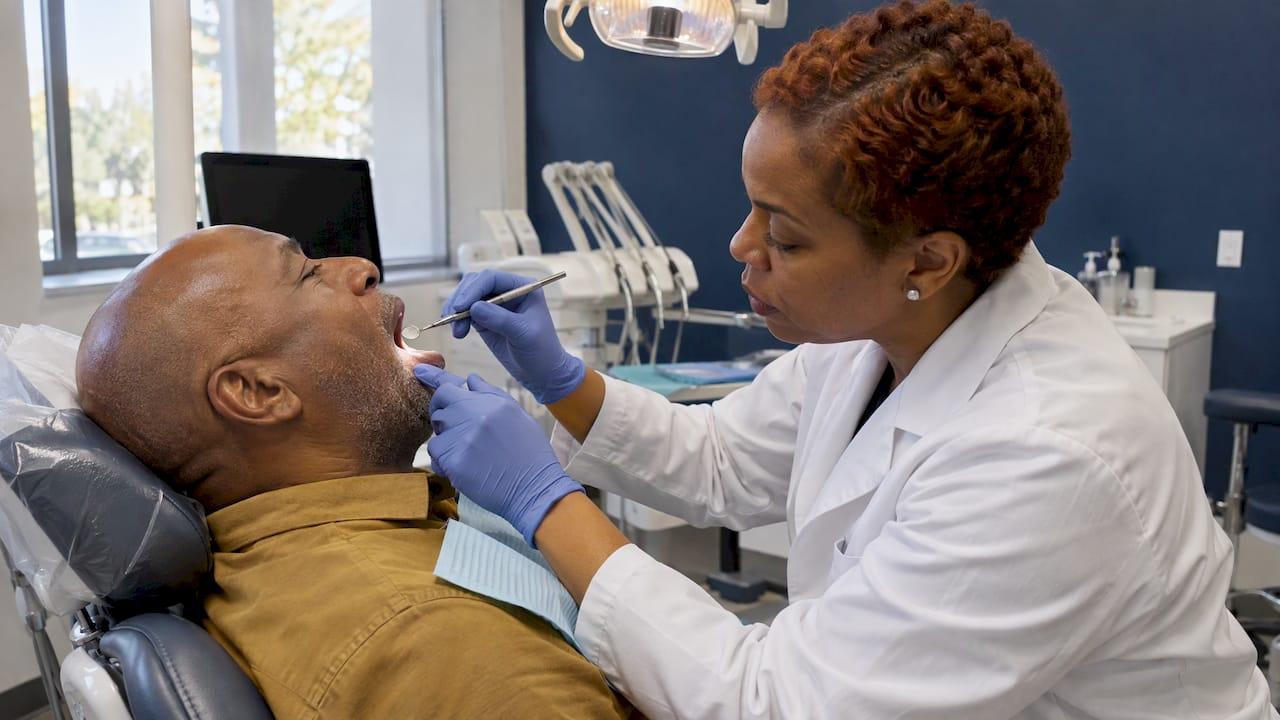
Yes, most people with diabetes can get dental implants. The American Dental Association says placement is generally safe and reliable when diabetes is properly controlled, and possibly when it is moderately controlled. What matters most is your blood sugar control before surgery, during healing and for years afterward, not the diagnosis itself.
This guide covers what the research shows about success rates, the risks, the numbers dentists look at, how to prepare, and the aftercare that protects an implant long term.
TL;DR
- Diabetes is not an automatic barrier to implants. Well-controlled diabetes shows survival rates comparable to people without diabetes.
- Poorly controlled diabetes (HbA1c above 8%) is linked to more bone loss, more gum inflammation around the implant and a higher risk of failure.
- Your dentist may ask for a recent HbA1c result and may coordinate with your physician before surgery.
- Lifelong maintenance matters most: regular hygiene visits and good home care make a measurable difference.
- If your numbers are not yet in range, treatment can be timed around improving them.
Table of Contents
- Are dental implants safe for people with diabetes?
- How blood sugar control changes the outcome
- What your dentist may check before surgery
- How to prepare for implant surgery
- The main risks: infection, bone loss and peri-implantitis
- Aftercare that protects your implants
- When other options may fit better
- Planning implants with us in Washington, DC
- FAQ
- Sources
Are dental implants safe for people with diabetes?
For most patients, yes, with the right planning. The ADA notes that two recent systematic reviews found predictably high survival rates in patients with diabetes, at least in the first three years, provided good glycemic control is maintained.
A 2023 German clinical guideline reaches a similar conclusion: implant rehabilitation in people with diabetes or elevated blood glucose is safe and predictable when the indication is correct and a risk-oriented approach is followed. It also classes diabetes as a potential risk factor for slower bone integration, inflammation around the implant and lower long-term survival. That is why planning and follow-up carry so much weight.
The ITI consensus statement on systemic conditions says high implant survival can be achieved in adults with type 2 diabetes, and that these patients should be managed together with a supervising physician.
How blood sugar control changes the outcome
A 2024 systematic review found that well-managed diabetes (HbA1c under 8%) did not significantly compromise implant survival. Survival ranged from 96.1% to 97.3% at one year and 87.3% to 96.1% at five years, comparable to people without diabetes. Gum health measures such as bone loss and probing depth were worse when HbA1c was above 8%.
A 2026 review of 54 studies describes a dose-response pattern: the higher the HbA1c, the worse the outcomes. People with HbA1c at or below 7% often had results comparable to people without diabetes.
| HbA1c range | What research suggests |
|---|---|
| 7% or below | Outcomes often comparable to people without diabetes |
| Above 7% to 8% | Many guidelines advise discussing timing with your physician |
| Above 8% | More bone loss, deeper pockets and a higher failure risk |
Biology explains this. Researchers describe how chronically high blood sugar impairs the white blood cells that fight infection and drives inflammatory chemicals that slow healing.
The good news from the German guideline: after about a year, implant stability appears no different between people with diabetes and healthy people. The early healing phase is where control counts most.
What your dentist may check before surgery
A careful implant dentist starts with your medical history, including when your diabetes was diagnosed and how it is managed. The German guideline recommends recording this before treatment begins. The ADA advises considering HbA1c values for risk assessment before placement and throughout the implant's lifespan.
Expect questions or requests such as:
- Your latest HbA1c result, or a new test if the last one is old.
- Your medications, including insulin, metformin and SGLT2 inhibitors.
- Permission to contact your physician, who may share lab results and adjust medication around surgery, per the ADA.
- 3D imaging and a written plan for the number of implants and the healing timeline.
Some reports use fasting glucose figures. One review cites 180 mg/dL fasting as a safe limit and 240 mg/dL as critical for postoperative complications. Another clinical review suggests deferring elective treatment if fasting glucose is below 70 mg/dL or above 200 mg/dL, or HbA1c exceeds 7%. Your dentist and physician will set the thresholds that fit you.
If your physician orders blood work, follow the fasting instructions exactly. This explainer on fasting for blood tests covers what to expect before a draw.
How to prepare for implant surgery
- Work on your numbers first. MedlinePlus advises focusing on diabetes control in the days to weeks before surgery.
- Talk to your prescriber about medication. MedlinePlus says to discuss stopping metformin 48 hours before and after surgery, and to tell your provider if you take SGLT2 inhibitors. Never change doses on your own.
- Stop tobacco. The same page recommends quitting ideally 6 weeks before surgery.
- Book a morning appointment. Clinical guidance suggests short morning visits after your usual medication and a normal breakfast. The FOR.org guideline likewise suggests early-day scheduling for insulin-dependent patients.
- Ask about infection prevention. A 2022 systematic review describes perioperative antibiotics and chlorhexidine as standard because they seem to improve implant success.
If your numbers are above target, elective surgery may be postponed. The ADA says treatment may need to be delayed until diabetes is stable or better controlled. That is a scheduling decision, not a refusal. For a sense of the whole process, see our dental implant timeline and recovery guide.
The German guideline also advises being critical about immediate or early loading in poorly controlled diabetes, because of slower bone integration. Ask your dentist whether same-day options suit your situation. Our page on immediate implant placement explains candidacy.
The main risks: infection, bone loss and peri-implantitis
Peri-implantitis is inflammation and bone loss around an implant. A 2023 meta-analysis of 21 observational studies found a significant association between diabetes and peri-implantitis. It suggested testing glucose control before surgery so problems can be addressed early.
A 2022 systematic review found poorly controlled diabetes brings more peri-implantitis and higher long-term implant loss, while under controlled conditions success rates are similar and there is no contraindication for surgery. The FDA notes that implant failure from systemic infection may be more likely with uncontrolled diabetes.
Know the warning signs: bleeding gums around the implant, swelling, a bad taste, or an implant that feels loose or sore. Tell your dental provider right away, as the FDA advises. Our guides on implant failure signs and the peri-implantitis treatment roadmap explain what happens next.

Aftercare that protects your implants
The 2022 review notes that the risk of inflammation seems to rise over time, so risk-adapted follow-up is needed. The 2026 review recommends that patients with diabetes join a lifelong supportive care program with recalls as often as every 3 to 4 months. A consensus report recommends a maintenance interval of 6 months or less for patients who have had peri-implant mucositis.
Professional hygiene shows a measurable effect. In one 2024 study of patients with diabetes, peri-implantitis occurred in 12.6% of those who received professional hygiene after implantation, versus 42.4% of those who did not. Three-year survival was 98.4% versus 95.4%.
In practice:
- Brush twice daily and clean between the teeth and around the implant every day, as the FDA instructs.
- Keep every recall visit, and share your latest HbA1c at each one.
- Keep your physician in the loop. The German guideline says the dentist should review your HbA1c during follow-up.
If you wear an implant-supported denture, see our daily cleaning and checkup guide.
When other options may fit better
Implants are not the only way to replace teeth. If your blood sugar is not yet stable, if you cannot commit to the maintenance schedule, or if bone volume is limited, your dentist may suggest a different path. Options include dentures, implant-supported dentures that need fewer implants, or implant bridges. Some patients also start with bone grafting or begin implant treatment once numbers have improved. The right choice comes from your exam, imaging and your physician's input.
Our perspective
We see diabetes as a planning question, not a reason to turn someone away. Every step from exam to surgical placement happens in our office, so imaging, treatment planning and follow-up stay under one roof, and you get a clear written plan.
Dr. Kambez Shukoor's military medical background shapes how we approach medical history. We ask about your health first, coordinate with your physician when needed, and time treatment around your goals and your numbers. Same-day appointments also mean a loose or sore implant does not have to wait.
Our advice: get your HbA1c checked, bring your medication list, and make recall visits part of the plan from day one.
Jake
Planning implants with us in Washington, DC
At DC Implant & Cosmetic Dentistry, we offer dental implants, All-on-4 and All-on-6 and related care, including extractions, bone grafting and implant repair, at our single Washington, DC location. Financing options are available for higher-cost treatment. Bring your recent lab results and medication list to your first visit, and we will build a written plan around them.

To discuss your case, visit our dental implants page and book a consultation.
FAQ
Can type 1 and type 2 diabetics both get dental implants?
Yes, in many cases. The ITI consensus covers type 2 diabetes specifically, and the clinical reviews above include people with either type when blood sugar is well managed. Your dentist and physician decide based on your control and overall health.
What HbA1c do I need for dental implants?
There is no single universal cutoff. Reviews report good outcomes at or below 7%, and the 2024 review found survival comparable to non-diabetic patients under 8%. Some guidelines advise postponing elective surgery above 7%. Ask your physician and dentist for your target.
Will diabetes slow implant healing?
It can, especially when blood sugar runs high. The German guideline reports delayed bone integration with poorly controlled diabetes, though stability appears similar to healthy patients after a year. Good control and a careful aftercare plan reduce the risk.
How often should I see the dentist after getting implants?
Research suggests every 3 to 4 months for patients with diabetes in a lifelong care program, and no longer than 6 months after any peri-implant mucositis. Your dentist will set the interval for your risk level.
Sources
- ADA: Diabetes
- German S3 guideline on dental implants with diabetes (AWMF, 2023)
- ITI consensus statement on systemic conditions and implant survival
- Success rates of dental implants in patients with diabetes (PMC, 2024)
- Dental implant outcomes in patients with diabetes mellitus (BMC Oral Health, 2026)
- Preoperative HbA1c and blood glucose measurements (MDPI, 2023)
- Rehabilitative considerations for dental implants in diabetics (PMC)
- MedlinePlus: Preparing for surgery when you have diabetes
- FOR.org: Diabetes risk assessment
- Systematic review on diabetes mellitus and dental implants (PMC, 2022)
- Systematic review on diabetes and dental implants (Int J Implant Dent, 2022)
- Diabetes and peri-implantitis meta-analysis (Evidence-Based Dentistry, 2023)
- FDA: Dental implants, what you should know
- Peri-implant maintenance consensus report (PMC, 2019)
- Hygiene and care protocols for implant-supported restorations (2024)
- Fasting for blood tests: what patients need to know