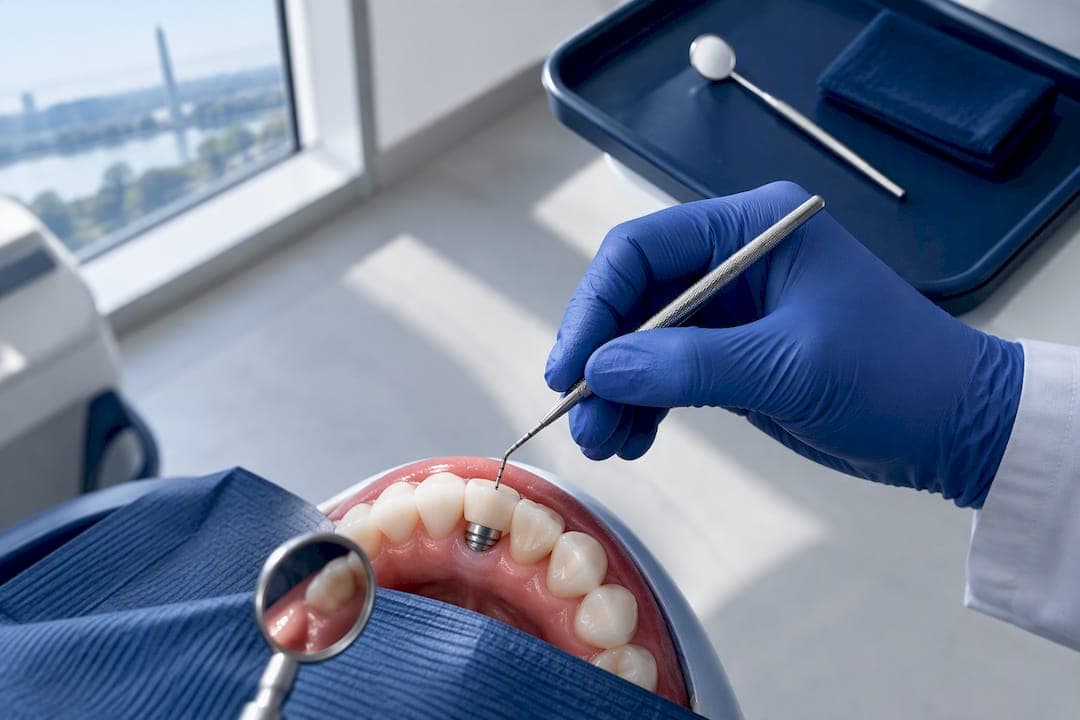
Peri-implantitis is treated with staged, guideline-driven care: non-surgical mechanical debridement and risk-factor control first, followed by a re-evaluation, then surgical decontamination and reconstruction only if clinical targets aren't met. Success means probing depths of 5 millimeters or less, minimal bleeding on probing, and no suppuration. Routine antibiotics aren't part of the standard plan, and long-term maintenance is what keeps the disease from coming back.
TL;DR:
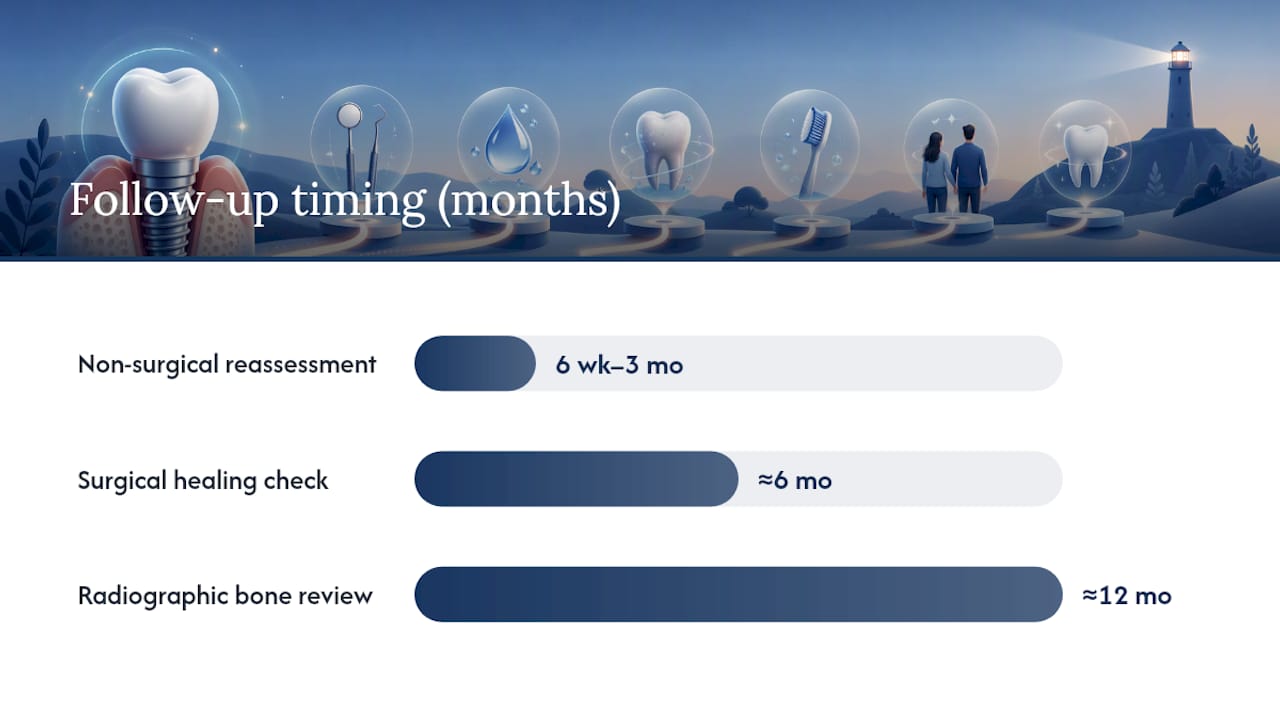
- Non-surgical treatment aims for probing depths of 5 mm or less, with minimal bleeding and no suppuration, typically re-evaluated between 6 weeks and 3 months.
- Mechanical debridement and personalized oral hygiene instructions are the first steps, with prosthesis design critically affecting the ability to clean the implant area effectively.
- Surgery is necessary only if non-surgical measures fail, with options including resective, reconstructive, or implantoplasty procedures based on the bone defect and tissue condition.
- Antibiotics are not routinely recommended; mechanical cleaning remains the primary therapy, with antibiotics reserved for complex cases under specialist guidance.
- Long-term success depends heavily on managing local factors like residual cement, prosthesis design, and systemic risk factors such as smoking or uncontrolled diabetes, along with regular maintenance visits.
Table of Contents
- What Does Successful Peri-Implantitis Treatment Look Like?
- Non-Surgical Peri-Implantitis Treatment: What Actually Happens
- When Is Surgery Needed, and What Are the Options?
- Do Antibiotics Actually Treat Peri-Implantitis?
- Why Local and Systemic Risk Factors Determine Your Outcome
- Supportive Peri-Implant Care: Your Long-Term Maintenance Plan
- What Recovery and Long-Term Outcomes Actually Look Like
- Practical Steps Patients Often Overlook
- The Gap Between Guideline Language and What Patients Actually Experience
- How DC Implant & Cosmetic Dentistry Supports Peri-Implantitis Care
- Guidelines and Reviews Behind This Article
- Sources
- FAQ
What Does Successful Peri-Implantitis Treatment Look Like?
Clinicians don't guess whether treatment worked. They measure it against specific numbers, and those numbers come straight from the EFP S3 clinical practice guideline.
A treated implant is considered stable when probing depth measures 5 millimeters or less around the implant, no more than one site shows bleeding on probing, and there's no suppuration, or pus, at any point. Those three markers work together. A single bleeding site with an otherwise healthy pocket depth is a very different picture than multiple bleeding sites paired with a deepening pocket.
Beyond the numbers, your dentist is watching for practical, functional signs too:
- Whether the implant itself still feels mechanically stable, not loose or shifting under light pressure
- Whether the crown or bridge attached to the implant can actually be cleaned at home, which affects whether the disease returns
- Whether you're comfortable chewing and speaking without tenderness around the site
- Whether the gum tissue and visible crown margin still look acceptable cosmetically
Statistic to know: Guideline-backed reviews use PD ≤5 mm as the primary threshold for calling non-surgical therapy successful, and clinicians typically schedule the first formal re-evaluation between 6 weeks and 3 months after initial treatment, depending on how the guideline in use frames the interval.
Radiographs come into play when probing depths and bleeding don't resolve as expected, since imaging can show whether bone loss is stable or still progressing. A single visit rarely settles the picture. Your care team is comparing measurements across at least two visits to see a trend, not just a snapshot.
Non-Surgical Peri-Implantitis Treatment: What Actually Happens
Every guideline-driven peri-implantitis treatment plan starts here, and for good reason. Non-surgical therapy resolves a meaningful share of early and moderate cases without ever involving a scalpel, and it's always attempted before surgery gets discussed, according to the EFP S3 guideline.
Here's the sequence a patient typically moves through:
- Mechanical debridement. Your dentist or hygienist uses curettes designed for implant surfaces, along with ultrasonic or sonic instruments, to physically remove the biofilm and calculus built up on and around the implant, both above and below the gum line. This mechanical step is the backbone of treatment, and reviews on managing peri-implantitis note that lasers and air-polishing haven't shown enough evidence to replace it as a solo treatment.
- Oral hygiene instruction. You'll get specific direction on interdental brushes, water flossers, or floss threaders designed to reach the tight spaces around an implant crown, since flossing dental implants correctly is different from flossing natural teeth with visible gum margins.
- Prosthesis review. Your dentist checks whether the crown or bridge attached to the implant is actually cleansable in its current form. Sometimes light cleaning in place is enough.
- Adjunctive rinses, used short-term. Chlorhexidine rinses or gels may be prescribed for a limited window right after debridement, functioning as a temporary support rather than a long-term daily habit.
- Re-evaluation. You come back, typically within 6 weeks to 3 months, and your dentist re-measures probing depth and bleeding.
The prosthesis question deserves more attention than it usually gets. If the crown or implant-supported bridge traps plaque because of its shape, its margins, or leftover dental cement, cleaning around dental implants at home becomes nearly impossible no matter how diligent you are. In those cases, your dentist may temporarily remove or modify the prosthesis to get better access for cleaning and to check for hidden cement remnants sitting below the gum line, a known contributor to peri-implant disease according to research on residual cement.
Pro Tip: Bring your own interdental brush or water flosser to your follow-up appointment. Watching your hygienist demonstrate the correct angle and pressure on your actual implant, instead of a generic model, is the fastest way to fix a cleaning technique that's been letting plaque creep back in.
What should you realistically expect from timing? Inflammation and bleeding often improve within the first few weeks as the bacterial load drops. But the real test is the re-evaluation visit. If probing depths haven't come down to that 5 millimeter target, and bleeding is still showing up at more than one site, that's the signal to talk about surgical options rather than repeating the same non-surgical routine indefinitely.
When Is Surgery Needed, and What Are the Options?
Surgery enters the picture when non-surgical therapy doesn't hit its targets, when bone loss is clearly progressing, or when imaging shows an intrabony defect, a crater-like pocket of bone loss around the implant, that mechanical cleaning alone can't reach.
Every surgical approach starts the same way: an access flap. Your surgeon lifts the gum tissue away from the implant to expose the contaminated surface directly, which allows for much more thorough decontamination than anything possible through a closed pocket. From there, the specific procedure depends on what the defect looks like once it's exposed.
Resective surgery reshapes the bone and gum tissue to eliminate the pocket entirely, which often means the gum line sits lower and some implant threads become visible. This tends to be the choice when the bone loss is shallow or wide rather than deep and narrow.
Reconstructive surgery uses bone grafting material, sometimes with a membrane, to rebuild lost bone rather than remove the pocket by reshaping tissue. Guideline evidence points to reconstructive approaches as preferable when the intra-osseous defect, meaning the vertical component of bone loss, measures 3 millimeters or more, since there's enough of a defect wall to actually support new bone growth.
Implantoplasty involves mechanically smoothing exposed, contaminated implant threads to make the surface less hospitable to bacteria. It's typically considered for the parts of an implant that will remain exposed after resective surgery, particularly on the side facing the cheek where aesthetics matter less. The trade-off is real: smoothing threads can weaken the implant slightly and changes how tissue responds to that surface, so it's not applied automatically.
| Surgical approach | Best suited for | Trade-off to know |
|---|---|---|
| Access flap debridement | All surgical cases, as the foundational step | Requires reflecting gum tissue, brief healing period |
| Resective surgery | Shallow, wide bone defects | Implant threads may become visible, gum line recession |
| Reconstructive surgery (grafting) | Intra-osseous defects ≥3 mm | Longer healing, success depends on defect shape |
| Implantoplasty | Exposed threads on non-esthetic surfaces | Slight reduction in implant surface strength |
Recovery isn't instant, and follow-up is where the guidelines get specific. Clinical parameters, probing depth and bleeding again, get recorded around 6 months post-surgery, with radiographs typically taken at 12 months to confirm bone levels have stabilized rather than continued to decline. If you're facing reconstructive surgery, ask your surgeon whether bone grafting is being planned around a membrane or graft material alone, since that decision affects both healing time and the strength of the eventual result.
Do Antibiotics Actually Treat Peri-Implantitis?
Not as a routine step, and this surprises a lot of patients who expect an antibiotic prescription the moment "infection" gets mentioned. The EFP S3 guideline is direct on this point: routine systemic or local antibiotics are not recommended as a standard adjunct to mechanical treatment in general practice.
The reasoning holds up clinically. Peri-implantitis is fundamentally a biofilm and bone problem sitting on a hard surface that antibiotics can't fully penetrate the way they can soft, inflamed gum tissue. Removing the physical biofilm mechanically matters more than any drug layered on top of it.
That said, there are situations where a specialist may still reach for something stronger. Guidance from bodies like SDCEP notes that systemic metronidazole or local minocycline placement can be considered in select complex cases, but always as part of a specialist's individualized risk-benefit conversation, never as a default first step.
What about the newer tools you might have read about?
- Lasers show mixed results and aren't backed as a standalone replacement for mechanical debridement.
- Air-polishing can help with surface cleaning but hasn't demonstrated consistent pocket-depth reduction on its own.
- Photodynamic therapy remains under investigation, without strong enough evidence to recommend routinely.
- Titanium brushes are increasingly used for implant surface decontamination in specialist hands, though the supporting evidence is still developing.
- Probiotics haven't shown reliable enough results to be treated as a standard adjunct.
None of these function as monotherapies. In a specialist's hands, they may support the core mechanical work. They don't replace it.
Why Local and Systemic Risk Factors Determine Your Outcome
Two implants can receive identical surgical care and heal completely differently, and the reason usually traces back to risk factors that were addressed, or weren't, alongside the procedure itself.
Residual cement deserves the first mention because it's so commonly overlooked. When a crown gets cemented onto an implant abutment, excess cement can squeeze below the gum line and sit there, undetected, acting as a constant irritant. Research on residual cement's role in peri-implant disease identifies it as a frequent local cause that's often missed on a routine visual exam and only found through careful probing or radiographs.
Prosthesis cleansability is the second major lever. A crown or bridge with overhanging margins or a shape that traps food and plaque will keep recreating the problem no matter how well surgery goes, which is why modification is sometimes part of the treatment plan itself.
Systemic factors round out the picture:
- Smoking impairs healing and blood flow to gum tissue, raising both risk and recurrence
- Uncontrolled diabetes slows healing and weakens the body's infection response
- A history of periodontitis (gum disease around natural teeth) signals a susceptibility that carries over to implants
Pro Tip: If you smoke, ask your dentist about cessation support before your surgical date is scheduled, not after. Even a short window of reduced smoking ahead of surgery can measurably improve early healing.
Supportive Peri-Implant Care: Your Long-Term Maintenance Plan
Treatment doesn't end when your probing depths hit target. Supportive peri-implant care, often abbreviated SPIC, is the maintenance framework that keeps a successfully treated implant from relapsing. Reviews on supportive care and recurrence point to structured, individualized recall programs as central to keeping results durable years down the line.
A typical SPIC visit includes three components:
- Professional cleaning above and below the gum line, repeating the same mechanical approach used in active treatment, just at a maintenance intensity rather than a therapeutic one.
- Re-measurement of probing depth and bleeding on probing, tracked over time rather than judged in isolation, so your dentist can catch a trend before it becomes a relapse.
- Risk reassessment, checking in on smoking status, diabetes control, and prosthesis condition since any of these can shift between visits.
Recall intervals aren't one-size-fits-all. A patient with no periodontitis history, good glycemic control, and a cleansable prosthesis might be seen every 6 months. Someone with a history of periodontitis, an active smoking habit, or a prosthesis that's harder to clean typically needs a tighter interval, sometimes every 3 months, because that combination of risk factors raises recurrence odds substantially. Short-term antimicrobial rinses may occasionally be advised between visits for higher-risk patients, but always as a temporary adjunct rather than a permanent daily habit.
What Recovery and Long-Term Outcomes Actually Look Like
Non-surgical therapy tends to show measurable improvement in inflammation and bleeding within a few weeks, though the formal re-evaluation at 6 weeks to 3 months is what actually confirms success. Surgical cases take longer. Meaningful healing plays out over months, with clinical parameters checked around 6 months and radiographs around 12 months to confirm bone stability.
Outcomes are judged on the same combination every time: probing depth, bleeding on probing, absence of suppuration, and how you personally feel about comfort and function.
Implant removal isn't the default outcome, but it's occasionally the right call:
- Bone loss that keeps progressing despite non-surgical and surgical intervention
- Infection that can't be brought under control through repeated treatment attempts
- A prosthesis or implant position that's no longer restorable in a functional way
When removal does happen, it's typically after multiple treatment attempts have been documented, not a first-line decision.
Practical Steps Patients Often Overlook
A few details make a real difference in how smoothly staged treatment goes, and they're easy to miss if nobody mentions them upfront.
- Prosthesis removal is common, not a red flag. If your crown or bridge comes off temporarily for access, that's a normal part of thorough decontamination, not a sign something went wrong.
- CBCT imaging matters for surgical planning. A 3D scan shows the true shape of a bone defect in ways a flat X-ray can't, which directly affects whether reconstructive grafting makes sense.
- Staged treatment means staged costs and time. Ask your dentist to walk through the full sequence, non-surgical first, possible surgery second, then years of maintenance, so nothing about the timeline or investment catches you off guard later.
The Gap Between Guideline Language and What Patients Actually Experience
Clinical guidelines describe peri-implantitis treatment in millimeters and percentages. Patients experience it as a series of appointments, uncertainty about whether their implant is actually failing, and questions about whether they did something wrong.
That gap is where most of the anxiety lives, and it's largely unnecessary. The staged approach exists precisely because peri-implantitis responds well to a predictable sequence when it's followed properly. What tends to go wrong isn't the biology. It's inconsistent follow-through, whether that's a patient who stops interdental cleaning once symptoms improve, or a practice that reaches for antibiotics reflexively instead of doing the mechanical work the evidence actually supports.
The most underappreciated factor in long-term success isn't the surgical technique chosen. It's whether the prosthesis was ever actually designed, or modified, to be cleanable at home. A beautifully executed reconstructive graft can still fail within a few years if the crown sitting on top of it traps plaque every single day. Dr. Kambez Shukoor and the team at DC Implant & Cosmetic Dentistry see this pattern often enough that prosthesis review gets treated as seriously as the surgical plan itself, not as an afterthought. With over 200 five-star reviews and a track record built on comprehensive, same-day care, the practice's approach reflects exactly what the evidence recommends: fix the mechanics first, escalate only when needed, and never skip the maintenance conversation. Bringing a written list of your symptoms, prior treatments, and specific questions about your prosthesis design to a first consultation helps ensure a thorough clinical exam.
— Jake
How DC Implant & Cosmetic Dentistry Supports Peri-Implantitis Care
If you've been told you have peri-implantitis, the next move is a focused evaluation, not a guessing game. DC Implant & Cosmetic Dentistry provides in-house peri-implant evaluation, non-surgical debridement, and surgical management, including bone grafting and implant repair, all performed by the same team rather than handed off between offices.

That in-house continuity matters more than it sounds. When the dentist who diagnosed your peri-implantitis is the same one performing the debridement or planning the graft, treatment decisions get made with full context instead of a referral summary. Dr. Kambez Shukoor, a U.S. Navy veteran, built the practice around same-day appointment availability and detailed, written treatment plans so patients understand exactly what stage they're at and what comes next.
Booking an evaluation is straightforward: schedule a visit, bring any prior implant records or X-rays you have, and expect a clinical exam that measures probing depth and checks your prosthesis fit before any treatment plan gets proposed. Financing options are available for patients facing surgical or reconstructive work. Schedule a peri-implant evaluation to get a clear, staged plan specific to your case.
Guidelines and Reviews Behind This Article
This article draws on the EFP S3 clinical practice guideline for prevention and treatment of peri-implant diseases, alongside the open-access narrative review on comprehensive treatment protocols and the systematic review on managing peri-implantitis. Findings on residual cement come from a dedicated review on that specific risk factor, and supportive care guidance draws on research covering SPIC programs.
This article is general information, not a substitute for advice from a qualified doctor. Consult a qualified healthcare professional about your own circumstances before acting on anything here.
Sources
- Comprehensive treatment protocol for peri-implantitis: an up-to date narrative review of the literature
- Prevention and treatment of peri-implant diseases—The EFP S3 level clinical practice guideline
FAQ
Does Peri-Implantitis Go Away on Its Own?
No. Peri-implantitis is a progressive bacterial and inflammatory process, and without professional debridement and risk-factor control, bone loss around the implant typically continues rather than resolving on its own. Early intervention with non-surgical therapy gives the best chance of stopping progression before surgery becomes necessary.
What Antibiotic Treats Peri-Implantitis?
Guidelines don't recommend routine antibiotics as standard treatment; mechanical debridement is the core therapy according to the EFP S3 guideline. In select complex cases, a specialist may consider systemic metronidazole or local minocycline placement, but only as part of an individualized treatment decision.
What Does Early-Stage Peri-Implantitis Look Like?
Early peri-implantitis typically shows as bleeding on probing with mild swelling or redness around the implant, often before significant bone loss shows up on X-rays. Catching it at this stage usually means non-surgical debridement alone can resolve it, which is why regular monitoring matters as much as treatment itself.
What Mouthwash Helps With Peri-Implantitis?
Chlorhexidine rinses are commonly prescribed as a short-term adjunct right after professional debridement, not as a long-term daily solution. Your dentist will typically specify a limited window of use, since chlorhexidine isn't meant to replace mechanical cleaning or ongoing supportive peri-implant care.
How Often Should I See a Dentist After Peri-Implantitis Treatment?
Recall intervals are individualized based on your risk factors, but many patients move to supportive peri-implant care visits every 3 to 6 months after active treatment resolves. Higher-risk patients, including smokers or those with a periodontitis history, generally need the shorter end of that range. A practice like DC Implant & Cosmetic Dentistry can set a specific schedule based on your exam findings.