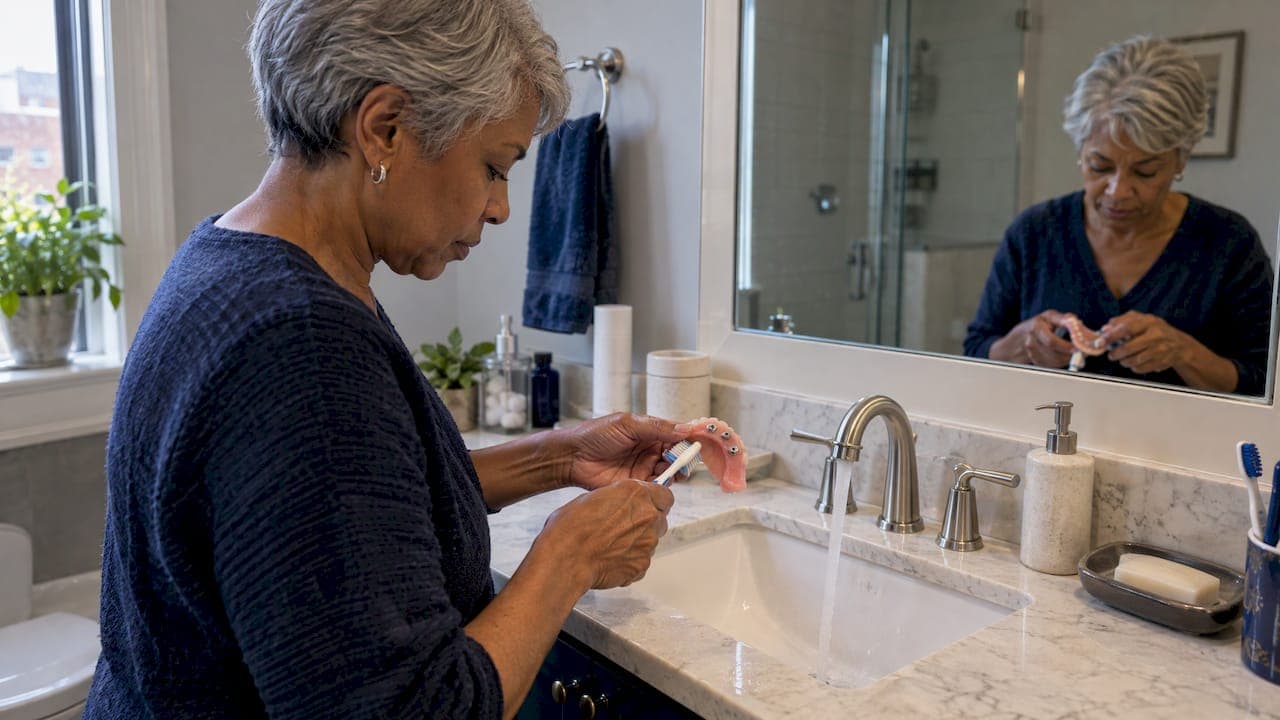
Implant dentures need a daily routine, and the routine depends on which type you have. A removable (snap-in) denture comes out to be cleaned, and you brush the implant posts in your mouth separately. A fixed denture stays in, so you clean the gums and the space beneath it with brushes and a water flosser. Either way, plan on a professional checkup at least every six months. The details below show how to do each step well.
TL;DR
- Clean removable implant dentures and the implant parts in your mouth at least twice a day, with a soft brush and a cleaner your dentist recommends (ADA and American College of Prosthodontists guideline).
- Fixed implant dentures need a soft brush with nonabrasive toothpaste twice a day, plus floss threaders, interdental brushes or a water flosser underneath (Cleveland Clinic).
- Skip bleach, powdered household cleansers and hot or boiling water, which can damage a denture (ADA).
- Book professional maintenance at least every 6 months for life; people at higher risk may need visits every 2 to 6 months.
- Call your dentist for bleeding, swelling, a loose feeling, a broken part or sore, red tissue under the denture.
Table of Contents
- First, which kind of implant denture do you have?
- Daily cleaning for removable (snap-in) implant dentures
- Daily cleaning for fixed implant dentures
- Helping a parent or relative with fixed implants
- Caring for the gums
- Professional maintenance: how often
- Mistakes that shorten the life of an implant denture
- When to call the dentist
- Our perspective
- Plan your implant denture care with us
- FAQ
- Sources
First, which kind of implant denture do you have?
People say "implant dentures" for two quite different restorations, and the care differs.
Removable implant-supported dentures (snap-in dentures, overdentures). The denture clicks onto attachments on a small number of implants. You take it out at night and for cleaning. Care is a mix of conventional denture care and implant care.
Fixed implant dentures (All-on-4, All-on-6 and similar). The prosthesis is screwed onto the implants and stays in your mouth. You clean it the way you would natural teeth, with extra tools for the underside. If you are not sure which you have, ask at your next visit. The answer changes your daily routine.
If you are still comparing options, our page on implant-supported dentures explains full and partial versions, and the All-on-4 and All-on-6 pages cover the fixed designs.

Daily cleaning for removable (snap-in) implant dentures
The 2016 clinical guideline from the American Dental Association and the American College of Prosthodontists recommends cleaning removable implant-supported prostheses at least twice a day with a soft brush and a professionally recommended denture-cleaning agent. The implant components in the mouth get the same frequency, with a soft brush and a recommended oral topical agent (JADA guideline).
A simple morning and evening routine
- Remove the denture. Pull evenly on both sides so you do not twist the attachments or crack the acrylic. Do this over a folded towel or a sink of water in case it slips.
- Rinse it. Run lukewarm water over it to wash off food.
- Brush the denture. Use a soft brush and a denture cleanser or denture soap. The ADA says denture-cleansing creams, pastes and gels belong on dentures that are out of the mouth, never on ones you are wearing (ADA).
- Clean around the implants. With the denture out, use a single-tuft toothbrush around each implant abutment, as Hong Kong's Department of Health advises (Oral Health Care Zone). Brush the gums and the roof of the mouth as well.
- Check the underside. Look at the attachment housings in the denture. Debris packed in them can keep the denture from seating properly.
- Rinse and reinsert in the morning. At night, leave it out.
Overnight storage
The same Hong Kong guidance says to take the prosthesis out at night and keep it in a cup of water (Oral Health Care Zone). Do not let it dry out, and keep it where children and pets cannot reach it. Your dentist may suggest a particular soaking product, so ask before adding one.
Water temperature and cleaners
The ADA warns against bleach and powdered household cleansers, which may damage dentures. It also says never to put dentures in hot or boiling water, which could warp them (ADA). Regular toothpaste is often more abrasive than a denture cleanser, so use the paste or soap your dentist suggests on the denture itself.
An ultrasonic cleaner is an option for loosening food and deposits from removable dentures, as long as you use it together with a recommended denture cleanser (Cleveland Clinic).

Daily cleaning for fixed implant dentures
A fixed denture does not come out, so cleaning happens in place. The Cleveland Clinic describes brushing twice a day with a soft-bristled toothbrush and nonabrasive toothpaste. It adds cleaning underneath the prosthesis with floss threaders, interproximal brushes or a water flosser (Cleveland Clinic).
What to use and where
| Tool | What it does | Tips |
|---|---|---|
| Soft manual or powered toothbrush | Cleans the visible surfaces and the gumline | Angle bristles toward the gum edge and go slowly |
| Interdental brush | Cleans under and between the prosthesis and posts | Choose a size that fits snugly without the wire rubbing the framework |
| Water flosser | Flushes debris from under the prosthesis | Start on a low setting and follow the gumline |
| Floss threader or implant floss | Reaches spaces a brush cannot | Use a dentist-recommended type and go gently |
Scotland's dental guidance says interdental brushes should fit snugly without the wire rubbing against the superstructure. It also notes that a rechargeable powered toothbrush can help people who cannot clean well with a manual one (SDCEP). The 2016 US guideline lists dental floss, water flossers, air flossers, interdental cleaners and electric toothbrushes as suitable aids for fixed restorations (JADA guideline).
A note on floss
The same Scottish guidance advises interdental brushes for people with exposed implant threads. It says floss remnants can act as foreign bodies and have been linked with a higher risk of peri-implant disease (SDCEP). If you use floss or a threader, check for shreds afterward and ask your dentist which product suits your prosthesis.
Get your own hands-on training
Scotland's guidance says patients with an implant-supported bridge or denture need personalized oral hygiene training, including how to clean the edge where the restoration meets the gum (SDCEP). Ask your dentist or hygienist to watch you clean and correct your technique. A few minutes of coaching beats any list of tips.
Helping a parent or relative with fixed implants
If you help someone who cannot manage a brush and water flosser alone, the job is mainly patience and a consistent time of day. Sit them comfortably, keep the water flosser on a low setting, and watch the gumline for redness or bleeding. These senior oral care steps for caregivers cover how to build the habit into a daily routine. Share anything you notice with the dentist at the next visit.
Caring for the gums
Healthy gum tissue is what holds an implant denture's foundation steady. If home care is not enough, the gum around an implant can become inflamed, leading to peri-implantitis. The implant may then gradually loosen or come out (Oral Health Care Zone).
With a removable denture, a clean fit matters too. Wearing an unclean denture for a long time may inflame the soft tissue underneath, with redness, swelling, pain or ulcers. This is called denture-induced stomatitis (Oral Health Care Zone). Removing the denture at night and cleaning it twice a day are the simplest defenses.
What healthy looks like: pink, firm gums that do not bleed when you clean them. Swollen, shiny or bleeding gums around a post deserve a call. Our guide to the peri-implantitis treatment roadmap explains what treatment involves, and our overview of dental implant failure signs lists the symptoms worth acting on early.
Professional maintenance: how often
Home care does most of the work, but it does not replace professional checks.
- The general rule. The 2016 guideline recommends a dental professional examination at least every 6 months, lifelong, for people with implant-borne restorations. Higher-risk patients should be seen more often. A visit includes an exam, hygiene instruction and cleaning with instruments that are compatible with implants (JADA guideline).
- Full-arch restorations. The American College of Prosthodontists' 2023 maintenance guidance says intervals should match your risk profile, such as a history of smoking or periodontitis, and range from 2 to 6 months (ACP).
- Do they take the denture off? For a fixed, screw-retained prosthesis, professional removal is not required for routine maintenance. It becomes necessary with mechanical complications, inadequate hygiene or signs of peri-implantitis (ACP).
- Tools. The 2016 guideline recommends powered instruments, such as glycine powder air polishing, for professional maintenance of implant-supported restorations (JADA guideline).
For how to match your interval to your own risk, see our article on dental cleaning intervals, and for routine visits, our dental cleanings page.
Mistakes that shorten the life of an implant denture
- Using hot water to "sanitize." Boiling or hot water can warp a removable denture.
- Reaching for bleach or gritty cleansers. Both can damage the denture.
- Using toothpaste meant for natural teeth on the denture surface. Use the product your dentist recommends.
- Skipping the posts. Cleaning only the denture and ignoring the implant abutments leaves plaque where it matters most.
- Wearing a removable denture around the clock. Take it out at night.
- Cleaning only what you can see. On a fixed denture, the underside is where debris collects.
- Skipping checkups because everything feels fine. Early gum problems around implants are often painless.
When to call the dentist
Book a visit soon if you notice any of these:
- Bleeding, swelling or pus around an implant
- Red, sore or ulcerated tissue under a removable denture
- A denture that feels loose, clicks differently or no longer snaps in firmly
- A persistent bad taste or odor that cleaning does not fix
- A chipped or cracked denture or prosthesis
If a denture breaks, collect all the broken parts and bring them to the dentist (Oral Health Care Zone). Do not try to glue it at home. If something feels wrong, we offer same-day appointments.
Our perspective
Implant dentures work best when the plan for keeping them clean is part of the treatment plan from day one. We perform every step in-house, from exam and imaging to surgery and the final prosthesis, so the same team that places your implants can show you how to care for them.
We write down the treatment plan, and we think home-care training should be just as clear. Showing you your own brush, your own water flosser angle and your own cleaning path is more useful than a handout.
Dr. Kambez Shukoor's military medical background shaped how we work: methodical, thorough imaging, and no surprises. Regular maintenance visits are how we catch small problems early, and we would rather see you for a quick checkup than for a repair.
Jake
Plan your implant denture care with us
If you already have implant dentures, we can review your routine, check the fit and show you the tools that suit your type of prosthesis. If you are considering implants, we can explain the options, including removable and fixed designs, and what daily care each involves. Our dental implant services include All-on-4 and All-on-6, and we offer financing options for higher-cost treatment. Learn about Teeth in a Day or contact the office to book.

If a denture needs repair or a refit, our dentures page and our implant repair services cover what we can do. For general oral hygiene guidance, see our oral hygiene information.
FAQ
How do I clean implant dentures every day?
For removable dentures, take them out, brush with a soft brush and denture cleanser, and use a single-tuft brush around the implants, at least twice a day. For fixed dentures, brush with a soft brush and nonabrasive toothpaste, then clean underneath with interdental brushes, floss threaders or a water flosser. Ask your dentist to demonstrate for your specific prosthesis.
Can I sleep with my implant dentures in?
It depends on the type. Removable implant-supported dentures should come out at night and be kept in a cup of water, according to Hong Kong's Department of Health. Fixed dentures stay in place all the time. If you are unsure which you have, ask your dentist.
Do implant dentures need professional maintenance?
Yes. National guidance calls for an exam at least every 6 months, for life, with shorter intervals of 2 to 6 months for people with higher risk such as smoking or a history of gum disease. Each visit includes an exam, hygiene instruction and a cleaning with implant-compatible instruments.
What should I avoid when cleaning implant dentures?
Avoid bleach, powdered household cleansers and hot or boiling water on removable dentures. Do not use denture-cleansing pastes while the denture is in your mouth. Avoid anything abrasive enough to scratch the prosthesis, and do not force a brush or wire against the framework.
Can I use a water flosser with implant dentures?
Yes, and it is a common tool for fixed implant dentures because it flushes debris from under the prosthesis. Start on a low setting and follow the gumline. Check with your dentist about the right pressure for your case.
Sources
- Clinical practice guidelines for recall and maintenance of patients with tooth-borne and implant-borne restorations (JADA, 2016)
- Oral Care Tips, Oral Health Care Zone for Grown-ups (Hong Kong Department of Health)
- Implant oral hygiene, Prevention and Treatment of Periodontal Diseases in Primary Care (SDCEP)
- Denture Care and Maintenance (American Dental Association)
- Implant Supported Dentures: Process, Benefits & Care (Cleveland Clinic)
- Denture Care (Cleveland Clinic)
- Maintenance of Full-Arch Implant Restorations (American College of Prosthodontists, 2023)