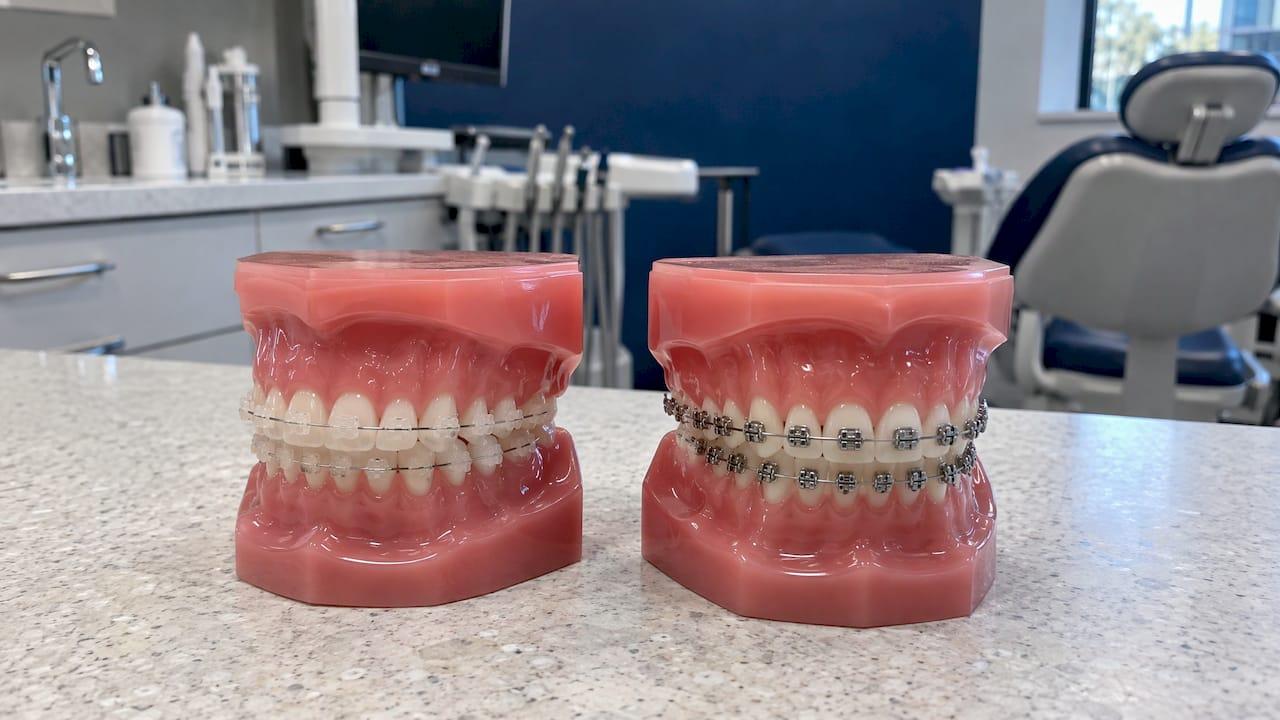
Metal braces are the sturdy, familiar choice, and ceramic braces are the less noticeable one. Both are fixed appliances: brackets bonded to your teeth and joined by a wire, which only a clinician can remove. The right pick depends on your bite, your goals, your daily habits and your budget, and it comes down to a handful of trade-offs that are easy to understand once they are laid side by side. If what you really want is straight teeth with the least visible hardware, there is a third route worth a look: removable clear aligners, which we offer at our Washington, DC office.
TL;DR
- Looks: ceramic brackets are clear or tooth-colored, so they blend in. Metal brackets are stainless steel and show when you smile. Ceramic is less noticeable, but still visible.
- Strength: metal is the usual pick when high durability or a complex case matters. Ceramic can be more brittle and may need extra care.
- Cost and time: ceramic often costs more because of the materials. Treatment length depends mainly on your case, not the bracket type.
- Comfort: it varies by person. Soreness after placement and adjustments is normal with either type.
- Another option: if the goal is a discreet smile, ask whether clear aligners fit your case.
Table of Contents
- What actually separates ceramic from metal braces
- Ceramic vs. metal braces at a glance
- How visible is each type?
- Which is more comfortable?
- Durability: do ceramic brackets break more often?
- Does treatment take longer with ceramic?
- What braces cost, and why the numbers vary so much
- Keeping teeth healthy under brackets
- Which one suits you?
- The third option: clear aligners
- Perspective
- See if clear aligners fit your smile
- FAQ
- Sources
What actually separates ceramic from metal braces
Metal braces use stainless-steel brackets and wires. Ceramic braces use clear or tooth-colored brackets and may add tooth-colored wires or clear ties, according to the American Association of Orthodontists (AAO). The AAO also notes that ceramic braces are fixed to the teeth, unlike removable clear aligners.
The mechanics are the same. A bracket is glued to each tooth, an archwire runs through the brackets, and gentle, steady pressure moves teeth into position over time. What changes is the material of the bracket and, often, the color of the wire and the tiny ties that hold the wire in place. The Cleveland Clinic describes the metal version as stainless-steel bands, brackets and wires, and says clear or tooth-colored ligatures (the small ties) can make them less noticeable.
That is the whole difference in kind. Everything else, such as comfort, cost and care, follows from the material.
Ceramic vs. metal braces at a glance
| Factor | Metal braces | Ceramic braces |
|---|---|---|
| Bracket material | Stainless steel | Clear or tooth-colored |
| Visibility | Visible when you smile | Blend in more, still visible |
| Durability | Often recommended when strength matters | Can be more brittle, may need extra care |
| Cost | Typically lower | May cost more because of materials |
| Comfort | Varies by patient | Varies by patient |
| Daily care | Meticulous brushing and flossing | Meticulous brushing and flossing |
| Removable | No | No |
The rest of this guide takes each row in turn.
How visible is each type?
This is the reason most people look at ceramic in the first place. Ceramic brackets are designed to match the shade of your teeth, so from a normal conversation distance they draw less attention than a row of steel. The AAO says they blend in more and are less noticeable.
Two honest details help you set expectations:
- They are still braces. Brackets have thickness and a wire runs across them, so up close you will see them.
- The wire and ties matter. A ceramic bracket paired with a dark wire looks very different from one paired with a tooth-colored wire. Ask which wire and tie options come with the plan you are quoted.
Metal braces, by contrast, are visible when smiling, though some people like that. Colored ties are a common way to personalize them, which is part of why younger patients often enjoy them.
Which is more comfortable?
The top search question here has no clean answer, and you should be wary of any page that gives one.
The AAO says comfort varies from patient to patient: some people notice differences in how brackets feel, and soreness or irritation can follow placement or an adjustment. Some marketing claims that ceramic brackets are smaller and smoother. Research on pain is mixed in the other direction. A 2019 study of 40 patients in India reported greater and longer-lasting pain in the ceramic-bracket group than in the group wearing conventional metal brackets. It is a small study, so treat it as one data point, not a rule.
What this means in practice:
- Expect tender teeth for a few days after the brackets go on and after tightening visits, whichever type you choose.
- Cheek and lip irritation from brackets is common early on. Your orthodontist can supply wax and advice for it.
- Your own sensitivity, your bite and how far your teeth must move will shape the experience more than the bracket material.
If you are comparing the two for comfort alone, it is not a reliable reason to pick either one.
Durability: do ceramic brackets break more often?
The common line is that ceramic is more fragile. The AAO agrees in part: it says metal may be recommended when high appliance durability or certain complex orthodontic needs matter, and that ceramic can also be effective but may need extra care because it can be more brittle.
The clinical evidence is more nuanced than the slogan. A 12-month clinical study published in 2020 followed 20 patients and recorded 14 failures among 195 metal brackets (7.2%) and 2 failures among 186 monocrystalline ceramic brackets (1.1%). A sample that small cannot settle the question, and brackets differ by manufacturer and type, but it shows that breakage depends on more than the label "ceramic" or "metal."

The practical takeaway is about habits. The AAO advises people in braces to avoid hard, sticky, crunchy and chewy foods to reduce the risk of breaking a bracket or dislodging a wire, and that applies to every type. If you chew ice, bite your nails or play contact sports, tell your orthodontist, because that may tip the choice toward the sturdier option or toward a mouthguard plan.
Does treatment take longer with ceramic?
Some ranking pages say ceramic runs longer and metal is quicker. The research we reviewed does not back a firm difference. The Cleveland Clinic says treatment averages about two years, with some cases finishing in under 12 months and others taking as long as three years, depending on how severe the misalignment is. It does not give a ceramic-versus-metal time gap.
What drives the timeline:
- How far the teeth need to travel.
- Whether the bite (how upper and lower teeth meet) needs correcting, not just alignment.
- How reliably you keep appointments and care for the appliance.
- Whether brackets break and need to be replaced, which can add delays.
That last point is the one place where material can matter indirectly, which is another reason to talk about your habits before you choose.
What braces cost, and why the numbers vary so much
Ceramic braces may cost more than metal because of the materials, says the AAO. It also lists other things that move the price: how complex your case is, how long treatment lasts, where you live, your insurance coverage and the orthodontic practice itself. In its cost guide, the AAO stops short of a fixed ceramic premium and recommends getting a personalized estimate from an orthodontist.
We will not quote a dollar range here, because any single national number hides the factors above. What you can do:
- Ask for the total, in writing. It should include appointments, retainers and any repairs.
- Check your insurance. The AAO says orthodontic benefits vary by policy and can be a percentage or a fixed benefit, so look at coverage limits, age limits and network conditions before you commit.
- Ask about payment plans. Many practices spread orthodontic costs over monthly payments.
If you want to see how that kind of pricing works for the alternative, our guide to what clear aligners actually cost walks through the factors.
Keeping teeth healthy under brackets
Hygiene is where braces succeed or struggle, and it is the same for both materials. The AAO says fixed braces require meticulous brushing and flossing around brackets and wires to clear plaque and food debris and reduce risks to enamel and gums. The Cleveland Clinic recommends:
- Brushing at least twice daily with a soft-bristled brush and fluoride toothpaste.
- Flossing daily around the braces.
- Avoiding hard, crunchy or sticky foods.
- Keeping regular orthodontic and dental visits.
That last item is easy to neglect. Cleanings and exams during orthodontic treatment let a dentist catch early decay or gum inflammation before it becomes a problem. We provide exams, X-rays and cleanings in-house, so routine care can sit alongside whatever alignment plan you choose.
Which one suits you?
The AAO says suitability depends on your teeth, bite, treatment goals, lifestyle and the orthodontist's recommendation. Use that as a checklist.
Metal braces tend to suit you if:
- Your case is complex and your orthodontist recommends the sturdiest appliance.
- You are hard on appliances, for example through sports, grinding or hard-food habits.
- You are not worried about visibility.
- You want to keep the cost down.
Ceramic braces tend to suit you if:
- You want a fixed appliance that is less noticeable.
- You are comfortable with the extra care a more brittle bracket may need.
- You are willing to pay more for the materials.
- Your orthodontist confirms your case works with ceramic.
Neither may be what you want if:
- You want the least visible option and prefer something you can take out to eat, brush and floss.
- You have a busy professional or social calendar and want to avoid brackets in photos and meetings.
The last group is larger than it used to be, particularly among adults.
The third option: clear aligners
Clear aligners are a series of removable, transparent trays. Unlike ceramic or metal braces, they are not fixed to the teeth, a difference the AAO draws in its aligners vs. braces comparison. For many adults, that is the deciding factor: no brackets, no wire, and trays that come out for meals.
Aligners are not right for every bite, and a proper exam decides that. We start with a full exam and imaging so the plan is based on your actual teeth, not a guess, and we give you a clear written treatment plan. Our clear aligners page explains the process, and these guides go deeper on the questions people ask next:
- Clear aligners for adults
- A month-by-month Invisalign timeline
- How aligners handle overbites
- Using elastics with aligners
If you are choosing between ceramic and metal mainly because of how braces look, comparing them with aligners first is a sensible move.
Perspective
When someone searches ceramic versus metal, the question underneath is usually: how do I get straight teeth without it taking over my life? Bracket material answers only part of that.
Here is how we see it. Both fixed options work, and the decision between them is a trade of looks against strength and cost. But a lot of the adults who come to us are not really choosing a bracket. They want a discreet plan, they want to brush and floss normally, and they want to know the whole picture before they start.
That is why we put so much weight on the first visit. Everything from exam to X-rays to treatment planning happens in our office, so you are not passed between providers, and you leave with a clear, written plan. Dr. Kambez Shukoor, a U.S. Navy veteran, leads that planning with the same care he brought to military medicine. For patients who qualify, clear aligners give a discreet, removable route, and we would rather show you exactly how your teeth would move than leave you guessing.
Whatever you decide, have your teeth and gums checked first. Healthy foundations make any alignment plan go better.
Jake
See if clear aligners fit your smile
Our Washington, DC practice offers clear aligners alongside general and cosmetic care, with same-day appointments available. Start with an exam and X-rays, and we will explain what your teeth need and whether aligners suit your case. You can read more or book through our clear aligners page.
If you also want to brighten or reshape your smile once the teeth are aligned, our cosmetic dentistry options include whitening, bonding and veneers.
FAQ
Are ceramic or metal braces more comfortable?
Neither is reliably more comfortable. The AAO says comfort varies by patient, and soreness after placement or adjustments is common with both. One small 2019 study reported more pain with ceramic brackets, so smoothness claims should not decide it for you.
How much more expensive are ceramic braces than metal?
Ceramic braces may cost more because of their materials, but the AAO does not give a fixed premium. Price also depends on case complexity, treatment length, location, insurance and the practice. Ask for a written estimate that covers the whole treatment.
Do ceramic braces stand out less than clear braces or aligners?
Ceramic braces blend in with your teeth but remain visible, because they are fixed brackets with a wire. Clear aligners are removable trays rather than brackets. A dentist can tell you which suits your bite and your priorities.
Are braces worth it at 40?
Adults of many ages straighten their teeth, and the decision rests on the health of your teeth and gums, your bite and your goals. A dental exam with X-rays comes first. From there, you can compare fixed braces with removable aligners based on what your case needs.
Sources
- AAO: Ceramic Braces, a Less Noticeable Way to Straighten Your Teeth
- Cleveland Clinic: Braces, Types and How They Work
- Comparison of the Perception of Pain during Fixed Orthodontic Treatment (2019)
- A Clinical Comparison of Failure Rates of Metallic and Ceramic Brackets (2020)
- AAO: How Much Do Braces Cost?
- AAO: Aligners vs. Braces, a Comparison