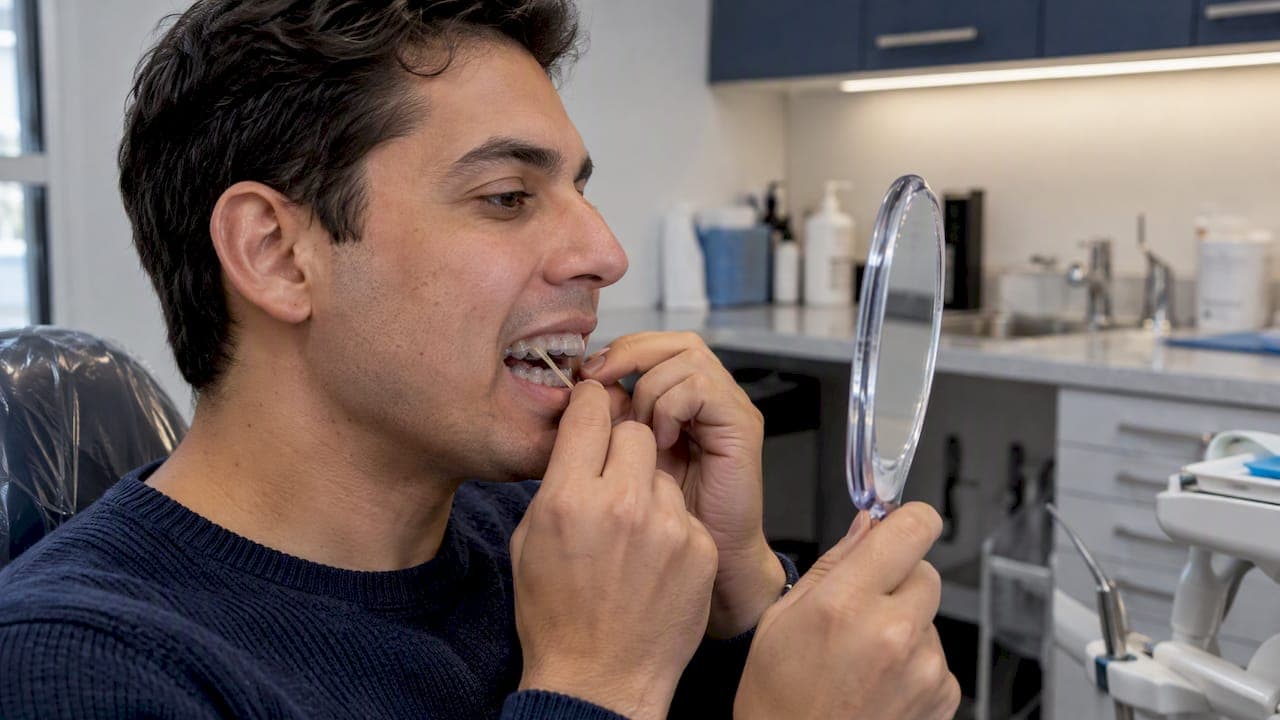
Elastics are commonly prescribed alongside clear aligners when a bite needs more correction than trays alone can deliver, such as sagittal shifts, vertical control, or final tooth settling. They attach to small buttons, cuts, or hooks built into the aligner or bonded to the tooth, giving your clinician a way to add a specific, planned force without switching you to braces.
TL;DR:
- Clinicians add elastics for overbite, underbite, crossbite, midline, or vertical corrections, choosing diagonal, reverse diagonal, or patterns linking three attachment points to direct force.
- Wear elastics most of the day, removing them for meals and brushing; replace them daily or twice daily as moisture and chewing weaken tension.
- Latex holds force more consistently, while nonlatex elastics suit people with latex sensitivities; choose force and configuration only as your clinician directs.
- Mild soreness usually fades within a day or two, but contact your clinician about loose attachments, repeated breakage, uneven bite, or severe or lasting pain.
- Clinicians usually introduce elastics partway through treatment and reassess them at visits; skipped wear can extend the timeline, even when gaps last only hours.
Table of Contents
- How elastics actually work with clear aligners
- Why your clinician may prescribe elastics during aligner treatment
- Types and materials: latex vs non-latex, typical sizes and force guidance
- How to attach and wear elastics with aligners
- Care, troubleshooting, and when to call your provider
- Clinician perspective: how elastic mechanics are planned during aligner treatment
- Getting your elastics checked at DC Implant & Cosmetic Dentistry
- FAQ
- Sources
How elastics actually work with clear aligners
Aligners move teeth by applying gentle, intermittent pressure through the plastic itself. That works well for tipping and leveling, but some corrections need a steadier pull between the upper and lower arches, which is where elastics come in. An elastic creates an intermaxillary force (pulling upper teeth against lower teeth) rather than an intra-arch force (moving teeth within the same arch), and that distinction matters for bite correction.
A clinical review of attachment design notes that attachments significantly improve aligner retention and help express the tooth movements a treatment plan calls for, which becomes especially important once elastics are added to the mix. Because aligner force is intermittent rather than continuous, elastics offer a simple way to introduce steady directional pull without converting a patient to fixed braces.
Attachments, buttons, and power ridges change how force gets applied in a few practical ways:
- They give the elastic a fixed point to hook onto so the pull stays consistent.
- They help the aligner grip the tooth more securely during active movement.
- They allow a clinician to aim force at a specific angle for better predictability.
Attachment design and placement can meaningfully change how efficiently a tooth moves and how well its root engages during treatment, according to a finite-element analysis of attachment shape, which matters most when elastics are adding extra intermaxillary load to the system.
Why your clinician may prescribe elastics during aligner treatment
Elastics get added to an aligner plan for a handful of recurring reasons, almost always tied to the bite rather than individual tooth position. Your clinician reviews your progress at scheduled checks and decides whether traction is needed to finish the case the way it was planned.
- Overbite correction (Class II relationship) using diagonal elastics from upper front teeth to lower back teeth.
- Underbite correction (Class III relationship) using the reverse diagonal pattern.
- Crossbite or midline correction, where one side needs more pull than the other.
- Vertical finishing, which helps back teeth settle together for a stable bite.
Elastics are usually introduced partway through treatment, once enough aligner trays have moved teeth into a position where traction can do its job, and they often extend the overall timeline slightly. Mild soreness for the first day or two of wearing elastics is normal and typically fades as your mouth adjusts.
Types and materials: latex vs non-latex, typical sizes and force guidance
Most orthodontic elastics are latex, which holds its force more consistently over several hours, though non-latex versions are available for patients with sensitivities. A narrative review of elastic biomechanics found that light, continuous force works best for most aligner cases, with heavier forces reserved for specific sagittal corrections and lighter forces used for vertical control.
- Latex elastics: better force stability over time, standard first choice for most patients.
- Non-latex elastics: used for patients with a latex allergy or sensitivity, with similar function.
- Replacement happens daily or twice daily, since intraoral moisture and chewing cause the material to lose tension quickly.
That same review emphasizes that replacement frequency matters as much as correct placement, because force decay inside the mouth happens faster than most patients expect.
How to attach and wear elastics with aligners
Putting elastics on correctly each time keeps your treatment on schedule and prevents unnecessary soreness. Follow the same routine every time so it becomes automatic within a few days.
- Wash your hands thoroughly before touching any elastics or your aligners.
- Remove your aligner trays from both arches.
- Hook the elastic onto the button, cut, or hook your clinician specified, usually starting with the upper arch.
- Stretch the elastic down to the matching lower attachment point and let it settle into place.
- Re-seat both aligner trays fully over your teeth.
- Check that the elastic sits snugly without pinching your cheek or gum tissue.
Common configurations include a diagonal pattern from an upper canine to a lower molar for Class II correction, the reverse diagonal for Class III correction, and a box or triangle shape connecting three points for vertical control. Each pattern aims the force differently, so placing the elastic on the wrong button changes what it actually corrects.
Most patients wear elastics for the majority of the day, removing them only to eat, brush, and floss, then replacing them with a fresh pair afterward. Carrying a small case of spares in a bag or car makes it easier to stay consistent instead of skipping a few hours when you forget.
Pro Tip: Keep a pack of elastics in your bag, your car, and at your desk so a forgotten pair never turns into several missed hours of wear.

Care, troubleshooting, and when to call your provider
If an elastic breaks or falls out, replace it right away rather than waiting until your next scheduled change. Keeping a stocked spare supply at home and on the go avoids gaps in wear that can slow your progress.
- Contact your provider if an attachment or button comes loose from a tooth.
- Call if you notice repeated elastic loss or breakage that seems unusual.
- Report sudden bite asymmetry or a feeling that your teeth no longer meet evenly.
- Reach out for pain that feels severe or lasts longer than a few days.
Mild, short-term soreness can usually be managed with an over-the-counter pain reliever and soft foods for a day or so. Skipping elastic wear, even for a few hours at a time, adds up and can push your treatment timeline back, since the bite correction depends on consistent, predictable force.
Clinician perspective: how elastic mechanics are planned during aligner treatment
Elastic mechanics are not a one-time instruction. They get stage-planned at the start and reassessed at in-person visits, where a clinician checks attachment condition, tooth movement, and whether the force direction still matches the plan. Adherence matters as much as the mechanics themselves, since a well-designed system only works if the elastics are actually worn as prescribed. If you are ever unsure whether an elastic is on the right button or whether an attachment needs attention, that is worth a quick evaluation rather than a guess.
— Jake
Getting your elastics checked at DC Implant & Cosmetic Dentistry
If you are starting clear aligner treatment or already wearing elastics and want a second look at your attachments, you can schedule an appointment for a check. Our clear aligner evaluations include a review of attachment placement and elastic configuration so the force stays aimed where your treatment plan needs it.

Every exam, adjustment, and follow-up happens in a single office location, reducing the need to visit multiple specialists for attachment work and aligner checks. If an elastic feels like it is pulling wrong, an attachment seems loose, or you simply want confirmation that your bite is tracking the plan, book a visit through our clear aligners page and we will take it from there.
FAQ
How do Invisalign elastics work?
Invisalign elastics hook onto small buttons or cuts built into the aligner tray or bonded to specific teeth, pulling the upper and lower arches together in a direction your clinician plans. This adds steady intermaxillary force that aligner trays alone cannot generate, which helps correct bite issues like overbite or underbite.
Is $4,000 a lot for Invisalign?
Clear aligner pricing varies widely depending on case complexity, location, and whether elastics or attachments are needed, so there is no single "normal" price across every practice; for detailed patient expectations on clear aligner treatment, see Clear Aligners For Adults: What To Expect. For an exact quote based on your bite and treatment goals, a clinical evaluation is the only reliable way to get a number specific to your case.
How painful is Invisalign on a scale of 1 to 10?
Most patients describe aligner pressure and elastic-related soreness as mild to moderate, especially during the first couple of days after a new stage or a new set of elastics. Discomfort typically eases within a day or two and can usually be managed with an over-the-counter pain reliever and soft foods.
What is the biggest complaint with elastics worn alongside aligners?
The most common frustration patients report is remembering to wear elastics consistently and replacing them often enough, since force decays quickly inside the mouth. Skipping wear or forgetting to swap in fresh elastics after meals is the main reason treatment timelines stretch longer than planned.