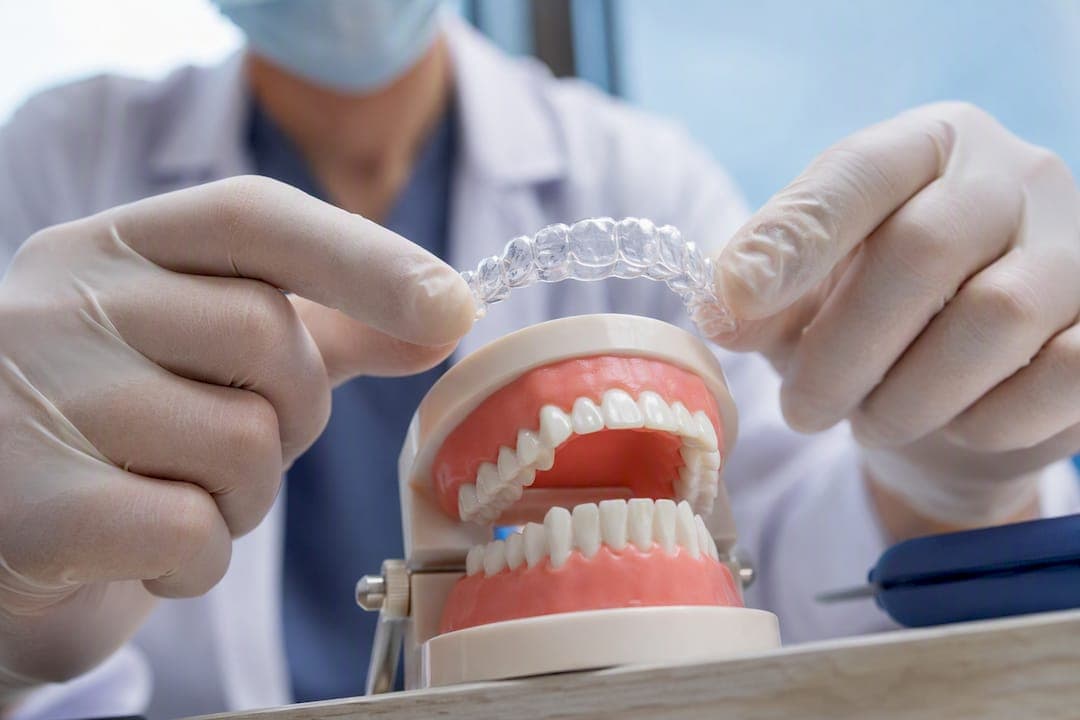
Yes. Clear aligners can correct many mild to moderate overbites, using a series of custom trays that intrude, tip, and level teeth into a healthier bite. Severe skeletal overbites usually need braces, hybrid mechanics, or jaw surgery instead. Expect roughly 12 to 24 months of treatment, with success hinging on wearing the trays about 22 hours a day.
TL;DR:
- Clear aligners effectively correct mild to moderate overbites by intruding, tipping, and leveling teeth, but severe skeletal cases often require braces or jaw surgery.
- Treatment duration usually ranges from 12 to 24 months, with approximately 22 hours of daily wear needed for successful outcomes.
- Digital planning tools, attachments, bite ramps, and overcorrections improve aligner accuracy, but full correction often falls short of digital predictions, especially in complex cases.
- Aligners are most effective for dental overbites in adolescents, while adults with significant skeletal discrepancies may need hybrid or surgical options.
- DIY aligner kits pose risks such as root resorption or bite worsening, so professional diagnosis and monitoring are essential for safe and predictable results.
Table of Contents
- What Counts as an Overbite, and When Does It Need Treatment?
- How Aligners Move Teeth to Correct an Overbite
- Are You a Good Candidate for Aligner Treatment?
- What to Expect From Consultation to Final Aligner
- What the Research Actually Shows About Predictability
- Why DIY Bite Correction Is Not Worth the Risk
- How DC Implant & Cosmetic Dentistry Approaches Overbite Cases
- The Gap Between Aligner Marketing and Aligner Reality
- Ready to Find Out if Aligners Can Fix Your Bite?
- Sources
- FAQ
What Counts as an Overbite, and When Does It Need Treatment?
A normal bite has the upper front teeth covering about one-third to one-half of the lower front teeth. Anything beyond that half mark starts sliding into "deep bite" territory, and dentists generally sort cases into mild, moderate, and severe based on how much extra coverage exists and whether the jaw bones themselves are misaligned, not just the teeth.
Left untreated, a deep bite does more than affect a smile.
- Excess wear on the lower front teeth from constant contact with the uppers
- Gum recession and irritation where lower teeth strike the roof of the mouth
- Jaw and joint pain from an uneven bite (TMJ symptoms)
- A possible link to sleep-disordered breathing in some patients
Quick fact: The line between "normal" and "needs treatment" often comes down to millimeters. A bite just slightly beyond the ideal range might only need monitoring, while a noticeably deep bite generally calls for active correction.
How Aligners Move Teeth to Correct an Overbite
Fixing a deep bite with clear trays isn't just about straightening crooked teeth. It requires specific, coordinated movements working together: intruding the lower front teeth back into the jawbone, tipping the upper front teeth forward slightly (proclination), and extruding the back teeth to open the bite from the rear. Orthodontists call this leveling the curve of Spee, the natural curve visible when you look at the lower teeth from the side.
The appliances doing this work have gotten more sophisticated. Bite ramps, small raised platforms molded into the back of certain aligners, hold the back teeth apart just enough to let the front teeth intrude without interference. Attachments (tiny tooth colored bumps bonded to specific teeth) give the plastic something to grip so force actually transfers into movement rather than just flexing the tray.
- Bite ramps: prevent posterior teeth from blocking front tooth intrusion
- Attachments: anchor points for controlled, directional force
- Precision wings: guide the lower jaw forward in teens with Class II bites
Digital planning software, most notably Invisalign's ClinCheck, maps every stage of movement before a single tray gets manufactured. Because certain movements underperform their digital plan, many clinicians build in deliberate overcorrection from the start rather than waiting to discover a shortfall later.
Pro Tip: Ask your dentist to walk you through your ClinCheck simulation stage by stage. Overbite cases often show the biggest visual change in the first third of treatment. That's normal, not a sign the rest of the plan is unnecessary.
Are You a Good Candidate for Aligner Treatment?
Mild to moderate overbites, cases where the issue is dental (teeth position) rather than skeletal (jaw structure), respond well to aligner therapy in most patients. Skeletal overbites, where the upper or lower jaw itself is misaligned, often need surgical orthodontics or a combination of aligners and fixed braces to get a stable result.
Age matters more than most people expect. A study evaluating mandibular incisor intrusion found adolescents achieve about 63.5% intrusion accuracy compared to roughly 45.3% in adults. Adolescent jaws are still growing and remodeling, which gives aligner-driven tooth movement more room to work as planned.
Certain signs point away from aligners alone and toward hybrid care or a surgical consult:
- A deep bite exceeding 5mm of coverage
- A visible skeletal discrepancy between the upper and lower jaw
- A pronounced curve of Spee that resists leveling with trays
- Significant crowding combined with the bite issue
Teens dealing with a related concern, a lower jaw that sits noticeably behind the upper jaw (Class II bite), have another option worth knowing about: mandibular advancement features built into certain aligner systems using precision wings. These guide the lower jaw forward gradually while the trays continue moving teeth into position, addressing two problems in one appliance.
What to Expect From Consultation to Final Aligner
Aligner treatment for an overbite follows a fairly predictable sequence, even though every mouth is different.
- Digital scan and diagnosis. A 3D scan of your teeth feeds into software that maps a full treatment plan and gives a projected timeline before any trays are made.
- Wearing the trays. Success depends on roughly 22 hours of daily wear, removing them only to eat, drink anything besides water, and brush.
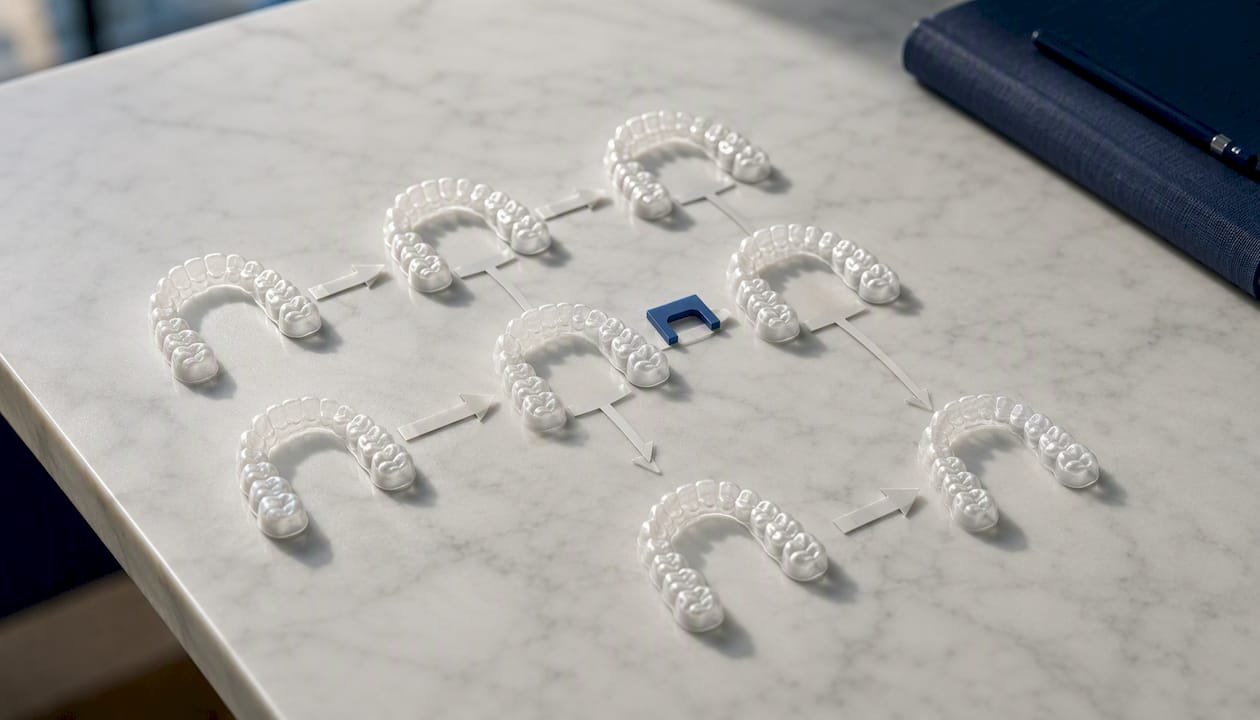
- Changing aligners. Most patients switch to a new tray every one to two weeks as teeth gradually shift toward their planned position.
- Refinements. Additional trays get made partway through treatment to fine-tune movement that didn't track exactly as planned. Research on refinement efficiency found most overbite correction happens during the first set of aligners, with later refinements adding comparatively little extra bite closure.
- Retention. Once teeth reach their target position, a retainer holds them there while surrounding bone stabilizes.
Total treatment time for overbite correction commonly falls between 12 and 24 months, depending on how much correction is needed and how consistently the trays get worn.
What the Research Actually Shows About Predictability
Aligner marketing tends to promise smooth, linear progress. Clinical studies tell a messier, more useful story. One study measuring how well aligners level the curve of Spee found average effectiveness of 71.8%, with a standard deviation of 19.0, meaning outcomes varied widely from patient to patient depending on facial and bite characteristics.
A separate retrospective study looked specifically at overbite correction accuracy and found a mean of about 37.6% after the first set of aligners, with total accuracy across the completed case landing around 38.5%. In plain terms: aligners typically deliver a solid fraction of the planned correction, not the full digital projection, and refinements only close part of the remaining gap.
A few things explain the shortfall:
- The bite-block effect. Aligner material sitting between the back teeth can limit spontaneous molar intrusion, which is sometimes desirable but also changes how the bite closes overall.
- Tracking failures. Trays that don't seat fully against the teeth transfer less force than planned.
- Insufficient posterior extrusion. Back teeth not erupting as projected leaves the front bite from closing as much as intended.
When these gaps show up early and don't respond to refinement, clinicians often shift to a hybrid approach, pairing aligners with limited fixed appliances or referring for a surgical evaluation.
Why DIY Bite Correction Is Not Worth the Risk
Mail order aligner kits and online "bite correction" gadgets skip the one step that makes aligner treatment work: a licensed dentist reading a scan, planning tooth movement in a specific sequence, and checking progress along the way. Moving teeth without that oversight can cause real, sometimes irreversible harm.
- Root resorption from uncontrolled or excessive force
- Bite collapse or worsening jaw joint pain
- Tooth movement that can't be fully undone even with later treatment
Predictable results depend on the same two things every time: near constant wear (about 22 hours daily) and scheduled check-ins so a dentist can catch a tray that isn't tracking before it compounds. If a tray stops fitting snugly, teeth feel loose, or jaw pain develops mid-treatment, that's a signal to call your dentist immediately rather than waiting for the next scheduled visit.
How DC Implant & Cosmetic Dentistry Approaches Overbite Cases
Every overbite evaluation at DC Implant & Cosmetic Dentistry starts with a digital scan and a real conversation about what the bite looks like today versus what's realistic to achieve. Dr. Kambez Shukoor, a U.S. Navy veteran leading the practice, builds each clear aligner plan around the patient's specific bite pattern rather than a one-size template, and same-day appointments mean a first scan and consultation often happen in a single visit.
When a scan shows signs pointing toward a skeletal issue rather than a simpler dental correction, the practice says so upfront and discusses hybrid options rather than pushing aligners as a universal fix. That straightforward approach is part of why the practice has built more than 200 five-star reviews from patients across Washington, DC.
The Gap Between Aligner Marketing and Aligner Reality
Most of what gets written about aligners and overbites treats the treatment like a formality: scan your teeth, wear some trays, done. The clinical data tells a different story, and it's one patients deserve to hear before they start.
It's that the finish line moves depending on the starting bite, the patient's age, and how much of the plan relies on movements that are historically less predictable, like incisor intrusion. Adults should walk in expecting a partnership with adjustments along the way, not a guaranteed straight line from scan to finished smile.
Where conventional advice falls short is treating "mild to moderate" as a self-diagnosis. A couple of millimeters of difference in bite depth, or a jaw discrepancy hiding behind teeth that look reasonably straight, changes the entire calculus. That distinction belongs to a dentist reading an actual scan, not a quiz on a website.
Prioritize finding a dentist who shows you the digital plan, explains the accuracy tradeoffs honestly, and tells you early if your case needs more than trays alone.
— Jake
Ready to Find Out if Aligners Can Fix Your Bite?
A consult is where the guesswork ends. Bring your dental history, a list of any current medications, and your insurance information if you have it. If you've had prior orthodontic treatment or old X-rays from another office, bring those too. During the visit, expect a digital scan, a conversation about your bite specifically, and a realistic timeline instead of a generic estimate.

DC Implant & Cosmetic Dentistry offers same-day scheduling, so the evaluation that answers whether your overbite qualifies for aligners doesn't have to wait weeks on a calendar. Financing options are available for patients who want to spread out the cost of treatment, and the practice's clear aligners page walks through what a typical case looks like from first scan to final retainer. If cost is part of your decision, the aligner cost breakdown covers what most patients actually pay before financing. Book your scan and get a plan built around your bite, not a generic case study.
This article is general information, not a substitute for advice from a qualified doctor. Consult a qualified healthcare professional about your own circumstances before acting on anything here.
Sources
- Invisalign
- The effectiveness of clear aligners in levelling the curve of Spee and related maxillofacial factors in patients with a deep overbite
- Does aligner refinement have the same efficiency in deep bite correction?: A retrospective study | BMC Oral Health
- Does age influence deep overbite correction with Invisalign? A prospective study evaluating mandibular incisor intrusion in adolescents vs adults
FAQ
Is $4,000 a Lot for Invisalign?
Cost varies widely by case complexity and location, so $4,000 can be reasonable for a moderate case requiring many aligners and refinements, while a mild case might cost less elsewhere. Ask for a written treatment plan with the total aligner count before comparing prices.
Why Do Some Dentists Recommend Against Invisalign for Certain Cases?
Aligners struggle with movements like significant intrusion and severe skeletal discrepancies, so a dentist may steer a patient toward braces or hybrid treatment when the case falls outside what trays reliably correct. This isn't a rejection of aligners generally, just a match between the tool and the specific bite problem.
What Is the 22 Hour Rule With Aligners?
Aligners need to stay in for approximately 22 hours a day, leaving roughly two hours for meals, drinks besides water, and brushing. Falling short of that wear time is one of the most common reasons treatment runs longer than planned.
How Long Does It Take to Fix an Overbite With Aligners?
Most overbite cases treated with aligners take 12 to 24 months, though mild cases can finish faster and cases needing refinements or hybrid mechanics can run longer. Most of the actual bite correction happens in the earlier aligner sets rather than at the end.