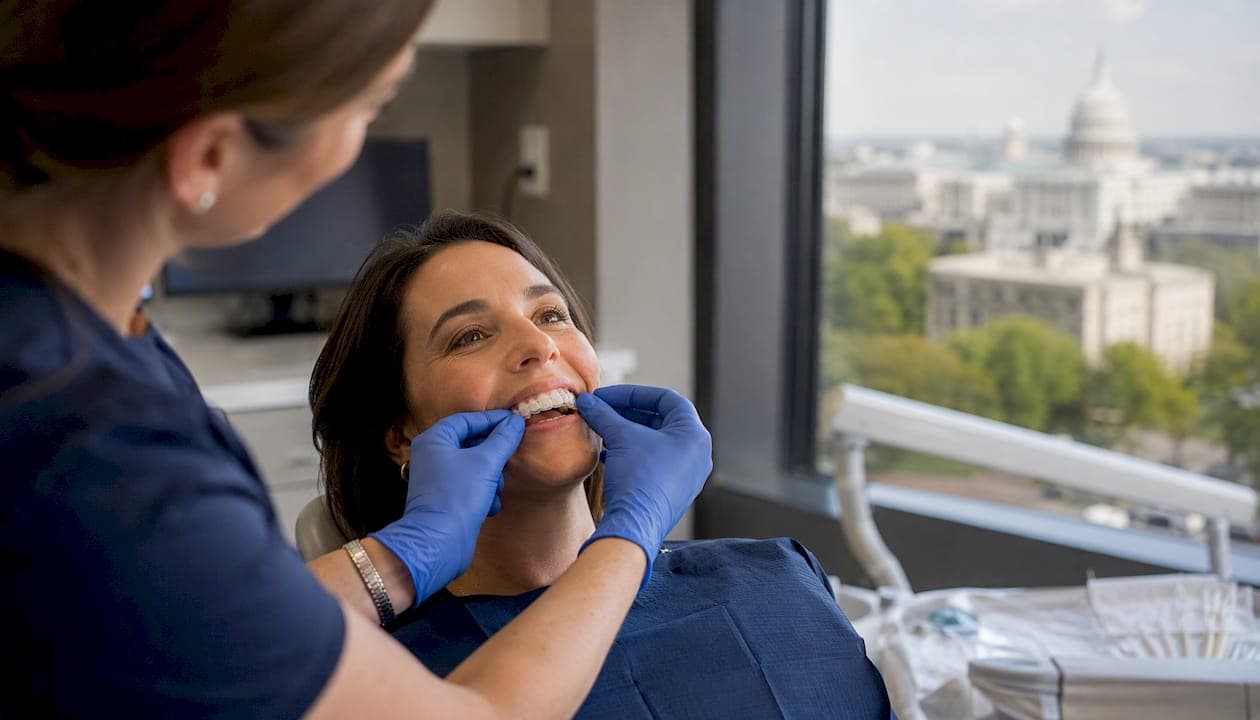
Clear aligners work well for many adults with mild-to-moderate crowding, spacing, or bite issues — and the first real step is an in-office consult with a 3D scan, not a selfie-based online quiz. The American Association of Orthodontists recommends clinical evaluation before starting any aligner treatment, because candidacy depends on bone health, existing restorations, and bite complexity that no photo can assess.
Here's the short version before we go deeper:
- Typical U.S. cost: roughly $1,800–$8,000 depending on case complexity and whether you choose in-office or at-home treatment
- Average treatment window: ranges broadly depending on individual case complexity and treatment plan
- The 22-hour rule: aligners must stay in at least 22 hours per day — skipping hours compounds and delays results
- Who to see: a licensed dentist or orthodontist, not a remote-only service, especially for anything beyond mild crowding
- DC Implant & Cosmetic Dentistry offers in-office Invisalign treatment in Washington, DC, with same-day appointments and 3D scanning
Key Takeaways
Clear aligners are a clinically supported option for most adults with mild-to-moderate alignment issues, but candidacy, outcomes, and cost all depend on in-person clinical evaluation, consistent 22-hour daily wear, and lifelong retention.
| Point | Details |
|---|---|
| Candidacy requires a clinical exam | A 3D scan and X-rays are necessary before starting; no photo-based quiz can confirm you're a candidate. |
| Wear time determines outcomes | The 22-hour daily wear rule is non-negotiable; missed hours compound into delayed results and more refinements. |
| Cost ranges from $1,800–$8,000 | In-office supervised treatment typically runs $3,000–$8,000; FSA/HSA and financing options can reduce out-of-pocket cost. |
| Complex cases need auxiliaries | Open bite and crossbite correction often require attachments, elastics, or TADs — not aligners alone. |
| DC Implant & Cosmetic Dentistry | Offers in-office Invisalign in Washington, DC with 3D scanning, Dr. Shukoor's direct oversight, and same-day appointments. |
Table of Contents
- What are clear aligners and how do they move your teeth?
- Do clear aligners actually work for adults?
- What does adult aligner treatment look like from start to finish?
- Who benefits most, and when should you consider other options?
- How do in-office aligners compare with braces and at-home kits?
- How much do clear aligners cost in the U.S., and what are your payment options?
- Daily wear, hygiene, and what to expect after treatment
- How do you choose the right provider or treatment path?
- What does the research actually say?
- A clinical perspective on treating adults with clear aligners
- DC Implant & Cosmetic Dentistry offers in-office clear aligner treatment in Washington, DC
- Sources
What are clear aligners and how do they move your teeth?
Clear aligners are removable, custom-fitted trays made from a medical-grade thermoplastic polymer. Each tray is slightly different from the last, applying gentle, controlled pressure to nudge specific teeth a fraction of a millimeter per stage. The AAO describes them as sequential appliances — you wear one set, move to the next, and the cumulative effect produces the planned tooth movement.
A few terms worth knowing:
- Aligner: the clear tray itself, snapped over your teeth
- Attachment: a small tooth-colored composite bump bonded to a tooth to give the aligner a grip point for more precise movements (rotations, extrusions)
- IPR (interproximal reduction): a controlled slimming of enamel between teeth to create space — common in crowding cases
- Elastics: rubber bands worn between upper and lower trays to correct bite relationships
- Retainer: the final appliance worn after active treatment to hold teeth in their new positions
One stage looks like this: you snap in a new tray, wear it for the prescribed 7–14 days, then swap to the next set. Each tray moves teeth slightly further along the planned path. By the time you reach the last tray, the cumulative shifts add up to the corrected position your clinician mapped out at the start.
Do clear aligners actually work for adults?
Yes — with important caveats. Adults often have denser alveolar bone than teenagers, which can slow tooth movement and extend treatment timelines. WebMD notes that adults with crowns, bridges, or implants may need coordinated care between their orthodontic provider and their restorative dentist to protect existing work during movement.
The clinical evidence for mild-to-moderate cases is solid. A retrospective cohort study published on PubMed Central found statistically significant improvements in open-bite measurements in adults treated with aligners, with a mean treatment duration of approximately 18 months. Most patients in that sample achieved a positive overbite post-treatment. The authors note sample limitations, so one study isn't a guarantee — but the direction of the evidence is consistent across multiple trials.
Statistic callout: In the PMC open-bite cohort, mean pre-treatment overbite was -3.5 mm; post-treatment, it improved to approximately +1.5 to +1.6 mm.
Where aligners become less predictable:
- Severe skeletal discrepancies (jaw-level problems, not just tooth-level)
- Large vertical open bites with a strong skeletal component
- Significant crossbites without auxiliaries — clinical literature confirms that attachments, elastics, or temporary anchorage devices (TADs) are often required for complex crossbite or open-bite correction
- Active periodontal disease — movement through inflamed bone is contraindicated
Compliance is the other variable that clinicians watch closely. Miss two hours a day consistently and you're effectively wearing each tray for 20 hours instead of 22. Over months, that gap accumulates into delayed tooth movement, more refinement rounds, and a longer overall treatment.
What does adult aligner treatment look like from start to finish?
Step-by-step patient checklist
- Initial consultation: dental exam, X-rays if needed, periodontal check, and discussion of goals
- 3D intraoral scan or impressions: the digital scan feeds the treatment-planning software
- Treatment plan review: your clinician walks you through the ClinCheck or equivalent simulation
- Aligner delivery and attachment placement: first set of trays delivered; attachments bonded if needed
- Active treatment: swap trays every 7–14 days; attend monitoring appointments every 6–10 weeks
- Mid-course refinements: if teeth aren't tracking as planned, new scans generate a revised set of trays
- Final trays and debond: attachments removed, teeth polished
- Retainer delivery: impressions or scan taken for retainers; wear schedule established
Typical timeline
| Phase | Typical Duration |
|---|---|
| Pre-treatment workup | 1–3 weeks |
| Active aligner treatment | 6–24 months (most adults: 12–18 months) |
| Mid-course refinements | 2–4 months added if needed |
| Retainer phase | Lifelong (nightly after initial full-time period) |
Digital treatment plans frequently require mid-course refinements because software predictions can overestimate certain tooth movements. A responsible clinic builds refinements into the quoted fee upfront — ask about this before you sign.
Who benefits most, and when should you consider other options?
Ideal candidates
Adults who tend to get the most predictable results share a few characteristics: mild-to-moderate crowding or spacing, minor overbite or underbite, cosmetic rotations, and good baseline periodontal health. The Cleveland Clinic emphasizes that treatment choice depends on the type and severity of malocclusion and on overall oral-health status — diagnostic imaging before starting is standard of care, not optional.
Red flags that point to a different path
- Active gum disease or bone loss — treat periodontal issues first
- Severe skeletal open bite or crossbite — may require surgery or fixed appliances
- Missing anchor teeth that would otherwise stabilize the aligner
- Large crowns or bridges that prevent proper aligner seating
- Significant vertical discrepancies where intrusion/extrusion magnitudes exceed what aligners reliably achieve
When any of these are present, an orthodontist evaluation is the right call, not a general dentist working alone. Complex bite cases, cases requiring TADs, or cases with surgical planning components need specialist-level diagnosis. A general dentist can manage straightforward adult aligner cases well — but knowing the boundary between the two is what separates good care from a costly mistake.
How do in-office aligners compare with braces and at-home kits?
| Dimension | Clinician-supervised aligners | Fixed braces | At-home aligner kits |
|---|---|---|---|
| Typical U.S. cost | $3,000–$8,000 | $3,000–$8,000 | $1,800–$3,000 |
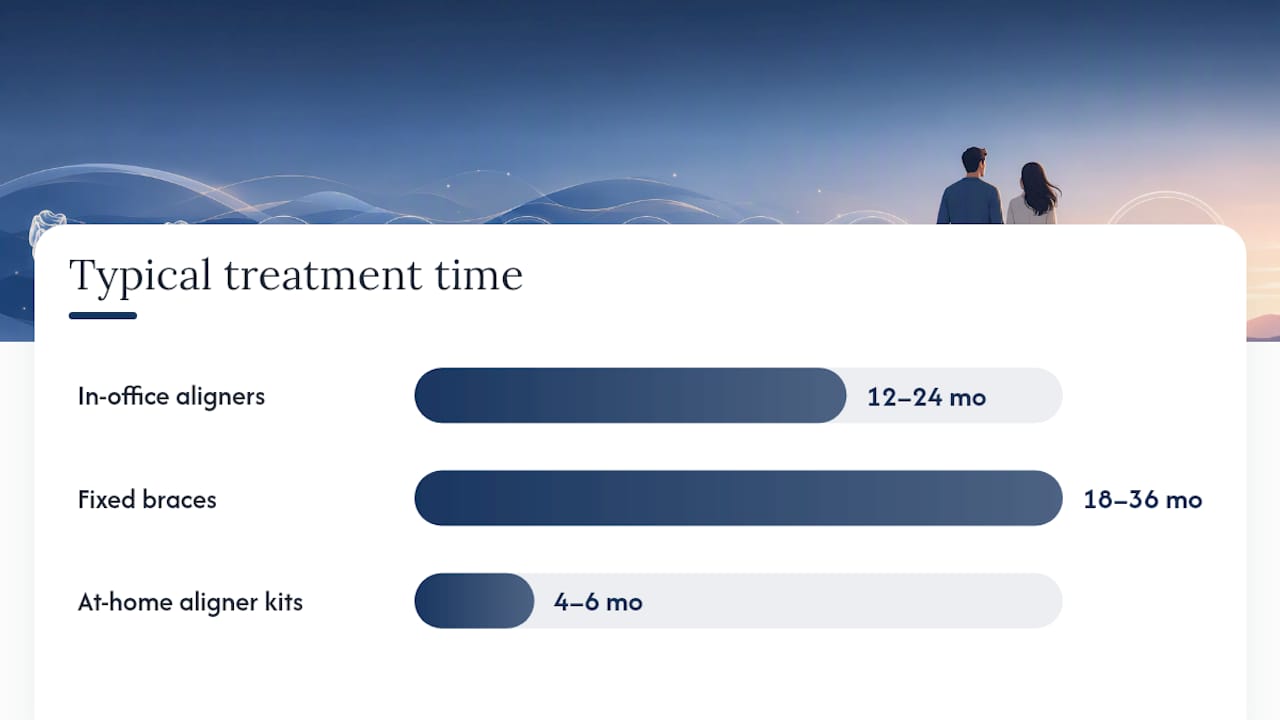
| Typical treatment time | 12–24 months | 18–36 months | 4–6 months (mild cases only) |
| Supervision level | In-office, regular monitoring | In-office, regular monitoring | Remote only (photos/app) |
| Case complexity handled | Mild to moderate-complex | Mild to severe | Mild only |
| Insurance coverage | Often partial | Often partial | Rarely covered |
| Monitoring frequency | Every 6–10 weeks | Every 4–8 weeks | Minimal to none |
A few scenarios to make this concrete:
Mild crowding, no bite issues: An in-office aligner program or, in some cases, a supervised at-home option may both be reasonable. The key difference is what happens if something goes wrong — an in-office provider can catch tracking problems early.
Open bite or crossbite: This is where at-home kits fall short. Correcting an open bite with aligners often requires attachments, elastics, and careful biomechanical sequencing. The question "can Invisalign fix open bite?" gets a qualified yes — but only under clinical supervision, with the right auxiliaries, and only when the open bite has a dental (not purely skeletal) component. The same logic applies to crossbite: aligners for crossbite correction are possible, but complex crossbite cases typically need attachments and elastics to achieve reliable results.
Severe skeletal discrepancy: Fixed braces combined with orthopedic appliances or surgical consultation is the more appropriate path.
How much do clear aligners cost in the U.S., and what are your payment options?
Healthline's consumer overview puts the range at roughly $1,800–$8,000 across different options. In-office, clinician-supervised treatment typically sits in the $3,000–$8,000 band; at-home kits occupy the lower end. What drives that spread:
- Case complexity: more trays, more refinements, more cost
- Auxiliaries needed: attachments, elastics, and TADs add clinical time
- Provider expertise and market: an orthodontist in a major metro charges more than a general dentist in a smaller market
- Refinement policy: some practices include unlimited refinements; others charge per round
Payment strategies worth knowing
- Dental insurance: many plans cover a portion of orthodontic treatment (typically a lifetime maximum of $1,000–$2,000); confirm whether your plan covers adult orthodontics, since some exclude patients over 18
- FSA/HSA: orthodontic treatment qualifies as a medical expense — use pre-tax dollars to reduce out-of-pocket cost
- Third-party financing: CareCredit and Lending Tree offer payment plans, often with promotional 0% APR periods
- In-office payment plans: many practices split the fee into monthly installments with no interest
Questions to ask before you commit:
- Does the quoted fee include refinements, or are they billed separately?
- What is the retainer fee after active treatment?
- Does my insurance plan cover adult orthodontics, and will the office submit claims on my behalf?
- Is there a fee for missed or rescheduled appointments?
Daily wear, hygiene, and what to expect after treatment
The 22-hour rule in practice
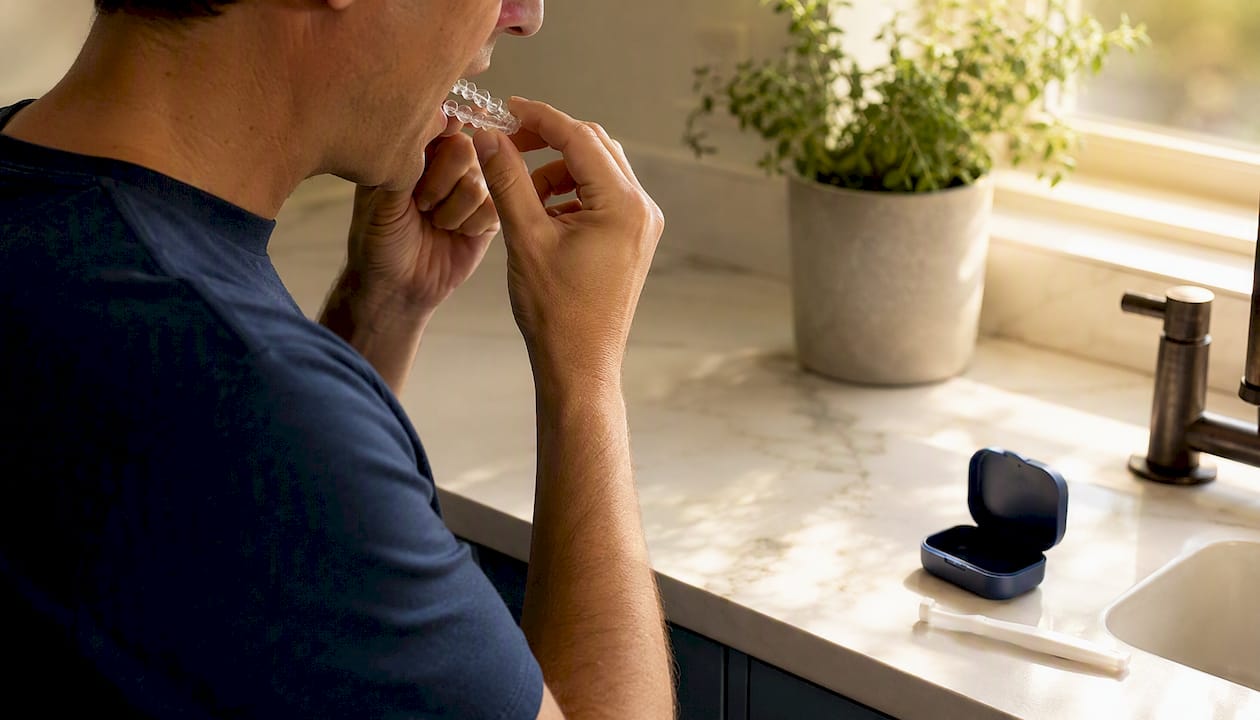
The AAO's guidance is clear: aligners should be worn at least 22 hours per day. That leaves two hours for eating, drinking anything other than water, and brushing. Wear them while sleeping — that's non-negotiable. For more detail on scheduling wear time around meals and coffee breaks, the 30-minute rule for Invisalign is a practical framework worth reading.
Hygiene during treatment
- Remove aligners before every meal and before drinking anything other than plain water
- Brush and floss before reinserting — food trapped under a tray accelerates decay
- Clean aligners with a soft toothbrush and mild soap or a dedicated aligner cleaner; avoid hot water (it warps the plastic)
- Avoid colored mouthwash while wearing trays — it stains
Common side effects
Soreness for 1–2 days after switching to a new tray is normal and usually manageable with over-the-counter pain relief. A temporary lisp when you first start is common and typically resolves within a week or two. Gum irritation at tray edges can happen; a small amount of dental wax or a nail file to smooth a sharp edge usually fixes it.
Retention after treatment
Teeth want to drift back. Without a retainer, relapse starts within weeks. Most clinicians prescribe full-time retainer wear for the first few months, then nightly for life. Skipping retainers is the single most common reason adults end up back in treatment years later.
Pro Tip: If you're planning teeth whitening after aligner treatment, a retainer-style whitening tray is an efficient way to combine both steps. Using a whitening kit with your retainer is straightforward when done correctly — ask your provider about timing relative to your final tray.
How do you choose the right provider or treatment path?
The consultation is where you gather the information you need to make a safe decision. Go in with specific questions:
- Will you take X-rays and a 3D scan before starting treatment?
- What is the expected number of trays and the estimated treatment duration?
- Are refinements included in the fee, and how many rounds are typical for a case like mine?
- Who monitors my progress — the doctor or a staff member?
- What happens if I have a problem between appointments?
Red flags to walk away from
- No clinical exam or X-rays before starting
- Remote-only monitoring with no in-person check-in option
- Vague or verbal-only pricing with no written treatment contract
- No clear policy on what happens if teeth don't track as planned
A 2025 MDPI review noted that digital planning software can overestimate movement predictions, making iterative refinements and clinician expertise critical to achieving high success rates. That finding has a practical implication: a provider who tells you the plan is fixed and won't need adjustment is either oversimplifying or hasn't done enough complex cases to know better.
Pro Tip: Verify credentials before booking. Orthodontists complete 2–3 years of specialty training beyond dental school specifically in tooth movement and bite correction. For complex cases — open bite, crossbite, significant crowding with bite involvement — an orthodontist's training matters. A general dentist can handle straightforward adult aligner cases, but ask directly about their aligner case volume and whether they refer complex cases out.
What does the research actually say?
The evidence base for clear aligners has grown substantially, though it's still maturing for complex movements.
A retrospective cohort published on PubMed Central specifically examined open-bite correction with Invisalign in adult patients. Mean pre-treatment overbite was -3.5 mm; post-treatment, it reached approximately +1.5 to +1.6 mm, a clinically meaningful shift. Mean treatment duration in that sample was consistent with typical adult aligner treatments. The authors flag sample-size limitations, which is worth noting — a single retrospective cohort doesn't establish universal outcomes.
A randomized trial published in ScienceDirect comparing clear aligners with other appliances found aligners effective for certain tooth movements while emphasizing that clinician selection of candidates and protocols drives outcomes. The takeaway for patients: aligners aren't universally superior or inferior to braces — the right tool depends on the specific movement needed.
Practical reading guide for patients:
- Single studies with small samples give directional evidence, not guarantees
- Look for whether a study reports pre- and post-treatment measurements, not just patient satisfaction scores
- "Effective" in a study means statistically significant improvement in the measured outcome — it doesn't mean every patient achieved the same result
- Emerging evidence on complex movements (severe open bite, skeletal crossbite) is still catching up to clinical practice
A clinical perspective on treating adults with clear aligners
At DC Implant & Cosmetic Dentistry, adult aligner treatment starts with a thorough clinical exam and a 3D intraoral scan — not a mold kit mailed to your house. Dr. Kambez Shukoor reviews each case personally, which means the treatment plan reflects your actual bone structure, existing restorations, and bite relationship, not a software estimate alone.
Adults often come in having already researched options online, which is a good thing. The consultation is where we translate that research into a specific plan: how many trays, whether attachments are needed, what the refinement policy looks like, and how treatment fits around any existing dental work. Transparent pricing and a clear explanation of what's included — and what isn't — are part of every consult.
If you're considering clear aligners and want a clinical opinion on whether you're a good candidate, an in-office evaluation is the only way to know for certain.
DC Implant & Cosmetic Dentistry offers in-office clear aligner treatment in Washington, DC
Adults in Washington, DC who want clinician-supervised aligner treatment have a local option with a track record. DC Implant & Cosmetic Dentistry provides in-office Invisalign and clear aligner treatment under Dr. Kambez Shukoor's direct oversight, with 3D scanning, in-person monitoring appointments, and transparent pricing that includes refinement policies upfront.
The practice carries over 200 five-star reviews and offers same-day appointments for new patients. Financing through CareCredit and Lending Tree is available, and the team helps patients navigate insurance benefits for orthodontic coverage. For patients interested in pairing aligner treatment with cosmetic work, smile makeover planning is available as part of a combined treatment workflow.
Schedule a consult at DC Implant & Cosmetic Dentistry to get a 3D scan, a clinical candidacy assessment, and a clear treatment plan with pricing — all in one appointment.
Sources
- Straighten Your Smile Discreetly with Clear Aligners
- Effectiveness of Invisalign Treatment on Open Bite Correction - PMC
- Am I Too Old for Clear Aligners? - WebMD
- 4 Best Invisible Braces and Teeth Aligners for Adults - Healthline
- Malocclusion - Cleveland Clinic
This article is general information, not a substitute for advice from a qualified doctor. Consult a qualified healthcare professional about your own circumstances before acting on anything here.