
Most people feel mild pressure or soreness for one to four days after each new tray, peaking around the 24 hour mark and fading by day four or five. About 54% of Invisalign patients report mild pain and 35% report none at all. Sharp, worsening, or lingering pain past day five is not typical and deserves a call to your dentist.
TL;DR:
- Most Invisalign patients experience peak soreness around 24 hours after inserting a new tray, with 54% reporting mild pain and 35% experiencing no pain.
- Discomfort typically involves pressure and dull ache, not sharp pain, which usually results from mechanical issues like rough edges or attachments.
- Soreness lasts about three days, peaking at around 24 hours and fading by day five, with pain decreasing after the first few trays as teeth adjust.
- Proper management techniques, such as overnight insertion, chewing exercises, cold compresses, and consistent wear of 20 to 22 hours daily, significantly reduce discomfort.
- Pain severity is generally moderate, with most patients rating it between 1 and 6; sharp or persistent pain should prompt a dental check for fit issues or damage.
Table of Contents
- What Does Invisalign Discomfort Actually Feel Like?
- How Long Does Soreness Last With Each New Tray?
- Why Does Invisalign Hurt in the First Place?
- When Should You Worry About Aligner Pain?
- How Do You Manage Invisalign Pain at Home?
- Is Invisalign Really Less Painful Than Braces?
- What Does a Dental Practice Actually Do About Tray Pain?
- What the Research Actually Tells You to Prioritize
- Get a Same-Day Fit Check for Aligner Discomfort
- Sources
- FAQ
What Does Invisalign Discomfort Actually Feel Like?
Real Invisalign pain rarely feels like pain in the sharp, stabbing sense. Most patients describe pressure, tightness, or a dull ache that shows up when biting into something firm, plus a general tenderness across the teeth being moved. Sharp, localized pain is the outlier, and it almost always traces back to a mechanical cause, like a rough tray edge or an attachment digging into your cheek, rather than the tooth movement itself.
If you want a rough scale to compare notes against, this is how most patients report it:
- Mild (1 to 3): Pressure or tightness, noticeable but not distracting, no OTC medication needed
- Moderate (4 to 6): Aching that affects chewing comfort, often eased with an over the counter analgesic
- Rare severe cases (7+): Sharp or throbbing pain, usually linked to a fit issue rather than normal adaptation
Around 54% of wearers land in the mild category, and roughly 35% report no pain at all, according to Healthline's review of Invisalign pain data. Existing tooth sensitivity, active gum inflammation, and a naturally lower pain threshold can all push someone's experience toward the higher end of that range even when nothing is actually wrong.
How Long Does Soreness Last With Each New Tray?
Every tray follows a similar arc, and once you've been through a few, the pattern becomes predictable.
- Hours 4 to 12: Pressure sets in as the new tray starts applying force to teeth that were comfortable in the last one.
- Hours 24 to 72: Soreness peaks. A prospective study comparing Invisalign to fixed appliances recorded the highest pain scores at the 24 hour mark specifically.
- Day 4 to 5: Discomfort should be clearly fading and close to gone.
- Day 7: Most patients report their lowest pain scores of the entire cycle, right before the next tray starts it over.
This cycle repeats with every new aligner, but it doesn't stay equally intense forever. After the first three or four trays, most consistent wearers notice each new one feels less dramatic, as the teeth and surrounding tissue adjust to the routine of periodic pressure.
Why Does Invisalign Hurt in the First Place?
Tooth movement triggers a real biological response, not just a vague ache. When an aligner applies force, it sets off inflammation in the ligament holding the tooth in place, releasing biochemical mediators like prostaglandins and interleukins that sensitize nearby nerve endings. Research on orthodontic force shows these mediators typically peak around 24 hours after force is applied and normalize by around day 7, which lines up almost exactly with what patients report feeling.
Aligners and braces cause pain differently. Braces apply concentrated force through brackets and wires at fixed points, while aligners spread pressure more evenly across each tooth's surface, which is part of why the pain profiles differ. On top of that baseline biological soreness, mechanical issues can pile on extra discomfort: a poorly trimmed tray edge, an attachment with a rough spot, or simply not wearing the tray enough hours a day to let teeth settle into position.
When Should You Worry About Aligner Pain?
Normal Invisalign discomfort is uncomfortable, not alarming. A few signs mean it's time to stop treating it as routine and get it checked.
- Sharp or throbbing pain that doesn't ease with rest or medication
- Visible facial or gum swelling
- Bleeding gums beyond light irritation from a tray edge
- A tooth that feels distinctly loose or shifting oddly
- Peak level soreness that hasn't improved at all by day 4 or 5
If you notice any of these, stop forcing the tray into place, use orthodontic wax over any sharp or rubbing edge, and avoid leaving the aligner out for extended stretches while you wait for an appointment. Call your dentist or orthodontist for a same-day evaluation. In-office fixes for these issues are usually quick: smoothing a rough tray edge, re-seating a loose attachment, or checking whether the tray is tracking properly on the teeth.
Pro Tip: Keep a small case of orthodontic wax in your bag or car. A rough spot on day two of a new tray is common, and wax buys you comfort until you can get it professionally smoothed.
How Do You Manage Invisalign Pain at Home?
The 24 to 72 hour window after a new tray is when a few small habits make the biggest difference.
- Insert new trays at bedtime. Sleeping through the first several hours of pressure means you skip the worst of the initial adjustment while conscious.
- Use chewies right after insertion. Biting down on a chewie for five to ten minutes helps seat the tray fully against every tooth, and doing it again the next morning reinforces that fit. This is one of the most consistently endorsed tactics among orthodontic practices, because it's low effort and genuinely reduces friction points.
- Consider the 30 minute rule. Taking an over the counter analgesic about 30 minutes before inserting a new tray, if you're able to take one, can blunt the initial soreness peak before it fully sets in. This is a commonly recommended technique rather than a formal clinical protocol, so follow label directions or your physician's guidance.
- Stick with soft foods for the first day or two. Soup, eggs, pasta, and similar foods reduce the strain on teeth that are still adjusting to new pressure.
- Use a cold compress if your jaw feels tender. Fifteen minutes on, fifteen off works well for general facial soreness.
- Keep wear time at 20 to 22 hours a day. Dropping wear time doesn't just slow your treatment, it also tends to prolong soreness, since teeth that get repeated breaks from pressure never fully settle into the new position.
Pro Tip: Consistent wear in the first three months of treatment does more to shorten your adjustment period than any single comfort trick. Skipping hours here and there tends to backfire by dragging out the soreness over a longer stretch.
Call your dentist if pain is still at peak intensity past day 4 or 5, if you notice a new sharp pain that wasn't there before, or if you see any signs of infection like swelling or unusual gum color.
Is Invisalign Really Less Painful Than Braces?
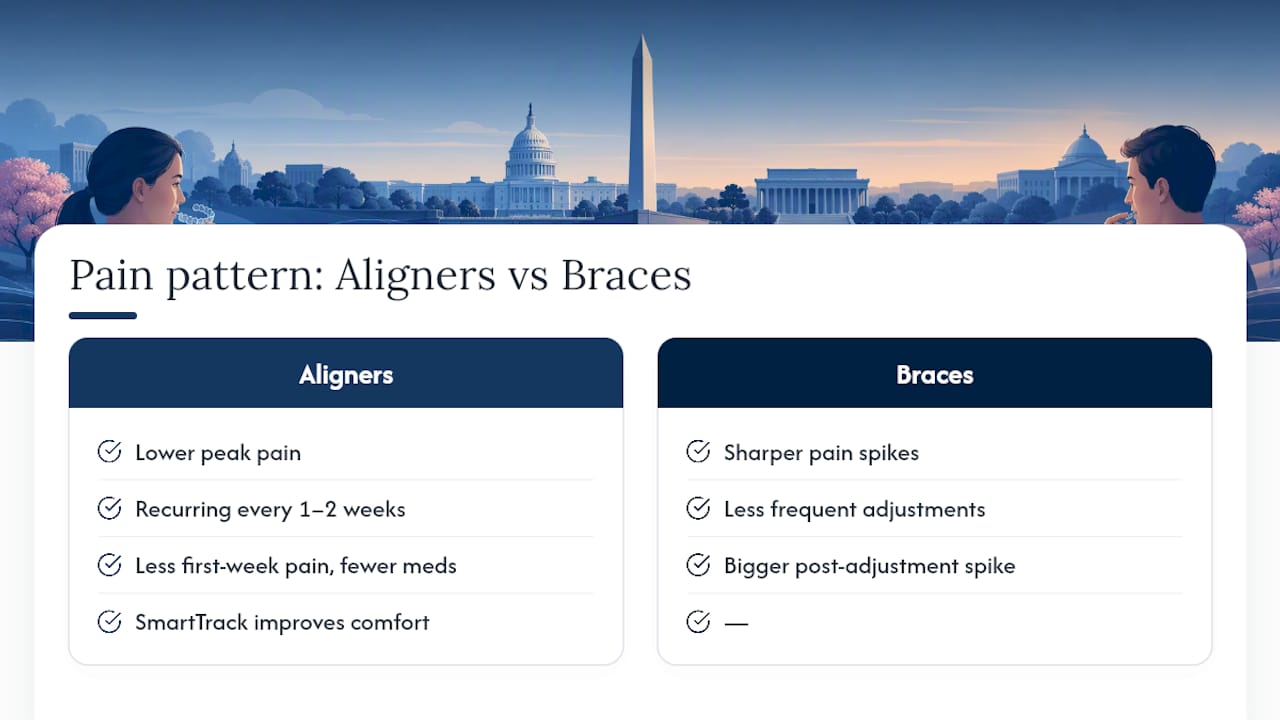
The research backs this up fairly consistently. Clinical studies comparing aligners to fixed appliances show Invisalign patients report lower pain and use fewer pain relievers, particularly during the first week of treatment. A systematic review of clear aligners versus fixed appliances found the same pattern holding at the seven day mark, and it noted that SmartTrack aligner material specifically improves comfort compared to older aligner materials.
The trade-off is really about the shape of the pain, not just the amount. Aligners produce a lower peak per tray but repeat that cycle roughly every one to two weeks. Braces tend to cause a sharper spike after each wire adjustment, but those adjustments happen less often. Neither pattern is objectively easier, it depends on whether you'd rather deal with smaller recurring soreness or bigger, less frequent spikes.
What Does a Dental Practice Actually Do About Tray Pain?
Dr. Kambez Shukoor, a U.S. Navy veteran who leads treatment planning at DC Implant & Cosmetic Dentistry, built the practice's comfort protocol around the same pattern the research shows: soreness that follows a predictable curve and resolves on its own, versus soreness that signals a fit problem. Patients are guided to insert new trays at night, use chewies to seat them fully, and reach for OTC medication on the schedule that fits their tolerance. The practice offers same-day appointments so issues like a rough tray edge or a poorly tracking aligner can be addressed promptly.
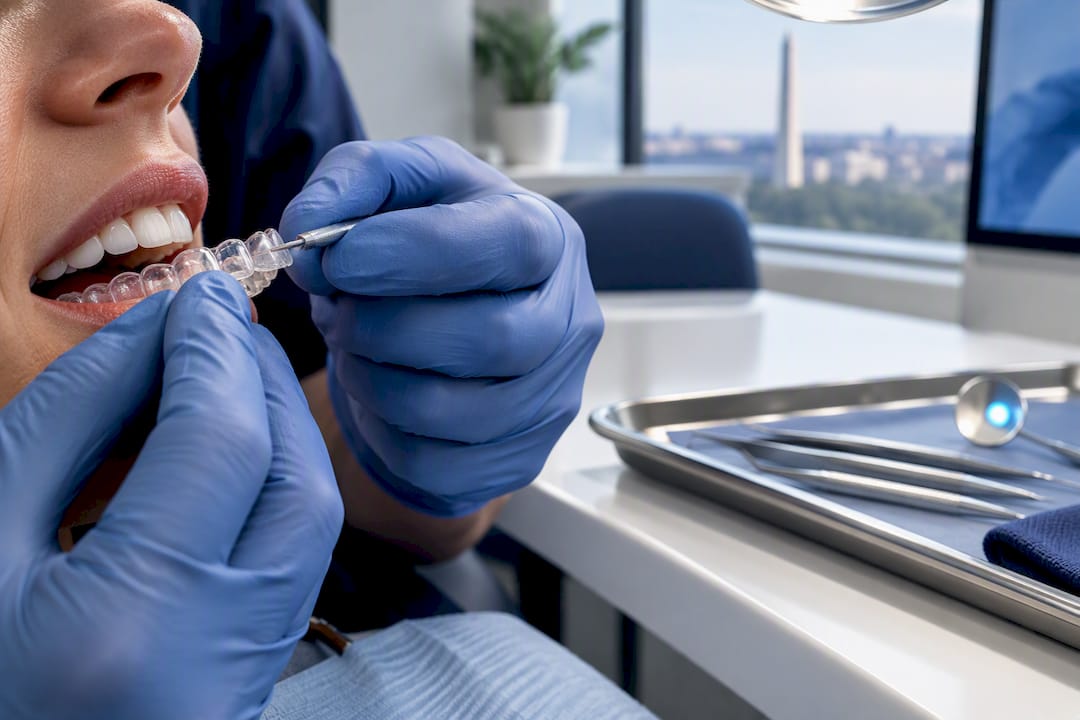
A same-day soreness visit typically involves checking how the current tray fits against your teeth, smoothing any edge that's causing irritation, evaluating whether attachments are seated correctly, and confirming the pain pattern matches a normal adjustment rather than a signal that something needs to change in your treatment plan.
What the Research Actually Tells You to Prioritize
The data on Invisalign pain is more reassuring than most people expect walking into treatment, but it also gets misapplied. The conventional advice, "just push through it," treats every twinge as normal adaptation. That's wrong often enough to matter. A predictable pain curve peaking at 24 hours and fading by day five isn't the same thing as pain that plateaus or climbs past that window, and conflating the two is how minor fixable issues turn into weeks of unnecessary discomfort.
What the evidence actually supports is treating the first 72 hours as expected and everything past day five as information. If soreness is still sharp or unchanged at day six, that's not a tolerance problem, it's a fit problem, and it usually has a same-day fix. The advice that gets underweighted is wear time discipline. Patients fixate on medication and cold compresses, but consistent 20 to 22 hour wear in the early months does more to shorten the adjustment period than any single comfort tactic on this list. Prioritize the hours in the tray first, then layer on the rest.
— Jake
Get a Same-Day Fit Check for Aligner Discomfort
If a rough tray edge, a nagging attachment, or soreness that's stuck past day five is making Invisalign harder than it should be, DC Implant & Cosmetic Dentistry offers same-day appointments to sort it out fast, no waiting a week for a five-minute fix. Every stage of clear aligner treatment, from the initial fitting to attachment adjustments to troubleshooting a tray that isn't tracking right, happens in-house under Dr. Kambez Shukoor's direct planning.

A same-day visit for tray discomfort typically covers a fit check, smoothing any sharp edge causing irritation, a look at attachment placement, and a quick walkthrough of the 30 minute rule and chewie technique if you haven't been using them yet. If you're mid-treatment and something feels off, or you're still deciding whether clear aligners are right for you, visit the Clear Aligners page to see what's involved and schedule a visit.
This article is general information, not a substitute for advice from a qualified doctor. Consult a qualified healthcare professional about your own circumstances before acting on anything here.
Sources
- Does Invisalign Hurt? Pain level and more | Healthline
- Pain perception among patients treated with passive self-ligating fixed appliances and Invisalign aligners | PMC
- Comparison of clear aligners vs fixed appliance pain: systematic review (Progress in Orthodontics)
FAQ
What Is the Most Painful Stage of Invisalign Treatment?
The first 24 to 72 hours after inserting each new tray is when discomfort peaks, with the highest reported pain typically landing around the 24 hour mark. This repeats with every tray change, though the intensity often decreases once you're past the first three or four trays.
What Is the 30-Minute Rule for Invisalign?
The 30 minute rule refers to taking an over the counter pain reliever about 30 minutes before inserting a new tray, for those who are able to take one, so it's already working by the time pressure sets in. It's a widely used comfort strategy rather than a formal medical guideline, so check the label or your doctor first.
Why Don't Some Dentists Recommend Invisalign for Every Case?
Invisalign works best for patients who can commit to wearing trays 20 to 22 hours a day and whose alignment issues fall within what clear aligners can predictably correct. More complex bite problems sometimes respond better to fixed appliances, which is a treatment planning decision rather than a reflection of aligner pain levels.
How Painful Is Invisalign on a Scale of 1 to 10?
Most patients rate it between 1 and 6, with roughly 54% describing mild pain and 35% reporting no pain at all. Scores of 7 or higher are uncommon and usually point to a fit issue rather than typical tooth movement.