
Interproximal reduction (IPR) is a precise, controlled procedure used during clear aligner therapy to remove small amounts of enamel between teeth, creating space and improving how teeth contact each other. The typical amount removed per contact point is 0.2–0.5 mm, which is less than the thickness of a fingernail. If your Invisalign plan includes IPR, that is not a red flag. It is a planned engineering step built into your digital treatment setup, and skipping it can cause your aligners to lose tracking and require mid-course corrections.
IPR is also called interproximal stripping, enameloplasty, or slenderizing. The procedure is referenced in ADA clinical guidance and aligns with Andrews' Six Keys of Normal Occlusion as a tool for achieving proper tooth contacts. According to a scoping review, IPR is planned in a majority of clear-aligner cases, so if your provider recommends it, you are among about two-thirds of clear-aligner patients for whom IPR is planned according to published studies.
Table of Contents
- What is interproximal reduction, exactly?
- When does an orthodontist recommend Invisalign IPR?
- How IPR is actually performed: tools and steps
- What to expect at your IPR appointment
- Does IPR hurt? What the sensation actually feels like
- Aftercare and the long-term outlook for your enamel
- Risks and benefits: an honest trade-off
- What are the alternatives to IPR?
- Can you refuse IPR? What happens if you do?
- Is IPR included in the cost of Invisalign? Insurance and billing
- What research and clinical guidelines say about IPR safety
- Who is a good candidate for IPR during Invisalign treatment?
- Does IPR affect long-term tooth stability and alignment?
- When IPR is not recommended
- What patients actually experience with IPR and Invisalign
- How to talk to your orthodontist about IPR
- Key Takeaways
- The part most patients miss about IPR
- Clear aligner treatment at Dc-dentistry in Washington, DC
- Further reading and authoritative sources
What is interproximal reduction, exactly?
IPR means your clinician removes a thin, measured layer of enamel from the sides of specific teeth, the surfaces that face neighboring teeth. The goal is to reshape the contact points so teeth can shift into their planned positions without crowding each other out.
A few things worth knowing upfront:
- IPR is irreversible but far less invasive than tooth extraction.
- It is not the same as filing teeth down for cosmetic reasons. Every millimeter is planned in the digital setup before your first aligner is made.
- The procedure targets enamel only. Dentin and pulp are not involved at standard reduction amounts.
- Common clinical reasons to use it: mild-to-moderate crowding, tooth-size discrepancy (sometimes called a Bolton discrepancy), reducing black triangles between teeth, and improving long-term contact stability.
The distinction between IPR and extraction matters. Extraction removes a whole tooth to create space. IPR creates space by reshaping existing teeth, conservatively and predictably, when the crowding is modest enough that a full extraction would be overkill.
When does an orthodontist recommend Invisalign IPR?
The most common trigger is mild-to-moderate crowding where the arch simply does not have enough room for teeth to align without some reshaping. Bolton-type tooth-size discrepancies, where upper and lower teeth are mismatched in width, are another frequent indication. Triangular tooth shapes that leave visible dark spaces (black triangles) at the gumline also respond well to IPR because slenderizing the contact point closes that gap.
Research published in a scoping review found that the mean total IPR prescribed per patient was a few millimeters across multiple contact points. That spread across multiple teeth is why the per-contact amount stays small even when the cumulative total sounds larger.
Consider a realistic scenario: a patient with 3 mm of lower anterior crowding and no significant skeletal discrepancy. Extraction would create far more space than needed and alter the facial profile. Arch expansion might not be stable long-term. IPR at six anterior contacts, 0.3–0.5 mm each, creates the precise space the digital plan needs without any of those trade-offs.
How IPR is actually performed: tools and steps
IPR is not a single motion with a single instrument. It follows a sequence, and the tools used have evolved considerably.
The step sequence:
- Digital treatment planning (DTP): The exact contacts, amounts, and timing are mapped in the 3D software before any enamel is touched.
- Access and visualization: Soft tissue is retracted so the clinician has a clear view of the contact to be reduced.
- Progressive enamel removal: The clinician removes enamel in small increments, measuring as they go.
- Finishing and polishing: A distinct step using progressively finer abrasives to smooth the surface.
- Documentation: The actual mm removed per contact is recorded, both for clinical records and patient consent files.
Tools used:
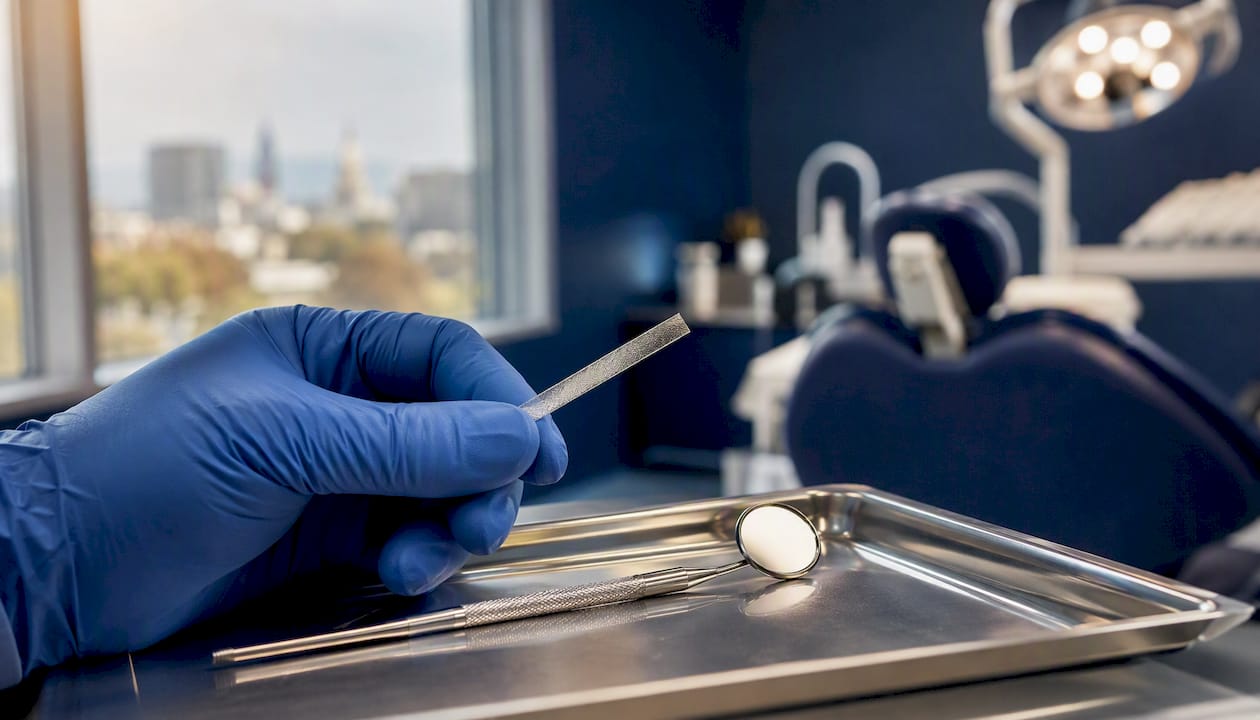
- Manual diamond strips: Thin abrasive strips passed between teeth. Effective but slower and more technique-sensitive.
- Oscillating mechanical systems: Motorized handpieces with abrasive discs or strips. Systematic review evidence shows these provide higher precision, greater efficiency, and gentler effects on enamel compared with manual methods. Most modern clinics favor them.
- Safe-tipped burs: Used for posterior contacts where strip access is limited.
Polishing is not optional. Research consistently shows that skipping or rushing the polishing step increases surface roughness, which raises plaque retention risk. Clinicians should use progressively finer abrasives and verify smoothness by tactile feel and visual inspection before moving on.
Pro Tip: Before your IPR appointment, ask your clinician to show you the digital plan and point out the exact mm planned for each contact. A good provider will have this documented and will walk you through it.
What to expect at your IPR appointment
A typical IPR visit is shorter than most patients expect. After reviewing the digital plan with you, the clinician retracts soft tissue for access, performs IPR on the planned contacts, polishes each surface, and documents the results. Depending on how many contacts are being treated, the hands-on portion usually takes a short appointment.
Local anesthesia is usually not required. The enamel being removed is thin and does not reach the nerve. Some clinicians offer topical desensitizing agents if a patient is particularly sensitive, but most appointments proceed without any numbing at all.
Before your appointment:
- Brush and floss thoroughly. Clean teeth give the clinician better access and reduce contamination risk.
- Bring any prior scans or records if you are switching providers mid-treatment.
- Write down your questions about mm amounts, which contacts are being treated, and the polishing protocol used.
Not all IPR happens at the start of treatment. A significant share of IPR prescriptions occur during refinement phases, so do not assume that if you had none at the beginning, you will have none later.
Does IPR hurt? What the sensation actually feels like
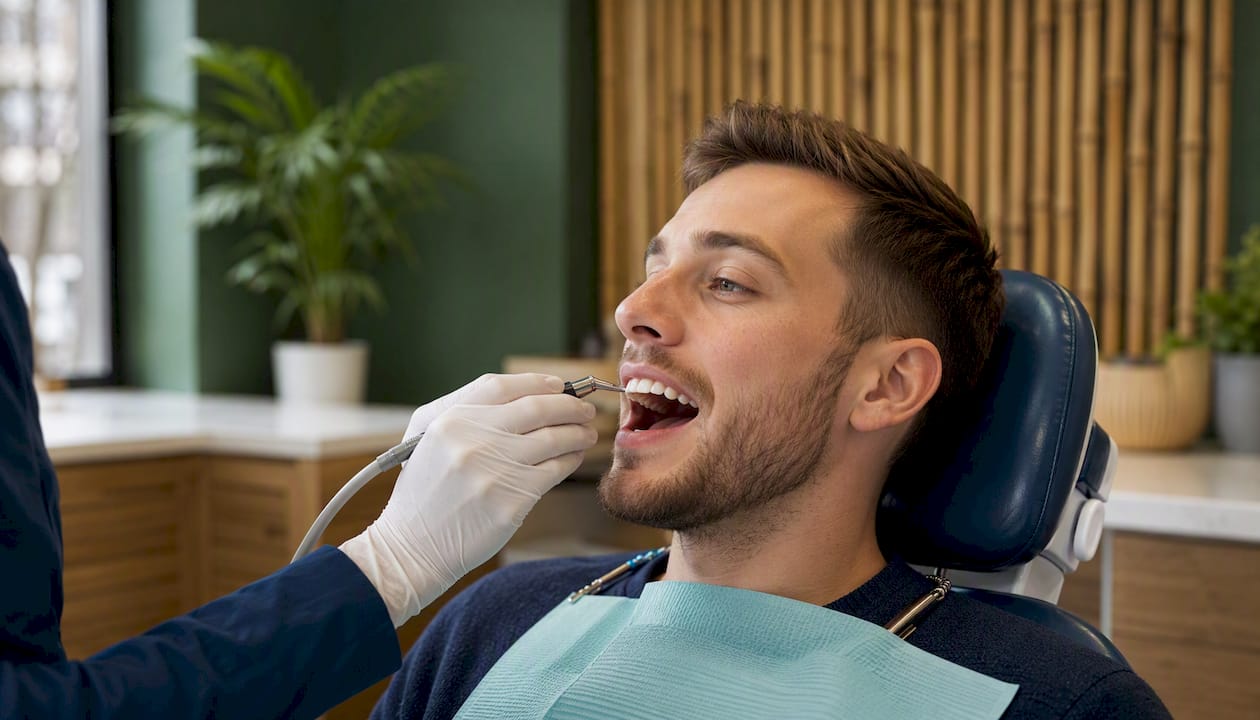
For most patients, IPR is described as pressure and vibration rather than pain. Clinical evidence and patient reports consistently characterize it as minimally invasive, with local anesthesia rarely needed.
What you might notice:
- A vibrating or buzzing sensation from the mechanical instrument.
- Brief sensitivity when the strip or disc passes through the contact point.
- Mild temperature sensitivity in the hours after the appointment.
Short-term sensitivity typically resolves within a few days. To manage it:
- Switch to a desensitizing toothpaste (look for potassium nitrate or stannous fluoride) for a week or two after the procedure.
- Avoid very hot or very cold foods and drinks for 48–72 hours.
- Soft foods are not required, but if a contact feels tender, eating on the opposite side briefly is fine.
If sensitivity persists beyond a week or feels sharp rather than mild, contact your provider. That is not typical and warrants a check.
Aftercare and the long-term outlook for your enamel
Short-term recovery is minimal. Most patients leave the appointment and go about their day normally. The main aftercare priorities are oral hygiene and remineralization.
Short-term steps:
- Continue brushing twice daily with a fluoride toothpaste.
- Floss carefully around treated contacts; the surfaces are smooth but still need cleaning.
- If your provider recommends a topical fluoride or CPP-ACP product, use it as directed.
Follow-up and refinements:
Refinement-stage IPR is common. Studies show that refinement prescriptions tend to be smaller than initial-stage prescriptions, but they still need to be completed on schedule. Skipping IPR at the planned aligner stage causes aligners to lose fit, which is one of the most common practical failures in aligner workflows.
Long-term enamel health:
Systematic reviews find no significant long-term increase in caries or sensitivity when IPR is performed with proper finishing in patients with low caries risk. The polishing step, combined with topical remineralization, is what makes that outcome possible. Patients with active decay, high caries risk, or thin enamel need individualized assessment before IPR is appropriate.
Risks and benefits: an honest trade-off
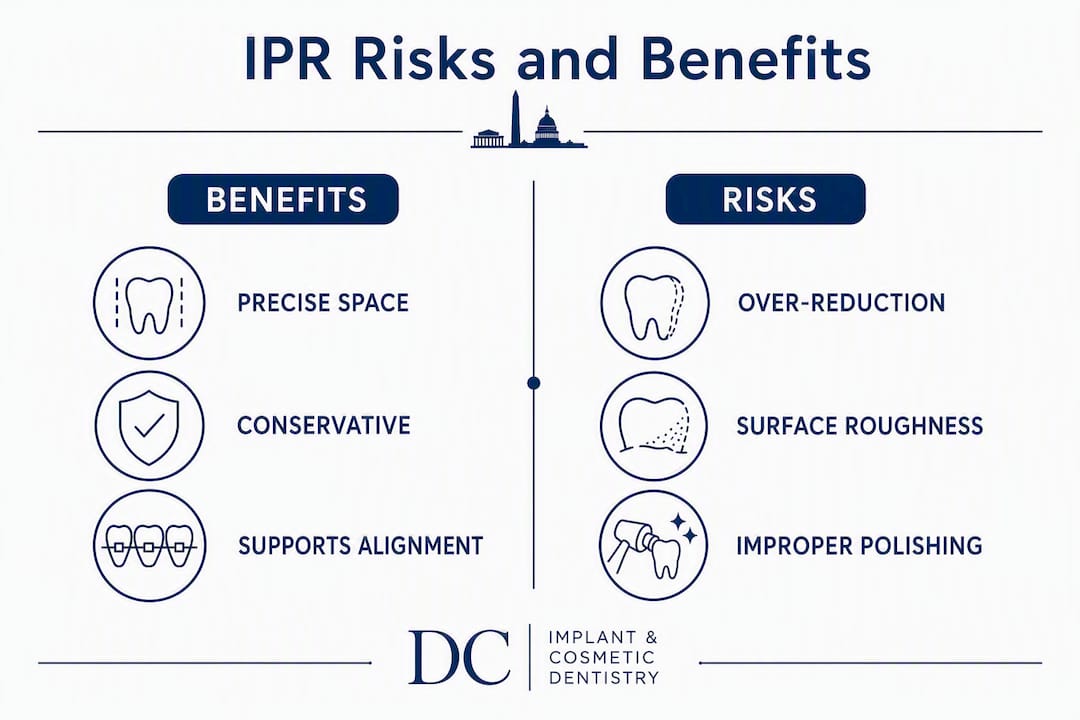
IPR is safe and well-supported when it is planned carefully and executed precisely. That does not mean it is without trade-offs.
Benefits:
- Creates space without extraction, preserving all teeth.
- Improves contact point shape, which can reduce black triangles.
- Supports better long-term contact stability after treatment.
- Keeps the aligner plan on track by giving teeth room to move as designed.
Risks:
- Over-reduction beyond the planned amount removes enamel that cannot be replaced.
- Poor finishing leaves rough surfaces that accumulate plaque.
- Temporary sensitivity is common; persistent sensitivity is a warning sign.
- If IPR is not done at the right aligner stage, tracking problems follow.
| Factor | IPR | No IPR (when indicated) |
|---|---|---|
| Space creation | Precise, conservative | Relies on expansion or extraction |
| Enamel impact | Minimal, irreversible | None |
| Tracking risk | Low when sequenced correctly | Higher if crowding is not resolved |
| Black triangle management | Effective | Limited |
| Extraction avoidance | Often achieved | May still be needed |
Risk mitigation comes down to four things: proper case selection, precise digital planning, staged execution at the correct aligner intervals, and thorough polishing with documented measurements. ADA-style clinical guidelines emphasize all four as non-negotiable elements of a safe protocol.
What are the alternatives to IPR?
IPR is not the only way to create space, and a good clinician will explain why it was chosen over the alternatives for your specific case.
Main alternatives:
- Tooth extraction: Appropriate for severe crowding where IPR cannot create enough space. Removing a premolar, for example, creates several millimeters of room. The trade-off is losing a permanent tooth and a longer, more complex treatment. Extraction is a separate clinical decision with its own risks and recovery.
- Transverse arch expansion: Widening the arch using aligners or expanders to create space. Works well in younger patients with growth potential or mild constriction. Less predictable in adults with fully developed bone.
- Interproximal composite bonding: Used specifically for black-triangle management rather than space creation. A small amount of composite resin reshapes the contact area. It is additive rather than subtractive, but it requires maintenance and can chip.
Decision factors your clinician weighs: severity of crowding, tooth morphology (triangular teeth respond differently than square ones), patient age, periodontal status, and long-term stability goals. Ask your provider to explain which factors drove the recommendation for your case.
Can you refuse IPR? What happens if you do?
Yes, you can decline any procedure. Informed consent is your right. But refusing IPR that is integral to the digital plan will likely compromise aligner tracking and treatment effectiveness. The digital plan is built around specific tooth movements that assume the prescribed space will exist. Without it, aligners may not seat properly, teeth may not move as planned, and mid-course corrections become necessary.
In practical terms: refusing IPR may mean extended treatment time, additional refinement rounds, and in some cases, a recommendation to pursue extraction instead.
Questions to ask before consenting:
- How many mm are planned at each contact, and which specific teeth?
- At which aligner stage will each IPR be performed?
- What polishing protocol do you use after reduction?
- How do you document the actual mm removed?
- What happens to my plan if I decline IPR at a specific contact?
Getting clear answers to these questions is not being difficult. It is exactly what a well-prepared patient should do.
Is IPR included in the cost of Invisalign? Insurance and billing
Billing practices vary by office. In many comprehensive aligner fees, IPR is bundled into the total treatment cost. In other practices, particularly those billing by time or complexity, IPR may appear as a separate line item depending on the number of contact sites and the clinical time involved.
What to do before you commit:
- Request an itemized treatment quote that specifies whether IPR is included or billed separately.
- Ask how many contacts are planned and whether refinement-stage IPR would carry an additional charge.
- Check your dental insurance's orthodontic benefit. Most plans cover a portion of comprehensive orthodontic treatment, but coverage for individual adjunct procedures varies widely.
- If out-of-pocket costs are a concern, ask about financing options. Practices like Dc-dentistry offer financing through CareCredit and Lending Tree, which can spread costs over time.
Insurance checklist:
- Confirm whether your plan covers "orthodontic treatment" or only specific procedure codes.
- Ask if IPR is billed under a separate CDT code at your provider's office.
- Verify your remaining orthodontic lifetime maximum before treatment begins.
What research and clinical guidelines say about IPR safety
The clinical consensus is clear: properly planned and executed IPR, with polishing, is safe and predictable for mild-to-moderate crowding in clear aligner therapy. The evidence base has grown substantially in recent years.
| Research finding | Clinical implication |
|---|---|
| Per-contact reduction of 0.2–0.5 mm is standard in structured protocols | Clinicians should not exceed this range without documented justification |
| Oscillating mechanical systems increase precision and reduce chair time vs. manual strips | Modern clinics should favor motorized systems for consistency |
| No significant long-term caries or sensitivity increase in low-caries-risk patients with proper finishing | Patient selection and polishing quality determine long-term safety |
| IPR planned in ~two-thirds of aligner cases | Patients should expect IPR as a routine part of many treatment plans |
Clinical practice checklist from guidelines:
- Select cases carefully: low caries risk, adequate enamel thickness, healthy periodontium.
- Complete alignment before IPR where possible; moving teeth into better position first reduces the amount of reduction needed.
- Protect soft tissue during the procedure.
- Measure and document mm removed per contact.
- Polish with progressively finer abrasives and verify smoothness.
- Apply topical fluoride or CPP-ACP after IPR.
One important caveat: study heterogeneity is real. Protocols, instruments, and measurement methods vary across the literature, which is why practitioner skill and strict adherence to the digital plan remain the most critical variables.
Who is a good candidate for IPR during Invisalign treatment?
Not every patient is a candidate. The ideal profile for IPR during clear aligner therapy includes: mild-to-moderate crowding (roughly 1–4 mm of discrepancy), adequate enamel thickness, low caries risk, healthy gingival tissue, and no existing large restorations at the planned contact sites. Patients with existing inlays or onlays at a contact point require special consideration, since reducing a restoration rather than natural enamel changes the clinical calculus entirely.
Adults with stable periodontal health and no active decay are generally the best candidates. Adolescents can be candidates too, though enamel thickness and maturation are factored in. Patients with a history of bruxism or significant enamel erosion need individualized evaluation before IPR is planned.
Does IPR affect long-term tooth stability and alignment?
When executed correctly, IPR tends to support stability rather than undermine it. Reshaping triangular contact points into flatter, broader contacts creates more surface area between adjacent teeth, which resists relapse. Black triangles that are closed through IPR also tend to stay closed because the contact geometry has been physically changed.
The risk to stability comes from two sources: over-reduction and poor finishing. Over-reduction weakens the contact and can create spacing that drifts over time. Rough, unpolished surfaces accumulate plaque, which raises the risk of interproximal decay and gingival inflammation, both of which destabilize the periodontium and indirectly affect tooth position.
Retention compliance matters here too. IPR does not replace the need for retainers after treatment. Teeth that have been reshaped still need retention to hold their new positions, just like any other orthodontic result. Understanding aligner wear rules and compliance expectations is part of protecting your long-term outcome.
When IPR is not recommended
Several clinical situations make IPR inappropriate or require significant modification:
- Active caries or decalcification at or near the planned contact. Removing enamel from a compromised surface accelerates damage.
- Thin enamel from erosion, fluorosis, or genetic factors. Standard reduction amounts may reach dentin.
- Large existing restorations (crowns, onlays) at the contact site. Reducing a restoration is not the same as reducing enamel.
- Severe crowding beyond what IPR can resolve. Attempting IPR when extraction is the appropriate treatment delays the right solution.
- Periodontal disease that is active or poorly controlled. Inflamed tissue complicates the procedure and increases risk.
- High caries-risk patients without a remineralization protocol in place. The evidence for safety is specific to low-caries-risk populations.
If any of these apply to you, the conversation with your provider should shift to alternatives before IPR is scheduled.
What patients actually experience with IPR and Invisalign
The most consistent theme across patient accounts is surprise at how uneventful the procedure is. Most people expect something closer to a filling appointment and find that IPR is quicker and less uncomfortable than anticipated. The vibration from a mechanical system is the dominant sensation, and it passes quickly at each contact.
Sensitivity after the appointment is the most commonly reported side effect, and it is almost always described as mild and short-lived. Patients who use a desensitizing toothpaste for a week or two after IPR rarely report it as a significant issue.
The frustration that does come up in patient accounts tends to be about communication rather than the procedure itself: not knowing in advance how many contacts were planned, not understanding why IPR was needed, or not being told that additional IPR might be prescribed during refinements. That gap is entirely preventable with a clear pre-treatment conversation.
How to talk to your orthodontist about IPR
Walking into the conversation prepared makes a real difference. These are the questions worth asking:
- "How many contacts are planned for IPR, and how many mm at each one?" You want a specific number, not a general answer.
- "At which aligner stage will each IPR be done?" Timing matters for tracking.
- "What instrument do you use, and do you polish afterward?" Oscillating systems and polishing are the current standard.
- "How do you document what was actually removed?" Good practices keep records.
- "What happens to my treatment if I skip a planned IPR?" Understanding the consequence helps you weigh the decision.
- "Is there an alternative to IPR for my specific case?" A clinician who has considered alternatives and can explain why IPR was chosen is one you can trust.
If your provider cannot or will not answer these questions clearly, that is worth noting.
Key Takeaways
IPR is a planned, measured enamel-reduction step built into most clear aligner digital plans, and proper execution with polishing is what separates a safe outcome from a problematic one.
| Point | Details |
|---|---|
| Standard reduction per contact | IPR removes a small, measured amount of enamel per contact, following structured clinical protocols. |
| How common it is | IPR is planned in about two-thirds of clear-aligner cases, making it a routine part of many Invisalign plans. |
| Polishing is non-negotiable | Skipping or rushing the polishing step raises plaque retention risk and affects long-term enamel health. |
| Refusing IPR has real consequences | Declining prescribed IPR can compromise aligner tracking and may require mid-course corrections or additional refinements. |
| Dc-dentistry's approach | Dc-dentistry integrates IPR into a documented digital plan with measured reduction, polishing, and patient education at every stage. |
The part most patients miss about IPR
Most articles about IPR focus on whether it hurts (it usually does not) and how much enamel is removed (not much). What they underemphasize is the sequencing problem.
IPR is not just a procedure. It is a timed event in a staged engineering plan. The digital setup assumes that a specific amount of space will exist at a specific contact point at a specific aligner stage. If that space is not created on schedule, the aligner that follows cannot seat correctly, and the entire movement sequence downstream is affected. That is why clinicians who skip or delay IPR, even by a few aligner stages, end up with patients who need refinements that could have been avoided.
The other thing worth saying plainly: the quality of polishing after IPR is as important as the reduction itself. A clinician who removes the right amount of enamel but leaves a rough surface has done half the job. Rough enamel accumulates plaque at a higher rate, and over a multi-year retention period, that adds up. Ask about polishing. It is not a minor detail.
Clear aligner treatment at Dc-dentistry in Washington, DC
Dc-dentistry offers clear aligner treatment in Washington, DC, with IPR integrated directly into the digital treatment plan from the start. Every IPR prescription is documented with exact mm per contact, performed using current instrumentation, and followed by polishing, so patients know precisely what was done and why.
Dr. Kambez Shukoor, a U.S. Navy veteran with over 200 five-star reviews, leads a practice built around same-day appointments and transparent patient communication. If you are weighing whether IPR is right for your case, or if you want a second opinion on a plan that includes it, the team at Dc-dentistry can walk you through the digital plan in detail before any enamel is touched. Financing through CareCredit and Lending Tree is available for patients managing out-of-pocket costs.
Schedule a consultation at dc-dentistry.com/clear-aligners to review your aligner options and get a clear answer on what your specific plan requires.
This article is for general informational purposes only and does not constitute dental or medical advice. Confirm your specific treatment plan and any clinical recommendations with a licensed dental professional.
Further reading and authoritative sources
These are the primary sources used in this article, selected for clinical authority and relevance to IPR in clear aligner therapy:
- Guidelines for Interproximal Enamel Reduction (IPR): ADA-style clinical guidelines covering case selection, protocol elements, and consent standards.
- Interproximal reduction (IPR) — Cleveland Clinic: Patient-facing procedural overview from a major U.S. academic medical center.
- The Role of the Interproximal Enamel Reduction in Orthodontics: A Systematic Review: Comprehensive review of instruments, techniques, polishing evidence, and long-term outcomes.
- Interproximal reduction with clear aligner therapy: A scoping review: Scoping review covering prevalence, mean prescriptions, and refinement-stage patterns in aligner cases.
- Interproximal reduction: optimising clear aligner treatment: Clinical practice article on per-contact mm ranges and sequencing in aligner workflows.