
Most patients start Invisalign using one of five routes: an in-house clinic payment plan, a third-party healthcare lender like HFD, a health credit card like CareCredit, a buy-now-pay-later plan, or HSA/FSA dollars stacked on top of insurance. Nearly all of these let you begin treatment with little or nothing down and pay the balance monthly. The fastest next step is simple: ask your provider for a written monthly estimate based on your actual case, not the sticker price.
TL;DR:
- Most financing options allow starting Invisalign treatment with little or no down payment and offer monthly payments tailored to your total cost.
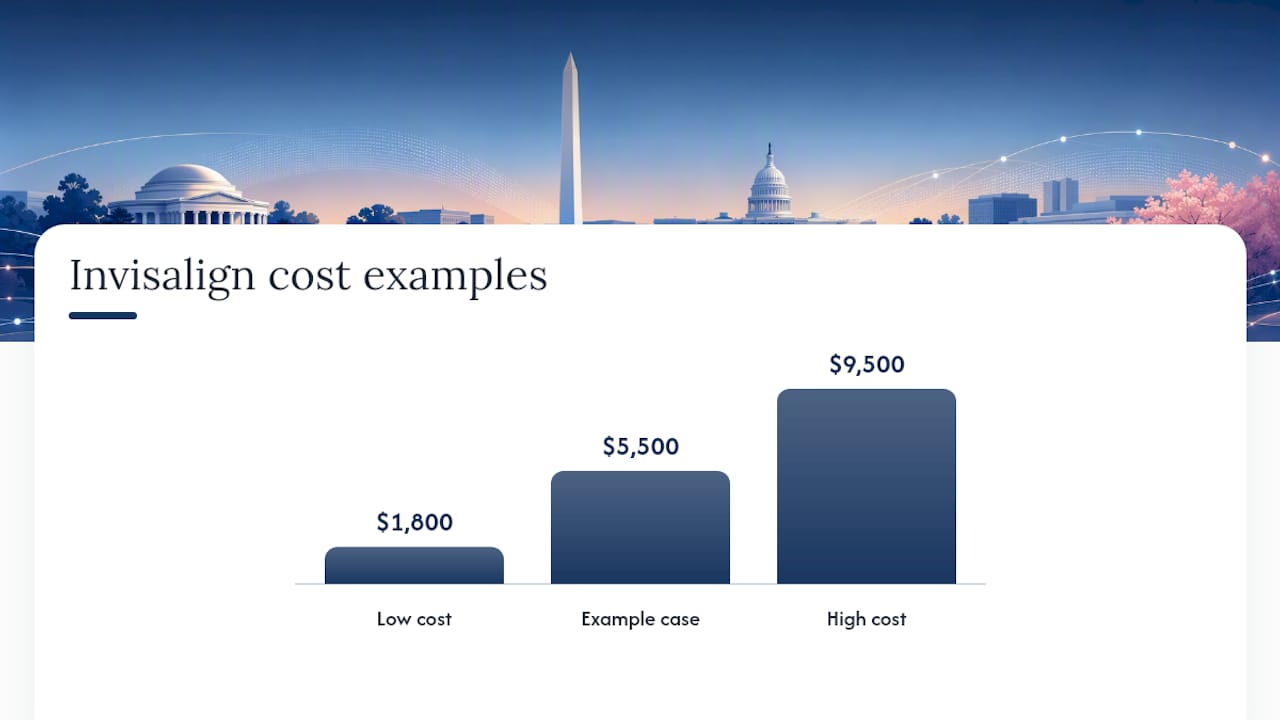
- The treatment cost typically ranges from $1,800 to $9,500, with longer durations and complex cases increasing the final price.
- Converting the total cost into monthly payments depends on insurance contributions, down payments, and financing terms, with longer terms reducing monthly bills but increasing total interest.
- Comparing the total repayment amount, interest rates, loan length, and early payoff penalties is crucial to choosing the most cost-effective plan.
- Working with a provider that offers in-person guidance simplifies understanding insurance, HSA/FSA, and financing, helping you start treatment sooner and with clearer costs.
Table of Contents
- Payment Options Explained: In-House Plans, HFD, CareCredit, BNPL, and Insurance
- What Does Invisalign Cost, and How Do You Turn That Into a Monthly Number?
- How Do You Choose the Right Financing Plan?
- Why Work With DC Implant & Cosmetic Dentistry on Financing?
- When Should You Actually Start Treatment?
- Ready to Start? Here's How Financing Works at Our Office
- Where to Verify These Financing Details Yourself
- Sources
- FAQ
Payment Options Explained: In-House Plans, HFD, CareCredit, BNPL, and Insurance
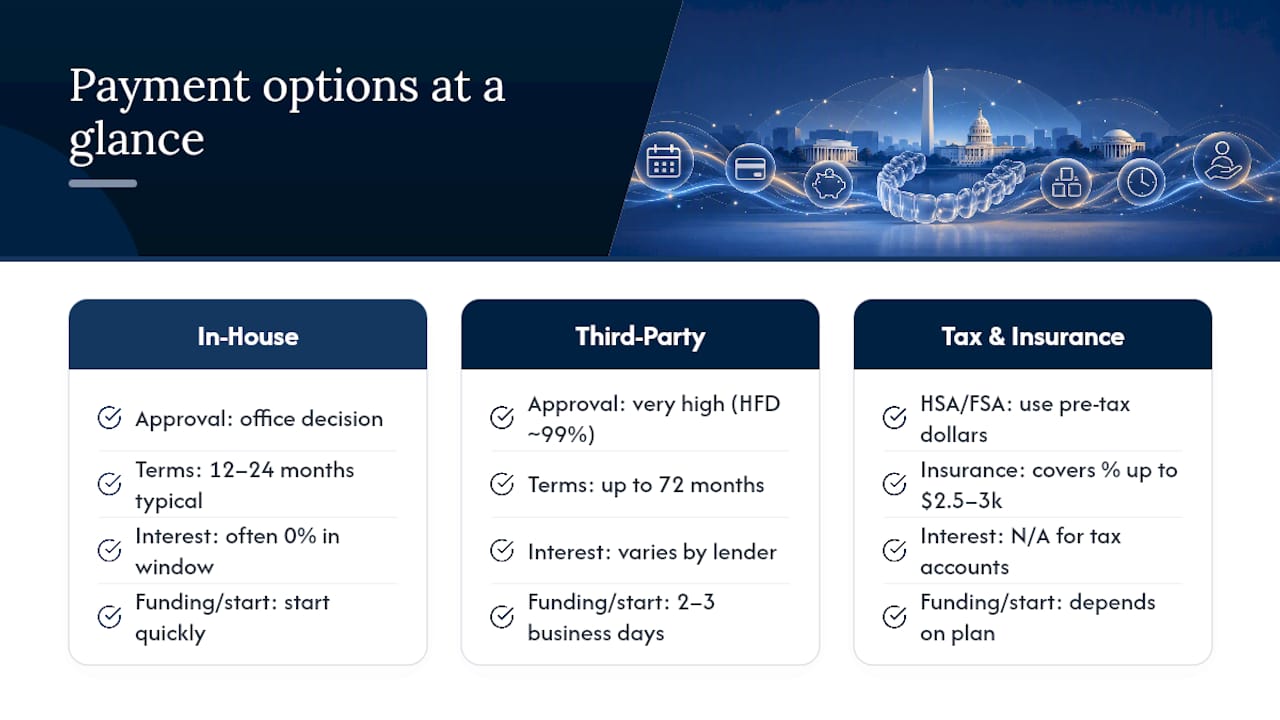
Every financing route works a little differently, and the right one depends on your credit situation, how fast you want to start, and whether you'd rather pay a lender or your dentist directly.
In-house clinic plans are the simplest option. Most practices split the remaining balance into equal monthly installments over the treatment length, often 12 to 24 months, frequently with no interest if you pay inside a set window. Longer in-house plans sometimes carry a small interest markup, but you are negotiating directly with the office that's treating you, which means more flexibility if your circumstances change mid treatment.
Third-party lenders, particularly Healthcare Finance Direct (HFD), are built for near-universal access. HFD advertises approval rates near 99%, uses a soft credit inquiry that won't ding your score, and guarantees approvals of $7,000 or more for many applicants. Terms run up to 72 months, and funding typically reaches the office within 2 to 3 business days of signing.
CareCredit functions like a health-specific credit card, often with a promotional 0% APR window if you pay off the balance within a set number of months. Acceptance varies by practice, so confirm your office takes it before counting on it.
BNPL plans work well for smaller balances, usually offering interest-free terms over a few months, then charging real fees once you stretch the term longer.
HSAs and FSAs let you pay with pre-tax dollars, which effectively lowers your net cost since that money was never taxed. Keep your itemized treatment plan for documentation.
Dental insurance with orthodontic benefits typically covers a percentage up to roughly $2,500 to $3,000 lifetime, not per year, so check your plan's cap before you build your budget around it.
What Does Invisalign Cost, and How Do You Turn That Into a Monthly Number?
Clear aligner treatment in the U.S. typically runs $1,800 to $9,500, with a commonly cited average around $5,100 to $5,700. Where you land in that range depends on a handful of factors, and none of them are random.
Treatment length matters most: a 6-month minor correction costs far less than an 18-month full realignment. The number of aligner trays, whether you need refinements partway through, attachments to help move stubborn teeth, and whether you're treating with a general dentist or an orthodontist all shift the final number. Location plays a role too, since overhead costs in a market like Washington, DC differ from a smaller town.
Once you know your total cost, converting it to a monthly payment is one formula:
- Start with the total treatment cost.
- Subtract any insurance contribution (up to your plan's cap).
- Subtract your down payment, if any.
- Divide the remaining balance by your financing term in months.
A $5,500 case with a $1,500 insurance credit and no down payment leaves a $4,000 balance. Spread over 12 months at 0% interest, that's about $333 a month. Stretch it to 24 months and it drops to roughly $167. Push it to 48 or 72 months through a lender like HFD, and monthly payments can fall well below $100, though a longer term at a nonzero APR means paying more in total interest over the life of the loan. Run the math on your own numbers using a detailed cost breakdown before committing to a term.
How Do You Choose the Right Financing Plan?
The lowest monthly payment isn't automatically the best deal. A plan that stretches your balance across 72 months might feel comfortable today but cost hundreds more in total interest than a shorter, higher-payment plan. Compare offers on four things: the monthly payment, the total amount you'll repay by the end of the term, the APR or fee structure, and whether there's a penalty for paying it off early.
Bring these questions to your consultation:
- What's my exact monthly payment after insurance and any down payment?
- Is the credit check a soft pull or a hard pull, and will it show on my credit report?
- What's the APR, and does it change after a promotional period ends?
- What's the total amount I'll repay by the last payment?
- Can I use my HSA or FSA card directly, or do I need to submit for reimbursement?
- How fast can treatment start once financing is approved?
Watch for red flags: any plan that won't state the total repayment amount in writing, mandatory add-on fees not disclosed upfront, or a hard credit pull run without telling you first. A legitimate office will hand you a written schedule without hesitation.
Pro Tip: Always ask whether the financing term extends past your expected treatment length. If your loan runs 60 months but treatment finishes in 18, you're still on the hook for payments long after your aligners are gone.
Why Work With DC Implant & Cosmetic Dentistry on Financing?
Sorting through financing offers is easier with a team that walks you through it in person instead of leaving you to compare fine print alone. Our team offers same-day appointments and strives to provide high-quality patient care, reflected in numerous positive reviews.
At your consultation, the team can:
- Review your insurance benefits and tell you exactly what your plan covers toward orthodontic treatment.
- Walk you through HSA/FSA paperwork so your pre-tax dollars apply correctly.
- Help you apply for in-office or partner financing on the spot.
- Provide a written monthly payment estimate before you commit to anything.
Bring your insurance card, HSA/FSA account information, a photo ID, and, if requested for a financing application, a recent pay stub. Adult demand for orthodontic treatment is at an all-time high, and having a clinic that handles the paperwork alongside the treatment plan removes a real barrier to starting.
When Should You Actually Start Treatment?
Cost shouldn't be the only reason to delay Invisalign if there's no medical reason to wait. If a financing route gets you a manageable monthly payment and there's no active infection or structural issue that needs addressing first, starting sooner usually beats waiting for a "better time" that may never come.
A few things reliably lower the bill: bundling any needed prep work into one visit instead of spreading it across separate appointments, running HSA or FSA dollars against the balance first, and asking specifically about short-term interest-free windows before accepting a longer term. Financed responsibly, with a clear written schedule in hand, the outcome is the same as paying in full. Only the timeline for your wallet changes.
— Jake
Ready to Start? Here's How Financing Works at Our Office
Comparing lenders and reading fine print gets tiring fast, and plenty of patients just want a straight answer about what they'll owe each month. That's the gap DC Implant & Cosmetic Dentistry closes: instead of researching five different financing platforms on your own, you sit down with our team once, and we run your insurance, HSA/FSA eligibility, and financing options together in a single visit.

Same-day consults mean you don't wait weeks just to find out your number. Bring your insurance information and we'll check your orthodontic benefit cap, walk you through applying for in-office or partner financing, and hand you a written monthly estimate before you leave. If you're ready to see what your case actually costs, book a visit through our clear aligners page and get a real number instead of a guess.
Where to Verify These Financing Details Yourself
Check your specific coverage and financing terms directly at the source before you commit. Invisalign's own payment options page covers insurance and HSA/FSA rules, its HFD financing page details soft-pull approval terms, and you can confirm any lender's registration through NMLS Consumer Access before signing anything.
Sources
FAQ
Is $4,000 a Lot to Pay for Invisalign?
Not really. $4,000 sits near the middle of the typical $1,800 to $9,500 national range, and spread over a 24 to 48 month financing term, it usually breaks down to a manageable monthly payment rather than a lump sum.
Can I Pay Monthly for Invisalign?
Yes. Most practices offer in-house monthly plans, and third-party lenders like HFD extend terms up to 72 months, so a monthly structure is the norm rather than the exception.
Can I Pay for Invisalign in Installments?
Yes, through in-house plans, healthcare lenders, health credit cards like CareCredit, or BNPL services, all of which split your balance into fixed installments rather than requiring payment in full upfront.
Is $6,000 Too Much for Invisalign?
No, this falls close to the commonly cited national average of $5,100 to $5,700, so it's a realistic price for a full course of treatment rather than an inflated one, especially for more complex cases requiring a longer timeline.