Most patients pay $3,000 to $8,500 for Invisalign, with the majority landing in the $5,000 to $7,000 range before insurance. Financed and stacked with benefits, monthly payments often fall within a moderate range.
- Typical total cost range varies considerably depending on case complexity and location.
- Typical monthly payments after stacking benefits are generally affordable and vary by patient.
- Best cost order: insurance → HSA/FSA → 0% financing
Quick fact: 92% of insurance plans verified in one large dataset qualified for up to $3,000 toward orthodontic treatment, and the average payout came in at $1,772.
TL;DR:
- Most patients pay between $3,000 and $8,500 for Invisalign, with the typical cost for most adults falling in the $5,000 to $7,000 range.
- Costs increase by treatment tier, with full treatments exceeding $8,500 for complex cases, and location can add 20% to 40%.
- Insurance and FSA or HSA funds can cover an average of $1,772 to $3,000, significantly reducing out-of-pocket expenses.
- The total cost depends mainly on case complexity, treatment length, provider type, and what is bundled versus billed separately.
- Comparing multiple detailed quotes, verifying insurance benefits, and choosing experienced providers help ensure accurate pricing and reduce hidden costs.
Table of Contents
- How Much Does Invisalign Cost by Treatment Tier?
- What Actually Determines Your Total Invisalign Cost?
- Will Insurance or My HSA/FSA Cover Invisalign?
- What Will Your Monthly Payment Actually Look Like?
- What Should Be Included in a Real Invisalign Quote?
- Is Invisalign Cheaper Than Braces, or Just Different?
- How Do You Get a Quote You Can Actually Trust?
- Why Getting the Right Provider Matters More Than the Price Tag
- Get Your Exact Invisalign Price at DC Implant & Cosmetic Dentistry
- Key Takeaways
- Sources
How Much Does Invisalign Cost by Treatment Tier?
Invisalign isn't one price. It's sold in tiers based on how many aligners your case needs, and that's the single biggest lever on your final bill.
- Express: roughly $1,500 to $3,000 for minor crowding or spacing, usually 7 to 14 aligners
- Lite: about $3,000 to $5,000 for mild to moderate shifts, capped around 14 aligner sets
- Moderate: typically $4,500 to $7,000, the tier where most adult patients actually land
- Full/Comprehensive: $5,000 to $8,500-plus for complex bite corrections with unlimited aligners over the treatment arc
Most adult patients fall into the Moderate tier, which is why the $5,000 to $7,000 midpoint shows up so often in national pricing data. Where you live moves that number too. Major coastal metro markets like New York, San Francisco, and Washington, DC commonly run 20% to 40% higher than mid-size city pricing for a comparable case, mostly driven by clinic overhead and provider demand rather than anything different about the treatment itself.
Statistic to remember: a Moderate case in a major metro can cost $1,000 to $2,000 more than the identical case treated in a smaller city, purely on location.
What Actually Determines Your Total Invisalign Cost?
A quote isn't a random number. Four variables drive nearly all of the difference between a $3,500 estimate and an $8,000 one.
- Case complexity and aligner count. More correction means more trays, and more trays means a higher tier.
- Treatment length. Longer plans (18 to 24 months) generally cost more than short 6 to 12 month cases.
- Provider type. Orthodontists often charge more for complex bite work, while experienced general dentists can deliver comparable results on cosmetic or minor-to-moderate cases for less.
- What's bundled versus billed separately. Some quotes include retainers and monitoring visits; others tack those on later.
Pro Tip: Ask every office the same question before comparing prices: "Is this quote based on my ClinCheck treatment plan, or a general estimate?" A ClinCheck-based number is the only one worth comparing apples to apples.
Will Insurance or My HSA/FSA Cover Invisalign?
Many dental plans treat Invisalign the same way they treat traditional braces, and the American Association of Orthodontists confirms that coverage parity between aligners and braces is now standard across most plans. That's a meaningful shift from a decade ago, when clear aligners were sometimes excluded as "cosmetic."
The dollar amounts are real, not vague. Insurance-verification data on more than 100,000 patients found an average orthodontic benefit of $1,772, and 92% of verified plans covered up to $3,000 toward treatment. Stack that with an HSA or FSA, and the math changes fast.
| Funding Source | Typical Amount Available |
|---|---|
| Average insurance orthodontic benefit | $1,772 |
| Plans covering up to $3,000 | 92% of verified plans |
| HSA/FSA use | Pre-tax dollars applied directly to treatment |
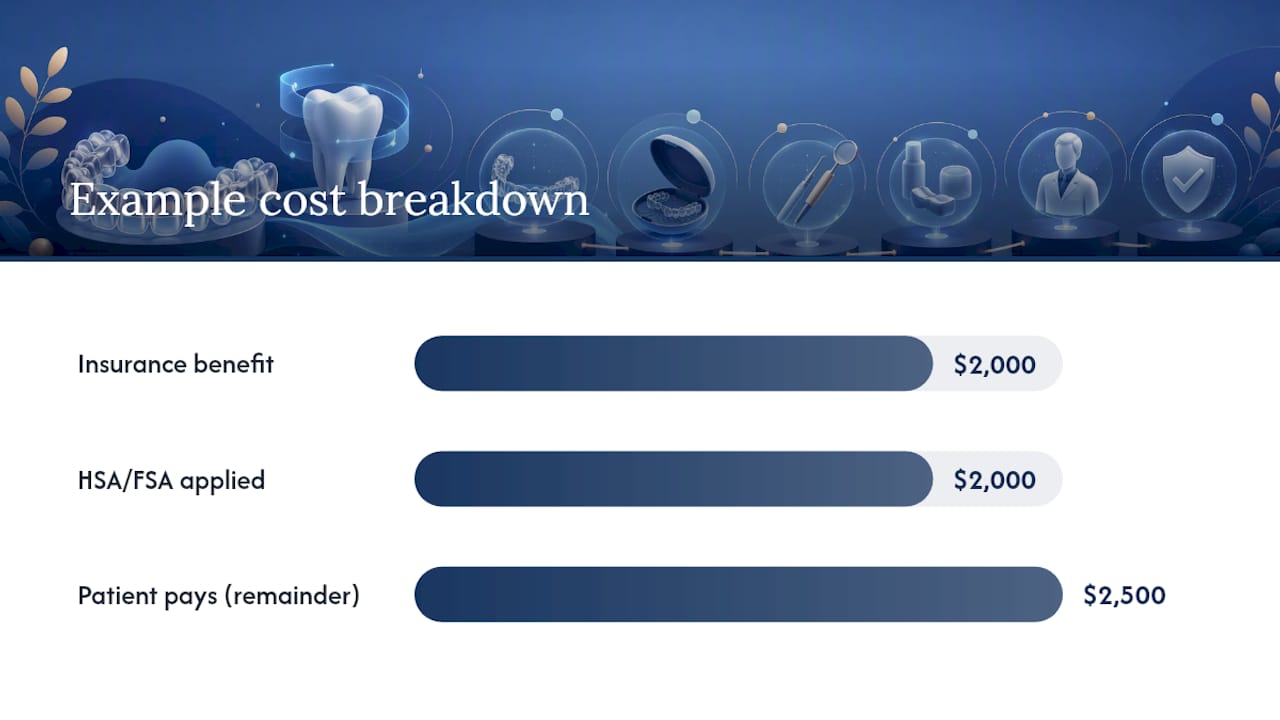
Worked example: a $6,500 Moderate case, minus a $2,000 insurance benefit, minus $2,000 pulled from an FSA, leaves $2,500 to finance.
What Will Your Monthly Payment Actually Look Like?
Financing is where most patients actually feel the cost, not in the sticker price. Clinics commonly offer 0% in-house payment plans, while third-party lenders can stretch terms out to 72 months with promotional 0% rates for well-qualified applicants.
- A $5,000 case after a $500 down payment and $1,500 in combined insurance/FSA funds leaves $3,000 to finance, about $125/month over 24 months.
- A $7,000 case after the same $500 down payment and $2,500 in stacked benefits leaves $4,000 to finance, roughly $167/month over 24 months.
- Extending the term to 36 or 48 months lowers the monthly number further, though it may forfeit a promotional 0% window if the plan has a shorter deadline.
What Should Be Included in a Real Invisalign Quote?
A complete quote bundles more than just the aligners. Confirm exactly what's in writing before you commit to a number.
- Digital scans or impressions and the ClinCheck treatment plan
- All aligner sets required for your case, not just the first phase
- Progress monitoring visits through treatment
- At least one set of retainers (this varies by office, so don't assume)
Common extras that show up later as separate charges include Vivera retainers ($400 to $900), interproximal reduction (IPR) fees, replacement trays if one is lost, and refinement aligners if your teeth need extra correction near the end.
Pro Tip: Ask point-blank: "If I need refinements, is that included or billed separately?" That single question exposes more hidden cost than anything else on the estimate.
Is Invisalign Cheaper Than Braces, or Just Different?
Cost overlap between the two is bigger than most people expect. In one industry survey, 53.5% of providers reported that Invisalign cost the same or less than braces for an equivalent case.
- Traditional braces often run $3,000 to $7,000, overlapping heavily with Invisalign's range
- Invisalign trays come out to eat and brush; braces don't
- Braces may still be the better call for severe bite corrections or younger patients who can't reliably wear aligners the recommended hours
How Do You Get a Quote You Can Actually Trust?
Getting multiple written estimates for the same treatment plan is one of the most reliable ways to catch an inflated quote. Differences of $1,000 or more for identical scope aren't unusual.
- Ask what's included versus billed separately, in writing
- Ask the office's specific refinement and retainer policy
- Request an insurance verification with your actual out-of-pocket number, not a general estimate
- Bring prior X-rays or records if you have them, to avoid paying for duplicate imaging
- Collect at least two or three quotes based on the same ClinCheck plan before deciding
- A quote without a total treatment timeline isn't complete
- A quote without a refinement policy in writing isn't complete either
Why Getting the Right Provider Matters More Than the Price Tag
The lowest quote isn't always the best deal once refinements and retainers show up as extras nobody mentioned upfront. Dr. Kambez Shukoor, a U.S. Navy veteran leading care at DC Implant & Cosmetic Dentistry, built the practice around same-day scheduling and full transparency on clear aligner pricing, backed by more than 200 five-star reviews. One practical detail worth asking about at any consult: the 30-Minute Rule, a wear-compliance habit that keeps treatment on schedule and avoids costly refinements later. Book a verification appointment to get your exact number in writing.
— Jake
Get Your Exact Invisalign Price at DC Implant & Cosmetic Dentistry
Every range in this article is a starting point, not your actual bill. The only way to know your real number is a verified quote based on your teeth, your insurance, and your timeline.
DC Implant & Cosmetic Dentistry runs your insurance verification in-office and tells you your net out-of-pocket number before you commit to anything, no guessing required. Same-day appointments mean you're not waiting weeks just to get a written estimate. The practice accepts financing through CareCredit and Lending Tree, so you can stack your insurance benefit, your FSA or HSA dollars, and a 0% payment plan into one manageable monthly number. If you're ready to see what your Moderate or Full case actually costs after everything is applied, visit the Clear Aligners page to schedule a consultation and get your written estimate this week.
Key Takeaways
Most Invisalign patients pay $3,000 to $8,500, and stacking insurance, FSA/HSA funds, and 0% financing is what actually brings the monthly payment down.
| Point | Details |
|---|---|
| Know your tier | Express, Lite, Moderate, and Full pricing ranges from $1,500 to $8,500-plus based on aligner count. |
| Stack your funding | Apply insurance first, then FSA/HSA dollars, then finance the remainder at 0%. |
| Confirm what's included | Ask in writing whether retainers, refinements, and monitoring visits are bundled or billed separately. |
| Get multiple quotes | Compare estimates based on the same ClinCheck plan, since differences of $1,000-plus are common. |
| Verify your number locally | DC Implant & Cosmetic Dentistry runs insurance verification in-office and offers same-day consultations for an exact quote. |
This article is general information, not a substitute for advice from a qualified doctor. Consult a qualified healthcare professional about your own circumstances before acting on anything here.
Sources
- Average Cost of Invisalign® Aligners | Invisalign
- How Much Is Invisalign? 2026 Cost Breakdown & Examples | Toothoria
- Invisalign Cost in 2026: Full Treatment Price Breakdown — ToothCostGuide
- Clear Aligners (Invisalign®) Treatment Cost and Financing | CareCredit
- Aligners | American Association of Orthodontists (AAO)