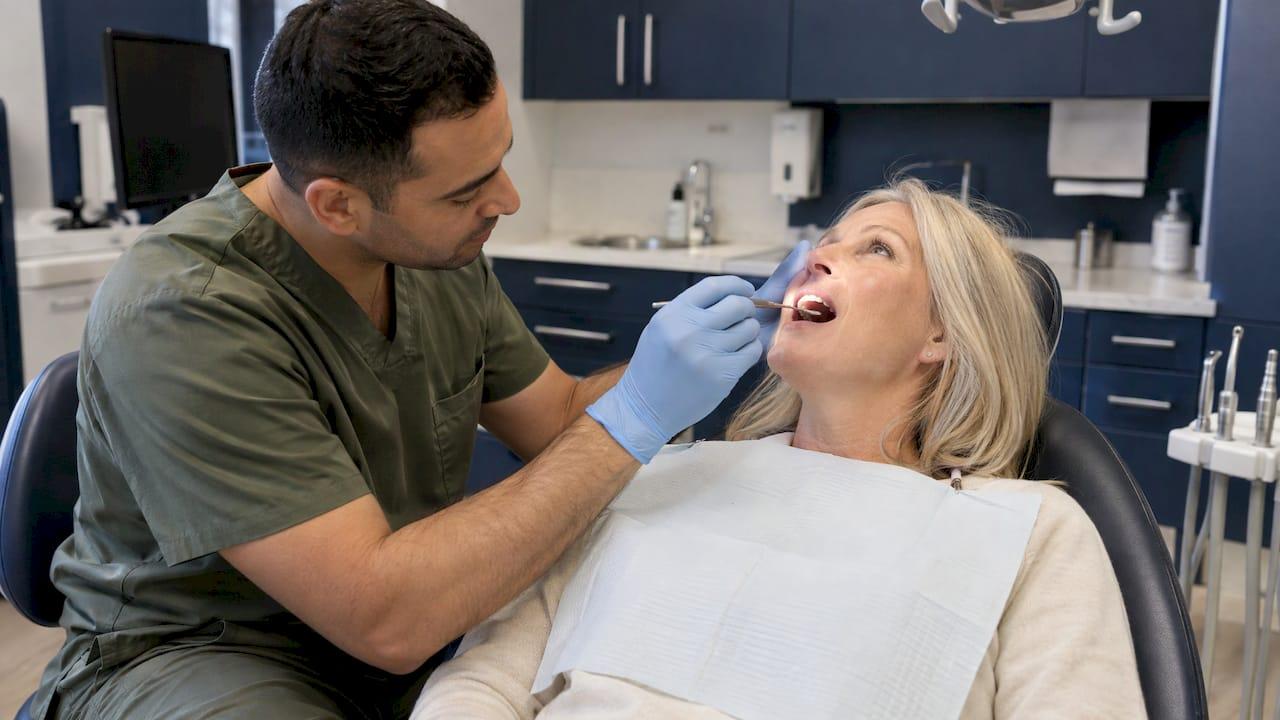
A loose implant crown is most often a mechanical problem: the small screw or cement holding the crown to the implant has lost its grip. It is usually fixable, and often without touching the implant in the jawbone. But a crown that moves should still be seen promptly, because the cause decides the fix, and only an exam and an X-ray can tell a loose crown from a loose implant. If you are in Washington, DC, we offer same-day appointments.
TL;DR
- A crown that wiggles, clicks or makes your bite feel "high" usually points to a loosened screw or failed cement, not a failed implant.
- Pain, swelling, pus, bleeding gums or movement of the whole implant make it urgent. Call a dentist the same day.
- Do not glue it, force it back on or keep chewing on it. Soft foods on the other side and gentle cleaning are the safe holding pattern.
- Tightening a screw or recementing a crown is typically a short visit. A cracked part or a damaged crown takes longer.
- Loosening often has a trigger, such as a heavy bite or clenching, so the fix should include checking your bite.
Table of Contents
- What "loose" can actually mean
- Signs your implant crown is loose
- Why implant crowns come loose
- Loose crown or loose implant: how the difference shows up
- What to do before your appointment
- When a loose implant crown is urgent
- How a dentist fixes a loose implant crown
- How long should an implant crown last?
- How to keep an implant crown from loosening again
- Our perspective
- Loose implant crown in Washington, DC: book a visit
- FAQ
- Sources
What "loose" can actually mean
An implant has three main parts. The implant (the fixture) sits in the bone. The abutment connects to it. The crown is the visible tooth. When someone says "my implant is loose," the movement could be at any of three levels:
- The crown moves on the abutment. The cement has washed out, or the crown is screwed directly in and the screw has backed off.
- The abutment moves on the implant. The abutment screw has lost tension.
- The implant moves in the bone. This is the rare and more serious one, and it is a biological problem, not a mechanical one.
Most people who search for this are in the first or second group. Numbers back this up. A five-year retrospective study of single implant crowns found abutment screw loosening in 2.1% of cases and abutment fracture in 0.4%, with 98.2% of crowns surviving. So loosening happens, but it is an uncommon complication on a well-placed implant, and it is a known, manageable one.
Signs your implant crown is loose
The Journal of the Canadian Dental Association describes the clinical picture of a loose abutment screw: a loose implant-supported crown, and sometimes redness or swelling of the surrounding tissue. In daily life, that tends to show up as:
- The crown shifts or rotates when you press it with your tongue or finger.
- Your bite feels different or "high." The same JCDA article notes that a bite that feels high is a common report.
- A clicking sound or sensation when you chew.
- Food packing or a bad taste around the crown, because a small gap lets debris and bacteria collect.
- Tender, puffy or red gums around the tooth.
- Sometimes, the crown comes off entirely.
Not every sign is equally worrying. A slight rotation of the crown with no pain is a different situation from a sore, swollen gum with pus. Both deserve a call, but the second deserves it today.
Is it normal for an implant crown to wiggle?
No. A healthy, fully restored implant should feel as solid as a natural tooth, and a natural tooth has only a tiny amount of give. Any movement you can see or feel in an implant crown is worth a visit. The wiggle is usually a sign of a fixable mechanical issue, but you cannot tell that from the outside.
The type of movement gives clues that your dentist reads during the exam. The JCDA notes that movement with a loose abutment screw can range from barely detectable to 1 to 2 mm with a "hard stop," a metal-on-metal click, while a loose fixture tends to have a "soft stop." That distinction is one reason the exam is done in the chair and not by guesswork at home.

Why implant crowns come loose
Loss of screw tension
Most implant crowns are held by a screw that is tightened to a specific torque. That tightening creates a clamping force called preload. Oral Health Group explains that when forces in the mouth exceed that clamping force, the preload is lost, which loosens the screw and then the restoration. The same source lists overload from the bite or from clenching and grinding, improper torque and a restoration that does not fit passively as typical contributors.
Cement failure
Cement-retained crowns can lose their bond. A 12-month prospective study of single implant crowns found screw loosening was more common in screw-retained crowns (18%) than in cement-retained ones (4%), while cement-retained designs showed more marginal discrepancy and cement washout. In plain terms: the way your crown is attached shapes how it is likely to fail. A screw-retained crown tends to loosen. A cemented crown tends to pop off or leak at the margin.

Bite problems and grinding
If the crown takes more than its share of chewing force, the joint is under constant stress. Natural teeth have a ligament that cushions the bite. Implants do not, so a slightly high crown matters more than it would on a natural tooth. If you clench or grind, mention it. A night guard may be part of keeping a repaired crown stable.
Gum and bone problems
The less common causes are biological. Oral Health Group lists peri-implantitis or loss of osseointegration among them. Peri-implantitis is inflammation and bone loss around an implant. If the whole implant, not just the crown, moves, this is the category your dentist needs to rule in or out first. The JCDA adds that pivotal movement appearing to come from well below the base of the abutment may indicate fracture or failure of the implant.
Loose crown or loose implant: how the difference shows up
| What you notice | More likely a mechanical problem (crown, screw, cement) | More likely a bone or implant problem |
|---|---|---|
| Movement | Crown shifts or clicks, sometimes rotates | Whole tooth and implant move together |
| Pain | Mild, or tender when pressing on the crown | Deep ache, pain on touching or chewing |
| Gums | May be a little red from trapped debris | Swollen, bleeding, pus, receding |
| Bite | Feels high or uneven | Feels unstable |
| Timing | Any time, often after a bite change or grinding | Often with a history of gum disease or smoking |
This is a guide, not a diagnosis. Visual inspection cannot confirm true implant-level mobility. Oral Health Group is clear that the restoration should be removed so the fixture can be assessed directly. That is what a proper exam does.
What to do before your appointment
You cannot repair this at home, and you should not try. Here is how to protect the implant and the crown until a dentist can see you.
- Call as soon as you notice it. The sooner it is addressed, the less time the joint spends moving under load. A screw that keeps flexing can wear its threads or break.
- Stop chewing on that side. Choose soft foods and chew on the opposite side. Avoid sticky, hard or crunchy items.
- Do not use household glue or drugstore cement. These products are not made for implant parts. They can make the dentist's job harder and can hide the real problem.
- Do not try to twist or press the crown back on. Forcing it can damage the abutment or the screw.
- Keep it clean. Rinse with warm water after meals. Brush gently around the area and keep the rest of your routine as normal.
- Save any part that comes out. If the crown or a small screw falls out, keep it in a clean container and bring it. Do not swallow or inhale it. If you cannot find a piece or feel you may have swallowed it, get medical help.
- Note the details. When did it start? Does it hurt? Did anything happen, like biting something hard? These help diagnosis.
If you are unsure whether a similar problem is a crown on a natural tooth, our guide to fixing a loose crown the same day covers that case.
When a loose implant crown is urgent
Call a dentist the same day, or go to urgent care if you cannot reach one, when you have:
- Swelling of the gum, face or jaw
- Pus, a bad taste that does not go away, or a pimple-like bump on the gum
- Severe or throbbing pain
- Bleeding around the implant
- The whole implant moving, not just the crown
- Fever along with any of the above
Facial swelling with fever or trouble breathing or swallowing is an emergency room situation, not a dental-office one.
A crown that is slightly loose and painless is less urgent. It still should not wait weeks. Not every loose implant is an emergency, but ignoring one lets bacteria collect in the gap and can turn a simple fix into a bigger one. If your concern is wider than the crown, see our overview of dental implant failure signs and causes.
How a dentist fixes a loose implant crown
The fix depends on what the exam finds. A standard visit has these parts:
1. History and exam. The dentist checks the crown, the gums and your bite. They test how the crown moves and whether the movement is at the crown, the abutment or the fixture.
2. Imaging. X-rays show the bone level around the implant, whether the parts are fully seated and whether there is damage to a screw or abutment. We use thorough imaging before deciding on treatment.
3. Removing the crown. To assess the abutment and implant, the crown is taken off. A screw-retained crown comes off through the access hole. A cemented crown may need to be separated.
4. Cleaning. The parts and the tissue are cleaned of debris, plaque and old cement.
5. Re-seating and tightening. If the screw has simply loosened, it can be re-tightened to the manufacturer's recommended torque or replaced with a new one. If the cement failed, the crown can be recemented.
6. Bite adjustment. Because bite overload is a common trigger, the contact is checked and adjusted so the crown is not taking too much force.
7. Replacement parts if needed. If a screw, abutment or crown is damaged, it is replaced. If the problem is bone loss around the implant, treatment shifts to managing the gum disease, and the plan is different.
How long does it take, and what does it cost?
A simple screw tightening or recementing is generally a short appointment. A replacement part, new crown or treatment of infection takes more visits.
Cost varies by what is wrong, so there is no single honest number. A tightening is a small procedure. A new crown is a larger one. Published ranges online differ widely, and a figure from one office does not predict another's. We do not publish a price list. After an exam and imaging, we give you a clear, written treatment plan with the cost before work begins, and we offer financing options such as CareCredit and Lending Tree for larger treatments.
Insurance coverage for implant parts varies by plan, so ask your insurer what applies to repairs versus replacements.
How long should an implant crown last?
The implant and the crown have different lifespans. The implant itself is built to last decades. A 10 to 12 year case series reported 100% implant survival and 97.5% crown survival, though 32.5% of patients had some biological or technical complication over that time. A patient guide puts the typical crown replacement timeline at 10 to 15 years, with the implant fixture often lasting much longer.
The takeaway is that minor maintenance is a normal part of implant ownership. Catching a loose screw early is routine care, not a sign that your implant has failed.
How to keep an implant crown from loosening again
- Attend checkups. Your dentist can check screw tightness and bite contacts and see problems before you feel them.
- Treat grinding. If you clench or grind, ask about a night guard.
- Keep the gums healthy. Clean around the implant daily, including with floss or interdental brushes that suit your crown. Gum inflammation around an implant is the biological route to trouble.
- Avoid using your teeth as tools or biting hard objects such as ice.
- Report changes early. A bite that feels off after a new crown is easy to correct. A bite that has felt off for months is a loose screw waiting to happen.
- Do not skip a follow-up after any adjustment.
If you are still planning an implant, our guide to the single tooth implant timeline, steps and risks explains how the crown fits into the process, and our dental implant recovery guide covers healing.
Our perspective
Most loose implant crowns we hear about are not disasters. They are small mechanical problems that got bigger because the patient waited, hoping it would settle down.
What we believe matters is who looks at it and how fast. Because every procedure from exams to surgical implants is performed in-house, the same team that assesses your crown can take the imaging, find the cause and do the fix, with no referral and no hand-off between offices.
Dr. Kambez Shukoor is a U.S. Navy veteran, and his military medical background shapes how we work: assess carefully, explain clearly and write the plan down. You should leave knowing whether the problem was a screw, the cement, your bite or the gum, and what happens next.
We also keep same-day appointments available, because a crown that is moving under your bite should not wait a week. If you notice it, call us.
Jake
Loose implant crown in Washington, DC: book a visit
If your crown feels loose, shifts when you touch it or has come off, we can see you the same day. We examine the crown, take the images, find out whether the issue is the crown, the abutment or the implant, and give you a written plan. Implant repair, tooth extractions and bone grafting are part of our implant and oral surgery services, so your care stays under one roof.

If you are considering implants and want to know how the whole system works, see our dental implant services.
FAQ
How do I fix a loose implant crown?
You cannot fix it yourself. A dentist removes the crown, cleans the parts, then re-tightens or replaces the screw, or recements the crown, and checks your bite. If a part is damaged, it is replaced. Until your visit, avoid chewing on it and do not use glue.
How much does it cost to tighten an implant crown?
It depends on the cause. Tightening a screw is a smaller procedure than replacing a damaged abutment or a crown, and fees differ between offices and insurance plans. We give a written estimate after the exam and imaging, and financing is available for larger treatments.
How long should a crown last on an implant?
A patient guide puts the typical crown replacement timeline at 10 to 15 years, while the implant itself often lasts much longer. Clenching, gum disease and missed checkups can shorten that.
Is it normal for an implant crown to wiggle?
No. Any movement you can feel is worth a visit. It is often a loose screw or failed cement, which is fixable, but only an exam and X-ray can rule out a problem at the implant. If you have pain, swelling or pus, call the same day.
Can a loose implant crown cause an infection?
It can allow trouble. A gap lets bacteria and food debris collect, which can cause bad breath, a bad taste and inflamed gums. Having it checked early helps prevent this.
Sources
- Managing Patients with a Loose Implant Abutment Screw, JCDA
- Troubleshooting common implant prosthetic complication of the loose implant crown, Oral Health Group
- Assessment of Prosthodontic Complications in Screw-Retained and Cement-Retained Implant Crowns, PMC
- Five-year retrospective study on success, survival and complication of implant-supported single crowns, PubMed
- Incidence of Peri-Implantitis, Technical and Biological Complications, PMC
- Dental Implant (Single Tooth): Procedure, Risks and Lifespan