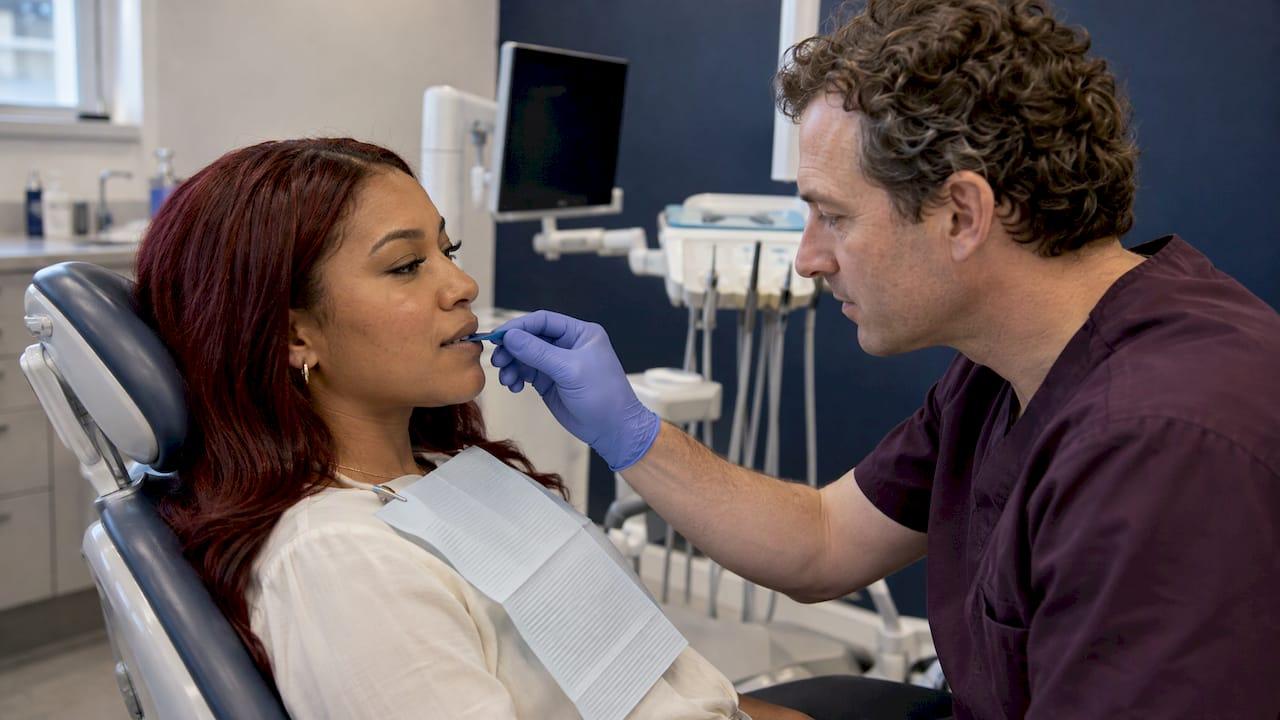
A bite adjustment, which dentists call an occlusal adjustment or bite equilibration, is a procedure that changes how your upper and lower teeth meet. The dentist finds the contacts that hit too early or too hard and reshapes those spots, or corrects a crown or filling that sits too high, so the force of chewing spreads evenly. It starts with a careful exam and imaging, which is why the first step is a dentist who examines, images and treats in the same office. At DC Implant & Cosmetic Dentistry in Washington, DC, exams, X-rays, fillings and same-day crowns are all done in-house, and same-day appointments are available.
This guide explains what the procedure is, how a dentist decides you need one, what happens in the chair, and what to expect afterward.
TL;DR
- A bite adjustment (occlusal adjustment) reshapes tooth surfaces or restorations that contact too early, so your teeth meet evenly and your jaw moves smoothly.
- Bite equilibration is the planned, more thorough version: the goal is stable, simultaneous contacts on many teeth and smooth side-to-side and forward movement.
- A bite that feels "off" after a filling or crown is the most common reason to ask for a quick check. Jaw soreness, uneven wear or a changing bite also deserve an exam.
- Assessment comes first: a bite check, X-rays and a written plan, so you know whether you need adjustment, a restoration fix, aligners or something else.
- Never grind a tooth yourself. Book a dentist visit, and treat sudden severe pain or swelling as urgent.
Table of Contents
- What a bite adjustment actually is
- Signs your bite may need attention
- How a dentist assesses your bite
- What happens during the adjustment
- What to expect afterward
- Is it permanent, and does it hurt?
- When another treatment is the better route
- How much does a bite adjustment cost?
- Our perspective
- Book a bite check in Washington, DC
- FAQ
- Sources
What a bite adjustment actually is
Your bite is called occlusion: the way the upper and lower teeth contact when you close your mouth and when you slide your jaw to chew. Ideally, many teeth touch at once and share the load.
A professional dental reference defines occlusal adjustment as altering the chewing surfaces of teeth to change the relationship of their contacts. Occlusal equilibration is the planned version of that: the surfaces are altered to give stable jaw relationships, with multiple stable contacts that happen at the same time and smooth movements that are not blocked by "interferences," which are high spots that catch the jaw as it moves.
In everyday terms:
- Occlusal adjustment is the broad term. It can be a tiny touch-up of one high tooth.
- Bite equilibration is the broader, planned reshaping across several teeth to balance the whole bite.
- Bite adjustment is the phrase patients use for either one.
The Merck Manual's dental chapter on malocclusion notes that occlusion can be improved by selectively grinding teeth and restorations that contact prematurely, and by placing crowns or onlays to build up surfaces that sit too low. So an adjustment can mean taking a little away, adding something, or both.
Signs your bite may need attention
People rarely say "my occlusion is unbalanced." They say things like:
- A new filling or crown feels tall, and you hit it first when you close.
- One tooth is sore to bite on, or reacts to cold more than its neighbors.
- Your jaw muscles feel tired or tight, especially in the morning.
- Your teeth feel like they do not fit together the way they used to.
- Some teeth look flatter, chipped or more worn than others.
- Your bite changed after orthodontic treatment, tooth loss or a restoration.
None of these proves you need an adjustment. An uneven-feeling bite has several possible causes, and the fix depends on which one it is.
Other causes the dentist will check
A good exam looks beyond the high spot:
- A restoration that is slightly too high. The simplest cause and the simplest fix.
- Shifting teeth. Teeth move after braces or aligners, or after a tooth is lost. Our guide on why teeth shift after braces explains how that happens and what to do.
- Gum or bone problems. Loose or sore teeth can make the bite feel different. Periodontal (gum) disease is one thing an exam screens for.
- A cracked or decayed tooth. Pain on biting can come from a problem inside the tooth, not from the way it meets its partner.
- Jaw joint or muscle problems. Clenching and grinding can strain the muscles and the joint. Sorting this out takes a proper diagnosis.
- A skeletal or alignment issue. Overbites and underbites involve how the jaws and teeth line up. For adults, aligners can address some of them, as covered in our clinician take on aligners for overbites.
This is why we suggest an exam before any reshaping. Removing tooth surface cannot be undone, so you want to be sure the cause is a contact problem and not something else.
How a dentist assesses your bite
The check is more careful than "does that feel okay?" Here is what the steps look like in the dental literature.
Looking at how you close
The Merck Manual's evaluation guidance describes checking the bite on each side by gently retracting the cheek while you close on your back teeth. It also warns that simply telling a patient to "bite" can make them close on their front teeth, which can falsely suggest a back-tooth problem. How you are asked to close matters.
Marking the contacts
A registered clinical trial protocol for occlusal splints describes a typical method: the bite is recorded with the jaw in a relaxed, reference position (called centric relation) after the muscles have been deprogrammed, the position of the jaw joint is verified, and contacts are marked with very thin articulating paper (20 micrometers) or a computerized bite analysis. The correction continues until the back teeth touch evenly on both sides, and forward and side movements are checked so the front teeth guide the jaw smoothly while the back teeth separate.

Articulating paper is the colored strip you bite on. It leaves marks where teeth touch, and the darkest marks show the heaviest contacts.
Planning before reshaping
For larger changes, dentists can rehearse on models first. A peer-reviewed case presentation describes performing a diagnostic adjustment on duplicate casts mounted in centric relation. That lets the clinician see where and how much tooth structure would be removed so the jaw's resting closure and the fully closed bite coincide. The authors also note that small changes in the back teeth can significantly affect where the front teeth sit, which is the reason planning matters.
That is the logic behind up-front planning with imaging and a written treatment plan: you should know what will be changed, and why, before anything is touched.
What happens during the adjustment
A simple adjustment is usually quick. The general sequence looks like this:
- Exam and history. You describe what you feel and when it started, including recent dental work.
- Imaging. X-rays show the teeth, roots and bone.
- Bite check. The dentist watches you close and slide, and marks the contacts.
- Selective reshaping. Small amounts are polished away from the marked high spots, or a restoration is refined. The mark, check, adjust cycle repeats until contacts are even.
- Final check. You sit up, close naturally and tell the dentist how it feels.
If a crown or filling is the culprit, the fix is usually done on that restoration. If a restoration is worn out, replacing it may be the better route, and a tall filling is a routine fix at a general exam visit. A full equilibration across many teeth is more involved and is planned over a longer visit or several.
What to expect afterward
Expect your bite to feel different at first, even if it is more balanced. Your tongue and muscles have learned the old pattern, so give yourself a few days to adapt. Contact your dentist if:
- the bite still feels uneven after a few days,
- one tooth is still sore when you chew,
- you notice new sensitivity to temperature, or
- jaw pain gets worse instead of easing.
If you ever have facial swelling, a fever, or severe pain that does not settle, treat it as urgent and call a dentist right away. If you cannot reach one, go to an emergency room.
What the benefits are
The Merck Manual says malocclusion is corrected mainly for appearance and psychological reasons. It adds that correcting it may also improve resistance to cavities, because realigned teeth are easier to clean, resistance to front-tooth fracture, and possibly resistance to gum disease, and that it can improve speech and chewing. In practical terms, a balanced bite spreads chewing forces and can make your teeth easier to keep healthy.
Is it permanent, and does it hurt?
Reshaping removes a small amount of enamel, so it is permanent. That is why precision matters and why conservative, step by step adjustment is the usual approach. It is typically comfortable. Because only tiny amounts are removed, many people need little or no numbing for a minor touch-up, but the dentist will tell you what is appropriate for your tooth. If a tooth is sensitive, say so before you start.
If what you want is a different tooth shape for looks rather than function, that is a related but separate procedure. Our article on tooth reshaping and contouring in Washington, DC explains why an X-ray comes first.
When another treatment is the better route
A bite adjustment fixes contact problems. It does not move teeth or change jaw size. Depending on what the exam shows, the plan may involve:
- Clear aligners for crowding, spacing or bite relationships that are about tooth position. See our guide to elastics with aligners for how bite corrections are done with them, and our clear aligners page.
- A new crown when a tooth is worn, broken or too low. Same-day crowns are part of our general dentistry services.
- Replacing missing teeth when a gap lets neighboring teeth drift and the bite collapses. Options include implants, bridges and dentures, such as our dental implants and dentures.
- Jaw surgery in rare cases. The Merck Manual notes that when orthodontic treatment alone is insufficient, orthognathic (jaw) surgery may be indicated for jaw abnormalities contributing to malocclusion.
The point of a written plan is that you see these options side by side, with the reason for each.
How much does a bite adjustment cost?
Cost depends on how much work is involved. A quick touch-up of one tall filling is a very different visit from a planned equilibration across multiple teeth with imaging and follow-up. Whether insurance applies depends on your plan and on whether the work is billed as part of a restoration visit or a separate procedure, so ask for the billing details before you start.
We do not publish a price for this, because it depends on your exam findings. After your exam you receive a clear written treatment plan, and we offer financing options for higher-cost care, including CareCredit and Lending Tree.
Our perspective
Most bite complaints we hear about are small things that grew because nobody looked at them: a filling that felt tall, a tooth that got sore, a jaw that ached in the morning. The best outcomes begin with a careful look, not a bur.
That is why we put the exam first. Imaging, a close look at how you close, and a written plan mean you know what is going on before anything changes. Because exams, X-rays, fillings and crowns, and aligners are all handled in one office, there is no hand-off between a dentist who finds the problem and another who fixes it.
Our approach is to treat the cause, not just the symptom. If the high spot is a restoration, we address the restoration. If the bite is shifting because a tooth is missing or teeth are moving, we say so and lay out the options.
Dr. Kambez Shukoor, a U.S. Navy veteran, leads our team, and we work to see you promptly. Same-day appointments are available when something feels wrong.
Jake
Book a bite check in Washington, DC
If your bite feels off, you do not need to wait for it to settle. At DC Implant & Cosmetic Dentistry, an exam and X-rays are the starting point, followed by a written plan that explains your options in plain language. Same-day appointments are available, and our patients have left more than 200 five-star reviews.

Start with our exams and X-rays, or visit dc-dentistry.com to request an appointment.
FAQ
Is a bite adjustment the same as bite equilibration?
They overlap. Occlusal adjustment is the general term for reshaping tooth surfaces or restorations to change how teeth contact. Equilibration is the planned, more complete version that aims for stable, even contacts across many teeth and smooth jaw movement. Patients often use "bite adjustment" for both.
Can a bite adjustment fix a filling that feels too high?
Yes. Selective grinding of teeth and restorations that contact prematurely is a standard way to improve the bite, per the Merck Manual. Do not wait for it to wear down, and never file it yourself. A dentist can mark the high spot and refine it in a short visit.
Will I need X-rays first?
Usually. Imaging shows the roots, bone and any decay or cracks that could be the real source of biting pain. That way the plan matches the cause, and you are not reshaping a tooth that needs a different treatment.
Does insurance cover occlusal adjustment?
It depends on your plan and on how the work is billed. Adjustments made as part of a filling or crown visit are often handled differently from a separate planned equilibration, so ask for the procedure details and confirm with your insurer. Financing is available for larger treatment plans.
How long does it take to get used to a new bite?
Most people notice the change right away and adapt over several days as the muscles adjust. If something still feels off, or you have lingering soreness, contact your dentist so it can be rechecked.
Sources
- 11 – Occlusal Adjustment and Equilibration, Pocket Dentistry
- Malocclusion, Merck Manual Professional Edition
- Occlusal Stabilization Splints Equilibrated by Different Methods, ClinicalTrials.gov NCT04661670
- Diagnostic Occlusal Adjustment: Case Presentation, PMC