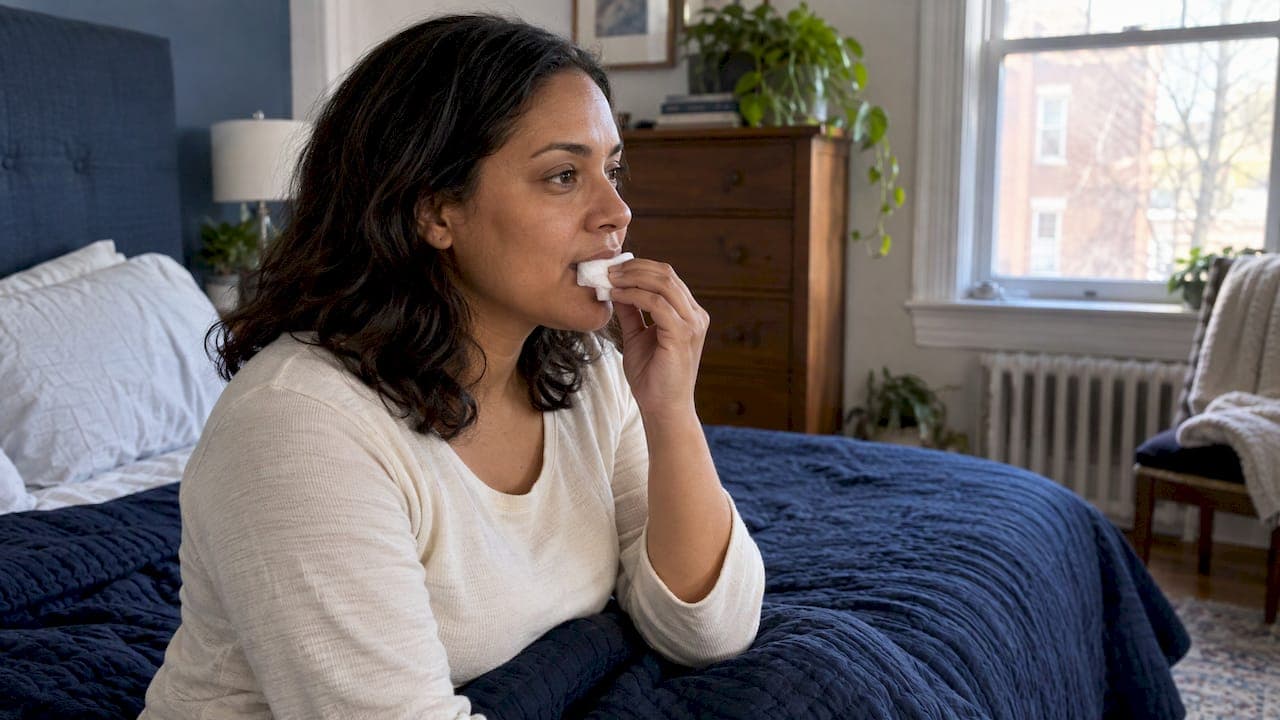
Most people feel the worst of it in the first two or three days, then improve steadily. Pain and swelling usually start to ease after 1 or 2 days, and soreness can last up to 2 weeks. Below is what to expect each day, how to manage pain, swelling, food and cleaning, when you can exercise, and which symptoms mean you should call your dentist or oral surgeon.
TL;DR
- Expect pain and swelling to start improving after 1 to 2 days. Jaw soreness and stiffness can last up to 2 weeks.
- Protect the blood clot: no smoking, no spitting or rinsing for the first 24 hours, and no strenuous exercise for 7 to 10 days.
- Use ice on your cheek for the first 3 days, take pain medicine as directed, and eat soft foods until chewing feels comfortable.
- Call your dentist promptly for bleeding that will not stop, worsening pain, a bad taste with pain, fever, or feeling unwell.
Table of Contents
- What to expect: the recovery timeline
- Wisdom teeth pain after 3 days: normal or not?
- Managing swelling with ice
- Pain relief and medications
- What to eat and drink
- Keeping your mouth clean
- Smoking and recovery
- Exercise and getting back to normal
- Jaw soreness and stiffness
- Recovery checklist
- When we can help
- FAQ
- Sources
What to expect: the recovery timeline
Every mouth is different. Impacted teeth removed surgically often take longer than simple extractions, and your surgeon's instructions override any general timeline. Still, most recoveries follow a similar arc.
| Period | What is typical |
|---|---|
| Day 0 to 1 | Numbness wears off, oozing of blood mixed with saliva, first swelling. A clot forms in each socket. |
| Days 2 to 3 | Swelling and soreness are often at their peak. Jaw may feel stiff. |
| Days 4 to 7 | Pain and swelling fade. Eating gets easier. Many people return to normal routines. |
| Week 2 | Gums keep closing. Mild soreness or stiffness may linger. |
| Weeks 3 and beyond | Residual swelling settles. The sockets continue filling in beneath the gum. |
The NHS notes that you can expect some pain and swelling for up to 2 weeks. The Cleveland Clinic says soft tissue takes 1 to 2 weeks to heal, and some swelling may remain after the two-week mark.
The first 24 hours
Bleeding is normal. A small amount of blood mixed with saliva can look like a lot, and the Cleveland Clinic advises keeping steady pressure with gauze rather than panicking. Bite gently on fresh gauze and change it as directed.
The Mayo Clinic advises not rinsing or spitting during the first 24 hours so the protective clot stays in place. Skip straws too, since suction is a common way to disturb a clot.
Stay ahead of the pain. Health New Zealand stresses taking pain relief proactively for the first 48 hours instead of waiting until it becomes severe, as directed on the label or by your dentist.

Days 2 and 3
This is when many people worry, because swelling can look worse than it did on day one. That is common. Keep icing, keep your head slightly raised when resting, and keep taking pain medicine as directed.
Days 4 to 7
Things should turn a corner. If you are comfortable and no longer need prescription pain medication, the Cleveland Clinic says you can return to work. Many people with simple extractions feel close to normal by the end of the week.
Wisdom teeth pain after 3 days: normal or not?
Some pain at day 3 is usual. Pain that is slowly easing, controlled by the medicine your dentist recommended, and paired with swelling that is stable or shrinking is typical healing.
The pattern to take seriously is different. The NHS says to seek urgent dental advice if:
- pain and swelling are severe or getting worse and painkillers are not helping
- you have pain with a bad taste in your mouth
- you have a high temperature or feel unwell
- bleeding does not stop
Pain that gets worse instead of better several days in is the classic sign of dry socket. See our guide to dry socket symptoms and when to see a dentist or ER, and our piece on wisdom tooth pain red flags.
What dry socket is
The NHS explains that dry socket happens when the blood clot does not form properly or is dislodged before the gum heals. It is treatable, usually with a medicated dressing placed by your dentist, so do not tough it out at home.
Numbness and tingling
Tingling or numbness of the face, lips or tongue can occur after the anesthetic wears off. The HSE lists it as a rare symptom. Tell your surgeon if numbness lingers beyond what they described.
Managing swelling with ice
Ice helps most in the first 3 days. Alberta Health guidance says to apply a pack to your cheek near the site for 10 to 20 minutes at a time, every 1 to 2 hours while awake, with a thin cloth between the pack and your skin. The Mayo Clinic likewise recommends using an ice pack as directed by your dentist or surgeon.
Practical tips:
- Use a bag of frozen peas or a gel pack wrapped in a thin towel.
- Hold it on the cheek over the extraction site, not on the lips.
- Take breaks so your skin does not get irritated.
- After about day 3, many surgeons switch to warm compresses for stiffness. Ask yours before you switch.
Pain relief and medications
The NHS suggests paracetamol or ibuprofen for pain. In the US, paracetamol is sold as acetaminophen. Follow the dose on the label, or what your dentist prescribed, and check with them if you have kidney, liver or stomach conditions or take blood thinners.
Antibiotics are not routine. The Cleveland Clinic notes they are uncommon after surgery, and if you are prescribed oral antibiotics, you start them the day after surgery. Finish the course as instructed.
What to eat and drink
Stick with soft or liquid food until chewing is comfortable, as the NHS advises. Good options:
- yogurt, applesauce, smoothies eaten with a spoon
- mashed potatoes, scrambled eggs, oatmeal
- broth and blended soups that are lukewarm, not hot
- pudding, cottage cheese, soft pasta
Avoid hard or crunchy food, alcohol and very hot drinks. Chips, nuts and popcorn are the usual troublemakers, because small pieces lodge in the sockets.
Keeping your mouth clean
After the first 24 hours, gently rinse with warm salt water or mouthwash, as the NHS suggests. Let the water fall out of your mouth rather than spitting hard. Keep brushing your other teeth carefully and avoid the surgical area until your surgeon says otherwise. For general habits that protect healing gums, our oral hygiene page is a good reference.
Smoking and recovery
Do not smoke. The NHS warns that smoking can increase the risk of infection, and the suction and heat can also disturb the clot. If you are using this as a chance to quit, this overview of what your body goes through after quitting smoking shows what to expect as your body adjusts.
Exercise and getting back to normal
The Cleveland Clinic discourages strenuous activity for 7 to 10 days, while light activity such as an easy walk is fine when you feel up to it. The Mayo Clinic says to avoid high-energy activity for at least a week because it might dislodge the clot.
A sensible plan:
- Days 1 to 3: rest, short slow walks only.
- Days 4 to 7: light movement, no lifting, no heavy cardio, nothing that pounds your head or spikes blood pressure.
- After 7 to 10 days: return to workouts gradually if there is no throbbing at the site.
Contact sports and swimming are worth clearing with your surgeon first.
Jaw soreness and stiffness
Stiffness is common. The NHS says your jaw may be sore and stiff, and that it can last up to 2 weeks. Gentle opening and closing, soft foods and a warm compress after the swelling peak can help. If jaw pain at day 5 is getting worse rather than better, or comes with fever or a bad taste, treat it as a reason to call.
Recovery checklist
- Arrange a ride home and take the rest of the day off.
- Stock soft foods, gauze and a cold pack before surgery.
- Start pain medicine on schedule, not after the pain peaks.
- Ice for the first 3 days.
- Skip straws, smoking, alcohol and spitting.
- Rinse gently after 24 hours.
- Keep follow-up appointments and call if anything seems off.
Perspective
At our practice, we believe recovery goes best when the plan is clear before the procedure. Our approach is to do everything in-house, from imaging to the extraction itself, so you are not passed between offices and you know who to call afterward.
We put the treatment plan in writing, review what the X-rays show about your teeth and nerve position, and explain what your recovery should look like in your case. Dr. Kambez Shukoor brings U.S. Navy medical experience to that process, and we offer same-day appointments, which matters when pain at day three does not feel right.
Our advice: do not wait out worsening pain. A quick check is far better than a week of guessing.
Jake
When we can help
If your wisdom teeth are causing trouble, or you are having pain after an extraction elsewhere, we offer same-day appointments in Washington, DC. Learn about wisdom tooth removal at our office or see our tooth extractions and related care.

For a longer healing guide, read our day-by-day tooth extraction aftercare. If you are thinking ahead to replacing a tooth, see how long to wait after an extraction for an implant.
FAQ
How long does wisdom teeth recovery take?
Pain and swelling usually begin to improve after 1 or 2 days, and some soreness can last up to 2 weeks, according to the NHS. Surgical removal of impacted teeth can take longer than a simple extraction.
Is jaw pain 5 days after wisdom tooth removal normal?
Mild soreness and stiffness are common and can last up to 2 weeks. Pain that is getting worse, not better, or that comes with a bad taste, fever or worsening swelling needs a call to your dentist.
How long after wisdom teeth removal can I exercise?
Avoid strenuous activity for 7 to 10 days. Light activity such as walking is fine when you feel up to it. Build back gradually and stop if you feel throbbing at the site.
Do I need antibiotics after wisdom teeth removal?
Not usually. Antibiotics are uncommon after this surgery, per the Cleveland Clinic. If your surgeon prescribes them, take them as directed.
Sources
- Wisdom tooth removal, NHS
- What To Do After Oral Surgery: Recovery and Self-Care, Cleveland Clinic
- Wisdom tooth removal, Mayo Clinic
- Wisdom teeth, Health New Zealand
- Tooth Extraction: Care Instructions, Alberta Health
- Wisdom tooth removal recovery, HSE