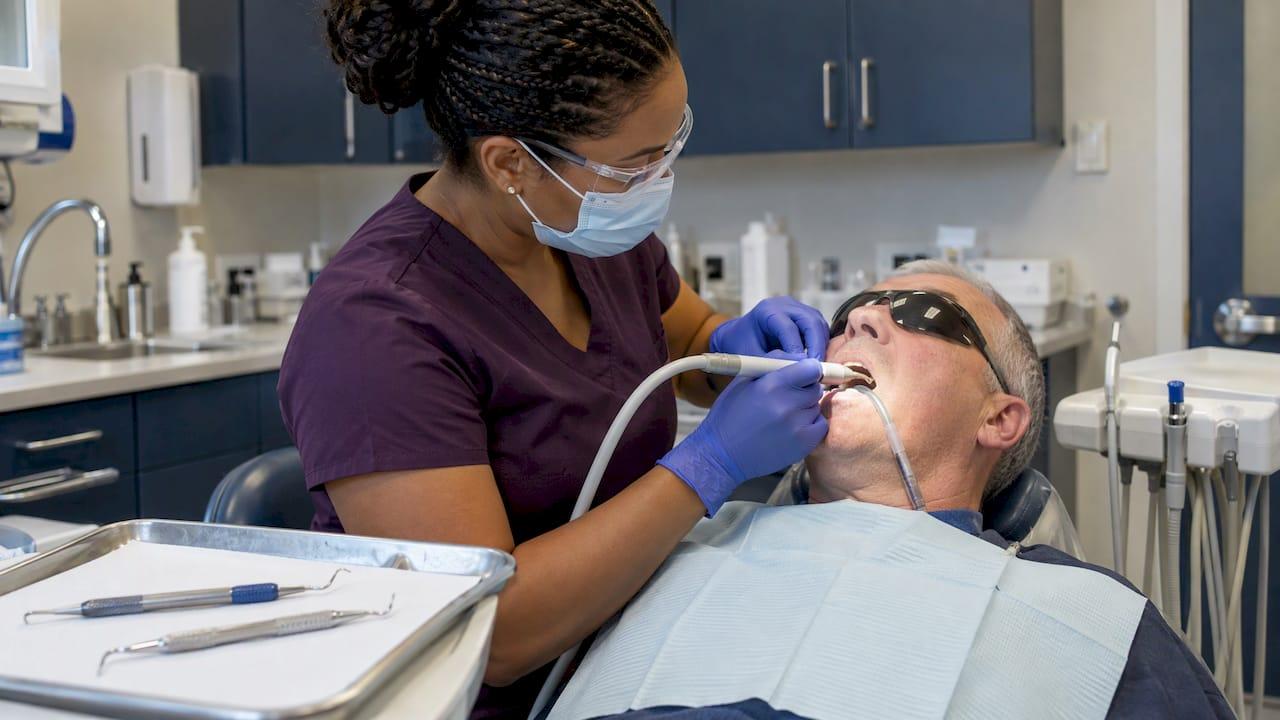
Ultrasonic scaling and hand scaling remove plaque and tartar equally well in most situations. The difference is how they do it. An ultrasonic scaler uses vibration and water to break deposits loose quickly. Hand instruments let the clinician feel and scrape the surface with fine control. Many cleanings use both, because each tool is strongest in a different spot.
If you searched "ultrasonic cleaning teeth," this is the same thing: the buzzing, water-spraying tool at your cleaning appointment. Below you will find how each method works, what the research shows, how each feels, and what to know about safe use.
TL;DR
- Large reviews of clinical trials find similar periodontal results from hand and ultrasonic instruments, and ultrasonic is usually faster.
- Hand scaling gives tactile precision, especially in deeper pockets. Ultrasonic reaches tight areas and flushes bacteria with water.
- Most thorough cleanings combine the two, in sequence.
- Ultrasonic scaling is well established and used widely. Water irrigation, correct power settings and a skilled operator are what keep it comfortable and safe.
- Tell your hygienist or dentist about a pacemaker, defibrillator or sensitive teeth before your cleaning.
Table of Contents
- What each method is
- What the research says about results
- When a cleaning uses ultrasonic, hand scaling, or both
- How each method feels
- Is ultrasonic scaling safe?
- How to choose and prepare for your appointment
- Book a cleaning with a clear plan
- FAQ
- Sources
What each method is
How an ultrasonic scaler works
An ultrasonic scaler is a handpiece with a thin metal tip that vibrates at very high speed while a stream of water cools it. According to a clinical guide from a dental equipment manufacturer, ultrasonic instruments move at 25,000 to 50,000 cycles per second. A 30 kHz insert completes 60,000 strokes per second.
Three things happen at the tip:
- Vibration chips hard deposits (calculus, or tartar) off the tooth.
- Water flow rinses debris out of the area and cools the tip.
- Cavitation and microstreaming: tiny bubbles form and collapse in the water, and the same guide describes this as helping fracture deposits and disrupt bacteria and plaque biofilm inside periodontal pockets.
The tool is not magic and it does not "blast" teeth. It works with light contact, and the sound and spray are part of how it cools and flushes.
How hand scaling works
Hand scaling uses metal instruments with sharp, shaped working ends: scalers and curettes. The clinician places the blade against the tooth or root, then pulls it across the surface with controlled strokes to lift off tartar. Different instrument shapes are made for different tooth surfaces and depths.
The main strength is feedback. Through the handle, the clinician feels the roughness of a deposit and can tell when the surface has become smooth. Hand instrumentation also takes real operator skill, and the technique is designed to be done one tooth surface at a time.
The quick comparison
| Factor | Ultrasonic scaling | Hand scaling |
|---|---|---|
| How it works | High-frequency vibration, water spray, cavitation | Manual strokes with sharp, shaped blades |
| Speed | Generally faster | Generally slower |
| Tactile feedback | Less direct | Very direct |
| Deeper pockets | Tips can be slim and reach narrow areas | Strong results, especially in deeper pockets |
| Furcations (areas between roots) | Slim tips often reach them well | Can be harder to reach with wider blades |
| Sound and sensation | Buzzing, water, mild vibration | Quiet, scraping pressure |
| Clinician ergonomics | Lower hand fatigue | More physical effort |
What the research says about results
Effectiveness is very similar
The most useful evidence comes from systematic reviews, which pool many trials. A 2020 review of 18 randomized trials found no statistically significant difference in clinical attachment gain between hand and sonic or ultrasonic instruments at 3 or 6 months. It also found that sonic and ultrasonic instruments took significantly less time.
A 2022 meta-analysis of treatment for chronic periodontitis reached the same broad conclusion: no appreciable difference in efficacy, and no significant difference in the occurrence or severity of side effects. A 2024 systematic review covering studies from 2013 to 2023 found that ultrasonic and manual instrumentation were comparable for pocket depth, attachment loss, bleeding on probing, plaque and gingival measures.
The American Academy of Periodontology reached a similar view earlier. Its position paper on sonic and ultrasonic scalers says power scalers appear to remove plaque, calculus and endotoxin about as well as hand instruments.
For a routine cleaning, that is the headline. Neither tool wins on its own. What matters is the skill of the person using it and how well the whole appointment is planned.

Where each tool has an edge
The finer detail is where combining tools makes sense.
Deeper pockets. A 2020 meta-analysis of 10 randomized trials found that when starting pocket depth was 4 to 6 mm, manual subgingival scaling gave a greater reduction in pocket depth, though attachment results did not differ. For pockets of 6 mm or more, manual scaling looked better on both measures. The authors suggested that for medium and deep pockets, using ultrasonic and manual instruments together is advisable.
Hard-to-reach anatomy. The same AAP paper notes that because of their narrow tips, furcations may be more accessible with ultrasonic or sonic scalers than with manual ones. The 2024 review adds that newer micro-ultrasonic tips can reach deep defects, root grooves and furcations more effectively.

Root surface. The AAP paper also says ultrasonic scalers used at medium power seem to produce less root surface damage than hand or sonic scalers. On the other hand, a 2023 laboratory study measured slightly higher microscopic surface roughness on enamel after ultrasonic scaling than after hand scaling. The difference on root cementum was not statistically significant. Roughness at this scale is why a finishing step with smoothing instruments or polishing is part of a careful cleaning.
Operator comfort. A hygienist writing in Dimensions of Dental Hygiene notes that ergonomics improve and clinician fatigue drops with ultrasonic instruments. That matters to you because a clinician who is not fatigued can work with more consistent control.
What the results mean in practice
- For ordinary tartar above the gumline, either tool works. Ultrasonic is usually quicker.
- For pockets and root surfaces below the gumline, a combination is a sensible approach.
- Technique matters more than the tool. Authors of a review in Periodontology 2000 describe mechanical therapy, by hand or ultrasonic, as the keystone of periodontal treatment, one that requires a high level of operator skill.
When a cleaning uses ultrasonic, hand scaling, or both
The published research does not prescribe one fixed routine for every mouth, so the sequence below describes a common, logical way the tools fit together, not a rule.
- Exam first. The clinician checks gum health, measures pocket depths and looks at X-rays to see where tartar sits and how much there is.
- Ultrasonic for bulk removal. Heavier tartar and stain buildup is broken up quickly, and the water flushes the area.
- Hand instruments for detail. Fine scalers and curettes check the surface by feel, clean tight spots and finish areas where the clinician wants more control.
- Smoothing and polishing. The teeth are polished and, if needed, rinsed and checked again.
- Recheck. If gums were inflamed, the response is reviewed at a follow-up visit.
A cleaning for healthy gums is typically shorter and simpler. When gum disease has caused deeper pockets, treatment moves into scaling and root planing, a deeper cleaning below the gumline. You can read how follow-up shapes those decisions in our guide to scaling and root planing and the 90-day recheck.
If you are due for a routine visit, our dental cleanings page explains what to expect.
How each method feels
Most people find ultrasonic scaling easier to tolerate than long sessions of manual scraping, mainly because it is faster and requires less pressure. You will feel vibration, hear a hum and notice water in your mouth, which your clinician suctions away.
The 2024 review reports that ultrasound devices appear to reduce pain and increase comfort, with patients rating discomfort in the lower range of a visual analogue scale. It also notes patients are more accepting when the water temperature can be adjusted.
Hand scaling feels like firm pressure and scraping. It is quiet, which some people prefer, and the clinician can be very precise about where they work.
If your teeth are sensitive, say so at the start. Options a clinician can consider include adjusting power and water temperature, working in sections, or numbing gel or local anesthetic when deeper cleaning is needed. Sensitivity is also common around whitening, so our guide to whitening with sensitive teeth may help if that is on your mind.
Is ultrasonic scaling safe?
Yes, it is a standard, widely used part of professional dental care. Like any powered instrument, it has specific safe-use conditions. These are the ones the literature highlights, and they are the reasons technique and settings matter.
Heat and water
A 2007 review in the International Journal of Dental Hygiene explains that temperature rise in a tooth can affect pulp and dentine. Heat is minimized by low or medium power, light contact and irrigation at a flow of at least 20 to 30 ml/min. Another review of ultrasonic hazards describes pulp heat as a known concern, which is why the water spray never stops during scaling.
Power and technique
The same 2007 review notes that wrong tip angle, or working on root areas that have no tartar, can cause scratches or nicks, and that this damage rises sharply when power moves from medium to high. A hygienist's analysis of power versus hand instrumentation adds that long, quick strokes may leave tartar behind and that poor technique can burnish calculus onto the root. This is a skill point: the answer is a trained clinician who adjusts settings to your mouth.
Aerosols
Power scalers create a spray that carries water, saliva and bacteria. The AAP position paper names contaminated aerosols as a significant disadvantage of power-driven scalers. Offices manage this with high-volume suction, protective gear and clean water lines, and you can help by following the clinician's instructions during your visit.
Pacemakers and implanted devices
This one is specific and worth stating plainly. A Canadian Dental Association journal review recommends avoiding magnetostrictive ultrasonic equipment on or near people with implantable pacemakers or defibrillators, while piezoelectric equipment appeared to have no substantial effects on these devices. It also advises patients with these devices to carry the manufacturer's identification card. If you have a pacemaker or defibrillator, tell the clinician before your cleaning and ask your cardiologist if you have questions about your specific device.
Dental work and implants
Tell your clinician about crowns, veneers, bridges and implants. Instrument choice and tip material can be adapted to restorations. If you have implants, our guide on peri-implantitis treatment explains why gum health around them matters.
How to choose and prepare for your appointment
You usually do not choose the tool. The clinician does, based on what they find in your mouth. You can still prepare in ways that help:
- Share your history, including heart devices, medications, sensitivity and anything that has bothered you at past cleanings.
- Ask what is planned: which areas will get which instruments, and why.
- Speak up during the visit. A raised hand is a normal signal to pause.
- Keep a regular schedule. Less buildup between visits means less time with any scaler.
- Maintain home care. Daily brushing and cleaning between teeth reduce what needs scaling. Our oral hygiene information covers the basics.
Our perspective
At our practice we see the "ultrasonic or hand?" question as less about the tool and more about the plan. The evidence says both can deliver comparable periodontal results, so the better question is which instrument suits which part of your mouth.
That is why we value having exams, imaging, cleanings, gum treatment and restorative care under one roof. When the same team reads your X-rays, measures your gums and performs the treatment, the instrument choice follows the findings, not a routine. We put the plan in writing so you know what is being done and why.
Dr. Kambez Shukoor's military medical background shaped how we think about precision and clear communication. For you, that means a cleaning where nothing is a mystery.
Jake
The section title above reads as written, but the quoted block carries our view in full: choose tools by findings, plan in writing, and keep care in one place.
Book a cleaning with a clear plan
If you are due for a cleaning or have bleeding gums, tartar buildup or a long gap since your last visit, we can see you for an exam, X-rays and a cleaning tailored to what we find. We offer same-day appointments, and all of our procedures, from exams to surgical implants, are performed in-house.
See our general dentistry services or book through our website to get started. Financing options are available for higher-cost treatment.
FAQ
Is ultrasonic scaling better than hand scaling?
Not across the board. Systematic reviews find similar clinical results, with ultrasonic usually faster. In deeper pockets, one meta-analysis found manual scaling performed better and suggested combining both. The best outcome comes from the right tool in the right place, used by a skilled clinician.
Is Cavitron the same as ultrasonic scaling?
Cavitron is a brand name for an ultrasonic scaler, and many people use it as shorthand for the whole category. The principle is the same: a vibrating tip, water flow and cavitation. What matters for you is the technique and settings, not the brand.
Does ultrasonic cleaning hurt?
For most people it is mild: vibration, a humming sound and water. A review of studies reports pain and discomfort rated in the lower range, and comfort can improve with adjustable water temperature. If you have sensitive teeth or inflamed gums, tell your clinician so settings can be adjusted or numbing used where appropriate.
Is ultrasonic scaling safe with a pacemaker?
It depends on the type of equipment. A Canadian dental journal review recommends avoiding magnetostrictive ultrasonic units near pacemakers and defibrillators, while piezoelectric units appeared not to have substantial effects. Tell your dental team about your device before treatment, and bring your device ID card.
Why do some dentists and hygienists still use hand scaling?
Hand instruments give direct tactile feedback and precise control, particularly in deeper pockets and for checking that a surface is smooth. Many clinicians use ultrasonic for speed and access, then finish by hand. It is a matter of combining strengths, not an either-or choice.
Sources
- Getting the Most Out of Ultrasonic Scaling (clinical guide)
- Comparison between hand and sonic/ultrasonic instruments for periodontal treatment: systematic review with meta-analysis (2020)
- Comparing the Effectiveness of Ultrasonic Instruments Over Manual Instruments (2022)
- Treating periodontitis: a systematic review and meta-analysis (2020)
- Sonic and Ultrasonic Scalers in Periodontics, AAP position paper (2000)
- Effectiveness of Ultrasonic and Manual Instrumentation in Non-Surgical Periodontal Therapy (2024)
- Effect of Hand and Ultrasonic Scaling-Root Planing Methods on tooth surface (2023)
- Efficacy of Hand Instrumentation vs Power Instrumentation (2021)
- Ultrasonic vs. hand instrumentation in periodontal therapy (2016)
- Sonic and ultrasonic scalers in periodontal treatment: a review (2007)
- Mechanized scaling with ultrasonics: Perils and proactive measures (2013)
- Does ultrasonic dental equipment affect cardiovascular implantable electronic devices? (2011)