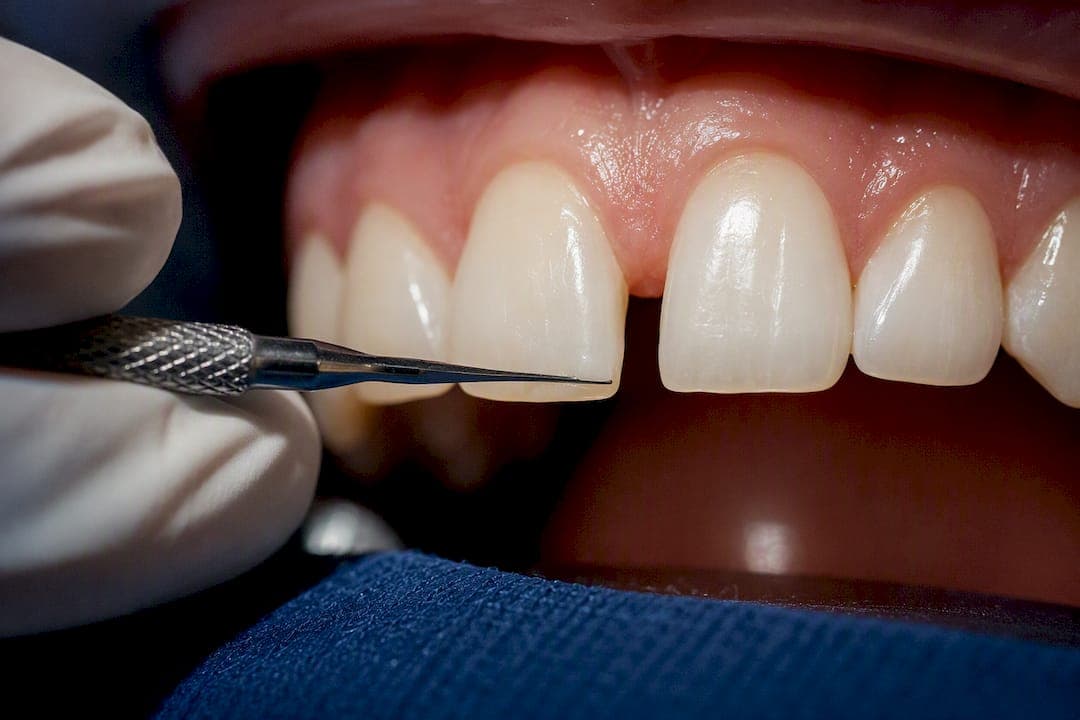
The realistic diastema closure options fall into five categories: dental bonding, porcelain veneers, orthodontic movement with braces or clear aligners, frenectomy, and restorative work like implants or bridges when a missing tooth caused the gap. Interproximal enamel reduction sometimes assists any of these. The rule that decides between them is simple: treat the cause, not just the symptom. Move the teeth if the gap comes from tooth position, and restore or reshape if it's purely cosmetic.
TL;DR:
- Orthodontic movement offers the most long-term stability for gaps caused by tooth position but requires 6 to 24 months and a proper retention plan.
- Bonding is quick and inexpensive but suitable only for small gaps up to 2 millimeters, lasting around 5 to 10 years with staining risks.
- Porcelain veneers provide a durable, aesthetic solution for small to moderate gaps, last over 10 years, and involve enamel reduction.
- Frenectomy addresses gaps caused by an oversized frenum and is a minor surgical procedure with immediate results.
- Restorative options like implants or bridges are suitable for gaps from missing teeth, but they are invasive, costly, and not easily reversible.
Table of Contents
- What Are the Main Diastema Closure Options?
- How Do These Treatments Compare on Time and Cost?
- How Do You Choose the Right Closure Option?
- What Do Timelines and Costs Actually Look Like?
- How Long Do These Results Actually Last?
- What Happens After Treatment to Keep the Gap Closed?
- How Dc-dentistry Approaches Diagnosis and Treatment Planning
- Ready to Close Your Gap? Here's the Next Step
- Sources
- FAQ
What Are the Main Diastema Closure Options?
Every option closes the same visual gap through a different mechanism, and that mechanism decides how long the result lasts.
Dental bonding applies tooth colored composite resin directly to the edges of the teeth bordering the gap, sculpted and cured in a single visit. It works best on small gaps, roughly 1 to 2 millimeters, and it's fully repairable if it chips. Composite resin closure is one of the more conservative options available, since it doesn't require removing healthy enamel. Expect it to last 5 to 10 years, with staining a real risk if you drink a lot of coffee, tea, or red wine.
Porcelain veneers are lab fabricated shells bonded over the front of the tooth. Unlike bonding, veneers require a small amount of enamel reduction, which makes the change more durable but also less reversible. They give you far more control over shape and shade, which matters if the gap sits alongside discoloration or misshapen teeth. Well maintained veneers often last 10 years or longer.
Orthodontic movement, through braces or clear aligners, is the only option that physically relocates the teeth rather than covering the space. It's the more stable fix for gaps caused by tooth position or spacing, though it takes longer, often 6 to 24 months for spacing focused cases, and requires retention afterward to hold the result.

Frenectomy removes or repositions an oversized labial frenum, the tissue band between your upper lip and gum, when it's wedging the front teeth apart. Implants, bridges, or crowns address gaps caused by a missing tooth, requiring surgical and restorative planning that can stretch over months. Interproximal enamel reduction (IPR) shaves tiny amounts of enamel between teeth to create modest space, and it's governed by specific clinical guidelines around how much can safely be removed.
How Do These Treatments Compare on Time and Cost?
The fastest fix isn't always the best one, and the most permanent one isn't always necessary.
- Bonding: masks the space, minimally invasive, done in one visit, lower cost band, fully reversible.
- Veneers: masks the space, moderately invasive (enamel removal required), 2 to 3 visits over several weeks, mid-to-high cost band, not reversible once enamel is cut.
- Orthodontics: moves the teeth, non-invasive to tooth structure, 6 to 24 months plus retention, mid cost band, reversible only through relapse or re-treatment.
- Frenectomy: addresses a structural cause, minor surgical procedure, single session with days of healing, lower-to-mid cost band, irreversible tissue removal.
- Implants/bridges: replace missing structure, surgically invasive, months from planning to final restoration, higher cost band, long-term but not truly reversible.
Orthodontic literature consistently frames biologic tooth movement as more stable than restorative masking, particularly for gaps rooted in actual tooth position rather than tooth shape.
Pro Tip: If long-term stability matters more to you than speed, orthodontic movement paired with a retainer protocol beats bonding or veneers on durability, even though it takes months longer to finish.
How Do You Choose the Right Closure Option?
Start with diagnosis, not preference. A dentist or orthodontist needs to rule out structural causes before recommending a purely cosmetic fix.
- Check the frenum. A blanch test, pulling the lip and watching for tissue blanching near the papilla, helps determine if the frenum is contributing to the gap.
- Evaluate bite and occlusion. Misaligned bites often need orthodontic correction regardless of the gap itself.
- Look for missing or undersized teeth. Tooth size discrepancies or a missing lateral incisor change the whole treatment plan.
- Ask about habits. Tongue thrust or thumb sucking history can predict relapse if untreated.
- Screen periodontal health. Bone loss or active gum disease needs to be addressed before any cosmetic work begins.
Clinicians should document the case with radiographs, digital scans, or study models. Bring a list of questions to your consult: expected lifespan of the result, whether it's repairable, anesthesia needs, recovery time, and financing options. Active periodontal disease, significant bone loss, or craniofacial anomalies are red flags that call for a specialist referral before any closure method moves forward.
What Do Timelines and Costs Actually Look Like?
Bonding wraps up in a single appointment. Veneers typically need two to three visits spread across a few weeks for prep, fabrication, and placement. Aligners or braces run anywhere from 6 to 24 months depending on how much movement is needed. Implant-based fixes take months once you count surgical healing time. Frenectomy is usually a single procedure. with a short recovery.
- Bonding sits at the lower end of the cost spectrum.
- Veneers and implants sit higher, driven by lab work, the number of teeth involved, and any sedation or advanced imaging.
- Orthodontics falls in the middle, though comprehensive cases cost more than spacing-only treatment.
Insurance often treats cosmetic bonding and veneers as elective, while frenectomy or implants tied to function may qualify differently. Ask your office about financing, including CareCredit style payment plans, and request an itemized, imaging-based estimate before committing.
How Long Do These Results Actually Last?
Bonding typically holds up for several years, often around five or more. Veneers often exceed 10 years with good care. Orthodontic closure depends almost entirely on retention.
That last point matters more than most patients realize. Without a bonded retainer supplemented by a vacuum-formed retainer, a closed diastema tends to reopen without retention over time. Common complications include chipping or staining on bonding, marginal decay at veneer margins if hygiene slips, and minor bleeding risk after frenectomy. Routine hygiene visits, avoiding habits like nail biting, and periodic checks catch small issues before they become expensive ones.
What Happens After Treatment to Keep the Gap Closed?
- Immediately after bonding or veneers, avoid biting into very hard foods for the first 24 hours and stick to gentle brushing around the treated area.
- After frenectomy, expect mild soreness for a few days, manage it with over-the-counter pain relief, and follow a soft-food diet as directed.
- After orthodontic closure, wear the retainer exactly as prescribed. A bonded wire behind the front teeth plus a removable vacuum-formed retainer at night is the combination most orthodontists prefer for reducing relapse.
- Schedule routine check-ins every 6 months to catch chips, wear, or shifting early.
Pro Tip: If a tongue thrust habit contributed to your gap, ask about myofunctional or habit reversal therapy alongside your closure treatment. Skipping it is one of the more common reasons gaps reopen.
How Dc-dentistry Approaches Diagnosis and Treatment Planning
Diastema cases rarely fit one template, which is why treatment planning should start with a real diagnostic workup rather than a quick cosmetic pitch. Dc-dentistry builds its process around imaging, a review of bite and frenum anatomy, and a discussion of which category, restorative or orthodontic, actually fits the cause. The practice offers dental bonding, porcelain veneers, and clear aligners under one roof, led by Dr. Kambez Shukoor, a U.S. Navy veteran whose practice has earned over 200 five-star reviews. Same-day consults are available, and every plan comes with a written breakdown before anything is scheduled.

Ready to Close Your Gap? Here's the Next Step
If you've read this far, you already know the gap in your smile probably needs one of a handful of proven approaches, not a guess. Dc-dentistry treats diastema cases with the same in-house model it uses for its full range of cosmetic dentistry services, including bonding, veneers, aligners, and smile makeovers, so you're not bounced between a general dentist and an outside specialist for imaging or a second opinion.

Some dental clinics offer same-day appointments for new patients seeking a diagnosis before committing to treatment, and financing options may be available to help manage the cost of higher-priced procedures like veneers or aligners. Book a consult through the Smile Makeover and cosmetic dentistry page to get a written treatment plan built around what's actually causing your gap, not just what closes it fastest.
Sources
- Diastema - Cleveland Clinic
- Conservative and esthetic management of diastema closure using porcelain laminate veneers (PMC)
This article is general information, not a substitute for advice from a qualified doctor. Consult a qualified healthcare professional about your own circumstances before acting on anything here.
FAQ
How much does it cost to close a diastema?
Cost depends entirely on the method: bonding sits at the lower end since it's a single-visit procedure, while veneers, orthodontics, and implant-based fixes cost more due to lab work, visit count, or surgical planning. Dc-dentistry does not publish set prices online, but a consult produces an itemized, written estimate specific to your case.
How can I close my diastema?
The right method depends on what's causing the gap. Cosmetic gaps often respond well to bonding or veneers, while gaps caused by tooth position, a missing tooth, or an oversized labial frenum usually need orthodontic movement, restorative work, or a frenectomy instead.
Can veneers close a diastema?
Yes, porcelain veneers can close small to moderate gaps by reshaping the visible surface of the teeth bordering the space. They work especially well when the gap comes with uneven shape or shade, since veneers give more control over both than bonding alone.
Can Invisalign be used to close a diastema?
Clear aligners can close diastemas caused by tooth spacing or position by gradually moving the teeth into place, often over several months to two years depending on severity. Because this method actually repositions teeth rather than masking the space, it typically requires retention afterward to prevent the gap from reopening.