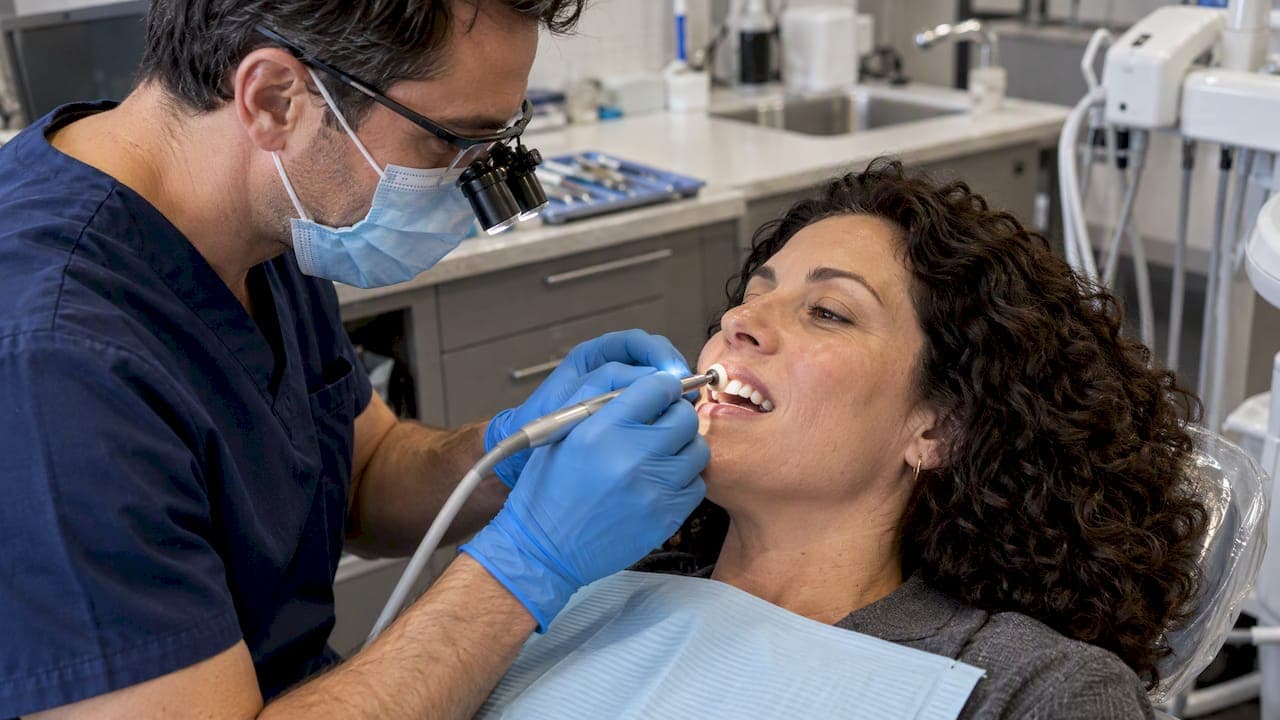
Composite bonding typically lasts 3 to 10 years, with many studies showing a central tendency of 5 to 7 years before a touch-up or replacement is needed. Where a tooth sits in your mouth, how hard you bite or grind, your diet, and how consistently you keep up with professional maintenance all push that number up or down. The sections below break down the evidence behind these ranges and what you can do to land on the longer end.
TL;DR:
- A systematic review found overall survival rates of 90.7% at 3 years, 89.5% at 5 years, and 75.6% at 10 years.
- Large molar restorations face greater stress than small front tooth repairs, while grinding, hard objects, and dry mouth can accelerate wear or staining.
- Brush gently with fluoride toothpaste, floss daily, limit staining drinks, and schedule cleanings every six months; people who grind should wear a fitted night guard.
- A chip, rough edge, new sensitivity, or lifting margin warrants prompt assessment; repair often preserves healthy tooth structure better than full replacement.
- Choose bonding for a small chip or gap; veneers resist stains and last longer, while crowns suit teeth with substantial structural loss.
Table of Contents
- What studies and major clinics report about bonding survival rates
- Factors that affect how long composite bonding lasts
- How to make composite bonding last longer
- Repair, touch-up, and replacement: knowing when to act
- How composite bonding compares with veneers and crowns for durability
- What to ask at a consultation about bonding longevity
- A realistic way to think about bonding over time
- Keep your bonded teeth on track with same-day care
- FAQ
- Sources
What studies and major clinics report about bonding survival rates
A systematic literature review of composite resin restorations gives us the clearest long-term picture available. It found overall survival rates of 90.7% at 3 years, 89.5% at 5 years, 89.3% at 7 years, and 75.6% at 10 years, with the same researchers concluding that longevity can stretch past 15 years when clinical protocol is followed closely.

Most bonded restorations that survive the first three years keep performing well for years afterward, according to that systematic review, which tracked composite resin outcomes across multiple follow-up points rather than a single snapshot.
Clinical guidance tends to land on a narrower, more conservative window. Restorative dentistry summaries from NHS-affiliated hospital services report that composites commonly perform well for 5 to 7 years in everyday practice, and that staining, chipping, or debonding are expected over time rather than signs of a failed procedure.
Why do the numbers vary so much between sources? A few reasons stand out:
- Follow-up length differs. A study that tracks patients for 3 years will naturally report a higher survival rate than one that follows them for 10.
- Failure definitions differ. Some studies count any visible staining as a failure; others only count restorations that fully debond or require replacement.
- Tooth type and restoration class matter. Small anterior repairs on front teeth generally outlast large posterior restorations on molars, which absorb far greater biting forces.
A small chip repair on an incisor and a large Class II filling on a lower molar are not the same bet, even though both fall under "composite bonding."
Factors that affect how long composite bonding lasts
Bonding failure rarely comes down to one cause. It's usually a combination of mechanical stress, chemical wear, technique, and daily habits.
Mechanical risks sit at the top of the list. Bruxism (nighttime grinding) and heavy occlusal forces wear down composite faster than normal chewing, and molars under constant load fail sooner than front teeth used mainly for biting into soft food. Larger restorations also have more surface area exposed to stress, which raises the odds of a chip or crack.
Staining and chemical wear show up gradually rather than all at once. Coffee, tea, red wine, tobacco, and acidic foods or drinks all contribute to surface discoloration and gradual softening of the resin, and dry mouth (xerostomia) can accelerate staining since saliva normally helps rinse away pigments.
Clinical and technical factors matter just as much as anything a patient does at home. The adhesive protocol used, how carefully the composite is layered and shaped, and how thoroughly each layer is light-cured all influence how long a restoration holds up. Operator skill and attention to detail during placement are consistently cited as factors separating bonding that lasts years from bonding that chips within months.
Patient behaviors round out the picture:
- Skipping regular brushing and flossing lets plaque build up along bonded margins, increasing the risk of staining and secondary decay.
- Habits like biting nails, chewing ice, or opening packages with your teeth put sharp, concentrated stress exactly where composite is weakest.
- Wearing a night guard if you grind your teeth protects bonded surfaces from forces they were never designed to absorb.
Pro Tip: If you already know you grind your teeth, ask about a night guard before your bonding appointment rather than after your first chip.
How to make composite bonding last longer
Extending the life of bonded teeth comes down to a short list of habits, done consistently, plus a maintenance schedule you actually keep.
- Brush with a nonabrasive, fluoride toothpaste and a soft-bristled brush; gentle daily cleaning protects the composite surface from premature wear.
- Floss daily around bonded margins, where plaque tends to collect and cause staining or decay if left undisturbed.
- Limit stain-heavy foods and drinks, or rinse with water after coffee, tea, red wine, or dark sauces.
- Avoid biting hard objects directly on bonded teeth, including ice, pens, and fingernails.
- Keep up with routine hygiene visits, typically every six months, so a dentist can polish the surface and catch early wear before it becomes a chip.
- Wear an occlusal or night guard if you grind or clench, and ask about a bite adjustment if a bonded tooth feels high after placement.
Professional polishing restores shine and smooths minor surface roughness, but it has limits. Repolishing can refresh a restoration that's dulled from staining, yet it cannot rebuild lost structure or fix a crack. When a restoration has visible chips, a rough margin, or sensitivity that wasn't there before, repair or replacement becomes the appropriate next step rather than another round of polishing.
Pro Tip: Schedule your bonding touch-up check at the same visit as your regular cleaning so it never falls off your calendar.
If bruxism is a factor, a well-fitted mouthguard is one of the more practical ways to protect bonded teeth overnight, a point echoed in independent guidance on mouthguards for teeth grinding.
Repair, touch-up, and replacement: knowing when to act
Bonded teeth tend to send clear signals before they fail outright. Watching for these signs helps you act early, when a simple repair is usually all that's needed.
- A visible chip or rough, sharp edge you can feel with your tongue
- Staining concentrated along the margin where the composite meets natural tooth
- New sensitivity to hot, cold, or sweets on a previously comfortable tooth
- Recurrent decay detected at a checkup
- Visible lifting or debonding at the edge of the restoration
Repair, rather than full replacement, is often the better first move. A JADA prospective cohort study following defective resin restorations for seven years found that repair, sealing, or refinishing produced durable outcomes with notably low failure rates, supporting repair as a conservative strategy that preserves healthy tooth structure. Laboratory research backs this up from a materials standpoint: surface treatments and silane-containing adhesives improve the bond strength between old and new composite, which is part of why a well-executed repair can perform comparably to starting over.
If you notice a chip or rough spot, getting it evaluated quickly usually keeps the fix smaller and faster. Most repairs take a single visit, and functionally and cosmetically, a properly repaired bonded tooth should feel and look just like it did before the chip.
How composite bonding compares with veneers and crowns for durability
Bonding sits at the conservative end of the cosmetic dentistry spectrum, which is both its advantage and its tradeoff. Veneers and crowns generally outlast bonding, but they involve more preparation and higher cost.
- Bonding preserves the most natural tooth structure, requires little to no enamel removal, and is easy to repair chairside, but it has the shortest expected lifespan of the three.
- Porcelain veneers typically outlast composite bonding and resist staining better, making them a stronger choice for extensive cosmetic changes or long-term color stability, though they require some enamel removal and cost more.
- Crowns cover the whole tooth and tend to hold up longest under heavy bite forces, which makes them the preferred option when a tooth has lost significant structure, but they are the most invasive and expensive route.
For a single chipped incisor or a minor gap, bonding is usually the sensible, lowest-intervention choice. For someone planning a full smile makeover or dealing with extensive wear across several teeth, veneers or crowns often make more sense despite the higher upfront investment.
What to ask at a consultation about bonding longevity
We perform dental bonding alongside routine polishing, occlusal guard fittings, and the broader cosmetic and restorative care that keeps bonded teeth functioning well over time. A good consultation should cover more than just whether bonding fits your smile goals.
Worth asking at your visit:
- What composite material and adhesive protocol will be used
- How often you should expect professional polishing or touch-ups
- What the repair policy looks like if a bonded tooth chips
- What lifespan is realistic for your specific tooth and bite pattern
These questions help set expectations before treatment, rather than guessing afterward.
A realistic way to think about bonding over time
Composite bonding was never meant to be a one-time, permanent fix, and that's not a flaw. It's a conservative, reparable treatment that protects your natural tooth while giving you room to adjust course as wear happens. A chip at year four isn't a failure story, it's a normal part of owning bonded teeth.
The best outcomes come from treating bonding as a partnership: good daily habits on your end, paired with a dentist who checks in regularly and catches small issues before they grow. Bring up your specific risk factors, grinding, diet, tooth location, at your next visit, and build a maintenance plan around them.
— Jake
Keep your bonded teeth on track with same-day care
We offer dental bonding and broader cosmetic dentistry services at a single Washington, DC location, so exams, touch-ups, and repairs happen without referrals or hand-offs between offices. If grinding is part of your picture, we can also fit an occlusal guard to protect bonded surfaces overnight, and our routine cleanings double as a chance to catch early wear before it becomes a bigger repair.

Same-day appointments are available for patients who notice a chip or rough edge and want it looked at quickly. Reach out to schedule a consultation and get a clear, written plan for your bonded teeth.
This article is general information, not a substitute for advice from a qualified doctor. Consult a qualified healthcare professional about your own circumstances before acting on anything here.

FAQ
What happens after 10 years of composite bonding?
By the 10-year mark, survival rates drop to around 75.6% in systematic review data, meaning a meaningful share of restorations will have needed repair or replacement by then. Many bonded teeth that reach this point show staining, minor chipping, or margin wear, and a dentist can usually repair rather than fully replace them if the underlying tooth is healthy.
Can dental bonding last 20 years?
Some bonded restorations can exceed 15 years when protocol is followed closely and the restoration is well maintained, according to systematic review findings. Some bonded restorations can exceed 15 years when protocol is followed closely and the restoration is well maintained, according to systematic review findings. Longevity depends heavily on tooth location, bite forces, and maintenance habits.
How often should composite bonding be replaced?
There's no fixed replacement schedule since it depends on wear, staining, and whether the bonding chips, but clinical guidance suggests many composites perform well for 5 to 7 years before needing attention. Regular checkups let your dentist decide between a simple repolish, a targeted repair, or full replacement based on what the restoration actually needs.
What are the downsides of composite bonding?
Composite bonding stains more easily than porcelain and has a shorter expected lifespan than veneers or crowns, typically landing in the 3 to 10 year range. It can also chip under heavy biting forces or grinding, which is why night guards and careful habits matter more with bonding than with more durable restorations.
Sources
- The long-term results of teeth restoration with composite resin materials: a systematic literature review
- Journal of the American Dental Association — study on longevity of treated defective restorations
- Applied Sciences — effect of adhesive systems and surface treatments on repair bond strength (2025)
- Restorative dentistry guidance (Leicester Hospitals / NHS)