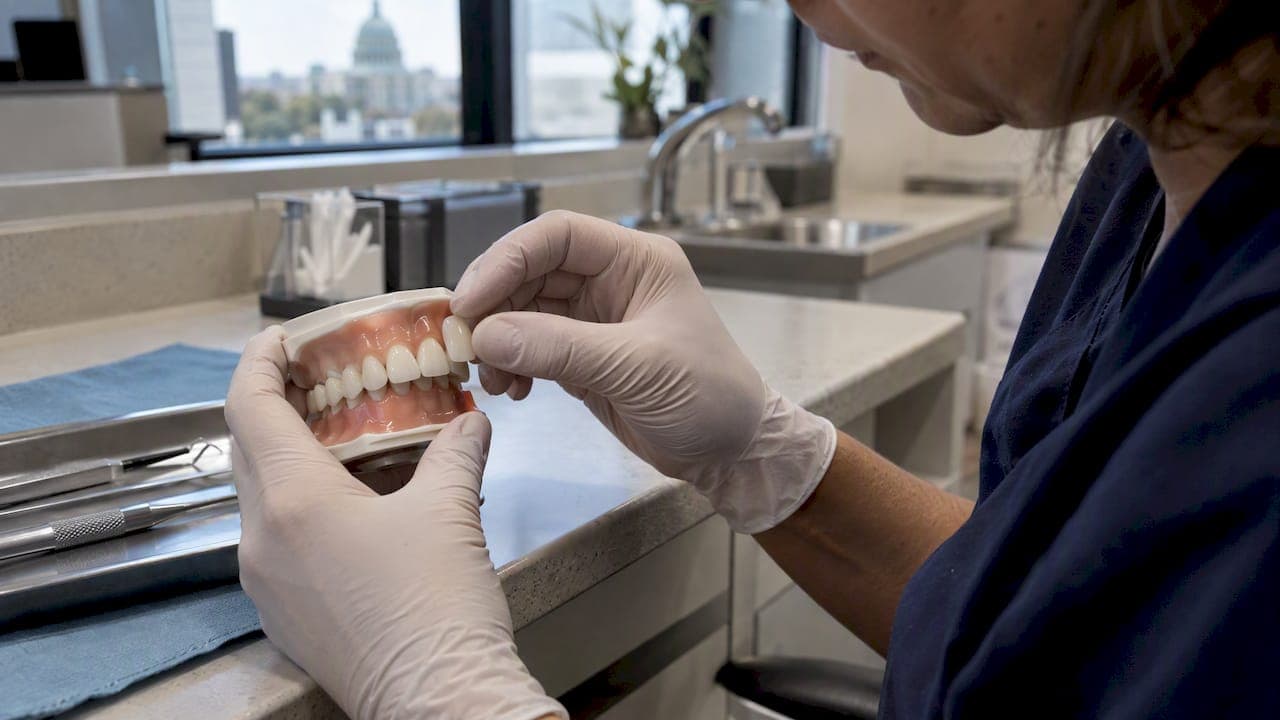
Porcelain veneers typically last 10 to 15 years, and well-bonded ones can pass 20. Composite veneers usually last 5 to 7 years. Those are ranges, not promises. Your bite, your habits, the amount of enamel left under the veneer and the dentist who placed it decide where you land. Below we explain what the research shows, what shortens a veneer's life, what replacement costs, and how to protect the investment.
TL;DR
- Porcelain veneers average 10 to 15+ years and composite veneers about 5 to 7, with consistent care pushing results to the upper end.
- A 2019 study of 413 pressable glass-ceramic veneers found 95% survived 10 years, 91% survived 15 and 87% survived 20.
- Fracture and debonding are the main failures, and grinding or clenching raises the risk.
- Porcelain typically runs $900 to $2,500 per tooth nationally, and insurance rarely pays, so plan for replacement too.
- Choose a licensed dentist. Social media "veneer techs" are not one.
Table of Contents
- How long veneers last, by material
- What the long-term studies say
- What shortens a veneer's life
- Do veneers last as long if you have crooked teeth?
- What happens when a veneer reaches the end of its life
- Veneer cost per tooth and the cost of replacing them
- How to make veneers last: a maintenance routine
- Porcelain or composite: which fits you?
- Our perspective on veneer longevity
- Thinking about veneers in Washington, DC?
- FAQ
- Sources
How long veneers last, by material
The answer depends first on what the veneer is made of.
| Veneer type | Typical lifespan | What drives the range |
|---|---|---|
| Porcelain (ceramic) | 10 to 15+ years, sometimes 20+ | Enamel left under the veneer, bite forces, bonding quality, home care |
| Composite resin | 5 to 7 years | Wear, staining, chipping, how well it is polished and maintained |
The University of Rochester Medicine describes porcelain as longer lasting and more stain resistant, while composite is cheaper but may wear sooner. Some public-health guidance is more conservative. A Leeds Teaching Hospitals NHS leaflet says a properly cared-for crown or veneer should normally last around 8 to 10 years, and ties that to regular check-ups and good brushing and flossing.
So you will see figures from 5 to 25 years online. They differ because they mix materials, study designs and patient habits. Read each number as a range for a specific kind of veneer.
What the long-term studies say
Survival data is more useful than a marketing range, because it follows real veneers in real mouths.
- Pressable glass-ceramic veneers. A retrospective case series of lithium-disilicate veneers reported survival of 95% at 10 years, 91% at 15 and 87% at 20.
- Feldspathic porcelain veneers. A study following veneers for up to 21 years estimated cumulative survival while accounting for clustered outcomes, meaning several veneers in one mouth that share the same habits and bite.
- Literature review. A 2024 narrative review looked at how tooth preparation, aging, veneer type and cement affect failure, and found that laboratory tests and clinical results do not always agree.
Two cautions. First, "survival" means the veneer is still in place and functioning. It does not mean it looks new. Edges can chip, margins can show, and shade can drift on the natural teeth beside it. Second, these studies describe carefully planned and executed cases. They are not a guarantee for every mouth.
What shortens a veneer's life
Researchers name two main failure mechanisms: fracture and debonding. Most of what follows feeds into one of them.
Grinding and clenching
Porcelain is strong under steady pressure and weaker under sudden shearing force. People who grind or clench at night put repeated stress on the edges, which is why reviews of veneer failure flag parafunctional habits as a risk. If you wake with a sore jaw, flat or chipped teeth, or a partner hears you grinding, tell your dentist before you commit. A custom night guard is the usual protection.
How much enamel is left
Enamel is the best surface to bond to. The 2019 pressable-ceramic study is often cited for this point: veneers bonded to enamel hold up better than those that expose dentin. A small patch of exposed dentin may be unavoidable in some cases, but a dentist who plans the preparation conservatively gives the veneer a stronger foundation. Ask how much enamel they expect to remove and whether they can show it on your X-rays and scans.

Bite and tooth position
Veneers on teeth that meet edge to edge, or that carry more than their share of biting force, take more punishment. A thorough exam should include how your teeth meet, not only how they look.
Using teeth as tools
Opening packages, biting nails, chewing ice and crunching hard candy are classic ways to chip porcelain. Composite chips more easily still.
Gum disease and decay
A veneer covers the front of a tooth. The tooth underneath can still get decay at the edge, and gums can still recede and expose the margin. Our guide on whether veneers prevent cavities covers this in detail, and the short answer is no.
Who places them
The American Dental Association has warned the public about "veneer techs", people who promote veneer placement on social media without being licensed dentists. The ADA's follow-up piece repeats that patients should see licensed professionals. A licensed dentist assesses your oral history, medications and existing conditions first. Check any provider's license with your state dental board. In the District, that means the DC Board of Dentistry.
Do veneers last as long if you have crooked teeth?
They can, but the way they are used matters. A paper in the Journal of the American Dental Association, "The Myth of Instant Orthodontics", raises clinical and ethical concerns about using porcelain veneers to correct malaligned front teeth. Straightening healthy teeth with veneers can mean removing a lot of healthy tooth structure, and that cannot be undone. More conservative routes, such as orthodontics, bonding or minor reshaping, deserve a conversation first.
We do place veneers for mild alignment and gap concerns, but we would rather tell you when clear aligners or bonding would protect more of your natural tooth.
What happens when a veneer reaches the end of its life
People often ask what happens after 10 or 20 years. Nothing dramatic, usually. Common signs it is time for a look:
- A dark line or ridge at the gumline where the margin has opened
- A chip, crack or rough edge you can feel with your tongue
- A veneer that feels loose or lifts when you floss
- A color mismatch as natural teeth change shade around it
- Sensitivity or a spot of decay at the edge
A loose or broken veneer is not a wait-and-see problem. Food and bacteria can get under it. Keep the piece if it came off, avoid chewing on that tooth, and call your dentist. Our veneer aftercare guide covers the first 48 to 72 hours after placement and what same-day repairs look like.
Because preparing a tooth often removes enamel, veneers are considered irreversible and are not a one-time fix. Expect to replace them at some point. Your real teeth stay under the veneer, which we explain in do you keep your real teeth under veneers.
Veneer cost per tooth and the cost of replacing them
A useful way to compare options is cost per year of service. Using national ranges compiled by Humana:
| Material | Typical cost per tooth | Typical lifespan | Rough cost per tooth, per year |
|---|---|---|---|
| Porcelain | $900 to $2,500 | 10 to 15 years | about $60 to $250 |
| Composite | $250 to $1,500 | 5 to 7 years | about $36 to $300 |
The last column is our own arithmetic on those ranges (cost divided by years), so treat it as a rough guide, not a quote. The comparison shows why the cheaper option is not always cheaper: composite often needs redoing twice in the time one porcelain veneer serves.
A few more points:
- Insurance rarely covers veneers, because they are generally classed as cosmetic.
- Full sets are priced by complexity, and national figures run from about $10,000 to well over $50,000.
- Prices in Washington, DC differ from practice to practice. Local offices list anything from the low thousands per tooth upward, so national averages are only a starting point.
- We do not publish a per-tooth price for veneers, because the right number depends on your plan: how many teeth, which material, and whether any foundational work is needed. We give you a clear written treatment plan with the cost before you decide.
Financing through CareCredit and Lending Tree is available for larger treatment plans.
How to make veneers last: a maintenance routine
The research ties the top end of every range to ordinary habits.
- Brush twice a day with a non-abrasive toothpaste and a soft brush. Gritty whitening pastes can dull composite.
- Floss daily. Veneers do not stop gum disease or decay at the margins.
- See your dentist and hygienist regularly. The Leeds NHS guidance lists check-ups first among the conditions for a veneer reaching its expected life. Professional cleanings also let us polish composite and check the edges.
- Wear a night guard if you grind. It is the single most protective accessory for porcelain.
- Keep sugar low. The risk is decay at the edge, not the veneer itself.
- Do not use teeth as tools. Use scissors, not your front teeth.
- Watch staining habits with composite. Porcelain resists staining well, while composite picks up coffee, tea and red wine over time.
Professional upkeep matters for any cosmetic treatment, not only teeth. The same logic applies to other aesthetic results that fade without maintenance: the outcome lasts longer when daily habits and professional visits work together.
Porcelain or composite: which fits you?
Choose porcelain if you want the longest service life, strong stain resistance and a major change in shape or shade, and you accept that preparation is irreversible.
Choose composite if you want a lower upfront cost, minimal or no tooth removal, or a shorter-term fix for chips and small gaps. Our page on composite bonding lifespan explains the 3 to 10 year range patients see and how repairs work, and our bonding service shows what is involved.

If you cannot decide, the 4-8-10 rule for veneers is a quick way to think about how many teeth show in your smile.
Our perspective on veneer longevity
We tell patients that the lifespan of a veneer is decided before the veneer exists. It is decided by the exam, the imaging and the plan.
At DC Implant & Cosmetic Dentistry, Dr. Kambez Shukoor, a U.S. Navy veteran, handles everything from exams to surgical implants in our own office. That matters for veneers because the person judging your bite, your gums and your enamel is the same person doing the work, with no hand-off. We take thorough imaging and write out a clear treatment plan before anything is done, so you know the material, the number of teeth and the cost.
Our honest advice is this. Do not pick veneers on price per tooth alone. Ask what will be removed, what your grinding risk is, and what a replacement in 15 years looks like. If bonding, whitening or aligners can meet your goal with less tooth loss, we will say so, even when it means a smaller treatment.
— Jake
Thinking about veneers in Washington, DC?
We offer porcelain veneers as well as bonding, whitening and full smile makeovers. Same-day appointments are available, and our patients have left more than 200 five-star reviews. Book a consultation and we will examine your teeth, discuss your options and give you a written plan with costs.
FAQ
How long do veneers last?
Porcelain veneers generally last 10 to 15 years and often longer, with long-term studies showing about 87% survival at 20 years for one pressable ceramic system. Composite veneers typically last 5 to 7 years. Grinding, poor hygiene and skipped check-ups shorten both.
How often should veneers be replaced?
There is no fixed schedule. Replace a veneer when it chips, cracks, loosens, opens at the margin or no longer matches your teeth. Regular exams let your dentist catch these early.
What happens after 10 or 20 years of veneers?
Many porcelain veneers are still functioning, but some will show edge wear, small chips or a visible margin as gums recede. Others need replacement because of fracture or debonding. Your dentist can polish, repair or redo them depending on the condition of the tooth underneath.
Are veneers permanent?
No. They are long-lasting, not permanent. Because enamel is usually removed to fit them, the change to the tooth is irreversible, and you should expect to replace veneers at some point.
Why do some dentists discourage veneers?
The concern is irreversible removal of healthy enamel, especially when veneers are used to straighten teeth that orthodontics or bonding could treat more conservatively. A good dentist will discuss those alternatives with you first.
Sources
- Clinical performance of pressable glass-ceramic veneers after 5, 10, 15 and 20 years (PubMed)
- Up to 21-year outcome of feldspathic porcelain veneers (PubMed)
- Clinical Survival Rate and Laboratory Failure of Dental Veneers (PMC)
- Leeds Teaching Hospitals NHS Trust: Crowns and veneers
- Humana: Veneers cost
- ADA: ADA advises public about veneer techs
- ADA: Debunking dental trends
- JADA: The Myth of Instant Orthodontics
- Colgate: How long do veneers last?