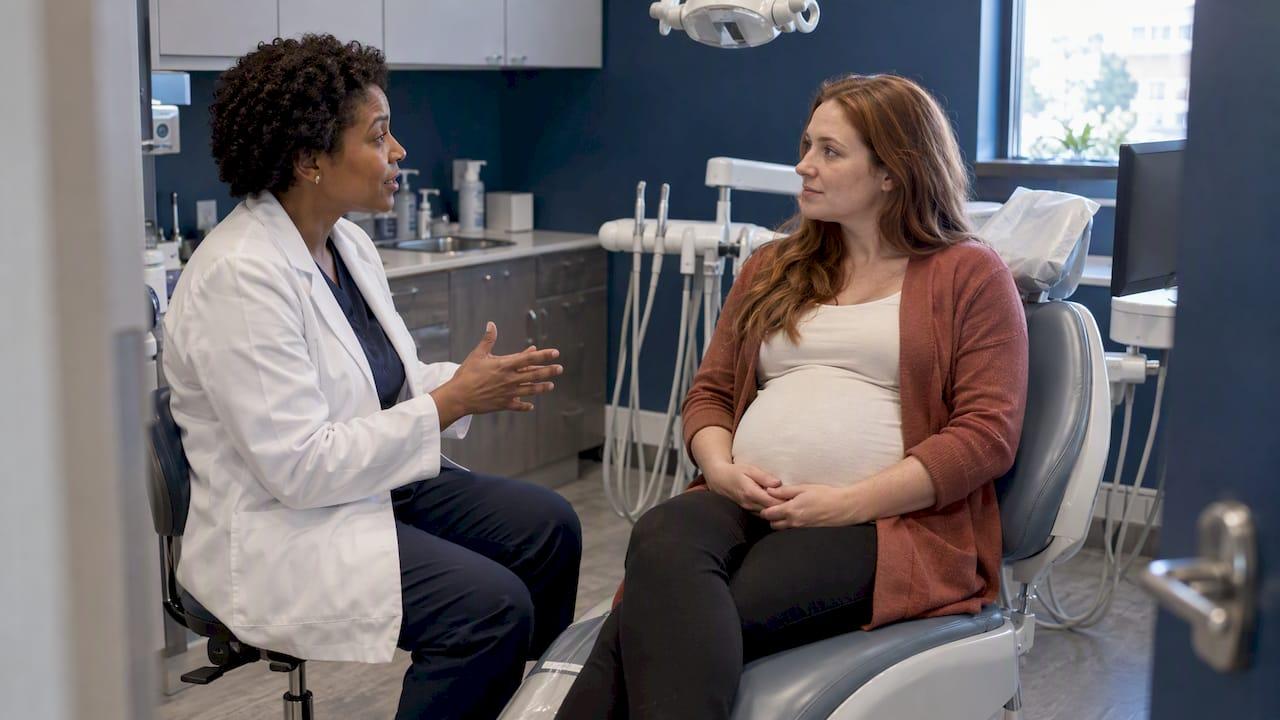
The short answer: wait. No one has shown that whitening harms a baby, but no one has shown it is safe either, and whitening is an elective treatment. Dental and obstetric groups advise postponing it until after delivery. Your teeth can look better in the meantime, and you can get any dental care you need safely.
Below we cover what the guidance says, why strips and trays are a worse bet than they look, what to do about yellow teeth now, and how to plan whitening once you are ready.
TL;DR
- Whitening is elective, and the research on bleaching agents in pregnancy is thin. The usual advice is to postpone it until after delivery.
- Necessary dental care, such as fillings, extractions and root canals, is safe at any point in pregnancy. Do not skip it.
- Pregnancy gums and enamel are more vulnerable, and sensitivity is the most common whitening side effect. That is a good reason to wait on its own.
- A professional cleaning, good daily hygiene and a whitening plan for after delivery are the safe route to a brighter smile.
Table of Contents
- What the guidance actually says
- Why pregnancy makes whitening a worse idea than usual
- Strips, trays, in-office, "natural": are any of them safe?
- Dental care you should not postpone
- Perspective: how we handle this question in the chair
- How to get a brighter smile now, without bleaching
- Whitening won't touch dental work
- Planning your whitening for after the baby
- Whitening with us after your baby arrives
- FAQ
- Sources
What the guidance actually says
There is no tidy, single rule here, and that is why search results disagree. Some pages say whitening is dangerous. Others say there is no evidence of harm. Both can be true at once.
The Rady Children's Health article on the subject says few good studies exist on whether bleaching products are safe in pregnancy. Which?, a UK consumer group, says there is no evidence that whitening is dangerous for pregnant people. The problem is the lack of studies, not a proven injury.
What tips the balance is that whitening is not medically necessary. The Colgate oral health guide reports that the American Pregnancy Association says cosmetic treatments that are not immediately necessary should be postponed until after delivery. It also reports that the American Dental Association (ADA) agrees, citing safety concerns about bleaching materials. The Canadian Dental Association has a position statement on bleaching too, and the same logic applies: when a treatment is elective and the data is missing, delay costs you nothing but a few months.
That is the same call we make at our practice. If a procedure can wait without any harm, and the evidence for doing it now is thin, we would rather you wait.

Why pregnancy makes whitening a worse idea than usual
Even setting the fetus aside, your mouth is not in its usual state.
Gums react more
Hormonal shifts commonly cause pregnancy gingivitis. ACOG notes that physiologic changes in pregnancy can include gingivitis, tooth mobility, tooth erosion and cavities. Whitening gel on inflamed gum tissue is a recipe for irritation.
Sensitivity is already the main side effect
The ADA says temporary sensitivity can affect up to two-thirds of people in the early stages of bleaching. If your gums are tender and your enamel is under stress, you may feel that more.
Morning sickness and reflux wear on enamel
A common fear is that the baby takes calcium from your teeth and weakens them. That is a myth. The real risks are indirect: more frequent snacking, more sugar, and stomach acid from vomiting or reflux washing over your teeth. Acid exposure erodes enamel, and bleaching enamel that is already eroded is not a combination you want. Our post on whitening and sensitive teeth explains why we go slowly even for patients who are not pregnant.
Strips, trays, in-office, "natural": are any of them safe?
The active ingredient in most whiteners is hydrogen peroxide or carbamide peroxide. Delivery changes, the chemistry does not.
| Option | Active agent | Main pregnancy concern |
|---|---|---|
| Drugstore strips | Hydrogen peroxide | Little safety data, gum irritation, uncontrolled application |
| Dentist-made take-home trays | Carbamide or hydrogen peroxide | Elective, sensitivity, less data on bleaching in pregnancy |
| In-office bleaching | Higher-concentration peroxide | Elective, stronger exposure, sensitivity |
| Salon or mall kiosk whitening | Varies, often unclear | Unsupervised, higher risk of burns and poor application |
| Whitening toothpaste | Mild abrasives, sometimes low peroxide | Lower risk, little effect on deep stains |
None of these has a pregnancy safety record that justifies doing it now. A few points on the details:
- "Natural" does not mean pregnancy-safe. Dental professionals note that natural and over-the-counter products are not automatically safe in pregnancy. A pharmacy fact sheet from NHS London advises checking with a dentist before adopting any new oral care product.
- Online kits and salons are the riskiest. Without a dental exam first, no one checks for cavities, gum disease or worn enamel, and a leaky tray can burn tissue.
- Whitening toothpaste is the mildest option. It will not change deep stains, and it is better to use a regular fluoride toothpaste twice a day.
Our article on why a dental exam beats label percentages goes into why the number on the box tells you little about whether a product suits your mouth.
Dental care you should not postpone
Some expectant mothers hear "avoid whitening" and extend it to "avoid the dentist." That is the wrong lesson.
ACOG states that necessary treatment, including fillings, extractions and root canals, can be done at any time during pregnancy, and that delaying it can lead to more complex problems. Routine exams and cleanings are part of that picture.
So book these:
- A cleaning and exam. Plaque control matters more when hormones make gums bleed easily.
- Treatment for any cavity, toothache or gum problem. An infection is a bigger risk than the treatment.
- A conversation about morning sickness and reflux, if either applies to you.
Tell the office you are pregnant when you book. It affects planning, including how long you can comfortably lie back in the chair late in pregnancy. The Colgate guide notes that the American Pregnancy Association suggests the second trimester for more extensive work, since the third can make sitting in the chair difficult.
If you have a dental emergency, such as severe pain, swelling or a broken tooth, call a dentist the same day. Do not wait for delivery.
Perspective: how we handle this question in the chair
Patients often ask us about whitening before a wedding, a baby shower or a maternity photo shoot. Our answer is the same each time: we would rather help you look your best safely than do something with unclear evidence and a possibility of sensitivity.

Here is how we think about it. A good whitening result depends on a healthy mouth. That means an exam, X-rays when appropriate, and a written plan. Because we perform everything from exams to implants in-house, we can see whether a stain needs bleaching, a cleaning, or something else entirely. Dr. Kambez Shukoor, a U.S. Navy veteran, brings a medical discipline to that planning: decide what is necessary, decide what can wait, and put both in writing.
For pregnant patients, what is necessary is cleaning, gum health and treating problems. What can wait is bleaching. We will happily book a whitening visit for a few weeks after delivery, or after breastfeeding if you prefer to wait until then, and we will talk about timing when the day comes.
— Jake
How to get a brighter smile now, without bleaching
You have options that do not involve peroxide.
- Get a professional cleaning. Dentist-run cleanings remove surface stain from coffee, tea and tobacco, and often make teeth look noticeably brighter. Plain polishing has nothing to do with bleaching.
- Brush twice a day with fluoride toothpaste and floss daily. This is ACOG's consistent advice for pregnancy, and it prevents the plaque yellowing that builds up fast with bleeding gums.
- After vomiting, rinse with water (or water with a little baking soda) rather than brushing right away. Acid-softened enamel is easier to scratch. Wait before brushing.
- Cut back on stain triggers. Dark sodas, tea, coffee, red wine and sugary snacks. Water after each cup helps.
- Understand why your teeth look yellow. Sometimes it is surface stain, sometimes it is thin enamel showing the darker layer beneath. Our guide on why teeth turn yellow and how to whiten them sorts out which is which.
If you are worried about a single dark or chipped tooth, ask us. Some problems are not whitening problems at all.
Whitening won't touch dental work
Before you plan ahead, remember that bleaching only changes natural tooth structure. The ADA is clear that only natural teeth can be whitened, not tooth-colored restorations. Crowns, veneers, bonding and fillings keep their shade. If you have front-tooth work, the timing and shade matching are worth planning with your dentist. If you have veneers, do porcelain veneers stain? covers what to expect.
Planning your whitening for after the baby
There is no single date the guidance names, so this is a practical plan rather than a rule.
- Wait until after delivery. Many dentists and OB-GYNs say to wait until breastfeeding is complete as well, but evidence is limited either way. Ask your own dentist and obstetrician or midwife, since they know your health history.
- Start with an exam. Gum inflammation and cavities need treatment before bleaching.
- Choose a method with a professional. In-office treatment, custom take-home trays, or a combined approach depend on your sensitivity and your goals.
- Go slowly if your teeth are sensitive. Shorter wear times and lower concentrations are gentler.
- Protect the result. Dark drinks and sauces are the usual culprits, and a guide on foods to avoid after whitening helps you keep the result longer.
If the shade you want is more than whitening can deliver, such as for uneven or worn teeth, talk to us about the wider cosmetic dentistry options. Those are also postpartum conversations.
Whitening with us after your baby arrives
When you are ready, our teeth whitening service in Washington, DC starts with an exam so we can see what is causing your discoloration and whether bleaching is the right tool. We offer same-day appointments, and financing options including CareCredit and LendingTree are available for higher-cost treatments. The site lists no price for whitening, so call us for a quote.
Need a cleaning or an exam while you are pregnant? Those are covered under general dentistry, and they are the best use of your time right now.
FAQ
Is teeth whitening safe during pregnancy?
Nobody has proven that it is harmful, and nobody has proven that it is safe. Because whitening is elective and the studies are lacking, the ADA and the American Pregnancy Association, as reported by Colgate, recommend waiting until after delivery. Your own dentist and obstetric provider can advise on your situation.
Can I use whitening strips while pregnant?
It is better to hold off. Strips contain peroxide, have little pregnancy-specific safety data and can irritate gums that are already tender. Sensitivity is common, with the ADA noting that up to two-thirds of users may experience it early in treatment.
Can I get a dental cleaning or other dental work while pregnant?
Yes. ACOG says necessary dental care is safe at any time in pregnancy. Tell the office you are pregnant when you book, and do not put off pain, swelling or a broken tooth.
How can I get rid of yellow teeth while pregnant?
Start with a professional cleaning to remove surface stain, brush twice daily with fluoride toothpaste, floss, and limit coffee, tea and dark sodas. Save bleaching for after delivery. If the yellow is from thin enamel or an old restoration, a dentist can tell you what will help later.
Does health coverage pay for whitening during pregnancy?
Not in general. Whitening is cosmetic, and cosmetic treatment is typically excluded even where pregnancy-related dental care is covered. In the UK, for example, the NHS does not provide whitening, so patients pay privately. Check your own US plan before booking.
Sources
- Teeth Whitening When Pregnant: Is It Safe? (Colgate)
- Oral Health Care During Pregnancy and Through the Lifespan (ACOG)
- Whitening (American Dental Association)
- CDA Position on Teeth Bleaching (Canadian Dental Association)
- Using Teeth Whiteners During Pregnancy (Rady Children's Health)
- Can I whiten my teeth while pregnant? (Which?)
- Pharmacy Dental Fact Sheet: Tooth Whitening (NHS London)
- Teeth whitening (NHS)