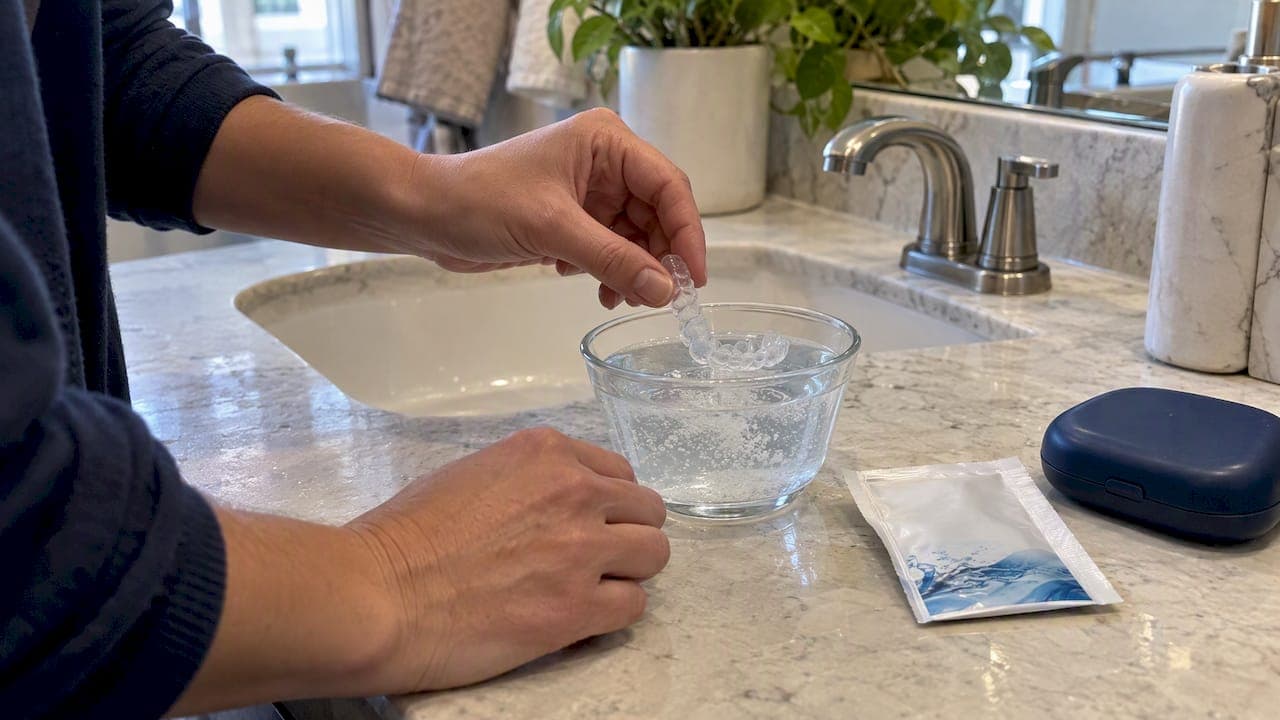
The simplest effective routine is this: rinse your aligners under lukewarm water every time you take them out, brush them gently once or twice a day, and soak them for 10 to 15 minutes daily with an approved cleaner like Invisalign cleaning crystals or denture cleaning tablets. Skip hot water entirely, since it can warp the plastic.
TL;DR:
- Wait 30 minutes after eating or drinking anything besides water before reinserting aligners, and brush and floss first to limit trapped food, sugar, and acid.
- Neutral detergent and gentle brushing limit color change, while denture tablets reduce biofilm but may alter tray color after 7 to 14 days.
- Ultrasonic cleaners run for five minutes, but research found they do not meaningfully improve stain removal alone; the cleaning agent matters more than vibration.
- See a dentist if odor, discoloration, cracks, warping, looseness, or gum irritation persists; report how long it has lasted and which cleaners you have tried.
Table of Contents
- Why cleaning your aligners matters for hygiene, fit, and appearance
- Your step-by-step daily and weekly cleaning routine
- Comparing the cleaners and gadgets people actually use
- What damages aligners: habits to avoid
- How often to clean and the 30-minute rule explained
- Signs your aligners need a professional check
- [Maintaining oral hygiene while wearing Invisalign](#maintaining-oral-hygiene-while-wearing-invisalignhttpsclaytondentalstudiocombloghow-to-maintain-white-teeth)
- Recommended products and tools beyond the basics
- How cleaning habits affect your treatment outcome
- What the evidence says about cleaning methods
- How we can help with your Invisalign care
- FAQ
- Sources
Why cleaning your aligners matters for hygiene, fit, and appearance
Aligners sit against your teeth and gums for 20 to 22 hours a day, which gives bacteria plenty of time to build biofilm on the plastic. That buildup is what causes the sour smell many wearers notice by the end of the day, and it is the same film that dulls the clarity of the trays over time. A microbiological and colorimetric study found that several disinfectant solutions significantly reduced Streptococcus mutans biofilm on aligner material, which is the bacteria most associated with cavities and plaque.
Left unchecked, biofilm and residue do more than smell bad:
- They can stain the plastic, making aligners visibly cloudy instead of clear.
- They may trap food particles against your teeth, raising your risk of decay.
- They can interfere with how snugly the tray fits as residue thickens along the edges.
A consistent daily routine, covered next, prevents all three problems before they start.
Your step-by-step daily and weekly cleaning routine
A workable routine does not need to be complicated. It needs to happen every time you take the trays out, and once a day it needs a proper soak.
- Rinse immediately on removal. Run each aligner under lukewarm water as soon as you take it out, whether that is for a meal or before brushing at night.
- Brush gently with a dedicated soft brush. Use a soft-bristle toothbrush you keep separate from your regular one, paired with clear antibacterial soap or a neutral detergent. Skip whitening or abrasive toothpaste, which can leave microscopic scratches where bacteria collect.
- Soak once a day for 10 to 15 minutes. Drop the trays into a glass or the provided case with Invisalign Cleaning Crystals or a denture cleaning tablet dissolved in lukewarm water, following the product's instructions.
- Rinse and air dry before reinserting. A quick rinse after soaking removes any residue or taste, and letting the trays air dry for a minute avoids trapping moisture against your teeth.
- Clean the case weekly. Wash the storage case with warm soapy water and let it dry fully; a damp case breeds the same bacteria you are trying to remove from the trays.
For a midday spot clean when you are out for lunch, a rinse under the nearest tap and a quick wipe with a clean fingertip is enough to hold you over until your next full brush and soak.
Pro Tip: Keep a small travel case with a spare toothbrush and a few individually wrapped crystal packets in your bag so a midday cleaning never depends on what you have at home.
Comparing the cleaners and gadgets people actually use
Several products show up again and again in aligner care routines, each with a different trade-off between how well it cleans, how it affects clarity, and how much time it takes.
Invisalign Cleaning Crystals are the manufacturer's own effervescent soak, designed specifically for Invisalign material. A randomized in vivo trial comparing five cleaning methods found the crystals kept aligner surfaces clean with no adverse surface effects, based on SEM and spectrophotometry analysis.
Denture cleaning tablets and effervescent solutions work on a similar principle and are widely used because they are inexpensive and easy to find. The same in-vitro study found Corega Tabs significantly reduced bacterial biofilm, though it noted a notable color change after 7 to 14 days of repeated exposure.
Gentle antibacterial soap or neutral detergent is the safest daily mechanical option. The same research found neutral detergent produced minimal color change while still cutting down biofilm, making it a sound everyday pairing with a soft brush.

Ultrasonic cleaners use high-frequency vibration to loosen debris, and the Invisalign-brand version runs at 42,000 Hz for a five-minute cycle. A more recent 2026 study found that household ultrasonic assistance did not meaningfully improve stain removal on its own, with the cleaning agent chemistry mattering more than the vibration itself.
UV sanitizing cases sanitize without water or chemicals, using a short UV-C cycle, which makes them a convenience tool rather than a stain or biofilm remover on their own.
| Method | Biofilm/debris removal | Staining risk | Soak/cycle time | Convenience |
|---|---|---|---|---|
| Invisalign Cleaning Crystals | Effective, manufacturer-tested | Low | 15 minutes | Moderate, needs water and time |
| Denture tablets | Effective | Moderate with repeated use | 10-15 minutes | High, widely available |
| Antibacterial soap/detergent | Effective for daily plaque | Minimal | A few minutes of brushing | High, daily habit |
| Ultrasonic cleaner | Depends on cleaning agent used | Depends on agent, not device | 5 minutes | Moderate, requires device |
| UV sanitizing case | Sanitizes surface bacteria | None, no chemicals | 5 minutes | High, water-free |
For most people, the strongest daily combo is a soft brush with neutral soap plus a once-daily soak in crystals or denture tablets. Save ultrasonic or UV devices for travel days or as a backup when you cannot do a full soak.
What damages aligners: habits to avoid
A few habits are responsible for most of the warping, staining, and micro-scratching dentists see in worn trays:
- Hot water of any kind, including boiling water or a dishwasher cycle, which can warp the plastic permanently.
- Abrasive toothpaste or hard scrubbing, which leaves tiny scratches that trap bacteria and dull clarity.
- Long soaks in strong disinfectants like concentrated bleach or sodium hypochlorite, which lab testing linked to noticeable color change over repeated use.
- Drying aligners in direct sunlight or near a heater, which exposes them to the same heat risk as hot water.
How often to clean and the 30-minute rule explained
Clean your aligners every time you remove them: a rinse at minimum, a brush twice daily, and one full soak each day. The 30-minute rule refers to waiting at least that long after eating or drinking anything besides water before reinserting your trays, since rinsing and waiting reduces the sugar and acid that would otherwise sit against your teeth under the plastic. If odor or cloudiness persists despite a consistent routine, it is worth escalating to a deeper soak or asking your dentist to take a look.
Signs your aligners need a professional check
Most hygiene issues resolve with a more consistent routine, but a few signs point to something your dentist should see:
- Persistent odor or discoloration that does not improve after cleaning.
- Cracking, warping, or a looser fit than when the tray was new.
- Gum irritation, soreness, or an allergic-feeling reaction after reinserting.
When you call to book, mention how long the issue has lasted and which cleaners you have already tried. That detail helps the clinic decide quickly whether you need a professional cleaning, a fit check, or a replacement tray.
Maintaining oral hygiene while wearing Invisalign
Aligners add a layer between your teeth and your toothbrush, so your regular habits need small adjustments. Brush after every meal before reinserting your trays, since any food trapped against your teeth under the plastic sits there far longer than it would without aligners. A fluoride toothpaste is fine for your teeth, but keep it off the trays themselves, since the mild abrasives that polish enamel can dull aligner plastic over time.
Flossing matters just as much as brushing. Food debris between teeth gets sealed in once the aligner goes back on, so a quick floss, even without the full routine, before reinsertion cuts down on trapped particles significantly. A water flosser is a convenient alternative if traditional floss feels slow between aligner changes.
Keep a travel kit with a toothbrush, floss, and a small container for your aligners so you are never tempted to skip a cleaning step because you are away from home. Orthodontic guidance commonly recommends brushing aligners twice daily alongside your regular oral hygiene, and treating the two as one combined habit rather than separate chores works best in practice. If you wear attachments or use elastics with your aligners, those add a few more surfaces to check each time you clean, which is covered in more detail in our guide to caring for attachments.

Recommended products and tools beyond the basics
Once the daily rinse, brush, and soak routine is solid, a few additional tools can round out your care without replacing the fundamentals. An ultrasonic cleaner, like the Invisalign Ultrasonic Cleaner, runs a five-minute cycle at 42,000 Hz and the manufacturer recommends adding 5 grams of Cleaning Crystals+ per 100 ml of water for a deeper clean. It is a fast option when you want a more thorough clean than a quick soak provides, though the evidence on ultrasonic devices suggests the cleaning agent you pair with it matters more than the vibration alone.
A UV sanitizing case is a useful travel companion since it needs no water or chemicals and runs a short cycle, making it a practical backup for sanitizing between a morning commute and a lunch break. It is not a substitute for your daily chemical soak, since it addresses surface bacteria rather than built-up residue or stains.
Keeping a dedicated soft-bristle brush just for your aligners, separate from your toothbrush, also helps avoid cross-contaminating trays with whatever abrasive paste you use on your teeth. Together, these tools support the core routine rather than replace it.
How cleaning habits affect your treatment outcome
Clean aligners are not just more pleasant to wear, they directly affect how well your treatment works. Trays with built-up residue can fit less precisely against your teeth, and a combined cleaning approach review found that pairing mechanical brushing with chemical soaking is more effective for both hygiene and material condition than relying on either method alone. A tray that fits properly transmits the intended pressure to move your teeth as planned, while a warped or residue-coated tray can shift that fit in small ways that add up over a full treatment course.
Staining is a cosmetic issue too, since part of the appeal of clear aligners is that they are nearly invisible. A tray that has yellowed or clouded from poor cleaning defeats that purpose well before it is due for replacement. Consistent cleaning also extends how comfortably you can wear each set for its full prescribed period, which keeps your treatment on the timeline your provider planned rather than needing adjustments for damaged trays.
What the evidence says about cleaning methods
Mechanical brushing paired with a chemical soak consistently outperforms either method alone for both bacterial reduction and material condition, based on in-vitro and in-vivo research on aligner cleaning.
Several of the agents tested in lab studies kill bacteria effectively but can alter aligner color with repeated, prolonged exposure, which is why daily use calls for gentler products and why concentrated disinfectants belong in occasional deep cleans rather than a daily habit. The Invisalign Ultrasonic Cleaner's 42,000 Hz, five-minute cycle gives wearers a fast option when a full soak is not practical, though recent research suggests the device works best paired with the right chemical agent rather than as a standalone fix. We built our clinic's Invisalign guidance around this balance of efficacy and material safety, and our oral hygiene resources reflect the same daily-habit approach.
— Jake
How we can help with your Invisalign care
When a cleaning routine is not enough to clear up odor, staining, or a fit that feels off, we offer same-day appointments to check your aligners and talk through what has changed. We provide clear aligner treatment from start to finish in one office, including replacement trays when yours need it.

If you have questions about the 30-minute rule or want a professional look at a persistent issue, give us a call or book online through our clear aligners page and we will get you in quickly.
FAQ
What is the 30-minute rule for Invisalign?
The 30-minute rule means waiting at least 30 minutes after eating or drinking anything besides water before putting your aligners back in. Rinsing your mouth and trays during that window reduces the sugar and acid that would otherwise sit trapped against your teeth, lowering your risk of decay and staining.
How often should Invisalign be cleaned?
Rinse your aligners every time you remove them, brush them gently twice a day, and soak them once daily for 10 to 15 minutes with an approved cleaner. This routine, reflected in common orthodontic guidance, keeps biofilm and odor from building up between changes.
Is $4,000 a lot for Invisalign?
Invisalign treatment cost varies widely depending on case complexity and location, so there is no single answer that applies to everyone. We quote treatment plans individually after an exam, and our clear aligners page is the best place to start if you want pricing specific to your case.
Is it worth getting an ultrasonic cleaner for Invisalign?
An ultrasonic cleaner can offer a fast, five-minute cleaning cycle that is convenient when you do not have time for a full soak, but recent research found that the device alone does not significantly improve stain removal without the right cleaning agent. It works best as a supplement to your daily brush-and-soak routine rather than a replacement for it.
Sources
- Cleaning solutions for orthodontic clear aligners: a microbiological and colorimetric analysis
- Household ultrasonic cleaning and its effects on stain removal of polyurethane aligners (2026)