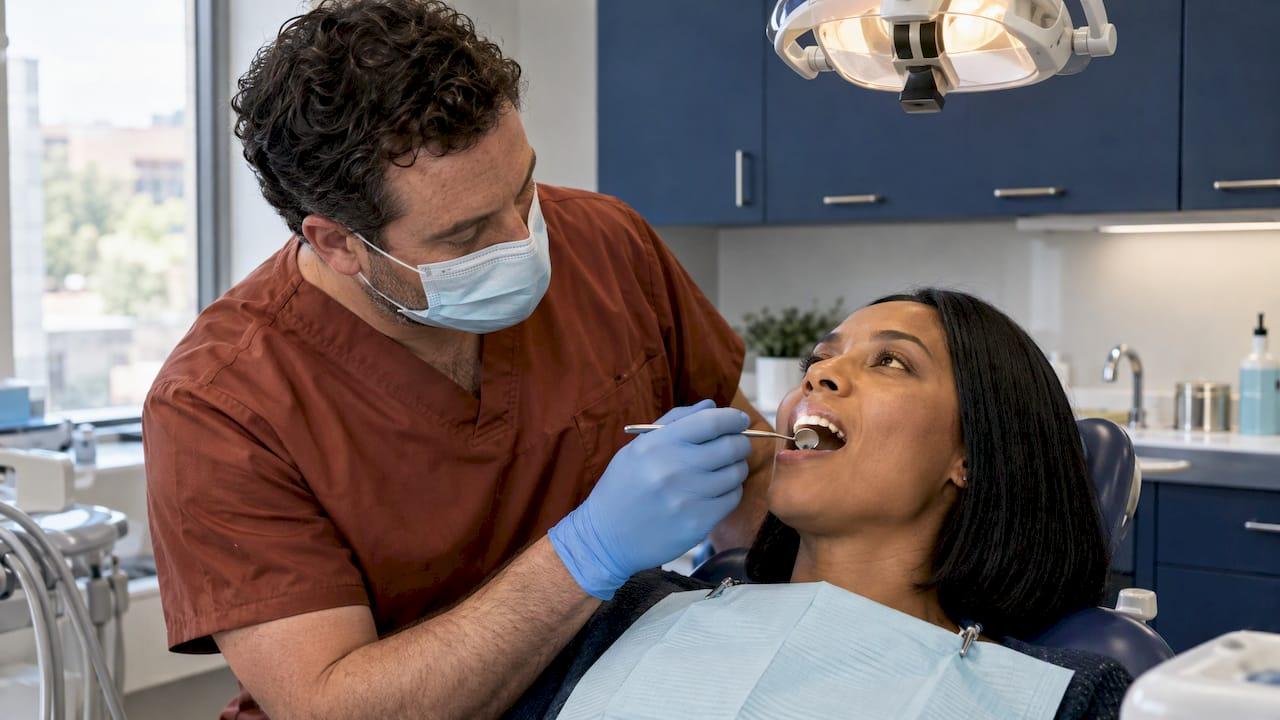
Translucent teeth are fixed by treating the cause first, then restoring what is missing. If the see-through look comes from acid wear, that means protecting the enamel you still have and covering thin areas with bonding, porcelain veneers or, for heavy loss, crowns. If it comes from the shape of your teeth, such as small peg laterals, cosmetic reshaping usually does the job. A dentist can tell you which situation you are in with an exam and X-rays.
This guide explains why teeth look transparent, what can and cannot be reversed, how each restoration works, and how to keep the problem from spreading.
TL;DR
- Enamel is the hard outer layer. When it thins, the yellower dentin underneath shows through and the tooth edges look glassy or see-through.
- Enamel does not grow back, so treatment means protecting what remains and restoring what is lost.
- Bonding suits minor loss, porcelain veneers suit visible front-tooth changes, and crowns suit significant loss.
- Peg laterals and other small teeth are a shape issue, not a wear issue, and are usually restored with veneers, bonding or crowns, sometimes after orthodontics.
- Cutting back on acidic drinks, rinsing with water and brushing with fluoride toothpaste help protect the enamel you have left.
Table of Contents
- Why teeth look translucent
- Can you reverse translucent teeth?
- How a dentist fixes translucent teeth
- Peg laterals and small teeth
- How to choose between bonding, veneers and crowns
- Protecting your enamel after treatment
- Our perspective
- See us in Washington, DC
- FAQ
- Sources
Why teeth look translucent
A healthy tooth is not a solid block of white. Enamel is a thin, semi-clear shell, and the dentin beneath it carries most of the color. Where enamel is thinner, as at the biting edges of the front teeth, light passes through and the edge can look gray, bluish or clear. A little of this is normal.
The look becomes a concern when it spreads, appears on teeth that were opaque before, or comes with sensitivity. There are four common reasons.
Age
The American Dental Association notes that enamel becomes more translucent and thinner with age, letting the yellower dentin show through and darkening the overall tooth color. This is one reason that people who whiten their teeth in their 40s or 50s sometimes find the edges look more see-through than they did at 25.
Acid erosion
Erosion is the most common treatable cause. The Australian government's Healthdirect service explains that acid first softens enamel, then eating and chewing wear the softened surface away. Untreated, the yellowish-brown dentin can be exposed. Sources of acid include soda, sports and energy drinks, fruit juice, citrus, wine, and stomach acid from reflux or repeated vomiting.
The Academy of General Dentistry says unhealthy enamel can look cracked, transparent and discolored, with a rounded or sand-blasted look, with small cracks and rough edges, and cupping on chewing surfaces. The ADA adds that people with erosion may notice a silky, glossy or melted appearance and flattened or smoothed biting surfaces. If your teeth look shiny and thin rather than chalky, erosion is a likely suspect. We explain how this plays out in more detail on our page about acid dental erosion.
Grinding and heavy brushing
Clenching and grinding wear enamel mechanically, and brushing hard, especially right after acidic food, can speed up loss. This is why a dentist asks about night-time habits and brushing technique, not only diet.
Development and genetics
Some people are born with thinner or differently formed enamel, and some have naturally small or cone-shaped teeth. These cases are not about damage at all. They are about how the teeth formed, and the fix is cosmetic and structural rather than preventive.
Can you reverse translucent teeth?
Partly. The honest answer depends on what is happening to the enamel.
Fluoride helps early, minor changes. A peer-reviewed review in PMC explains that fluoride promotes remineralization by forming fluorapatite, a mineral phase more resistant to acid than the original hydroxyapatite. That makes a fluoride toothpaste a sensible daily habit.
But it does not rebuild enamel that has already worn away. The AGD states that over-the-counter enamel-building products can re-harden enamel to make it more acid resistant, yet no product can reverse the damage caused by erosion. Healthdirect likewise says enamel can't grow back once it's gone.
The practical takeaway: use fluoride and acid control to protect what you have, and use dentistry to restore what you cannot get back. Remedies sold online as a natural cure do not replace lost enamel, and delaying an exam while the enamel keeps thinning only leaves more to restore later.

How a dentist fixes translucent teeth
The right restoration depends on how much enamel is gone, where, and what you want your smile to look like. The AGD describes the range simply: if enamel loss is minimal, a bonding material can protect the tooth and improve its appearance, and if loss is significant, a crown may be recommended. Verywell Health lists the same toolkit: fluoride gels or varnishes, bonding, fillings, crowns and veneers.
| Option | Best for | What it does | Typical visit pattern |
|---|---|---|---|
| Fluoride varnish or gel plus acid control | Early softening, no visible structural loss | Strengthens enamel against further acid attack | Applied at a regular exam |
| Dental bonding | Minor to moderate loss, chipped or thin edges, small teeth | Tooth-colored resin is shaped over the area to restore edge and opacity | Often one visit |
| Porcelain veneers | Visible front-tooth translucency, color and shape concerns | Thin ceramic shells cover the front surface and edge | Planning, preparation and placement visits |
| Crowns | Significant enamel loss, weakened or cracked teeth | Cover the whole tooth to restore strength and look | One or more visits |
Bonding for translucent teeth
Bonding is the least invasive restoration and the one most people ask about first. A dentist matches a composite resin to the shade of the tooth, builds up the thin or see-through edge, and polishes it. It can be a good fit for light wear, for a single edge that looks glassy, or for a small tooth that needs more size.

Bonding is also the natural first step when you want a conservative result. If the tooth later needs more coverage, a veneer or crown remains an option. Our cosmetic dentistry page covers bonding alongside our other smile treatments.
Porcelain veneers
When translucency is visible across several front teeth, or you want to change color, length and shape together, porcelain veneers are designed to do all of it at once. Ceramic is opaque enough to mask the gray, see-through look, and it can be matched to your natural shade. A case report in the Journal of Oral and Dental Research notes that lithium disilicate ceramics offer high esthetic potential and edge strength, allowing pressed restorations as thin as 0.3 mm, which makes them suitable for minimal-preparation veneers.
Two questions come up often, and we have written answers: whether you keep your real teeth under veneers, and whether porcelain veneers stain. Veneers also give the front surface a smooth, protected finish, which we discuss in our guide on whether veneers prevent cavities.
Crowns for heavier loss
When a tooth has lost a lot of structure, a crown covers it fully. It restores strength as well as appearance, which matters on back teeth where chewing forces are highest and where erosion often shows as cupping. Our practice offers dental crowns, including same-day crowns.
A note on whitening
Whitening changes stain, not thickness. On a tooth that is translucent from thin enamel, brightening the dentin may not make the edge look less see-through, and sensitive teeth need an exam first. If your concern is yellowing more than transparency, see our guide to why teeth look yellow and how to whiten them, then have your dentist confirm that whitening fits your enamel.
Peg laterals and small teeth
Searches for peg lateral treatment, short teeth and small teeth often sit next to searches about see-through teeth because small front teeth can also have thin, glassy edges. They are a different problem with a different fix.
A peg lateral is an upper lateral incisor, the tooth next to your two front teeth, that is smaller and cone-shaped. A PMC article on restorative dentistry describes the peg lateral as presenting on one or both sides, with or without a small root, but always with a small crown. The same source notes these teeth usually affect appearance and are weighed in treatment planning.
Pegged teeth often cause no symptoms. Colgate notes that treatment is usually sought for cosmetic reasons and lists crowns, veneers, bridges, and bonding and reshaping as the ways to restore or replace them. Whether to treat is entirely your call.
Which fix for a peg lateral
- Bonding and reshaping: Resin adds width and length in one visit. It can be sculpted to blend with the neighbors, though gaps on both sides of a small tooth make the shaping more demanding. Spear Education points to multiple gaps and the risk of overhangs and poor contact points as the reasons careful planning matters.
- Porcelain veneers: A laboratory-made veneer is designed on the final shape you want. The same Spear Education article says that when treatment is requested it is often best approached with orthodontics first, then indirect ceramic veneers.
- Aligners first: Moving the teeth to open the right amount of space gives the restoration room to look natural. The case report lists orthodontic treatment first to align the teeth among the standard options. We offer clear aligners for this step.
- Crowns and, in some cases, implants: The same case report also lists all-ceramic crowns, and for some patients extraction followed by an implant, as part of the range a clinician considers.
The common thread is space. Spear Education notes that inadequate restorative space is the most common reason these restorations fail, resulting in a bulky veneer. That is why a good plan starts with imaging and a written layout, not with the material.
How to choose between bonding, veneers and crowns
Use these questions in the consultation.
- How much enamel is left? Minimal loss points toward bonding. Significant loss points toward crowns, per the AGD guidance above.
- Is the cause still active? If acid, reflux or grinding continues, any restoration can wear. Address the cause alongside the cosmetic work. A night guard or a medical referral for reflux may be part of the plan.
- How many teeth are involved? One edge is a bonding conversation. Six to ten front teeth with the same look is often a veneer or smile makeover conversation.
- What is your timeline? Bonding is typically quick. Veneers and crowns involve more steps. Ask for the schedule in writing.
- What do you want the smile to look like? Color, length and shape goals change the answer more than the translucency itself.
Please note that heavy sensitivity, pain, a visible crack or a dark spot are reasons to see a dentist soon, not to wait and see. Those can mean decay or a fracture beneath thin enamel.
Protecting your enamel after treatment
The same habits that stop translucency from spreading protect restorations too. The AGD fact sheet recommends:
- Cutting down on soda, sports and energy drinks, and pure fruit juice.
- Drinking water through the day and using a straw for acidic drinks.
- Rinsing with water after acidic drinks and waiting at least 30 minutes before brushing.
- Chewing sugar-free gum and brushing with a soft-bristle, fluoride toothbrush.
The AGD also reports that enamel damage from sports drinks is three to 11 times greater than from cola and that having four or more acidic foods and drinks a day can raise erosion risk. Verywell Health suggests waiting at least an hour after vomiting or acidic food before brushing. Either way, rinse first and brush later.
If you take an acid-reflux medication or have frequent heartburn, mention it to your dentist and your physician, since stomach acid reaches the back of the front teeth.
Our perspective
Most people who come in asking about see-through teeth are not asking for a cosmetic upgrade. They want to know whether something is wrong. So we start with the diagnosis: imaging, a look at wear patterns, and a conversation about drinks, reflux and grinding.
What we like about handling this in one office is that the answer does not get passed along. Exams, bonding, veneers, crowns and aligners are all performed in-house, so the person who finds the thin enamel is part of the team that plans the repair. You get a clear written treatment plan before anything begins.
Our approach is to protect first and restore second. For a lightly worn edge, bonding can be a smart, conservative step. For a front smile with several affected teeth, porcelain veneers are designed to give a more complete result. Dr. Kambez Shukoor brings a military medical background and advanced credentials to these plans, and we pair them with thorough imaging and up-front planning.
If you have a peg lateral, we think of it as a design problem: space, shape, and how the tooth sits in your smile. Done well, it is one of the more satisfying cases in cosmetic dentistry.
Jake
See us in Washington, DC
DC Implant & Cosmetic Dentistry offers bonding, porcelain veneers, crowns, clear aligners and smile makeovers at a single Washington, DC location, with same-day appointments available. We perform procedures from exams to implants in-house and give you a clear written plan.
If your teeth look thinner or more see-through than they used to, book an exam through our general dentistry page or explore our cosmetic dentistry options. We offer financing options, including CareCredit and Lending Tree, for higher-cost treatment.
FAQ
Why are my teeth translucent?
Usually because enamel is thin at the edges. Causes include normal aging, acid erosion from drinks or reflux, grinding, aggressive brushing, and naturally thin enamel. A dentist can tell which applies with an exam and imaging.
Can bonding fix translucent teeth?
Yes, for minor to moderate changes. The AGD says bonding can protect a tooth and improve its look when enamel loss is minimal. Heavier loss may call for veneers or crowns.
How do I treat a peg lateral?
Options include bonding and reshaping, porcelain veneers, crowns, and sometimes aligners first to create space. Treatment is optional and usually cosmetic. Your dentist will recommend one after looking at your bite and the space around the tooth.
What toothpaste is best for translucent teeth?
Choose a fluoride toothpaste and a soft-bristle brush. Fluoride helps harden enamel against acid, but it cannot replace enamel that has worn away. Ask your dentist whether a prescription-strength option fits your situation.
Do translucent teeth always mean something is wrong?
No. Slight translucency at the biting edges is common, and enamel naturally thins with age. See a dentist if it is spreading, comes with sensitivity or pain, or the teeth look rounded and glossy.
Sources
- ADA: Whitening
- ADA: Dental Erosion
- AGD: Enamel Loss due to Erosion
- Healthdirect: Dental erosion
- PMC: Fluoride and remineralization
- Verywell Health: Tooth Erosion
- PMC: Restorative dentistry for hypodontia
- Colgate: Pegged Teeth Explained
- Spear Education: Restoration of the Peg Lateral
- Journal of Oral and Dental Research: Revamping the Peg Smile