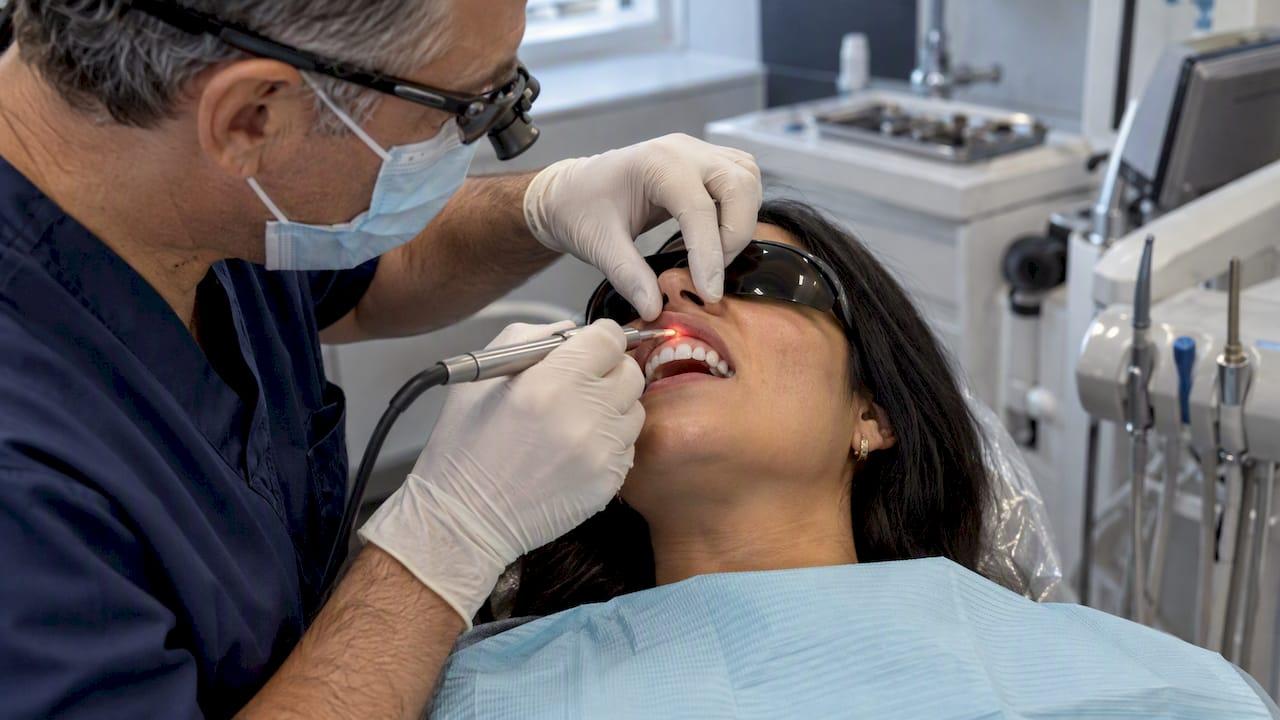
Laser gum depigmentation, often called gum bleaching, is a cosmetic procedure that uses a dental laser to remove the thin, pigmented top layer of the gums. As the tissue heals, the new surface usually grows back pinker. The treatment is quick, it is done under local anesthetic, and it is optional: dark gums caused by natural melanin are not a health problem. Below you will find how the procedure works, what to expect during healing, what it typically costs in the U.S., how often color returns, and the questions to ask before you book anything.
TL;DR
- Laser depigmentation removes the melanin-rich surface layer of the gums. It is purely cosmetic and is not a treatment for gum disease.
- A session typically runs about 20 to 45 minutes with local anesthetic, and most people are back to normal routines within a day or two.
- Published price guides commonly quote roughly $300 to $800 per arch, with premium quotes far higher. Insurance rarely covers it, so ask about financing.
- Pigment can return in some patients over the years, and smoking makes recurrence more likely.
- Get a proper exam first. Dark patches that are new, raised or changing need a diagnosis, not a cosmetic fix.
Table of Contents
- What gum depigmentation actually treats
- How laser gum depigmentation works
- Which laser: diode, Er:YAG, CO2 and others
- What recovery looks like
- How much does it cost?
- How long do results last?
- Depigmentation is not gum disease treatment
- Who is a good candidate, and who should wait
- Depigmentation versus gum contouring
- Questions to ask before you book
- Our perspective
- Thinking about a brighter, more even smile?
- FAQ
- Sources
What gum depigmentation actually treats
Gums get their color from melanin, the same pigment that colors skin. Some people simply have more of it in the gum tissue, and the result can be a brown, bluish or nearly black patchwork along the gumline. This is called gingival hyperpigmentation. Research on laser-assisted depigmentation describes it as a common aesthetic concern that can be physiological, meaning part of your natural makeup, or linked to other factors.
Common causes include:
- Genetics and ethnicity. Naturally darker gum tissue is common and harmless.
- Smoking. Tobacco can darken the gums, a pattern known as smoker's melanosis.
- Certain medications. Some drugs can leave pigment in oral tissue.
- Other conditions. Less often, a dark area in the mouth signals something that needs medical attention.
That last point matters. A patch that appeared recently, is raised, bleeds, is lopsided or keeps changing should be examined by a dentist or physician before anyone talks about cosmetic treatment. A pigmented spot is not always a harmless one, and no laser session replaces a diagnosis.
How laser gum depigmentation works
The principle is simple. The melanin cells sit in the gum's outer layer. A dental laser removes that layer in a controlled way. Your body then rebuilds the surface as the area heals, and the new tissue tends to look lighter and pinker than what was removed.
Here is the usual sequence:
- Consultation and exam. Your dentist checks your gum health, confirms the pigment is benign, and maps the area to treat. Photos are common so you can compare later.
- Local anesthetic. The gums are numbed. Published guidance lists local anesthesia as part of the standard approach, and a session usually takes 20 to 45 minutes depending on how much tissue is involved.
- Laser removal. The clinician passes the laser across the pigmented gum, vaporizing the surface layer. The depth is kept shallow on purpose.
- Aftercare instructions. You leave with guidance on eating, cleaning and managing tenderness.
Most people treat the gums that show when they smile, which is usually the upper front section. A full arch is possible, but the treated area drives both time and price.
Which laser: diode, Er:YAG, CO2 and others
Several laser types are used in dentistry, and the one in your dentist's office shapes the experience. A split-mouth clinical comparison of a 980 nm diode laser and an Er:YAG laser found both can achieve good depigmentation, and it highlights differences in bleeding control and patient comfort. Diode lasers are often favored for bleeding control and comfort, but the choice in practice often comes down to the equipment a dental office owns.

A practical takeaway: before you schedule, ask which laser will be used and why. Patients who want to minimize discomfort should ask directly how that laser compares on bleeding and healing.
Laser versus scalpel and other methods
Lasers are not the only option. The traditional approach is surgical scraping with a scalpel, and burs and other techniques exist as well. A clinical study comparing a scalpel, a ceramic bur and a 980 nm diode laser looked at outcomes and patient response across all three. A broader systematic review and network meta-analysis of oral hyperpigmentation treatments examined efficacy and risks across approaches.
The honest summary is that several methods work. Lasers are popular because many patients find them more comfortable and bleeding is easier to control. A scalpel remains a reliable alternative in skilled hands. The right pick depends on your goals, your pain tolerance and your anatomy, which is a conversation for the consultation.
| Factor | Laser | Scalpel |
|---|---|---|
| Bleeding during treatment | Usually easier to control | Typically more |
| Patient comfort | Often rated well, varies by laser type | Effective, can be more uncomfortable |
| Equipment needed | Dental laser | Standard surgical instruments |
| Results | Good pigment removal | Good pigment removal |
| Recurrence | Possible with any method | Possible with any method |
What recovery looks like
Expect the treated gums to look pale or raw at first, then settle over the following days as new tissue forms. Published guidance says most patients return to normal activities within one to two days. Full healing and the final color take longer than that, so judge the result after the tissue has fully matured, not in the first week.
Sensible habits that dentists commonly recommend during healing:
- Stick to soft, cool foods for the first few days and avoid anything spicy, crunchy or acidic.
- Keep brushing, but gently around the treated area, and follow whatever rinse your dentist prescribes.
- Skip tobacco. Smoking irritates healing tissue and is tied to pigment returning.
- Use an over-the-counter pain reliever only as your dentist advises, particularly if you take other medications.
Call your dentist if you have heavy bleeding, fever, spreading swelling or pain that gets worse after the first few days instead of easing.
How much does it cost?
Prices vary widely by city, practice and how much gum is treated. One published guide puts typical laser depigmentation at about $300 to $800 per arch, with some premium quotes reaching $2,500 per arch. Some practices in high-cost metro areas quote even more. Treat any single number as a rough guide, not a promise.
What moves the price:
- Area treated. A smile-line section costs less than a full upper and lower arch.
- Location. Big-city practices usually charge more than small-town ones.
- Technology and provider. A periodontal specialist, a cosmetic dentist and a general dentist may price the same service differently.
- Bundling. Depigmentation is often combined with gum contouring or a broader smile design, which changes the quote.
Because the treatment is cosmetic, dental insurance rarely pays for it. Plan on paying out of pocket, and ask the office whether payment plans or third-party financing are available. Get a written, itemized estimate before treatment, and ask what is included, such as follow-up visits.
If you are comparing cosmetic spending overall, our guide on which dental procedures cost the most gives context for how gum work fits alongside larger treatments.
How long do results last?
Laser depigmentation is often described as permanent, but that overstates it. Melanin-producing cells can return to the treated area from neighboring tissue. The research summarized in the network meta-analysis of oral hyperpigmentation treatments discusses recurrence as a real possibility, and figures reported in follow-up studies of roughly 20% to 35% over two to five years are common in the literature. That means most patients keep a lasting result, and a meaningful minority see some color come back.
Recurrence is more likely when the underlying cause persists. If smoking contributed to the darkening, the laser literature is clear that the pigment can return when the trigger is still there, so quitting tobacco is the most useful thing you can do to protect the result. If your pigment is purely genetic, a touch-up session later is a reasonable possibility to discuss up front.
Depigmentation is not gum disease treatment
This is the most common point of confusion, and the one that generates the search "laser treatment for gum disease." They are different things.
- Gum depigmentation targets melanin in healthy gum tissue for cosmetic reasons.
- Gum disease treatment targets bacterial infection and inflammation, usually with deep cleaning (scaling and root planing) and, in advanced cases, surgery.
Even for active gum disease, lasers are not a magic fix. The American Dental Association's clinical practice guideline on nonsurgical treatment of periodontitis found no net clinical benefit from adding diode, Nd:YAG or erbium lasers to standard scaling and root planing for chronic periodontitis. So a laser does not substitute for getting infection under control.
The practical rule: treat disease first. Red, swollen, bleeding or receding gums need a periodontal evaluation before any cosmetic work. If that sounds like you, read about periodontal disease treatment or our overview of what works for receding gums.
Who is a good candidate, and who should wait
You may be a good candidate if:
- Your gums are healthy and your dentist has confirmed the pigment is benign.
- The dark color bothers you when you smile or speak.
- You do not smoke, or you are ready to stop.
- You understand the result is cosmetic and pigment may partly return.
Hold off, or get further evaluation first, if:
- You have active gum disease, untreated infection or significant recession.
- A pigmented area is new, raised, uneven or changing. Ask for a diagnosis, and a biopsy if your clinician recommends one.
- You are pregnant or have a medical condition that affects healing. Check with your physician and dentist.
- You are hoping the procedure will change your gum shape or height. That is a different treatment.
Depigmentation versus gum contouring
People often lump these together, but they solve different problems. Depigmentation changes the color of the gums. Contouring changes their shape or height, for example when teeth look short because gum tissue covers too much of them. Some smile makeovers need both. If a gummy smile is your real concern, see our explanation of what gum contouring is and how it improves your gumline, or the cosmetic gum contouring page.
Questions to ask before you book
A good consultation should answer these clearly:
- Is my pigment physiological, or does it need further testing?
- Which laser will you use, and how do you manage comfort and bleeding?
- How much of my gum will be treated, and how many sessions should I expect?
- What is the full, itemized cost, and what financing is available?
- What is the chance of recurrence for someone with my background, and what happens if pigment returns?
- Can I see before-and-after photos of your own patients?
That last request is fair. Our smile gallery shows how we present cosmetic work, and you should expect any office to show you real cases.
Our perspective
We see gum color as part of a whole smile, not a stand-alone fix. Before any cosmetic decision, we want a clear diagnosis: healthy gums first, then appearance. That is why we put imaging and a written treatment plan at the start of care, so you know what is being done, why, and in what order.

Two things we tell patients who ask about darker gums. First, naturally pigmented gums are normal and healthy, so there is no medical urgency, and the decision is yours. Second, results depend as much on the cause and your habits as on the laser. Someone who smokes should expect a very different outcome from someone with genetic pigment.
Our office performs treatments from exams to surgical implants in-house, so you are not passed between providers, and same-day appointments are available. Dr. Kambez Shukoor is a U.S. Navy veteran, and that background shapes how we plan: clear steps, no surprises. We do not list gum depigmentation among our published services, so if it is what you are after, tell us when you book. We will examine your gums, tell you honestly what is appropriate, and talk through gum contouring, whitening or other options that could meet the same goal.
— Jake
Thinking about a brighter, more even smile?
Gum color is one piece of how a smile looks. If you are weighing several changes, such as tooth shade, shape or gum line, our cosmetic dentistry services in Washington, DC include smile makeovers, bonding and cosmetic gum contouring. We can review your gums and teeth together, give you a written plan, and discuss financing for higher-cost treatment. Book an exam and bring your questions.
FAQ
Does laser gum depigmentation hurt?
The gums are numbed with local anesthetic, so you should not feel pain during the procedure. Afterward, expect tenderness similar to a scrape inside the mouth for a few days. Comfort varies by laser type and how much tissue is treated, so ask your dentist what to expect.
Can dark gums turn pink again without treatment?
Naturally pigmented gums generally do not lighten on their own, because the melanin is part of your tissue. If tobacco caused the darkening, quitting may allow some improvement over time, but results vary. A dentist should confirm the cause first.
Is gum bleaching the same as gum depigmentation?
Yes, the terms are used for the same procedure. Despite the name, it is not a chemical bleach. The surface layer containing pigment is removed and the gums heal in a lighter shade.
Will insurance cover it?
Usually not. Plans generally treat depigmentation as cosmetic, so budget for out-of-pocket payment and ask the office about financing before you commit.
Can the dark color come back?
Sometimes. Pigment-producing cells can migrate back into treated areas, and follow-up studies report recurrence in a minority of patients over several years. Not smoking lowers the risk.
Sources
- Laser-Assisted Depigmentation: An Introspection of the Science, Techniques, and Perceptions
- Efficacy and Risks of Different Treatments for Oral Hyperpigmentation: A Systematic Review and Network Meta-Analysis
- Gingival Depigmentation Using Diode 980 nm and Erbium-YAG 2940 nm Lasers: A Split-Mouth Clinical Comparative Study
- Assessment of clinical outcomes and patient response to gingival depigmentation using a scalpel, ceramic bur, and diode laser 980 nm
- Gum Depigmentation and Bleaching (periodontics guide)
- ADA clinical practice guideline: nonsurgical treatment of periodontitis