Yes, but the honest answer has two parts. Mild recession usually stops progressing and stops hurting with conservative care, but tissue that's already gone typically does not grow back on its own, according to the Cleveland Clinic. If you want the root actually recovered, a surgical graft is generally what gets you there. For single or multiple recession defects, a connective tissue graft (CTG) combined with a coronally advanced flap (CAF) remains the most predictable approach for restoring root coverage, per a clinical review of gingival recession management.
Here's how the decision usually breaks down:
- Sensitivity and early recession: scaling and root planing, better brushing habits, and desensitizing agents often resolve symptoms without surgery.
- Visible root exposure or progressive recession: surgical reconstruction, most often CTG + CAF, offers the best odds of covering the root.
- Multiple adjacent teeth: tunneling techniques may reduce trauma while treating several sites at once.
Statistic to know: reviews of CTG procedures consistently report it as the surgical benchmark against which newer techniques like Pinhole Surgical Technique and biomaterial grafts are measured, largely because it also thickens the gum tissue itself.
Your next step is straightforward: get a periodontal probing exam. If recession is limited to one or two spots and there's no bone loss, a general dentist can usually manage it. If multiple teeth are involved or you have aesthetic concerns, ask for a periodontist referral.
Key Takeaways
Stopping gum recession from progressing is achievable for most patients, but restoring lost root coverage almost always requires surgical grafting, with CTG plus CAF offering the most predictable results.
| Point | Details |
|---|---|
| Tissue rarely regrows alone | Once gum tissue recedes, conservative care stops the damage but does not rebuild lost coverage. |
| CTG is the surgical benchmark | Connective tissue graft with coronally advanced flap has the strongest evidence for predictable root coverage. |
| NCCLs change the plan | Combined restorative-periodontal care reduces sensitivity but doesn't guarantee better long-term coverage. |
| Technique prevents recurrence | Soft-bristle brushing, regular recall visits, and nightguards protect results after treatment. |
| Get evaluated locally | DC Implant & Cosmetic Dentistry offers same-day recession evaluations covering probing, imaging, and treatment options. |
This article is general information, not a substitute for advice from a qualified doctor. Consult a qualified healthcare professional about your own circumstances before acting on anything here.
Table of Contents
- What Causes Gum Recession and How to Recognize It Early
- How Dentists Evaluate Recession and When You Need a Specialist
- Conservative Care That Stops Progression and Eases Symptoms
- Surgical Options: CTG, CAF, Tunneling, PST, and Biomaterial Alternatives
- Treating Recession That Occurs With Tooth Surface Loss
- Daily Care and Professional Maintenance to Prevent Recurrence
- Sources
What Causes Gum Recession and How to Recognize It Early
Recession rarely comes from one cause. Periodontal disease is the biggest driver, but aggressive brushing with a hard-bristle brush, thin gum biotype (some people are just built with less tissue), and orthodontic forces that push teeth outside the bone envelope all contribute. Occlusal trauma from grinding, tobacco use, poorly contoured restorations, and oral piercings round out the list.
Watch for these signs:
- Teeth that look longer than they used to, especially near the gumline.
- Visible notches or grooves at the base of a tooth (often from brushing too hard).
- Sharp sensitivity to cold, sweet, or air.
- Bleeding when you brush or floss, which usually signals active inflammation, not just recession.
Catching this early matters because the underlying driver (plaque, a bad habit, a misaligned bite) is often fixable. Left unaddressed, the same forces that started the recession keep eating away at what's left.
How Dentists Evaluate Recession and When You Need a Specialist
A basic exam involves more than just looking. Dentists measure recession depth, probing depth, and clinical attachment level, then take radiographs to check the bone underneath. Many use the Cairo or Miller classification system to describe severity, which helps predict how much root coverage is realistically achievable.
- Single tooth, shallow recession, healthy bone: your general dentist can usually monitor and manage this with cleanings and coaching on technique.
- Multiple teeth, thin biotype, or bone loss on X-rays: this typically warrants a periodontist referral, since these cases have more variables affecting graft success.
- Non-carious cervical lesions (notches at the gumline) or high aesthetic demands: a specialist visit usually includes detailed probing, photographs, and a walk-through of surgical versus non-surgical paths.
Bring any old X-rays or photos of your smile from a few years back. They often reveal how fast recession is moving.
Conservative Care That Stops Progression and Eases Symptoms
Non-surgical treatment is genuinely effective for many cases of early recession, and it's always the first stop before anyone talks about grafting. Scaling and root planing removes the plaque and calculus below the gumline that keeps inflammation active, letting tissue calm down and sometimes reattach slightly to the root surface. Most patients notice reduced bleeding and pocket depth within a few weeks of this cleaning.
Technique changes matter just as much as the professional cleaning:
- Switch to a soft-bristle brush and hold it at a 45 degree angle to the gumline.
- Use gentle circular motions instead of horizontal scrubbing, which is the single most common cause of brush-related recession.
- Floss daily, and consider a water flosser if manual flossing irritates already-thin tissue.
- Quit tobacco. It restricts blood flow to gum tissue and blunts healing capacity.
For sensitivity, desensitizing agents work through different mechanisms: potassium nitrate calms nerve signaling, while stannous fluoride, arginine, and strontium chloride help plug exposed dentin tubules. Your dentist may also apply an in-office varnish for faster relief.
If a misaligned bite or nighttime grinding is pushing on specific teeth, orthodontic adjustment or a nightguard can remove that mechanical stress entirely.
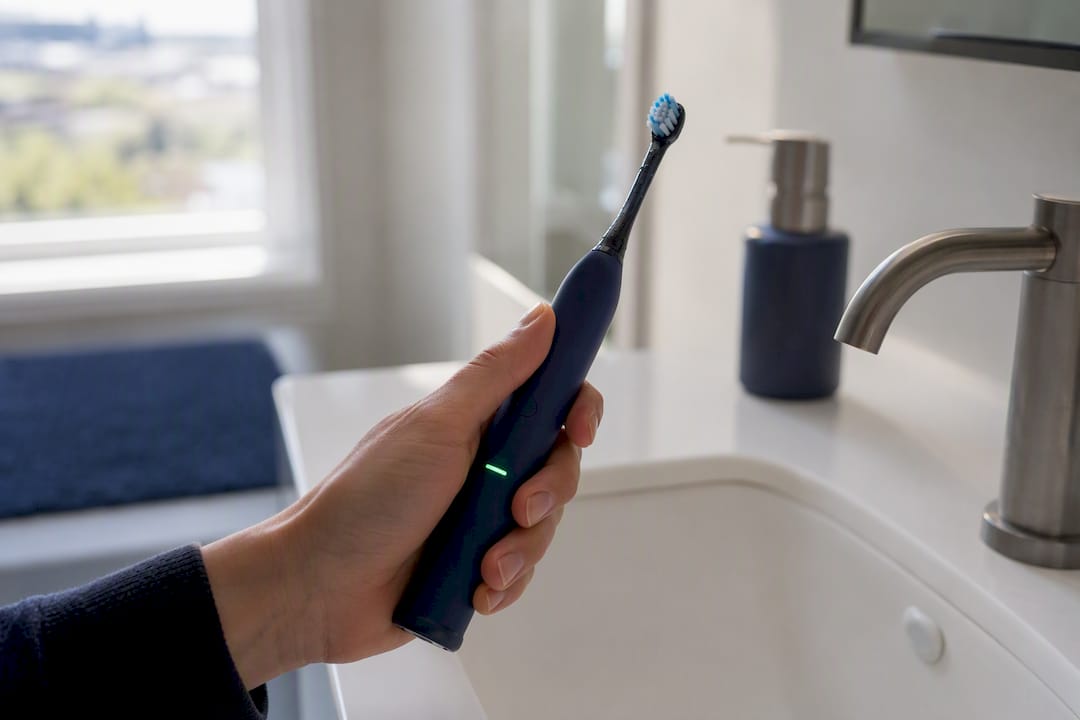
Pro Tip: If your electric toothbrush has a pressure sensor that flashes red, pay attention to it. Most people brushing too hard have no idea until they see the feedback in real time.
Here's the honest limit: none of this regrows tissue over an exposed root. Once recession has progressed past a few millimeters or become a cosmetic concern, conservative care manages the situation but doesn't reverse it.
Surgical Options: CTG, CAF, Tunneling, PST, and Biomaterial Alternatives
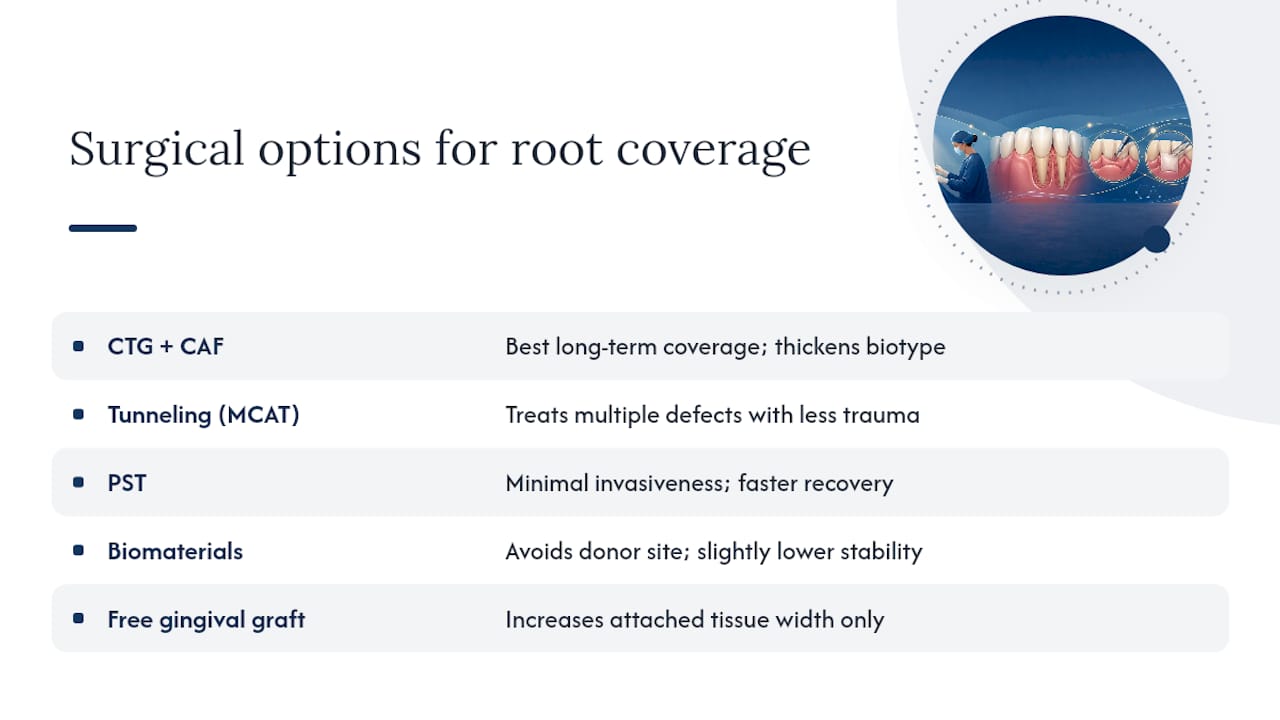
When root coverage is the goal, surgery is where the real evidence lives. Connective tissue graft combined with coronally advanced flap carries the strongest track record in clinical reviews, largely because the transplanted tissue does two jobs at once: it covers the exposed root and it thickens the gum biotype, which protects against future recession at that site. The trade-off is a second surgical site on the palate, which can mean extra discomfort during healing.
Tunneling techniques and modified coronally advanced tunnel (MCAT) approaches let a surgeon treat several adjacent recession defects through small tunnels rather than a full flap, reducing trauma while still allowing graft placement underneath.
Pinhole Surgical Technique (PST) takes minimal invasiveness further. A small pinhole entry lets the surgeon reposition existing gum tissue over the root without cutting a flap or harvesting a graft. Recovery is often faster and more comfortable, but PST doesn't add tissue volume, and in patients with thin biotype the long-term stability may not match CTG.
Biomaterials, including acellular dermal matrix and collagen matrices, offer an alternative when patients want to avoid a palatal donor site. These reduce post-op morbidity, though the same clinical review notes they often show somewhat lower long-term stability compared to a patient's own connective tissue. Enamel matrix derivative is sometimes added to encourage regeneration of the attachment apparatus rather than just coverage.
Free gingival grafts remain useful in narrower situations, typically when the goal is increasing the width of attached gum tissue rather than achieving cosmetic root coverage.
How clinicians actually choose: it comes down to gum biotype, the classification of the defect, how many teeth are involved, and what the patient values most, whether that's the fewest surgical sites, the fastest recovery, or the highest odds of full coverage. A thin-biotype patient with high aesthetic demands is often steered toward CTG despite the second surgical site, because it directly addresses the thin tissue that caused the problem in the first place.
Treating Recession That Occurs With Tooth Surface Loss
Non-carious cervical lesions, or NCCLs, are the notches and wedge-shaped defects that form at the gumline from a combination of abrasion, erosion, and flexural stress on the tooth. When they show up alongside gum recession, they complicate both the diagnosis and the sensitivity picture, since exposed dentin and exposed root surface can hurt for overlapping reasons.
A systematic review and meta-analysis comparing combined restorative-periodontal treatment to periodontal treatment alone found combined care meaningfully reduces dentin sensitivity. What it does not consistently show is a long-term advantage in root coverage over periodontal treatment by itself.
That nuance shapes the treatment plan directly:
- Shallow NCCLs with mild sensitivity may only need composite restoration, no grafting.
- Deeper lesions combined with significant recession often call for restoring the tooth defect first, then evaluating whether grafting is still needed.
- Bonding can address the cervical lesion cosmetically while a periodontal plan handles the gum tissue separately.
Recent evidence suggests these decisions should be individualized rather than standardized, since lesion depth and classification change what "success" looks like for each patient.
Daily Care and Professional Maintenance to Prevent Recurrence
Whatever treatment path you take, keeping the results depends on habits, not luck.
- Brush twice daily with a soft-bristle brush using gentle, circular strokes, and floss once a day without exception.
- Schedule professional recall every three to six months, more frequently if recession has been active or you have periodontal disease.
- Address mechanical drivers directly: wear a nightguard if you grind your teeth, and have any ill-fitting restorations reshaped so they stop trapping plaque or catching floss.
- Skip tobacco products entirely, since they interfere with the same healing response your gums rely on for maintenance.
At every recall visit, your dentist should re-measure pocket depths and recession to catch any new movement early. Consistent oral hygiene habits between visits do more to protect a graft than any single office procedure.
Pro Tip: Ask your hygienist to watch you brush at your next cleaning. Most people don't realize their technique has drifted until someone points it out.
What to Expect After Treatment: Healing and Realistic Outcomes
Non-surgical improvement in sensitivity and bleeding usually shows up within a few weeks to a couple of months. Surgical sites go through initial healing over four to six weeks, with tissue maturing and settling into its final position over several more months.
- CTG procedures are associated with the highest rates of complete root coverage among surgical options in clinical reviews.
- PST and biomaterial-based grafts tend to show good but somewhat more variable long-term outcomes, particularly in thin-biotype patients.
- Reduced sensitivity and stable, pink, firm tissue (not red or swollen) are the main signs healing is on track.
Follow post-op instructions closely, especially around the donor site if you had a CTG. That's usually where discomfort lingers longest.
Clinic and Author Credentials Behind This Guidance
This article draws on Dr. Kambez Shukoor's clinical background as a U.S. Navy veteran and the periodontal and restorative scope of DC Implant & Cosmetic Dentistry...
The practice offers same-day appointments, advanced imaging, and coordinates periodontal and restorative care under one roof, backed by over 200 five-star patient reviews..
Bring your most recent X-rays and a list of any sensitivity triggers to your first consult.
Choosing Between Predictability and Speed
If root coverage is the priority and you have thin biotype, choose CTG. It's still the more predictable option. If minimal downtime matters more and expectations are modest, PST or a biomaterial graft can be reasonable. Either way, this should be a shared decision, not a default.
— Jake
Get a Recession Evaluation That Actually Maps Your Options
A general checkup won't tell you whether you need scaling and root planing or a graft consult. At DC Implant & Cosmetic Dentistry, a same-day evaluation includes probing measurements, imaging, and a straight conversation about whether conservative care, periodontal treatment, or restorative coordination like bonding fits your specific defect.
The practice handles this under one roof rather than bouncing you between a general dentist and an outside specialist for imaging, restorative work, and follow-up. Financing options through CareCredit and Lending Tree are available for patients weighing surgical treatment costs, and most insurance plans are accepted for the diagnostic portion of the visit. If you've noticed longer-looking teeth, new sensitivity, or a notch at the gumline, book a cosmetic dentistry consultation to find out exactly where your recession stands and what it will take to treat it.
Sources
- Treatment of Gingival Recession: When and How? - PMC
- Efficacy of combined periodontal-restorative treatment versus periodontal treatment alone for gingival recession associated with non-carious cervical lesions
- Gum Recession - Cleveland Clinic
- PubMed entry on combined therapy nuance (2026)