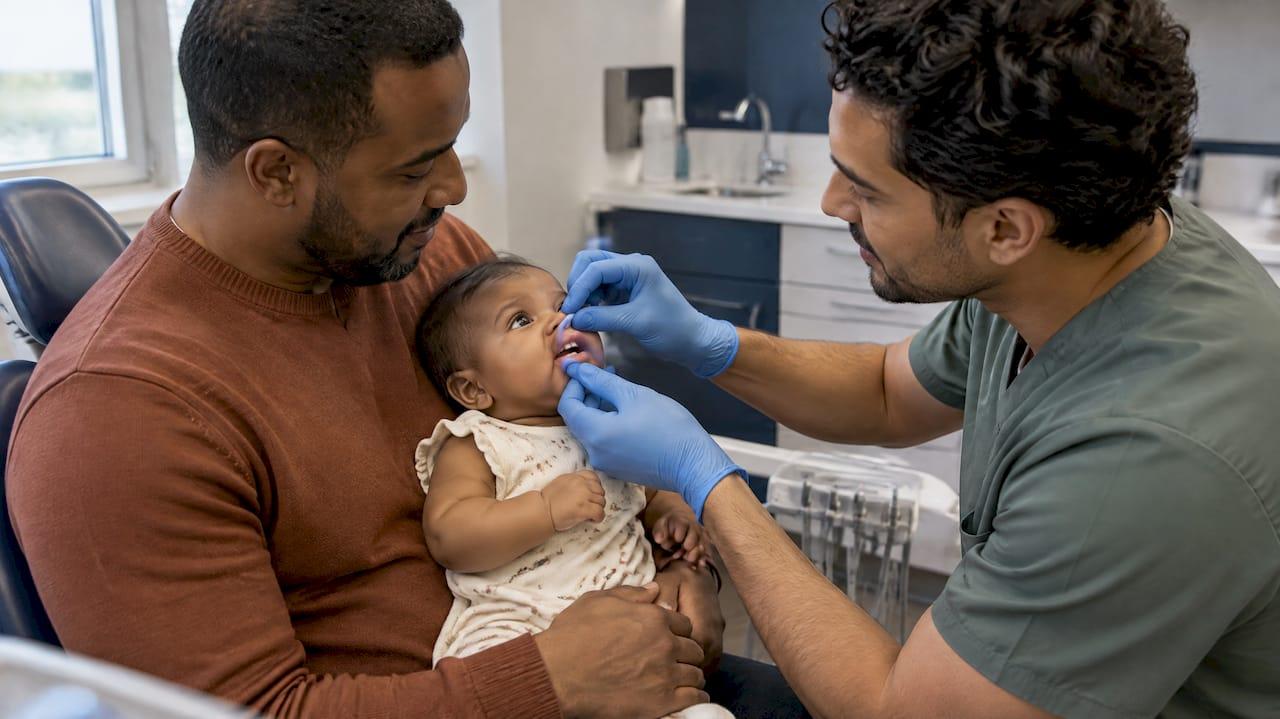
The first dentist visit should happen when your child's first tooth comes in, and no later than their first birthday, whichever comes first. Both the American Academy of Pediatric Dentistry (AAPD) and the American Dental Association give this same guidance. If your child is already past one and has never been seen, the answer is simple: book now. It is never too late to start.
This guide covers the timing, why it is so early, what happens in the chair, how to prepare, what to do if your child is older, and when a problem can't wait for a routine appointment.
TL;DR
- Book the first visit when the first tooth appears (usually around 6 months) and no later than the first birthday.
- The visit is mostly about building a "dental home," checking development, and coaching parents, not a deep cleaning.
- Your baby will likely sit on your lap. Fussing and crying are normal and expected.
- Past age one with no visit yet? Schedule now, and keep going every six months or as your dentist advises.
- Knocked-out teeth, severe swelling, or persistent pain need a call to a dentist right away, not a wait for the next check-up.
Table of Contents
- The recommended age for a first dental visit
- Why so early? Baby teeth get cavities too
- What happens at a first dental visit
- How to prepare your baby and yourself
- Family dentist or pediatric dentist?
- What if your child is already past age one?
- When you should not wait for the first visit
- Our perspective: make the first visit boring
- Book a visit with us
- Frequently asked questions
- Sources
The recommended age for a first dental visit
The rule has two triggers and one deadline:
- The first tooth erupts. The AAPD says to see a dentist when the first tooth appears, or no later than the first birthday.
- The first birthday arrives. If no tooth has shown by then, you still go.
In practice, most babies get their first tooth somewhere around six months. The ADA's guidance for parents on first dental visits matches the AAPD's. The AAPD's clinical periodicity schedule also states that the first examination is recommended at eruption of the first tooth and no later than 12 months.
Some parents have heard "wait until age 2 or 3." That is outdated advice. Current guidance from the major dental bodies is the first birthday at the latest.
Why so early? Baby teeth get cavities too
It sounds premature to take a one-year-old with four teeth to the dentist. The reason is that decay does not wait for a certain age. As the ADA puts it, as soon as your baby has teeth, they can get cavities, and that can affect eating, sleeping, speaking and learning.
A few more reasons the timing matters:
- Decay moves fast in small teeth. One pediatric oral health review notes that a lesion that looks minor one month can reach the pulp within three months.
- Parents get coaching when it counts. The first visit is the best time to talk about brushing, nighttime bottles, snacks, pacifiers and thumb sucking before habits set in.
- It can lower costs. The AAPD's guidebook cites a study in which children who had a first dental visit by age 1 had dental costs 40 percent lower over the first five years than those who did not.
- It sets up a dental home. A familiar office and a familiar face make later visits calmer, which matters for dental anxiety down the road.
One point from the AAPD's guidance is worth knowing if you are pregnant: oral health during the perinatal period is tied to your child's outcomes, and dental care during pregnancy is considered safe and recommended. Your own check-up counts as part of your baby's plan.
What happens at a first dental visit
Expect a short, gentle appointment. A typical first visit goes like this:
- You sit in the chair with your child on your lap. The ADA describes this lap exam as standard for babies and toddlers.
- The dentist checks teeth, jaw, bite and gums. They are looking at how things are developing and for any injuries, cavities or other issues.
- A light cleaning may happen if appropriate. It is not the focus, though.
- You get guidance. Brushing technique, fluoride, feeding habits, teething and what to expect in the coming months.
One fact sheet from a university medical center says the first visit often runs 30 to 45 minutes. Much of that is talking with you, not working in your child's mouth. Expect less of a "cleaning appointment" and more of an orientation: the goal is to establish a dental home, familiarize your child with the setting, and give you targeted guidance on preventing early childhood cavities.
How to prepare your baby and yourself
You do not need to do much, but a few things help.
Pick a time of day when your child is rested and fed. A nap-time appointment is a gamble. The ADA suggests making sure your child is well-rested and asking for intake forms ahead of time.

Write down your questions. Pacifier use, teething, night feeding, thumb sucking, water source, toothpaste amount. Bring them on paper, because it is easy to forget in the room.
Keep your tone light. Dental professionals recommend a positive, fun mindset. If your baby wiggles or cries, that is a normal part of the experience, and the real aim is a comfortable long-term relationship with the office.
Skip the scary talk with older toddlers. Avoid words like "hurt," "shot," or "don't worry." Say the dentist will count teeth and look at your smile.
If your child is autistic or has sensory sensitivities, give yourself more lead time. Visual preparation can help, and a guide to dental social stories walks through starting two weeks early and telling the dental team about your child's needs ahead of the appointment.
If you carry your own dental fear, our page on dealing with dental anxiety is worth a read before you go. Children pick up on a parent's tension quickly.
Family dentist or pediatric dentist?
The ADA says you may choose a family dentist who cares for patients of all ages, or a pediatric dentist who specializes in children's oral health. Both are valid starting points.
A few questions help you decide:
- Do you want the whole family seen in one place? A family practice makes scheduling simpler, with one set of records and one address.
- Does your child have complex medical or behavioral needs? Ask any office how they approach them before booking.
- How quickly can you get in if something goes wrong? A baby with a chipped tooth should not wait weeks.
You can see how we approach young patients on our children's dentistry and children's oral health pages.
What if your child is already past age one?
If your child is 18 months, 3 years or 8 years old and has never seen a dentist, don't spend time feeling guilty. Schedule the visit. The guidance on timing is a "no later than," not a window that closes.
A few practical notes by age:
| Child's age | What to do |
|---|---|
| Under 1, first tooth showing | Book now. This is the ideal moment. |
| Around 1 | Book the first visit if you have not already. |
| 2 to 5 | Book now. Keep the first appointment short and positive. Expect a fuller look at all baby teeth. |
| 6 to 12 | Book now. Permanent teeth are arriving, so bite and spacing are worth checking. |
| Teens | Book now. Our teenage hygiene page covers habits for this age. |
The AAPD's age-based assessment chart shows the exam and preventive steps recommended at each stage from 6 months through the teen years, and your dentist will tailor the schedule to your child's cavity risk.
If an older child has a cavity, you have options beyond "drill and fill" in some cases. We explain them in our guide to alternatives to filling cavities in baby teeth, and our page on tooth decay repair covers what restoration looks like.
When you should not wait for the first visit
A routine first visit is for prevention. These situations are different, and call for a dentist right away:
- A permanent tooth is knocked out. Children's Hospital Colorado says it needs to be re-implanted within 2 hours. Call a dentist immediately. Our guide on what to do for a knocked-out tooth lays out the steps.
- A baby tooth is knocked out. It cannot be re-implanted, but the child should still be seen promptly so a dentist can check for damage to the permanent tooth developing in the gum.
- Severe pain, swelling, or trouble chewing after an injury. These also warrant prompt contact. Our page on severe toothache relief covers what to do in the meantime.
- A baby under 1 year with any injury that worries you. The same hospital guidance says to contact a dentist or doctor immediately.
If it is after hours and you are unsure whether the emergency room can help, read what the ER can do for a dental emergency. In short, an ER can manage pain and serious trauma, but a dentist is who repairs the tooth. If your child has trouble breathing, heavy bleeding that will not stop, or a possible head injury, call 911 or go to the ER first.
Our perspective: make the first visit boring
At DC Implant & Cosmetic Dentistry, we are a Washington, DC practice that provides everything from exams to surgical care in-house. Dr. Kambez Shukoor is a U.S. Navy veteran, and our approach rests on clear, written treatment plans, thorough imaging and no surprises.
Here is what that means for a first visit in our view.
The best first visit is an uneventful one. If your child leaves with a sticker, a healthy exam and a parent who knows what to do at home, it was a success. Nothing needs to be "done." What matters is that the office becomes a familiar, safe place before anything is ever wrong.
Parents are half the patient. Most early cavities trace back to habits we can talk through in ten minutes: bedtime bottles, grazing on snacks, sippy cups of juice. We would rather coach you early than repair a tooth later.
Same-day availability matters for families. Children chip teeth and get toothaches at inconvenient times. We offer same-day appointments, so you are not left waiting when something happens.

One office for the whole household. Parents sometimes come in for a cleaning, whitening or aligners while their children are being seen. Keeping care in one place means one set of records and one team who knows your family.
Whatever practice you choose, the most important thing is that you go, and that you go early.
— Jake
Book a visit with us
If you are in Washington, DC and ready to schedule, we offer exams and X-rays, cleanings and fillings in-house, with same-day appointments available. Browse our children's dentistry page to see how we care for young patients, then contact us through our website to find a time. Parents often book their own check-up or whitening visit while they are at it.
Frequently asked questions
Should a 2-year-old go to the dentist?
Yes. By age 2, your child should already have had a first visit, since the recommendation is no later than the first birthday. If they have not, book one now. Your dentist will check all of the baby teeth and talk to you about brushing and diet.
What if my baby has no teeth at 12 months?
Book the visit anyway. The guidance sets the first birthday as the latest time for a first exam, whether or not teeth have come in by then. The dentist can check how the gums and jaw are developing and answer teething questions.
Is the first dental visit covered by insurance or Medicaid?
It depends on your plan, so call your insurer before booking. In the District, children on Medicaid are entitled to preventive and specialty care, including dental services, through the EPSDT benefit (called HealthCheck in DC). Ask the dental office whether they accept your specific plan.
Will my baby cry at the first visit?
Possibly, and that is normal. Dental professionals say a wiggly or crying baby is a normal part of the experience. The dentist is used to it, and the lap exam keeps your child close to you.
Should I wait to see a dentist if I do not see any problems?
No. Problems in baby teeth are often invisible to parents at first, and decay can progress quickly. The first visit is preventive, so you go before there is anything to fix.
Sources
- AAPD FAQ: When should I take my child to the dentist?
- ADA MouthHealthy: Your baby's first dental visit
- AAPD Periodicity Schedule
- AAPD Healthy Smiles Guidebook
- AAPD Recommendations for Pediatric Oral Health Assessment
- AAPD Perinatal and Infant Oral Health Care
- Pediatric Oral Health Habits Every Child Needs
- University of Rochester Medical Center: A Child's First Dental Visit
- Children's Hospital Colorado: Tooth Injuries in Children
- DC Department of Health Care Finance: children's oral health and EPSDT