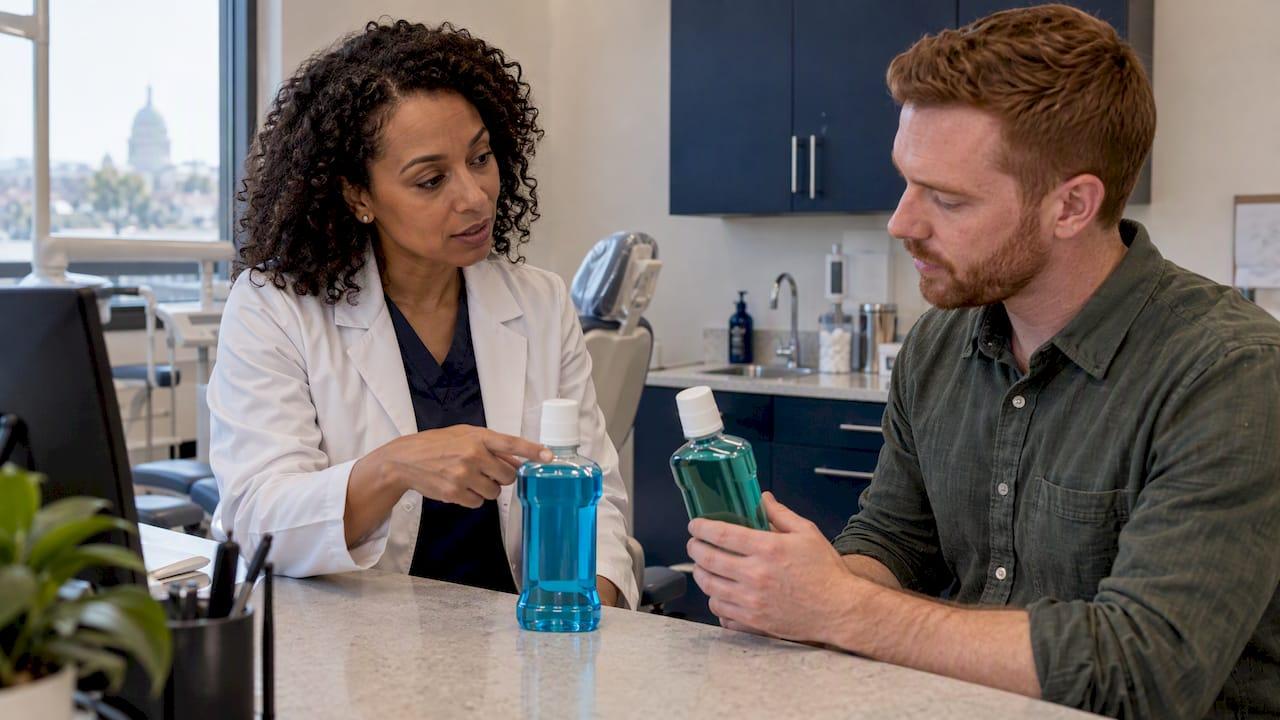
Both types can work. The right one depends on your mouth, not on a label that says "stronger" or "gentler." Alcohol-containing rinses have a slight edge in some plaque studies, while alcohol-free rinses cause fewer burning and dryness complaints and are the usual choice if your mouth is dry, sensitive or healing from a procedure. Below you will find what the research shows, who should lean which way, and how to use either type so it helps instead of irritating.
TL;DR
- Alcohol-containing and alcohol-free rinses both reduce plaque and gingivitis. Differences in the studies are small, and some trials find none.
- If your mouth is dry, sensitive or recovering from surgery, an alcohol-free rinse is usually the better fit.
- Current ADA information says a systematic review found no link between alcohol-containing mouthwash and oral cancer, though the older literature on the question is mixed.
- Mouthwash adds to brushing and flossing. It does not replace them, and it is not for children under 6.
- Persistent dry mouth, sores or burning are worth a dental visit, because a rinse will not fix the cause.
Table of Contents
- What the difference actually is
- Does alcohol-free mouthwash work as well?
- Alcohol-free mouthwash for dry mouth
- Is alcohol in mouthwash safe?
- Which should you choose?
- How to use mouthwash well
- Our perspective
- Get a recommendation that fits your mouth
- FAQ
- Sources
What the difference actually is
The core difference is the ingredient list. Ethanol works in mouthwash as both a solvent and an antimicrobial, according to a 2022 review of mouthwash ingredients. The same review notes that propylene glycol has largely replaced ethanol as the solvent in many modern brands. So an alcohol-free rinse is not an empty bottle. It is a rinse built on a different carrier, with other active ingredients doing the antibacterial work.
How much alcohol is in the bottle? Poison Control reports that mouthwashes typically contain roughly 5% to 27% alcohol. That is a wide range, so "alcohol-containing" covers everything from a mild rinse to a very strong one. Check the label for the percentage.
Alcohol also does real chemical work. As an antiseptic, it disrupts bacterial proteins and cell walls, which kills bacteria, as RSC Education explains. It also helps dissolve flavor oils such as menthol, thymol and eucalyptol so they can evaporate and leave that fresh, clean feeling. That is why essential-oil rinses, including the popular Listerine-style formulas, come in both versions. The alcohol-free versions rely on a different solvent and often feel milder, and some people find the flavor less intense.
What you feel in the first ten seconds
The sting is the difference most people notice first. Alcohol-containing rinses tend to burn, and the sharper sensation fades fast. Alcohol-free rinses are typically gentler on the tongue, cheeks and gums. That matters if you have canker sores, sensitive gums or braces that rub. It also matters for adherence: a rinse you can stand to use is a rinse you will actually use.

Does alcohol-free mouthwash work as well?
Short answer: close, but the studies are not unanimous.
Here is what the evidence says, kept to the numbers the sources report:
- A 2024 clinical study reported a mean plaque reduction of 25.4% for the alcohol-containing rinse and 23.1% for the alcohol-free one. That is a gap of 2.3 percentage points. The same study found fewer adverse effects, such as dry mouth and irritation, with the alcohol-free rinse.
- A 2024 systematic review and meta-analysis of essential-oil mouthwashes found small-to-moderate evidence that alcohol-free versions had less effect on plaque control than their alcohol-containing counterparts.
- A 2021 study observed that both alcohol-based and alcohol-free rinses were equally effective at controlling plaque and gingivitis.
Put together, the picture is a small potential edge for alcohol in plaque control, offset by more irritation. The Canadian Dental Hygienists Association position paper says an alcohol-free rinse may be warranted when alcohol rinses are poorly tolerated or contraindicated, though efficacy may be markedly reduced. Its wording is a useful reminder: the formula matters, and not every alcohol-free product performs the same.
The British Dental Journal took a different angle in 2009. It argued that because the added benefit of alcohol in mouthwash is often negligible, the dental team should weigh whether an alcohol-containing product is necessary in the first place.
So is alcohol-free "better"? It is better for some mouths and similar for others. For a healthy mouth with no sensitivity, a few percentage points of plaque reduction in a trial will not matter nearly as much as whether you brush twice a day and clean between your teeth daily.
Comparison at a glance
| Factor | Alcohol-containing | Alcohol-free |
|---|---|---|
| Sensation | Burning or sting for some people | Usually milder, little to no sting |
| Plaque control in studies | Equal or slightly higher in some trials | Equal in some trials, slightly lower in others |
| Irritation and dryness complaints | More often reported | Fewer reported in a 2024 trial |
| Typical active ingredients | Essential oils dissolved in alcohol | Often cetylpyridinium chloride, fluoride or other agents |
| Good fit | Healthy mouth, no sensitivity, tolerance for the burn | Dry mouth, sore or sensitive tissue, post-procedure care |
Alcohol-free mouthwash for dry mouth
This is the question behind most searches on this topic, and the answer is fairly clear. According to the American Dental Association, alcohol-free mouthwash is generally recommended for people with dry mouth, because alcohol can contribute to oral dryness. The ADA also says people with xerostomia should look for products containing enzymes, cellulose derivatives or animal mucins that mimic natural saliva.
There is one nuance worth knowing. A comparative study of alcohol-based and alcohol-free rinsing in healthy adults found no significant difference in salivary flow or dry mouth symptoms after one week. In other words, if your mouth is healthy, a short stretch of alcohol rinsing will probably not dry you out. If you already live with dry mouth, though, you have less margin, and the gentler option is the sensible default.
What to do if dry mouth is a daily problem:
- Choose an alcohol-free rinse made for dry mouth, ideally with the saliva-mimicking ingredients the ADA lists.
- Sip water through the day and avoid anything that dries you further, such as tobacco.
- Ask about the cause. Dry mouth is often a side effect of medication, and it raises the risk of cavities and gum problems because saliva protects teeth.
- Read our dry mouth resources for more on managing it.
Xylitol can also help keep the mouth moist and cavity-resistant. If you want to go that route, here is a look at what xylitol mints are good for and a full guide to using xylitol for teeth cleaning.
Is alcohol in mouthwash safe?
The worry that alcohol rinses cause oral cancer has followed this category for years. The evidence does not support a firm link. The ADA reports that a systematic review failed to find an association between alcohol-containing mouthwash and oral cancer. A 2009 paper in the British Dental Journal described the evidence as weak, inconclusive and controversial.
A Brazilian safety review of daily use concluded that, despite minor effects like burning for some people, there is no reason to avoid alcohol-containing mouthwash when it is used as directed by dental professionals and manufacturers.
That does not mean oral cancer is something to wave off. The real protection is a regular screening, since early changes are far easier to treat. Any sore, white or red patch, or lump that lasts more than two weeks should be examined. Our page on oral cancer explains the warning signs, and an oral cancer screening is part of a routine exam.
Safe use, whichever type you choose
- Children. The ADA does not recommend mouthwash for children under 6 because of the risk of swallowing, which could lead to toxicity. Poison Control advises storing mouthwash up, away and out of sight of children, and suggests products with child-resistant closures.
- Swallowing. Rinse and spit. Never swallow mouthwash, with or without alcohol.
- After surgery. One study notes that alcohol-containing rinses should be used judiciously during and after surgical procedures. After an extraction, implant placement or gum treatment, follow the rinse instructions you were given, not a general rule.
- Duration. Poison Control says to follow the product instructions on frequency, and that some products are not meant for long-term use. DermNet likewise notes that long-term use of mouthwash is not recommended. If you have used one daily for months, check the label and ask at your next visit.
Which should you choose?
There is no universal winner. Use these situations as a guide.
Choose alcohol-free if
- Your mouth is often dry, or you take medication that dries it.
- Alcohol rinses sting or leave your gums sore.
- You have canker sores, sensitive tissue or irritated gums.
- You are healing from oral surgery, an extraction or an implant procedure and your dentist has told you to avoid strong rinses.
- You want a rinse you can use comfortably every day without dreading it.
An alcohol-containing rinse can make sense if
- Your mouth is healthy and you tolerate the burn.
- You like the strong, clean feeling of essential-oil rinses.
- Your dentist has specifically recommended one.
Check the label for what you actually need
The alcohol question is only one line on the label. Ask what the rinse is meant to do:
- Cavity prevention: look for fluoride and the ADA Seal of Acceptance.
- Plaque and gingivitis: look for an antibacterial active, such as essential oils or cetylpyridinium chloride.
- Bad breath: cosmetic rinses freshen breath but may not treat the cause. Persistent bad breath often traces to gum disease, dry mouth or decay.
- Dry mouth: saliva-mimicking ingredients, as noted above.
If your gums bleed or feel tender, a rinse is not the answer by itself. Those are among the early signs of gum disease, and they call for a cleaning and an exam.
How to use mouthwash well
Technique counts more than the formula. A simple routine:
- Brush with fluoride toothpaste and clean between your teeth first.
- Measure the dose on the label. More is not better.
- Swish for the time the label states, then spit. Do not swallow.
- If your rinse contains fluoride, avoid rinsing with water or eating right away, so the fluoride stays on your teeth. Check your label for how long to wait.
- Do not use mouthwash right after brushing if your toothpaste and rinse are meant to be separated. Many people rinse at a different time of day, such as midday, so the two do not wash each other away.
How often should you use a non-alcoholic rinse? Follow the product's own directions. Most are labeled for once or twice a day, and some are designed for short-term use only.
If you have veneers, implants or aligners
Restorations do not change the basics, but a few habits protect them. Gentle, alcohol-free rinses are a comfortable daily option around implants and healing gums. With porcelain restorations, the question people ask is about staining, so it helps to know whether porcelain veneers stain. Rinses with strong dyes or those used for treatment-only periods are worth asking about at your next visit. Before whitening, a dental exam is also the better starting point than a label percentage, as our piece on teeth whitening safety explains.
Our perspective
We see mouthwash questions at nearly every new-patient visit, and the honest answer is rarely "this brand." It is "what is going on in your mouth?"
A patient with dry mouth from medication needs a different rinse than a patient with a healthy mouth who wants fresher breath. A patient healing from an extraction or implant placement needs yet another approach. That is why our first step is an exam with thorough imaging and a clear, written treatment plan, so the advice you take home fits you and not an average.
The research is reassuring in one way: both kinds of rinse can do their job, and the safety concerns are weaker than many headlines suggest. But a rinse supports the daily basics. It cannot substitute for cleanings, for a check on your gums, or for an oral cancer screening. We perform exams, cleanings, fillings, implants and cosmetic work in-house, so if your rinse is hiding a problem, you will not be passed along to another office to find out.
If something about your mouth feels off, such as burning, a persistent dry feeling or bleeding gums, we would rather see you than have you guess at the drugstore shelf.
Jake
Get a recommendation that fits your mouth
If you have been switching rinses without knowing why your mouth feels dry, sore or never quite fresh, a visit can sort it out. At DC Implant & Cosmetic Dentistry in Washington, DC, we offer exams and X-rays, cleanings, gum disease care and oral cancer screening, with same-day appointments available. Dr. Kambez Shukoor, a U.S. Navy veteran, and our team will look at the cause and recommend a rinse and routine that suit you.
See our general dentistry services or book an appointment through our website.
FAQ
Is alcohol-free mouthwash better?
It is better for people who find alcohol rinses irritating, have dry mouth or are healing after oral procedures. For a healthy mouth, studies show the two types perform similarly, with a small plaque-control edge for alcohol in some trials. Choose the one you can use comfortably every day.
Is alcohol-free mouthwash good for dry mouth?
Yes. The ADA generally recommends alcohol-free products for dry mouth because alcohol can add to dryness. Look for ones with saliva-mimicking ingredients, and raise persistent dryness with your dentist, since medication is a common cause.
Why do some dentists say not to use mouthwash?
Most concerns are about overuse and reliance. Some products are not meant for long-term use, and a rinse never replaces brushing and cleaning between teeth. Follow the label, and ask your dentist if you have used one daily for a long time.
What is the safest mouthwash to use?
The safest choice is one that matches your needs and is used as directed: spit it out, never swallow it, and keep it away from children. It should not be given to children under 6. Alcohol-free and alcohol-containing rinses both have a good safety record when used correctly.
How often should you use alcohol-free mouthwash?
Follow the instructions on your product, as frequency differs by formula. Many are labeled for once or twice daily, and some are for short-term use only. If you are unsure, ask your dentist at your next exam.
Sources
- A Fresh Look at Mouthwashes: What Is Inside and What Is It For (PMC, 2022)
- Mouthwash: Swish and spit (Poison Control)
- Brush up on the science of mouthwash (RSC Education)
- Efficacy and safety evaluation of alcohol-containing and alcohol-free mouth rinses (Bangladesh Journal of Medical Science, 2024)
- Essential oils mouthwash with or without alcohol (PMC, 2024)
- Efficacy and safety evaluation of alcohol-containing and alcohol-free mouth rinses (PMC, 2021)
- Oral Rinsing: CDHA Position Paper
- Are alcohol containing mouthwashes safe? (British Dental Journal, 2009)
- Mouthrinse (Mouthwash) (American Dental Association)
- Reviewed evidence about the safety of the daily use of alcohol-containing mouthwashes (SciELO)
- Mouthwashes (DermNet)