
An out-of-network dentist is simply a dentist who has no contract with your specific insurance plan. That one fact drives everything: the fees, who files the paperwork, and how many lands in your lap. Before your next appointment, do three things: call your insurer to confirm network status for your exact plan (not just the insurer's name), ask the dental office whether they will file the claim for you, and request a written pre-treatment estimate for any procedure over $200.
Quick actions:
- Verify network status by plan ID, not just the insurer's brand name
- Ask the office: "Will you file the claim, and do you require payment upfront?"
- Request a predetermination (pre-treatment estimate) in writing before any procedure likely to cost over $200.
TL;DR: Going out of network usually costs more because you face coinsurance on a lower "allowed amount" plus a potential gap between that amount and the dentist's actual fee. For many patients, though, clinical continuity or specialist access makes that extra cost worth it. Run the numbers first.
Table of Contents
- How out-of-network coverage typically works: PPO, DHMO, and indemnity plans
- What does an out-of-network dental bill actually look like?
- When going out of network is actually worth it
- Exactly what to ask before your first out-of-network appointment
- What to do in a dental emergency or if your dentist leaves the network
- How Dc-dentistry handles out-of-network patients in Washington, D.C.
- Key Takeaways
- When out-of-network care is clinically the right call
- Dc-dentistry is a transparent option for Washington, D.C. patients
- Useful sources for further reading
How out-of-network coverage typically works: PPO, DHMO, and indemnity plans
Your plan type determines whether you have any out-of-network benefit at all. The difference between PPO and DHMO plans is not a technicality. It is the line between partial coverage and zero coverage.
PPO (Preferred Provider Organization): The most common plan type for employer dental benefits. PPOs allow you to see any licensed dentist. When you go out of network, the insurer pays a percentage of its "allowed amount" (also called the UCR, or Usual, Customary, and Reasonable rate). You pay coinsurance on that allowed amount, plus any gap between the allowed amount and the dentist's actual fee. That two-layer cost exposure is what catches patients off guard.
DHMO (Dental HMO / managed-care plan): Requires you to use a designated in-network primary dentist. Out-of-network care is generally not covered at all, except in a documented emergency. If you have a DHMO and see a dentist not in network for a routine procedure, you pay the full bill yourself.
Indemnity plans: Less common and typically more expensive in premiums, but they reimburse a percentage of the dentist's actual charge rather than an insurer-set allowable. For patients who frequently need out-of-network care, an indemnity plan can offer better protection than a standard PPO.
| Plan Type | OON Coverage | Typical Patient Responsibility | Who Files Claims |
|---|---|---|---|
| PPO | Yes, at reduced benefit | Coinsurance + balance bill gap | Usually the office; patient if needed |
| DHMO | Emergency only | Full cost for non-emergency OON | Patient |
| Indemnity | Yes, % of actual charge | Remaining % after reimbursement | Patient submits; office may assist |
One important note: the federal No Surprises Act, which limits surprise billing for most medical services, generally does not apply to dental care. You do not have the same federal backstop for a dental balance bill that you might have for a hospital visit.
What does an out-of-network dental bill actually look like?
The cost of an out-of-network dentist has several moving parts, and they compound quickly. Here is what affects your final out-of-pocket amount:
- Deductible: Many plans have a separate, higher deductible for out-of-network care. You pay this first before any coverage kicks in.
- Allowed amount (UCR): The insurer's ceiling for what it considers a reasonable fee for a procedure in your area. The dentist's actual charge may be higher.
- Coinsurance: Your share of the allowed amount after the deductible. A common split is 80/20 in-network and 60/40 or 50/50 out of network.
- Balance bill: The gap between the dentist's fee and the insurer's allowed amount. You owe this on top of coinsurance.
- Annual maximum: Most dental plans cap total benefits at $1,000–$2,000 per year. Out-of-network charges may or may not count toward this maximum depending on your plan.
Worked example: a porcelain crown
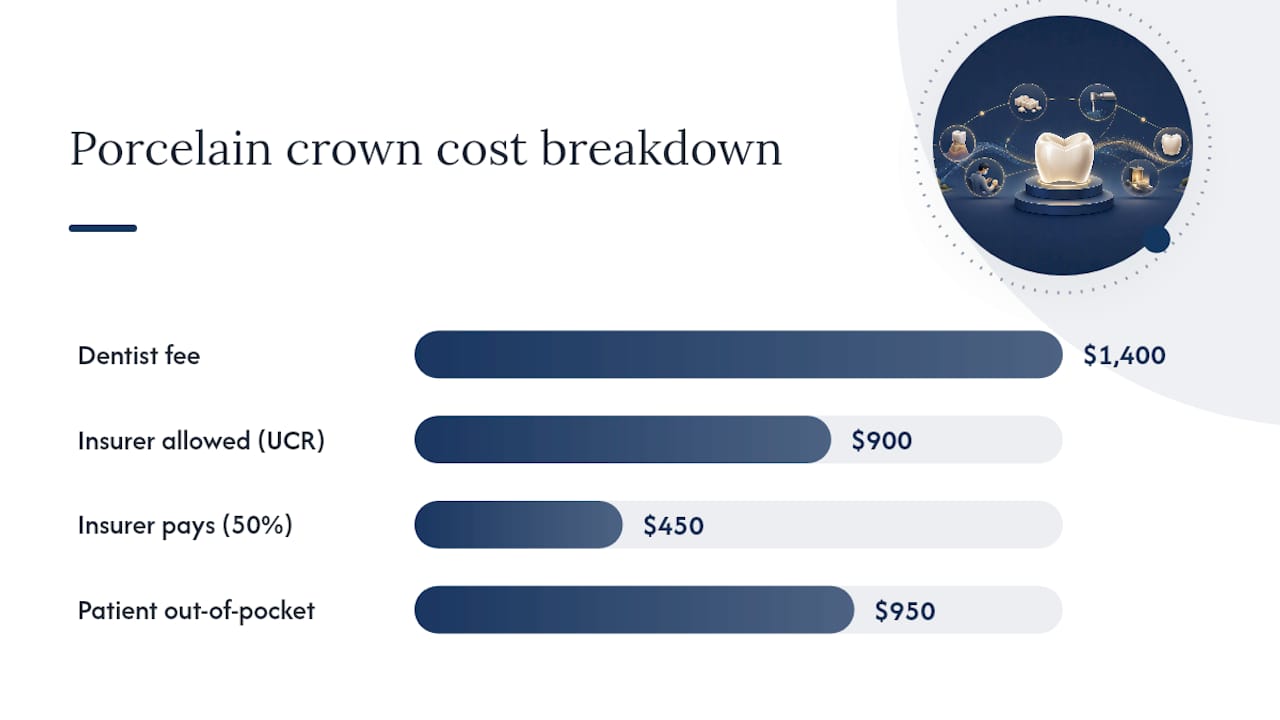
Say your dentist charges $1,400 for a crown. Your insurer's allowed amount for that procedure in your zip code is $900. Your plan pays 50% of the allowed amount out of network, and you have already met your deductible.
- Insurer pays: 50% of $900 = $450
- Your coinsurance: $450
- Balance bill (gap): $1,400 minus $900 = $500
- Total out of pocket: $950
Compare that to an in-network crown where the contracted fee might be $950, the insurer pays 80%, and your share is $190. The gap is real. Predetermination before procedures over $200 is the single best way to see this math before you commit.
| Procedure | Typical In-Network Fee | Insurer Allowed (OON) | OON Dentist Fee Range | Sample Patient Bill (OON) |
|---|---|---|---|---|
| Cleaning (prophylaxis) | typical lower range | typical allowance range | typical higher dentist fee | — |
| Composite filling | typical lower-mid range | typical allowed amount range | typical higher fee range | — |
| Porcelain crown | typical in-network fee range | typical allowed amount range | typical out-of-network dentist fee range | typical patient bill range |
Regional variation matters. In high-cost metros like Washington, D.C., the gap between insurer allowed amounts and actual dentist fees tends to be wider than in lower-cost markets, because dentist fees track local overhead costs while UCR rates often lag behind.
When going out of network is actually worth it
Cost is not the only variable. Delta Dental's guidance makes the point plainly: insurance is a tool to reduce costs, not a substitute for clinical quality. There are situations where paying more out of pocket is the right call.
Continuity of care: If you are mid-course in a complex restorative treatment, such as a multi-stage implant or an orthodontic case, switching dentists to stay in-network can create real clinical risk. Incomplete records, different material choices, and interrupted treatment timelines all carry costs that do not show up on an insurance statement.
Specialist access: Some procedures require a level of expertise or technology that simply is not available within a given network. A periodontist or oral surgeon with specific training may not participate in your plan, and the clinical outcome difference can outweigh the cost difference.
Established relationship: A dentist who knows your full history, your anxiety triggers, your bite, and your prior work is not easily replaced. For patients with complex dental histories, that continuity has real clinical value.
Quick checklist to test whether OON is justified:
- Is the treatment already in progress and clinically risky to transfer?
- Is the expertise or technology unavailable in-network?
- Have you calculated the actual dollar gap (not just assumed it is too high)?
- Does the dentist offer a payment plan or accept the insurer's allowable as full payment?
Pro Tip: Ask the dental office directly: "Will you accept the insurer's allowed amount as payment in full?" Some offices will, especially for established patients. Get the answer in writing before treatment starts.
Exactly what to ask before your first out-of-network appointment
Preparation is the only reliable way to avoid a surprise bill. Here is a numbered script you can use on two phone calls.
Call 1: Your insurance company
- "Does my plan cover out-of-network dental care, or is it DHMO-only?"
- "What is the allowed amount for procedure code [X] in my zip code?"
- "Is there a separate out-of-network deductible, and have I met it?"
- "Does the out-of-network charge count toward my annual maximum?"
- "Will payment be sent to me or directly to the dentist (assignment of benefits)?"
- "Can I request a predetermination before treatment?"
Call 2: The dental office
- "Will you file the insurance claim on my behalf, or do I submit it myself?"
- "Do you require full payment at the time of service?"
- "Will you accept the insurer's allowed amount as payment in full?"
- "Can I get a written estimate before the procedure?"
- "Do you offer a payment plan for the remaining balance?"
Request a predetermination (also called a pre-authorization or pre-treatment estimate) for any procedure likely to cost over $200. This is not a guarantee of payment, but it gives you the insurer's projected allowed amount and your estimated share before you sit in the chair. For high-cost work like root canal treatment or implants, this step is non-negotiable.
What to do in a dental emergency or if your dentist leaves the network
In a genuine emergency, network status is secondary. Seek care immediately, then sort the insurance details after stabilization. Waiting to find an in-network provider during an acute dental emergency can worsen the injury and increase the total cost of treatment.
If you need emergency care out of network:
- Get treatment. Document everything: the date, the provider, the procedures performed, and what you paid.
- Call your insurer within 24–48 hours. Ask about emergency out-of-network benefits and whether a predetermination is still required for follow-up care.
- Request an itemized receipt with CDT codes from the treating office.
- Submit the claim yourself if the office does not file it, using the claim form from your insurer's website.
If your dentist leaves the network mid-treatment:
- Ask the office for complete records: X-rays, treatment notes, and a summary of work completed.
- Ask whether the office will honor the in-network fee schedule for the remainder of your current treatment, given the disruption. Some practices will.
- Check whether any pre-authorizations already issued still apply. Call your insurer to confirm.
- If further treatment is needed, request a new predetermination under your out-of-network benefit before proceeding.
Pro Tip: For dental extractions or other urgent procedures performed out of network, ask the treating office to note "emergency" in the claim narrative. This can support coverage under plans that otherwise limit OON benefits.
How Dc-dentistry handles out-of-network patients in Washington, D.C.
DC Implant & Cosmetic Dentistry operates as a fee-for-service dental practice in Washington, D.C., which means it is not contracted with every insurance plan. For patients whose plans classify the practice as out of network, the office provides concrete support to reduce the friction.
The practice files insurance claims as a courtesy for patients, provides written pre-treatment estimates before major procedures, and offers in-house financing through CareCredit and Lending Tree for patients managing larger out-of-pocket balances. Same-day appointments are available for dental emergencies, so patients are not left searching for care when it matters most.
Dr. Kambez Shukoor, a U.S. Navy veteran, leads the practice with a focus on transparent communication about costs and treatment plans. With over 200 five-star reviews, the practice has a documented track record of patient satisfaction across a full range of services, from routine oral hygiene visits to complex restorative work like single-tooth implants.
For patients considering high-cost procedures like implants or full-mouth reconstruction, the practice's written estimate process and financing options make out-of-network care manageable rather than unpredictable.
Key Takeaways
Going out of network costs more in most cases, but the actual gap depends on your plan type, the procedure, and whether you negotiate before treatment starts.
| Point | Details |
|---|---|
| Verify by plan, not insurer | Network status is plan-specific; call with your dentist's NPI and exact plan name. |
| PPO vs. DHMO is the key split | PPOs offer reduced OON benefits; DHMOs typically cover nothing outside the network except emergencies. |
| Two-layer cost exposure | You pay coinsurance on the allowed amount plus any balance bill above it. |
| Predetermination first | Request a written estimate before any procedure likely to cost over $200 to see your real exposure. |
| Dc-dentistry offers written estimates | DC Implant & Cosmetic Dentistry provides pre-treatment cost estimates and files claims as a courtesy for Washington, D.C. patients. |
When out-of-network care is clinically the right call
The cost argument for staying in-network is real, and I do not dismiss it. But the framing that in-network always equals better value misses something important: dental care is cumulative. A dentist who has treated you for years holds clinical context that no intake form fully captures. They know which restorations are aging, which teeth are at risk, and how your bite has shifted. Transferring mid-treatment to an in-network provider to save a few hundred dollars can cost far more if the incoming dentist misses something or has to redo work.
The scenario I see most often where OON is clearly justified: a patient is two visits into a multi-stage implant case or a complex crown sequence, and their dentist leaves the network. The right move is almost always to finish with the original provider, negotiate the fee where possible, and use predetermination to cap the exposure. Switching at that point introduces clinical risk that the insurance savings rarely offset.
The one caveat: document everything. If you are continuing out-of-network care, make sure every step is predetermination-approved and that you have the insurer's projected payment in writing. Appeals are far easier when the paper trail is clean from the start.
Dc-dentistry is a transparent option for Washington, D.C. patients
If you are weighing a major procedure and your current plan classifies your preferred dentist as out of network, the math can feel paralyzing. Dc-dentistry gives Washington, D.C. patients a different starting point: written cost estimates before treatment, claims filed as a courtesy, and financing through CareCredit and Lending Tree so a large balance does not have to come out of pocket all at once.
The practice covers the full range of restorative and cosmetic work, from routine care to dental implants and full-mouth reconstruction. Same-day emergency appointments mean you are not left managing an acute problem without access to care. To get a written estimate or book an appointment, contact DC Implant & Cosmetic Dentistry directly through the website at dc-dentistry.com.
Useful sources for further reading
These are the primary sources referenced throughout this article. Each covers a distinct aspect of out-of-network dental care and is worth bookmarking if you want to dig deeper.
- Out-of-Network Dental Costs: Fees, Balance Billing & How to Avoid Them — ToothCostGuide
- Delta Dental - Member FAQs
- In Network vs Out of Network Dentist Guide — DentalCoverageGuide
- Fee-for-Service Dental: What It Means and How It Works | PracticeAlpha
- Dental insurance terms — Ameritas
- Fee for Service Dentistry - A Complete Consumer Guide — YourDentistryGuide