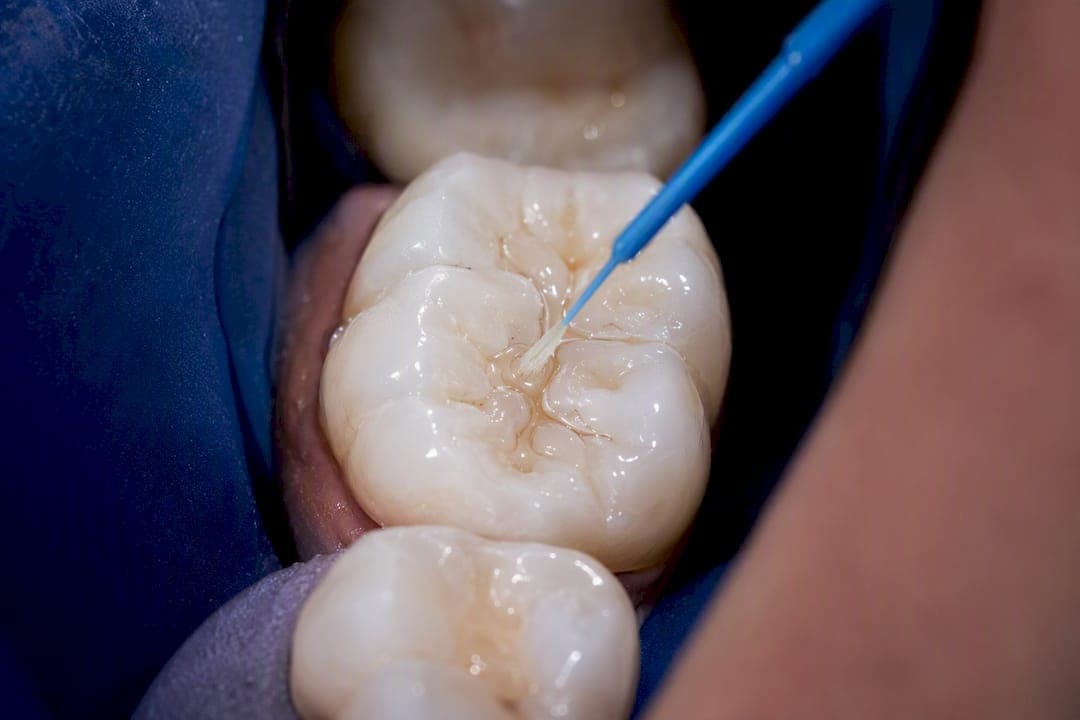
Yes, many adults benefit from dental sealants, especially those with unrestored molars and moderate-to-high cavity risk. Sealants have been shown to cut new caries risk by 73% compared with fluoride varnish alone, and they work by physically blocking the grooves where cavity-causing bacteria collect. If you have deep pits in your back teeth and no fillings there yet, ask your dentist to check whether you're a candidate at your next cleaning.
TL;DR:
- Sealants provide up to 80% cavity prevention in the first two years and can arrest early non-cavitated lesions, reducing future fillings.
- Candidates include adults with deep, unfilled pits and fissures, dry mouth, or a history of cavities, but not if decay has already broken through the enamel.
- The procedure takes 5 to 10 minutes per tooth, often avoiding anesthesia, with sealants lasting around five years when properly maintained.
- Material choice depends on moisture control and risk profile, with bioactive sealants showing promising durability and lesion inhibition in adults.
- Sealants should be combined with regular cleanings and fluoride use for optimal ongoing cavity prevention and overall oral health.
Table of Contents
- What Are Dental Sealants, and Where Do They Go?
- How Well Do Sealants Actually Work for Adults?
- Are You a Good Candidate for Adult Sealants?
- What Happens During the Appointment?
- Where Sealants Fall Short
- Resin, Glass Ionomer, or Bioactive: Which Material Wins?
- What Do Sealants Cost, and Does Insurance Cover Them?
- How Long Do Sealants Actually Last?
- How Dc-dentistry Approaches Adult Sealant Candidacy
- Can Adults Have a Reaction to Sealant Materials?
- Sealants vs. Fluoride Varnish vs. Regular Cleanings
- What Do Dental Associations Say About Adult Sealants?
- Do Diet and Daily Habits Change How Well Sealants Work?
- What the Research Actually Supports for Adults
- Ready to Find Out If You're a Candidate?
- Sources
What Are Dental Sealants, and Where Do They Go?
Dental sealants are thin plastic or ceramic coatings applied to the chewing surfaces of molars and premolars, the teeth that do the heaviest grinding work and collect the most food debris. Those surfaces have natural pits and fissures too narrow for a toothbrush bristle to clean out, which makes them a launch pad for decay. A sealant fills in the grooves and creates a smooth, closed surface bacteria and food particles can't penetrate.
Dentists choose from a few material families depending on the tooth and the patient's risk profile:
- Resin-based sealants bond tightly to enamel and hold up well under chewing pressure.
- Glass ionomer sealants release fluoride over time, useful for patients who need extra cavity-fighting support.
- Bioactive sealants combine strong retention with active mineral exchange, a newer category gaining traction in adult care.
The mechanism is simple: seal the groove, starve the bacteria of a hiding spot, and you interrupt decay before it starts.
How Well Do Sealants Actually Work for Adults?
The evidence is stronger than most adults realize. The CDC reports that sealants prevent up to 80% of cavities in the first two years after placement, with protection extending for several years beyond that. The ADA's review found a 73% drop in new caries lesions compared with fluoride varnish, a meaningful gap given how often varnish gets recommended as the default preventive treatment for adults.
Sealants do two distinct jobs. For a tooth with no decay, they act as pure prevention, a physical barrier against future cavities. For a tooth with an early, non-cavitated lesion, a soft spot that hasn't broken through the enamel, sealing it over can arrest further progression, a strategy clinical experts increasingly endorse as a conservative alternative to drilling.
Sealing a non-cavitated lesion instead of restoring it preserves healthy tooth structure and avoids the cycle of ever-larger fillings that often starts with a single small cavity.
The practical payoff: fewer fillings, less drilling, and a real shot at keeping your natural tooth structure intact for decades.
Are You a Good Candidate for Adult Sealants?
Candidacy comes down to a straightforward risk assessment your dentist can do in minutes during a routine exam.
You're likely a good fit if you have:
- Deep pits and fissures on molars or premolars with no existing fillings.
- A history of cavities, even if your current teeth look clean.
- Dry mouth, from medication side effects or a medical condition, which reduces saliva's natural cavity protection.
- Grooves too narrow to clean effectively even with careful brushing.
You're probably not a candidate if the tooth in question already has a filling or crown, if it's only partially erupted (common with wisdom teeth), or if there's active, cavitated decay that's already broken through the enamel. In that last case, you need a filling, not a sealant. A filling repairs damage that's already happened; a sealant only prevents damage that hasn't happened yet. Your dentist will typically use a visual exam plus a risk questionnaire covering diet, fluoride exposure, and cavity history to make the call.
What Happens During the Appointment?
The process is quick, and most adults skip anesthesia entirely because there's no drilling involved.
- Exam. The dentist or hygienist checks each candidate tooth for hidden decay.
- Cleaning. The tooth surface gets polished to remove plaque and debris.
- Isolation. Cotton rolls or a dental dam keep the tooth dry, since moisture ruins the bond.
- Etching. A mild acid gel roughens the enamel so the sealant adheres.
- Rinse and dry. The etching gel gets washed off and the tooth dried again.
- Application. The sealant material is painted into the grooves with a small brush.
- Curing. A blue curing light hardens the material in seconds.
- Bite check. The dentist checks your bite to make sure the sealant doesn't sit too high.
Expect roughly 5 to 10 minutes per tooth. Sealing a full set of molars in one visit usually takes under 30 minutes total.
Pro Tip: Call your insurance provider before your appointment and ask specifically whether "preventive resin restorations" or "sealants" are covered for adults, since many plans cap coverage at a certain age even though the procedure works just as well later in life.
Where Sealants Fall Short
Sealants aren't a cure-all, and a few real limitations deserve honest attention.
- A sealant placed over decay that wasn't caught during the exam can trap it and let it spread undetected.
- They can chip or wear down under heavy grinding, particularly in patients with bruxism.
- Average lifespan tops out around five years, so they're not a permanent fix.
- A sealant that's cracked, discolored at the edges, or partially missing has likely failed and needs evaluation.
If you notice a rough edge, visible gap, or sensitivity where a sealant used to feel smooth, get it checked at your next cleaning rather than waiting for your annual exam. And if decay has already reached the point of a visible cavity or breakthrough, a sealant won't fix it. That tooth needs a filling instead.
Resin, Glass Ionomer, or Bioactive: Which Material Wins?
Material choice depends on a trade-off between retention strength, fluoride release, and how well the material tolerates a less-than-perfectly-dry field.
- Resin-based sealants offer the best mechanical retention when the tooth can be kept completely dry during placement.
- Glass ionomer sealants tolerate moisture better and release fluoride continuously, a plus for patients who struggle with dry mouth or who can't sit still for a perfect isolation.
- Bioactive sealants are the newest entrant, designed to combine durability with active mineral exchange at the tooth surface.
A 24-month randomized clinical trial comparing a bioactive sealant against a fluoride-releasing sealant in adults found the bioactive product held up notably better, with stronger retention and better inhibition of lesion progression over two years. That's a meaningful data point for adults specifically, since most older sealant research focused on children. Dentists typically pick the material based on how well they can isolate the tooth from saliva and how aggressive the patient's caries risk looks on exam day.
What Do Sealants Cost, and Does Insurance Cover Them?
Sealants are one of the cheaper preventive procedures in dentistry, and the math favors them heavily over waiting for a cavity to form.
- Typical cost runs $30 to $60 per tooth, compared with $150 to $600 for a single filling depending on material and location.
- Sealing a full set of four molars might run $120 to $240 out of pocket, a fraction of what one cavity filling costs.
- Insurance coverage for adult sealants varies widely; many plans built their preventive benefits around children and cap sealant coverage at 14 to 18 years old, so always call and confirm your specific plan's age limits before assuming it's covered.
- Even paying out of pocket, sealants are usually cheaper long-term than treating the cavity they would have prevented.
How Long Do Sealants Actually Last?
Most sealants hold up for up to five years, though that range shifts based on material choice, your bite force, and habits like ice-chewing or grinding.
- Your dentist checks sealant integrity at every routine cleaning, typically every six months, and can repair or replace a worn section on the spot.
- Glass ionomer sealants tend to wear faster than resin but keep releasing fluoride the whole time they're in place.
- Brushing twice daily and avoiding hard, sticky foods on sealed teeth extends their working life significantly.
- A cracked or missing sealant isn't an emergency, but it does mean that tooth has lost its protection and should get reassessed soon.
Consistent oral hygiene habits between visits matter as much as the sealant material itself when it comes to getting the full five years out of the investment.
How Dc-dentistry Approaches Adult Sealant Candidacy
Adult sealant decisions shouldn't be one-size-fits-all, and that's the standard applied at DC Implant & Cosmetic Dentistry in Washington, DC. Every candidacy conversation starts with a real risk assessment, not a blanket recommendation, looking at your cavity history, saliva flow, grinding habits, and the actual depth of the grooves on your molars before suggesting a material.
Dr. Kambez Shukoor, a U.S. Navy veteran, leads treatment planning with an emphasis on conservative care first. That means recommending a sealant when the evidence supports it and steering toward a filling only when decay has already progressed past the point sealing can help. The practice's same-day appointment model means a caries risk exam, cleaning, and sealant placement can often happen in a single visit rather than requiring a return trip. Patients researching this decision can review the clinic's broader dental education resources for more preventive care background.
Can Adults Have a Reaction to Sealant Materials?
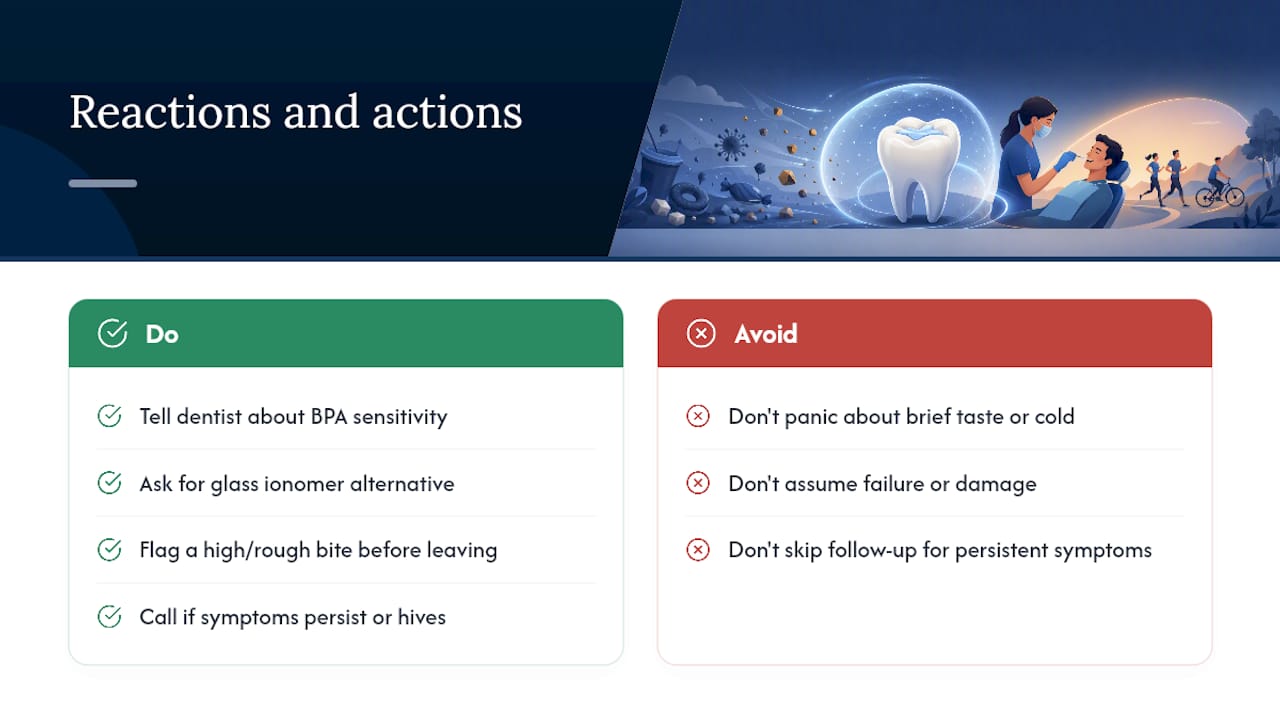
True allergic reactions to dental sealants are rare, but they're not zero, and adults should know what to watch for. Most modern resin sealants use bisphenol A-based compounds during manufacturing, and while trace BPA exposure during placement is minimal and brief, patients with a documented sensitivity should mention it before the procedure so the dentist can select a glass ionomer or bioactive alternative instead.
The more common issue isn't an allergy at all. It's a slightly rough or "high" feeling on the bite immediately after placement, which the dentist adjusts chairside if you flag it before leaving. Some patients notice mild, short-lived sensitivity to cold or pressure on the sealed tooth for a day or two, which typically resolves on its own without intervention.
A smaller number of adults report a temporary metallic or chemical taste right after the etching and curing steps, which fades within hours as saliva rinses the area. None of these are signs of failure or damage. They're normal parts of the material settling into place. If sensitivity persists beyond a few days, or if you notice swelling or a genuine allergic response like hives near the treatment site, that warrants a follow-up call. For most adults, though, the entire procedure passes without any of these side effects at all, which is part of why sealants remain such a low-risk preventive option compared with more invasive restorative work.
Sealants vs. Fluoride Varnish vs. Regular Cleanings
Adults often ask which preventive treatment deserves priority, and the honest answer is that these three tools solve different problems rather than competing for the same job.
Fluoride varnish strengthens enamel across the entire tooth surface, making it more resistant to acid attack everywhere it's applied. It's fast, inexpensive, and works well as a broad defense, but it doesn't physically block the deep grooves where decay most often starts on a molar. Sealants do exactly that: they target the specific pits and fissures that varnish can't fully protect. The ADA's finding of a 73% reduction in new caries lesions with sealants compared to varnish alone reflects this difference in mechanism, not a claim that varnish doesn't work.
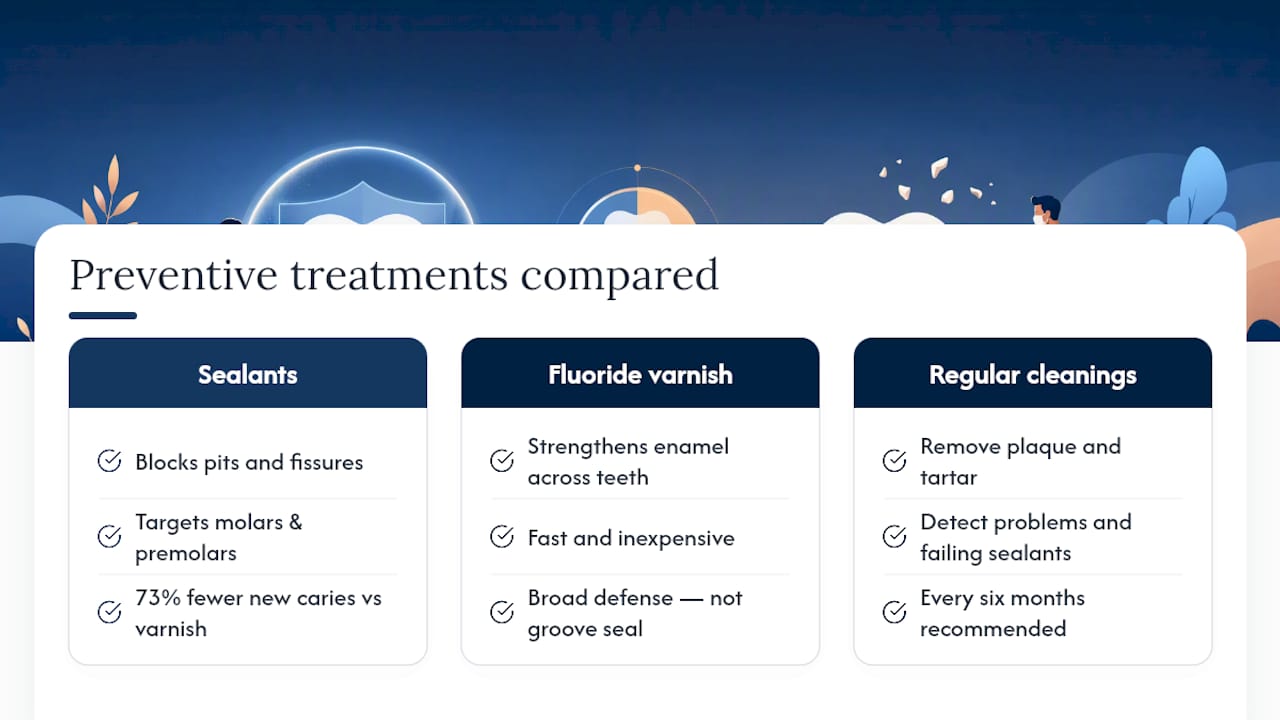
Routine cleanings serve a third function entirely. They remove plaque and tartar buildup that neither sealants nor varnish can address, and they give your dentist the chance to catch problems, including a failing sealant, before they become bigger issues. None of these three treatments replaces the others.
The strongest prevention strategy for most adults with elevated cavity risk combines all three: cleanings every six months to keep plaque under control, fluoride varnish for whole-tooth enamel support, and sealants specifically on molars and premolars where grooves are too deep to clean effectively at home. Treating sealants as a substitute for cleanings, or assuming varnish alone covers the same ground, misses how differently each treatment actually functions.
What Do Dental Associations Say About Adult Sealants?
For years, sealant guidance skewed heavily toward children, and that historical framing still shapes how many adults think about the treatment today. That's shifting. The ADA's current position supports sealants across a broader age range whenever the clinical picture, unrestored molars plus elevated caries risk, justifies it, rather than treating sealants as a pediatric-only intervention.
Clinical commentary in outlets like Dental Economics has pushed this further, recommending risk-specific prevention protocols for adults rather than blanket rules based on age alone. The core argument: a 45-year-old with dry mouth from medication and deep, unrestored molar grooves faces the same physical decay mechanism as a 12-year-old with the same anatomy. Age isn't the relevant variable. Risk and tooth structure are.
The CDC's public health materials reinforce this from a population angle, tracking sealant prevalence and program outcomes that demonstrate measurable cavity reduction wherever sealant programs reach wider populations, adult and pediatric alike. The practical takeaway for adults: don't assume your dentist will bring up sealants unprompted just because you're past your twenties. Ask directly whether your molars qualify, since guidance has moved past the old age cutoffs even if insurance policies haven't fully caught up yet.
Do Diet and Daily Habits Change How Well Sealants Work?
Sealants aren't a set-it-and-forget-it treatment. What you eat and how you care for your teeth day to day directly affects how long a sealant lasts and how well it does its job.
Sticky, sugary foods, think caramel, dried fruit, or hard candy, are the biggest threat. They cling to tooth surfaces and can work their way under sealant edges over time, especially once a sealant starts to show minor wear. Frequent snacking on sugary or starchy foods also keeps your mouth in a near-constant acid-production cycle, which stresses the sealant's margins even when the seal itself is intact.
Grinding or clenching, whether from stress or an untreated bite issue, wears down sealant material faster than normal chewing does. Adults who grind at night often see their sealants degrade well before the typical five-year mark, which is one more reason a nightguard conversation sometimes belongs alongside a sealant conversation.
On the positive side, consistent brushing with fluoride toothpaste and regular flossing around, not just over, the sealed tooth helps the sealant's edges stay intact longer. Patients who keep up biannual cleanings also give their dentist more chances to catch early wear and refresh the sealant before a gap forms. The sealant does real preventive work, but it works best as part of a routine, not as a replacement for one.
What the Research Actually Supports for Adults
The conventional wisdom treats sealants as something you either got as a kid or missed out on. That framing doesn't hold up against what the recent trial data actually shows. The 24-month bioactive sealant trial wasn't run on children. It was adults, and the results, meaningfully better retention with a bioactive material over a fluoride-releasing one, suggest the field is actively improving options for exactly this population.
Where I think most adults get it wrong is treating sealants and fillings as interchangeable "fix the tooth" options. They're not. A sealant only makes sense before decay breaks through enamel. Once you're past that point, you need restorative treatment, not prevention. The reader's actual priority should be timing: get the risk assessment done now, while your molars are still unrestored, rather than waiting until a routine exam turns up a cavity that sealants could have prevented. The cost math alone, $30 to $60 versus $150 to $600, makes procrastination the expensive choice here.
— Jake
Ready to Find Out If You're a Candidate?
If you've read this far wondering whether your own molars qualify, the fastest way to know is a direct exam, not more research. DC Implant & Cosmetic Dentistry offers same-day appointments in Washington, DC, which means a caries risk assessment and sealant placement can happen in one visit instead of stretching across multiple trips to the office.

Dr. Kambez Shukoor's practice evaluates each patient's grooves, saliva function, and cavity history before recommending a material, resin, glass ionomer, or bioactive, rather than defaulting to whatever's fastest. And if your exam turns up a tooth that's already past the point sealants can help, the same visit can move straight into a conversation about dental fillings or other restorative options without starting over at a new office. Call to schedule an exam and find out where your molars stand before your next cavity has the chance to form.
This article is general information, not a substitute for advice from a qualified doctor. Consult a qualified healthcare professional about your own circumstances before acting on anything here.
Sources
- Dental sealants | American Dental Association
- Sealants | Cleveland Clinic
- About dental sealants | Centers for Disease Control and Prevention
- 24-month efficacy of bioactive versus fluoride sealant for non-cavitated occlusal caries in adults: a randomized clinical trial | Scientific Reports
- Signed, sealed, and delivered: Using sealants to prevent or arrest occlusal caries in permanent dentition | Dental Economics