
Sometimes, but rarely in full. Most dental plans treat implants as a "major service" and pay a portion of the cost, only after you clear a waiting period and only up to a capped annual maximum that's usually smaller than the treatment itself. That cap, more than any percentage printed on your policy, decides what you actually owe.
Before you assume anything, check three things on your plan:
- Annual maximum: how much your plan will pay total for the year, across all procedures
- Waiting period: how long you must hold the policy before major services are covered
- Missing-tooth clause: whether your plan excludes teeth that were already missing before you enrolled
Quick fact: Standard dental plans commonly cap annual benefits between $1,000 and $2,000, an amount that rarely covers even one implant on its own.
The rest of this guide walks through how insurers classify implant treatment, what real numbers look like in practice, and the exact steps to get a written answer from your carrier before you commit to treatment.
Key Takeaways
Implant coverage depends far more on your plan's annual maximum, waiting period, and exclusions than on the coinsurance percentage printed on your card.
| Point | Details |
|---|---|
| Check the annual maximum first | Most plans cap benefits between $1,000 and $2,000 a year, often less than one implant costs. |
| Confirm the missing-tooth clause | Teeth lost before your policy's effective date may be excluded from coverage entirely. |
| Get a written predetermination | Ask your dentist for an itemized estimate and submit it to your insurer before starting treatment. |
| Stage treatment across benefit years | Splitting multi-implant cases across two calendar years can access two separate annual maximums. |
| Work with a practice that verifies benefits | Dc-dentistry provides itemized estimates and predetermination support for single, multiple, and full-arch implant cases. |
Table of Contents
- Does Dental Insurance Cover Implants? How the Coverage Actually Works
- What Do Dental Implants Actually Cost, and What Will Insurance Pay?
- Which Dental Plan Type Gives You the Best Shot at Implant Coverage?
- How Do You Verify What Your Plan Will Actually Pay?
- How Can You Lower Out-of-Pocket Costs for Implants?
- How Does DC Implant & Cosmetic Dentistry Help Patients Navigate These Details?
- What Should You Actually Expect When Planning Implant Treatment?
- Ready to Get a Clear Answer on Your Implant Costs?
- Sources
Does Dental Insurance Cover Implants? How the Coverage Actually Works
Insurers rarely deny implants outright. They just structure benefits in ways that quietly limit how much they'll pay. Understanding that structure is more useful than asking a yes or no question, because the honest answer is "it depends on four separate variables that interact with each other."
Most plans sort procedures into three tiers: preventive, basic, and major. Implants almost always land in the major services tier, alongside crowns, bridges, and root canals. Some older or budget plans skip implants entirely and label the whole procedure cosmetic, which removes it from coverage altogether regardless of medical need. That distinction between "major service" and "cosmetic exclusion" is the first thing worth confirming with your specific policy, since it changes everything downstream.
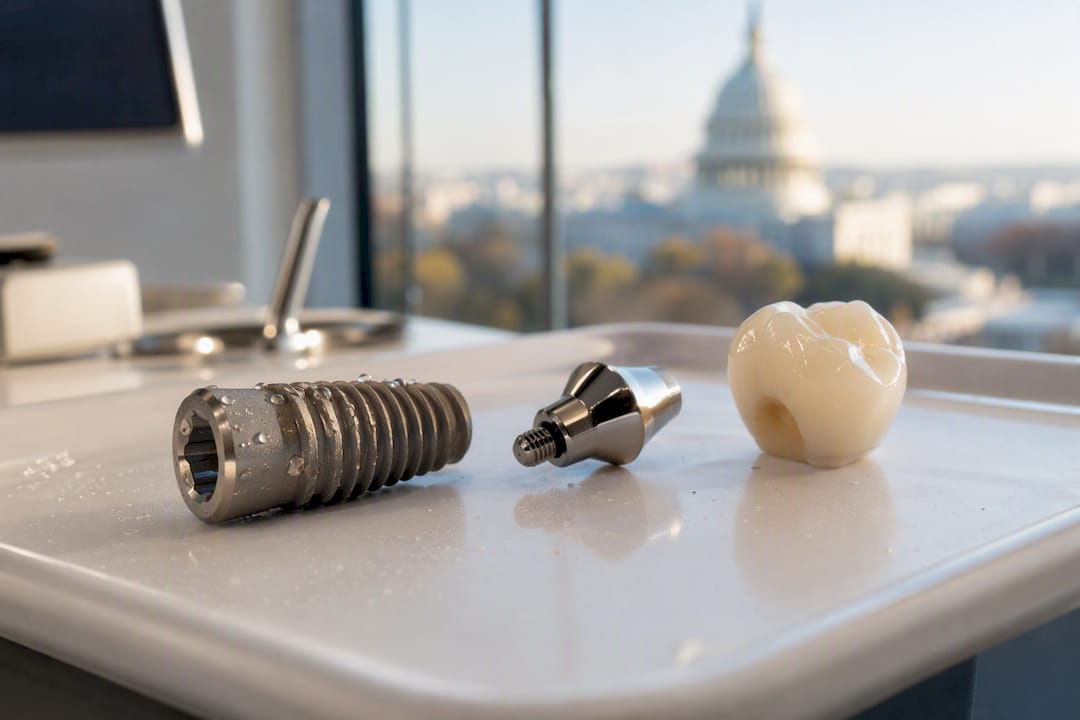
Implant treatment isn't one line item. It's a bundle of separate procedures, and plans often cover each piece differently:
- Surgical placement of the implant post — frequently covered at the major services rate once waiting periods are met
- Abutment and crown — sometimes covered, sometimes billed as a separate restorative procedure with its own rules
- Bone grafting, when the jaw needs rebuilding before placement — coverage varies widely and is often the most contested claim
- Diagnostic imaging (X-rays, CT scans) — usually covered under diagnostic benefits, separate from the major services cap
Then there's the interaction between annual maximums, lifetime caps, and missing-tooth clauses. A plan might advertise 50% coverage for major services, which sounds generous until you realize the $1,500 annual maximum gets consumed by the surgical placement alone, leaving nothing for the crown. Dentalinsurance advises treating the coinsurance percentage as far less important than the exclusions and caps buried in the policy language; that advice holds up in practice.
Pro Tip: Don't just ask "does my plan cover implants?" Ask "what percentage of the surgical placement, abutment, and crown does my plan cover separately, and what's my remaining annual maximum right now?" You'll get a far more useful answer.
Missing-tooth clauses complicate things further. If you lost the tooth before your policy's effective date, some insurers deny the claim entirely, treating the implant as replacing a pre-existing condition rather than a new dental event.
What Do Dental Implants Actually Cost, and What Will Insurance Pay?
A single implant, abutment, and crown typically runs several thousand dollars per tooth in the United States, with the exact figure swinging based on your location, whether you need bone grafting, and whether a specialist like a periodontist or oral surgeon handles the placement. Full-mouth cases, which replace an entire arch with implant-supported restorations, cost substantially more because they involve multiple surgical stages and a more complex prosthetic.
Here's where the annual maximum does its quiet work. Picture two patients with identical treatment plans and identical insurance percentages, say 50% coverage for major services, but different annual caps.
- Patient A has a $1,000 annual maximum. Even at 50% coverage, the plan stops paying once it hits $1,000 total for the year, no matter how much the remaining treatment costs.
- Patient B has a $2,500 annual maximum. That same 50% coverage stretches further, potentially covering the surgical placement and part of the crown before the cap kicks in.
Same policy language, wildly different real-world payout. This is the practical test worth running before you sign off on treatment: take the billed price, apply your insurer's allowed or negotiated amount, apply your coinsurance percentage, then check whether the result exceeds your remaining annual maximum. In most implant cases, the maximum stops payment long before the coinsurance percentage does.
What tends to get paid, when a plan covers implants at all: the surgical placement and basic diagnostic imaging. What tends to get excluded or heavily limited: bone grafting, sinus lifts, and sometimes the crown itself if the insurer classifies it as a separate cosmetic restoration. If you're comparing single-tooth replacement against a full-mouth approach, the component breakdown matters even more, since staged multi-implant cases multiply every one of these variables across several teeth.
Which Dental Plan Type Gives You the Best Shot at Implant Coverage?
Not all dental insurance handles implants the same way, and the plan type you carry often matters as much as the specific policy.
PPO plans tend to be the most practical option if you already have a preferred oral surgeon or periodontist. In-network negotiated fees can meaningfully reduce your bill even when the coinsurance for major services sits at a modest 50%, because the "allowed amount" your insurer negotiates is often lower than a provider's standard billed rate. Humana's guidance points to network access as one of the more underrated levers in implant affordability.
HMO and DHMO plans usually come with lower premiums and predictable copays, but the tradeoff is a narrower network and often thinner implant benefits. Some DHMO plans exclude implants from the covered procedure list entirely.
Full-coverage or high-tier plans advertise richer benefits, but check the fine print. A plan with 80% coverage for major services sounds excellent until you discover a 12-month waiting period and a $1,500 annual cap that undercuts the headline number.
Dental discount plans aren't insurance at all. You pay an annual membership fee in exchange for pre-negotiated reduced fees at participating providers. There's no claims process, no waiting period, and no annual maximum, which makes a discount plan a legitimate tool for lowering the sticker price on a high-cost procedure like implants, even though it never reimburses you directly.
How Do You Verify What Your Plan Will Actually Pay?
Guessing gets expensive. Here's the workflow that avoids surprise bills:
- Pull your Summary of Benefits (SOB) and read the exclusions section line by line, not just the coverage percentages up front.
- Check your remaining annual maximum for the current benefit year. If you've already used part of it on other work, that number is lower than the policy's stated cap.
- Look specifically for implants in the covered procedures list. Confirm which tier they fall under, whether a waiting period applies, and whether a missing-tooth clause could disqualify your case.
- Request a pre-treatment estimate, also called a predetermination, from your insurer. Your dentist submits an itemized treatment plan, and the insurer sends back a written statement of what it will actually pay before you commit to anything. Delta Dental recommends this step as standard practice for any high-cost procedure.
- Confirm network status for every clinician involved, not just the general dentist. If a periodontist or oral surgeon handles part of the case, verify their network status separately, since out-of-network specialist fees can erase any savings from an in-network general dentist.
Pro Tip: Keep the predetermination letter and your insurer's claims reference number in your own records. If a claim gets denied later despite a written predetermination, that document is your strongest evidence for an appeal.
If your policy denies coverage after the fact, you can typically file a formal appeal with supporting clinical documentation from your dentist explaining medical necessity, particularly when bone loss or a failed prior restoration makes the implant a functional necessity rather than a cosmetic choice.
How Can You Lower Out-of-Pocket Costs for Implants?
When insurance only covers part of the bill, a handful of practical moves can close the gap.
- Use HSA or FSA funds for qualified implant expenses. HSA contributions carry over year to year, while employer-sponsored FSA funds usually have lower limits and don't roll over, so timing your FSA spending matters.
- Consider staging treatment across two benefit years. If your case involves multiple implants, splitting the work across a calendar-year boundary lets you tap two separate annual maximums instead of one.
- Compare in-network negotiated fees against out-of-network billing before choosing a provider, and ask the office directly what discount an in-network agreement provides.
- Look into a dental discount plan as a supplement, not a replacement, for insurance. It won't file claims for you, but it can shrink the billed price itself.
- Ask your practice about financing options like CareCredit, which spreads the remaining balance into manageable payments.
If you're on Medicare, know that Original Medicare excludes routine dental care, including most implants. Some Medicare Advantage plans cover implants only if explicitly listed in the plan documents, and Medicare Part B may pay 80% of an approved amount, but only when the dental work is medically necessary as part of a covered medical treatment, not as standalone tooth replacement. Medicaid coverage for adult implants varies dramatically by state and is worth checking directly with your local program before assuming anything.
How Does DC Implant & Cosmetic Dentistry Help Patients Navigate These Details?
A practice that handles implant cases regularly can absorb a lot of the guesswork described above. Dc-dentistry works through insurance verification and predetermination requests as a standard part of implant planning, so patients get a written estimate of what their carrier will pay before treatment starts, not after.
That matters most for cases involving multiple teeth or a full arch, where staging treatment across benefit years or coordinating financing can meaningfully change the final bill. Services worth knowing about if you're weighing your options:
- Itemized clinical estimates that map directly onto what an insurer needs for predetermination
- Treatment planning for single-tooth, multiple-tooth, and implant-supported denture cases
- Same-day consultation availability, which shortens the time between diagnosis and a firm cost estimate
Pro Tip: Bring your Summary of Benefits to your first consultation. A practice that can read it alongside your treatment plan will spot coverage gaps faster than you would on your own.
What Should You Actually Expect When Planning Implant Treatment?
Most surprises come from assuming a coverage percentage means more than it does. Patients who ask for a written predetermination before starting treatment almost always end up with a smoother financial experience than those who don't. Talk to your provider's office about staging and financing early. It costs nothing and saves real money later.
— Jake
Ready to Get a Clear Answer on Your Implant Costs?
Generic insurance hotlines can tell you your coverage percentage. What they usually can't do is translate that into a real number tied to your specific case, your remaining annual maximum, and the treatment plan your teeth actually need. Dc-dentistry builds itemized estimates and submits predetermination requests as a routine part of implant planning, so you see the real out-of-pocket number in writing before treatment begins, not as a surprise afterward.
Whether you need a single implant, multiple teeth restored, or a full-arch solution, the full mouth reconstruction and implant page walks through what a consultation covers and how same-day scheduling works. Book a consultation and leave with an actual number, not a guess.
Sources
This article is general information, not a substitute for advice from a qualified doctor. Consult a qualified healthcare professional about your own circumstances before acting on anything here.