A single-tooth dental implant in the United States typically runs $3,000–$6,000 all-in, once you factor in the implant post, abutment, and crown together. Full-arch restorations climb considerably higher: All-on-4 procedures average $15,176 with a range of $11,640–$27,500, and complete full-mouth cases covering both arches can push well past $40,000 depending on materials and clinical complexity.
The single most important thing you can do before signing anything: ask for an itemized, all-in quote that explicitly lists the implant post, abutment, crown, lab fees, imaging, anesthesia, and any grafting. Many advertised prices quote only the implant root placement and leave the crown off entirely, which is a separate charge that can add materially to your final bill.
Key numbers to anchor your budget:
- Single-tooth implant (all-in): $3,000–$6,000, with a national median around $4,000
- Implant-supported bridge (3-unit): typically several thousand to mid five figures depending on span and materials
- Implant-supported dentures (one arch): costs vary widely, ranging from a few thousand to tens of thousands depending on implant count and attachment type
- All-on-4 (one arch): $11,640–$27,500 per arch
- Full-mouth restoration (both arches): typically ranges from tens of thousands to toward the higher tens of thousands
Statistic: CareCredit's cost guide notes that many published implant prices separate root placement from the crown, meaning the number you see in an ad or on a website frequently excludes one of the most significant charges in the whole procedure.
DC Implant & Cosmetic Dentistry in Washington, D.C. provides transparent, itemized estimates so patients know exactly what each line covers before treatment begins.
Key Takeaways
A single-tooth dental implant in the U.S. typically costs $3,000–$6,000 all-in, and the most important step before committing is requesting a written, itemized quote that explicitly includes the post, abutment, crown, lab fees, and any anticipated grafting.
| Point | Details |
|---|---|
| Single-tooth all-in range | Expect $3,000–$6,000; the national median is $4,000 per the Dental Economics 2025 survey. |
| Always ask for an itemized quote | Many advertised prices exclude the crown; confirm post, abutment, crown, lab, and imaging are all listed. |
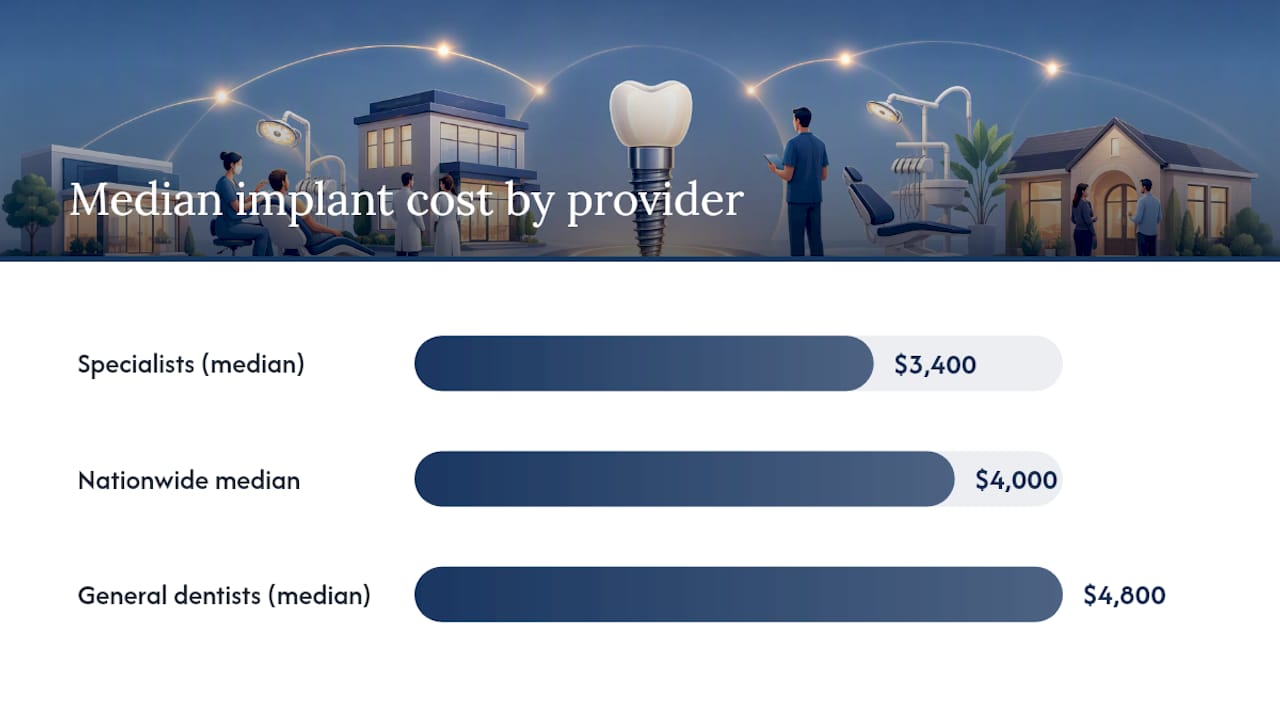
| Provider type affects price | Specialists median $3,400 vs. general dentists $4,800 in the same survey; high volume can mean lower cost. |
| Financing is widely available | CareCredit, FSA/HSA, and in-office plans can spread costs across a multi-month treatment timeline. |
| DC Implant & Cosmetic Dentistry | Provides transparent, itemized estimates and accepts CareCredit for patients in Washington, D.C. |
Table of Contents
- What does a dental implant quote actually include?
- What factors change how much you'll pay?
- What are typical U.S. costs for each type of implant?
- How does the treatment timeline affect your total cost?
- What does insurance cover, and what financing options exist?
- How to get an accurate all-in quote: a practical checklist
- Implants vs. bridges vs. dentures: which is the better long-term investment?
- How DC Implant & Cosmetic Dentistry approaches pricing and patient care
- Why the cheapest quote is rarely the best deal
- Ready to get an accurate implant estimate in Washington, D.C.?
- Sources
What does a dental implant quote actually include?
Understanding each line on a quote is the fastest way to compare offers without getting burned by a low headline number that hides real costs.
The AAID breaks a dental implant down into three core components: the titanium fixture (the post that fuses to the jawbone), the abutment (the connector piece), and the crown (the visible tooth). Each of these may appear as a separate charge, or some may be bundled. Here is what a thorough quote should itemize:
A few things to watch for when reviewing a quote:
- Crown omission: The most common gap. A quote for "the implant" often means the post only. Always confirm the crown and lab fees are included.
- Imaging billed separately: CBCT scans are standard for implant planning but frequently appear as a separate line after the initial consult.
- Anesthesia upgrades: If you want IV sedation rather than local anesthetic, expect an additional charge.
- Provisional restorations: If your treatment spans several months, you may need a temporary tooth during healing. That cost is real and often missing from initial estimates.
The question of what's commonly misunderstood about dental procedure pricing goes beyond implants alone, but implants are where the gap between advertised price and final bill tends to be widest.
What factors change how much you'll pay?
Dental implant pricing is not a fixed number. Several variables can move your final cost by thousands of dollars in either direction.
Provider type
A 2025 multi-city survey of 278 practices across six U.S. metropolitan areas found a nationwide median total implant cost of $4,000, but the breakdown by provider type was striking: specialists (periodontists and oral surgeons) had a median of $3,400, while general dentists came in at $4,800. High-volume specialist workflows tend to be more efficient, which can translate to lower per-procedure pricing even though specialists carry advanced training.
Geography
The same Dental Economics survey found city medians ranging from $3,665 in Houston to $5,505 in Minneapolis. Washington, D.C. sits in a higher-cost metropolitan market, so expect prices toward the upper end of national ranges. Overhead, lab costs, and local market competition all feed into regional variation.
Clinical complexity
This is where costs escalate most unpredictably:
- Bone grafting: Required when the jaw lacks sufficient density to support an implant. Adds $300–$3,000+ depending on graft size and source.
- Sinus lift: Needed for upper-jaw implants when sinus proximity limits bone height. Typically adds $1,500–$5,000.
- Ridge augmentation: Rebuilds the jaw ridge after significant bone loss. Can add $1,500–$3,000.
- Extractions: If a failing tooth needs removal before implant placement, add $150–$400 per tooth for simple extractions, more for surgical ones.
- Soft-tissue grafts: Less common but occasionally needed for aesthetic outcomes.
For bone grafting procedures specifically, the cost and timeline impact depends heavily on how much volume needs to be rebuilt before an implant can be placed.
Materials and restoration choices
Zirconia crowns cost more than porcelain-fused-to-metal but offer better aesthetics and durability. Premium implant brands (Nobel Biocare, Straumann) carry higher fixture costs than generic alternatives. For full-arch cases, the choice between acrylic, hybrid, or full-zirconia prosthetics can swing the total by $10,000 or more.
Patient health factors
Smoking significantly slows osseointegration and raises the risk of implant failure, which some practices account for with additional monitoring visits or by declining to proceed without a cessation plan. Uncontrolled diabetes impairs healing in similar ways. Severe bone atrophy, whether from long-term tooth loss or periodontal disease, almost always requires grafting before placement, adding both cost and months to the timeline.
Pro Tip: When a quoted protocol falls into a wide published range, like All-on-4, ask the office to confirm exactly what is included: the number of implants, the prosthetic material, whether a temporary prosthesis is provided during healing, and whether bone augmentation is anticipated. Two quotes at the same price can represent very different treatments.
What are typical U.S. costs for each type of implant?
Here are the practical ranges for the most common scenarios, grounded in published survey data and consumer-facing insurer guidance.
Single-tooth implant (all-in): MetLife's cost guidance places single-tooth implant costs in the several-thousand-dollar range, and the Dental Economics survey puts the national median at $4,000. Expect $3,000–$6,000 for a straightforward case with no grafting.
Implant-supported bridge: When two implants anchor a three-unit bridge to replace two or three adjacent missing teeth, costs typically run $5,000–$16,000. The range reflects implant count, span length, and material choices.
Implant-supported dentures (one arch): These range from roughly $3,500 for a basic removable overdenture on two implants to $25,000–$30,000 for a fixed, full-arch solution on four to six implants. The implant-supported denture options available at a given practice will determine which end of that range applies.
All-on-4 (one arch): CareCredit reports an average of $15,176 with a range of $11,640–$27,500. That spread exists because the same "All-on-4" label covers cases that differ substantially in bone augmentation needs, prosthetic material, and whether a temporary prosthesis is included.
Full-mouth restoration (both arches): Combining two full-arch solutions puts most patients in the $40,000–$90,000+ range. Cases requiring significant bone grafting on both arches can exceed that.
Statistic: A 2025 survey found city-level median implant costs varying by around a couple thousand dollars between included metro areas, with some urban markets like Washington, D.C. toward the upper end of that range.
Staging and additional procedures reliably push quotes toward the high end. A patient who needs a sinus lift, a bone graft, and an extraction before implant placement on a single tooth could easily see their cost double compared to a straightforward case.
For patients replacing multiple missing teeth, the per-implant cost sometimes decreases as the number of fixtures increases, but total treatment cost rises with each additional site.
How does the treatment timeline affect your total cost?
Dental implant treatment is not a single appointment. Mayo Clinic describes it as a staged surgical process in which osseointegration, the biological process of bone fusing to the implant surface, can take several months. That timeline directly affects how many billable visits occur and when each charge hits.
A typical single-tooth implant follows this sequence:
- Initial consultation and CBCT imaging (Week 1–2): Diagnosis, treatment planning, imaging fee billed.
- Extraction (if needed, Week 2–4): Separate surgical fee; may require a healing period before implant placement.
- Bone grafting (if needed, same visit or separate): Adds 3–6 months of healing before implant placement can proceed.
- Implant post placement (Month 1–7, depending on grafting): Surgical fee billed; provisional restoration placed if needed.
- Osseointegration (Months 2–6 post-placement): No major charges during this phase, but follow-up visits may be billed.
- Abutment placement (Month 4–8): Minor surgical visit; abutment fee billed.
- Final crown delivery (Month 5–9): Crown and lab fees billed.
For full-mouth reconstruction cases, the timeline can extend 12–18 months when bone augmentation is required across multiple sites.
Pro Tip: Set up your financing before the first surgical visit, not after. CareCredit and similar products are easier to activate when you have the full projected treatment cost in hand. If you start financing after implant placement and then face a separate crown bill three months later, you may be managing two separate payment arrangements simultaneously.
The question of how long to wait after an extraction before implant placement is one of the most common timing questions patients have, and the answer directly affects how many months of treatment you are budgeting for.
What does insurance cover, and what financing options exist?
Most dental insurance plans treat implants as elective or cosmetic, which means coverage is partial at best and absent at worst. Annual maximums of $1,000–$2,000 are common, and even when a plan covers implant-related procedures, it may cover only the crown or only the extraction, not the implant fixture itself. Always call your insurer before your consult and ask specifically: "Does my plan cover implant placement, the abutment, and the crown as separate benefits?"
Common financing routes:
- CareCredit: A healthcare credit card widely accepted at dental practices. Offers promotional financing periods, which can make a $4,000–$6,000 treatment manageable in monthly installments. Accepted at DC Implant & Cosmetic Dentistry.
- FSA/HSA funds: Flexible Spending Accounts and Health Savings Accounts can be applied to implant procedures. FSA funds are use-it-or-lose-it annually, so timing matters.
- In-office payment plans: Some practices offer direct installment arrangements, often interest-free for shorter terms.
- Personal loans and credit cards: Available as a fallback, though interest rates vary widely. A 0% introductory APR card can work well for patients who can pay off the balance within the promotional window.
The Synchrony/CareCredit Dental Lifetime of Care study found that average out-of-pocket lifetime dental costs (excluding specialized care) run $51,000–$95,000+, and that many adults are not financially prepared for large single dental expenses. Financing products like CareCredit exist specifically to bridge that gap for higher-cost procedures like implants.
When you approach a financing provider, bring three documents: a predetermination letter from your insurer (if applicable), an itemized quote from the practice, and a projected treatment timeline showing when each major charge will occur. That combination lets you structure a financing plan that matches your actual payment schedule, not just the first bill.
How to get an accurate all-in quote: a practical checklist
Getting a quote you can actually rely on takes about five minutes of preparation. Here is what to request and what to ask.
Items to request in writing:
- Itemized line-by-line pricing: implant post, abutment, crown, lab fees, imaging, anesthesia
- Confirmation that the crown is included in the total
- The brand and type of implant being used
- Number of planned visits and which provider performs each step (some practices split placement and restoration between different clinicians)
- Estimated additional procedures (grafts, sinus lift, extractions) and their costs
- Warranty or guarantee terms on the implant and restoration
- The practice's policy on complications and implant failure or replacement
Questions to ask the office:
- "Is this an all-in price, or does it exclude any component?"
- "Who places the implant, and who does the final restoration?"
- "Do you offer in-office financing or accept CareCredit?"
- "Can I get a printed predetermination letter for my insurance?"
- "If I need a bone graft, is that included in this estimate or billed separately?"
Three things to verify before signing a treatment agreement:
- The crown and lab fees are explicitly listed on the quote.
- The total reflects any anticipated additional procedures (grafts, extractions).
- You have a projected timeline with approximate dates for each major charge.
Implants vs. bridges vs. dentures: which is the better long-term investment?
The upfront cost of implants is higher than either a fixed bridge or a removable denture. But the comparison looks different over a 15–20 year horizon.
Short-term cost comparison:
- Traditional fixed bridge (3-unit): $3,000–$6,000, but requires grinding down two healthy adjacent teeth
- Removable partial denture: $1,000–$3,000
- Single implant (all-in): $3,000–$6,000
- Implant-supported denture (one arch): $3,500–$30,000
Long-term value factors:
- Bridges typically need replacement every 10–15 years and can cause bone loss under the gap, potentially requiring more complex treatment later.
- Removable dentures require relining every few years ($300–$500 each time) and full replacement every 5–10 years. Bone resorption under a denture accelerates over time, changing facial structure.
- Implants, when properly placed and maintained, can last decades. The crown may need replacement after 15–20 years, but the fixture itself often remains functional indefinitely.
The American Academy of Periodontology notes that full-mouth dental implants provide improved stability, function, and long-term maintenance advantages compared with conventional removable dentures, including simpler daily hygiene and a more natural feel.
The quality-of-life data supports that position. A cross-sectional study of 208 full-mouth implant patients found significant improvements in OHIP-14 oral health quality-of-life scores shortly after immediate-loading reconstruction, with continued gains at follow-up. Mean OHIP-14 scores dropped from 9.21 to 4.62 within five days of treatment.
Statistic: Over a 20-year period, the cumulative cost of replacing a removable denture, relining it, and managing the bone loss it accelerates can approach or exceed the original cost of an implant-supported solution, particularly for full-arch cases.
For patients comparing options, implant-supported dentures occupy a useful middle ground: more stable than a conventional removable denture, less expensive than a fully fixed full-arch restoration.
How DC Implant & Cosmetic Dentistry approaches pricing and patient care
DC Implant & Cosmetic Dentistry, located in Washington, D.C., structures its implant consultations around transparent, itemized estimates. Patients receive a quote that breaks out each component, so there are no surprises when the crown bill arrives months after placement.
Practice highlights:
- Dr. Kambez Shukoor: A U.S. Navy veteran with advanced training in implant and cosmetic dentistry, leading a practice built around precision and patient communication.
- Same-day appointments: Available for consultations and many procedures, reducing the time between decision and treatment start.
- Advanced imaging technology: In-office CBCT scanning supports accurate treatment planning and is included in the consultation process.
- Financing options: CareCredit is accepted, and in-office payment arrangements are available for qualifying patients.
- Patient reviews: Over 200 five-star reviews reflecting consistent satisfaction with both clinical outcomes and the overall patient experience.
For Washington, D.C. patients, a first visit to DC Implant & Cosmetic Dentistry typically covers a clinical exam, imaging review, a discussion of treatment options, and an itemized cost estimate. Patients are encouraged to bring their insurance card and any prior dental records to that appointment.
The practice handles single-tooth implants, multiple-tooth cases, and full-mouth reconstruction, with financing conversations built into the consult rather than left as an afterthought.
Why the cheapest quote is rarely the best deal
The lowest headline price on a dental implant quote is almost never the lowest total cost. The gap between what an ad shows and what a patient ultimately pays comes from a predictable set of omissions: the crown, the lab fee, the imaging, and any grafting the provider knew was likely but left off the initial estimate.
Patients who chase the lowest sticker price often end up paying more, not less, once complications or missing line items surface mid-treatment. A practice that provides a thorough, itemized quote upfront is giving you something genuinely valuable: the ability to plan. That transparency is worth more than a $200 discount on the headline number.
Provider experience matters in a similar way. Implant placement is a surgical skill. A high-volume specialist who places hundreds of implants per year has a failure rate and complication profile that a lower-volume provider simply cannot match. Implant failure, when it happens, means removal, additional grafting, and starting over, which can cost more than the original procedure.
The practical takeaway: prioritize practices that give you a written, itemized quote, explain what is and is not included, and have a clear policy on complications. That combination predicts your actual out-of-pocket cost far better than any advertised price.
Ready to get an accurate implant estimate in Washington, D.C.?
Patients in the Washington, D.C. area have a direct path to a no-surprise implant estimate at DC Implant & Cosmetic Dentistry. The practice provides itemized, all-in quotes that break out every component, from the implant post and abutment to the crown, lab fees, and imaging, so you know your real number before committing to treatment.
CareCredit financing is accepted, and in-office payment plans are available for patients who need to spread costs across the treatment timeline. Before your appointment, pull together your insurance card, any prior dental X-rays, and the checklist from the section above. That preparation typically cuts the consult time in half and gets you to a usable estimate faster.
Book a same-day consultation or request an itemized quote directly through the dental implants page. For full-arch cases, the full-mouth reconstruction page outlines the specific protocols and financing options available for more complex treatments.
Sources
- Dental implant surgery - Mayo Clinic
- All-on-4® Dental Implant Cost and Procedure Guide
- A comparative analysis of dental implant costs across major US markets (Dental Economics)
- Full‑mouth implant rehabilitation (PMC study)
- Full mouth dental implants - American Academy of Periodontology
- How much do dental implants cost? - MetLife
- AAID - What are dental implants?
This article is general information, not a substitute for advice from a qualified doctor. Consult a qualified healthcare professional about your own circumstances before acting on anything here.