
Start with tax-advantaged accounts and a predictable fixed-rate installment loan; add a short 0% promotional card only if you can pay it off before the promo ends. That combination keeps your borrowing cost lowest for most patients, whether you need one implant or a full arch.
Two things to do this week: get a written, itemized estimate from your dentist, and check your HSA or FSA balance while getting prequalified with a soft credit pull from at least one lender. Prequalification with a soft pull won't ding your credit score, so there's no reason to skip it before you commit to anything.
- Get a written, itemized treatment estimate before comparing any financing offer.
- Confirm your HSA/FSA balance and use it first to shrink the amount you finance.
- Prequalify with two or three lenders using soft pulls before applying anywhere.
Pro Tip: Run your dental insurance benefits and drain any HSA/FSA money first. Every dollar you pay from a pre-tax account is a dollar you don't pay interest on later.
Key Takeaways
The strongest dental implant financing strategy layers tax-advantaged accounts first, then a predictable fixed-rate loan, with promotional 0% credit used only when payoff is realistic.
| Point | Details |
|---|---|
| Use pre-tax money first | Apply your HSA or FSA balance before financing anything to shrink the loan principal. |
| Watch deferred interest | Medical credit cards like CareCredit can charge retroactive interest if a balance remains after the promo period. |
| Match lender to credit profile | Fair and poor credit patients often do better with in-house plans or lenders like Cherry and Sunbit. |
| Compare total repayment, not monthly cost | Ask every lender for the Truth-in-Lending disclosure before signing. |
| Confirm candidacy first | Dc-dentistry provides written estimates, benefits checks, and financing coaching before any loan decision. |
Table of Contents
- Dental Implant Financing Options, Explained One by One
- How to Choose the Right Financing Route
- A Clinician's View on Financing and Candidacy
- Get a Written Estimate and Financing Help at Dc-dentistry
- Frequently Asked Questions
- Sources
Dental Implant Financing Options, Explained One by One
Most patients end up combining two or three of these tools rather than relying on one. A 2026 financing guide recommends exactly that: pre-tax accounts first, a predictable loan for the balance, and promotional credit only in small, payable-off doses.
Health Savings Accounts (HSAs). Pre-tax dollars for qualified dental expenses, and unlike an FSA, the balance rolls over indefinitely. No credit check, no interest, no application. Best for anyone with an existing HSA balance or a high-deductible health plan who can contribute ahead of treatment.
Flexible Spending Accounts (FSAs). Same tax advantage as an HSA, but the money is use-it-or-lose-it within your plan year in most cases. Best for patients who already have funds sitting in an FSA and a treatment date before the plan year closes.
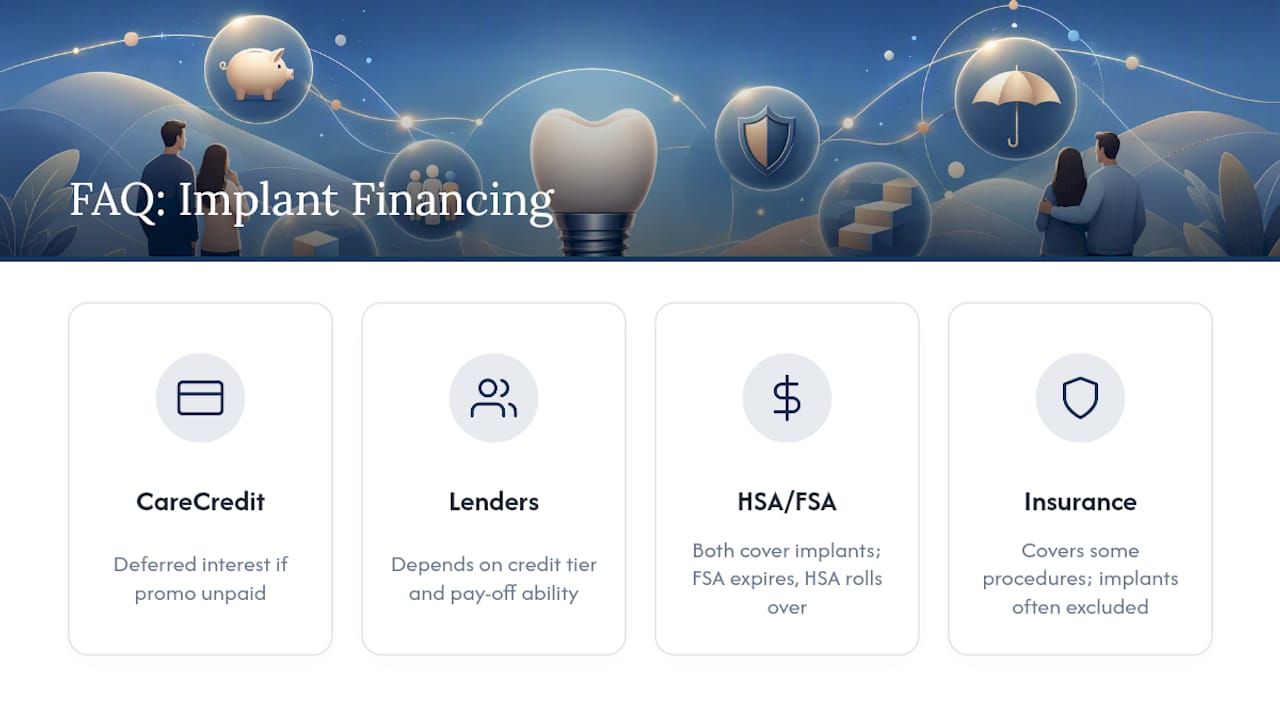
Medical credit cards (CareCredit and similar). These work like a store card built for health expenses. CareCredit offers promotional windows of 0% APR, but if any balance remains when the promo ends, deferred interest applies retroactively to the original purchase amount, not just the leftover balance. That's the trap that catches people off guard.
- Typical terms: 6, 12, 18, or 24 months promotional, then a high standard APR kicks in.
- Credit needed: fair to excellent for approval; higher limits need stronger credit.
- Speed: often instant approval in-office.
- Gotcha: deferred interest is retroactive, not just on the remainder.
- Best for: smaller balances you're confident you can pay off inside the promo window.
Third-party patient lenders and BNPL (Cherry, Sunbit, Proceed Finance). These fintech lenders specialize in point-of-care healthcare financing and often approve patients that traditional banks turn down.
- Cherry and Sunbit lean toward fast approval and serve fair-to-poor credit tiers with shorter repayment terms.
- Proceed Finance tends to offer longer terms (up to 84 months) with fixed rates for larger cases like full-arch implants.
- Credit needed: varies widely by lender, often fair credit or better.
- Speed: minutes to same-day funding.
- Gotcha: APRs can run high for lower credit tiers, so compare total repayment, not just the monthly number.
In-house payment plans. Many practices, including DC Implant & Cosmetic Dentistry, offer phased payment schedules tied directly to treatment stages rather than a third-party loan.
- No credit check in many cases, since the practice is financing itself.
- Terms are shorter, usually tied to the treatment timeline (a few months).
- Best for: patients who want to avoid interest entirely and can pay off the balance quickly.
Dental savings plans (discount plans). Not insurance and not a loan. You pay an annual membership fee for discounted rates at participating practices.
- No credit check, no interest, no waiting periods.
- Savings typically apply per procedure, not as a lump-sum discount.
- Best for: patients without insurance who want to lower the sticker price before financing the rest.
Unsecured personal or medical installment loans. Fixed monthly payments, fixed rate, no collateral. A credit union medical loan program often beats national fintech rates for members with solid credit.
- Terms commonly run 24 to 84 months.
- Credit needed: fair to excellent for the best rates.
- Gotcha: origination fees can add 1% to 8% to the loan amount.
HELOC or home equity loans. Uses your house as collateral, which means lower rates but real risk if payments lapse.
- Rates are typically lower than unsecured loans or cards.
- Terms can stretch 5 to 20 years.
- Gotcha: your home secures the debt. Missed payments carry consequences far beyond a credit score hit.
- Best for: homeowners with strong equity financing a large full-arch case who want the lowest possible rate.
Crowdfunding and nonprofit assistance. For patients who can't qualify for any of the above, Dental Lifeline Network connects eligible people with volunteer dentists for critical dental care at no cost, based on need and eligibility screening.
Provider discounts and promotions. Seasonal discounts, referral credits, or multi-procedure bundling can shave real money off the total before you finance anything.

Pro Tip: Always ask for the Truth-in-Lending disclosure before signing anything. It spells out the APR, the term, and the total repayment amount, not just the monthly figure the sales desk quotes you.
How to Choose the Right Financing Route
Your credit profile should drive the decision more than anything else.
- Excellent credit: You'll likely qualify for the best 0% promotional windows and the lowest fixed-rate installment loans. Prioritize a true 0% offer you can pay off on schedule, or a low-APR credit union loan for larger cases.
- Fair credit: Third-party lenders like Cherry, Sunbit, or Proceed Finance often approve fair-credit applicants when a bank won't. Compare total repayment across two or three lenders before signing.
- Poor credit: In-house payment plans, dental savings plans, and nonprofit assistance through organizations like Dental Lifeline Network become your strongest options. A cosigner can also open doors to better installment loan rates.
Before you commit to any lender, run through this checklist:
- Get the complete itemized treatment estimate, including imaging, grafting, and follow-up visits.
- Confirm exactly which procedures the estimate covers and which might be billed separately.
- Ask whether the lender uses a soft or hard credit pull for prequalification.
- Request the Truth-in-Lending disclosure and calculate total repayment, not just the monthly payment.
- Check the lender's licensing through the NMLS Consumer Access registry before applying.
Bring these questions to the consult or lender call: What's the APR after any promotional period ends? Is interest deferred or waived? Are there late fees or prepayment penalties? What happens if the treatment plan changes mid-course? Does the estimate include imaging and bone grafting, or are those extra?
Pro Tip: Run your insurance benefits and apply your HSA or FSA balance before you finance anything. Every dollar covered upfront shrinks the loan amount, the monthly payment, and the total interest you'll pay.
A Clinician's View on Financing and Candidacy
Financing decisions come after clinical decisions, never before. Bone density, gum health, and overall treatment planning determine whether implants are the right choice at all, and financing should never substitute for that clinical evaluation. Confirm candidacy first. Then let us help you run a benefits check and walk through financing options that fit your case.
Get a Written Estimate and Financing Help at Dc-dentistry
Dc-dentistry gives you something most financing comparisons can't: a real written estimate and in-office payment coaching before you sign anything with a third-party lender. Rather than guessing at monthly numbers from a national fintech's website, you sit down with a team that runs your insurance benefits, checks your HSA or FSA eligibility, and helps you prequalify with outside lenders using a soft credit pull first.
If your case involves multiple missing teeth or a full arch, our full mouth reconstruction and implant page walks through what larger cases typically involve and how phased in-house payment plans can work alongside outside financing. For single or multiple tooth replacement, the dental implants page covers standard pricing considerations and scheduling.
To get started, book a consultation and bring a photo ID, your insurance card if you have one, and your HSA or FSA account information. We'll confirm clinical candidacy, give you an itemized written estimate, and help you compare financing routes side by side before you commit to any lender.
Frequently Asked Questions
Is CareCredit good for dental implants? CareCredit works well if you can pay off the balance within the promotional window. If any amount remains once the promo ends, deferred interest applies retroactively to the full original amount, not just what's left.
Sunbit vs CareCredit: which is better for implants? The better choice depends on your credit tier and whether you can realistically pay off a promo balance on time.
Can I use my HSA or FSA for dental implants? Yes. Both accounts cover qualified dental expenses including implants, though FSA funds typically expire at the end of your plan year while HSA balances roll over.
Does dental insurance affect financing? Most plans cover a portion of implant-related procedures like extractions or grafting, but implants themselves are frequently excluded or capped. Running your benefits first reduces the amount you need to finance.
What credit score do I need for dental implant financing? It depends on the lender. Medical credit cards and credit union loans generally favor fair-to-excellent credit, while some third-party lenders approve lower credit tiers at higher rates.
This article is general information, not a substitute for advice from a qualified doctor. Consult a qualified healthcare professional about your own circumstances before acting on anything here.