
CareCredit, a healthcare credit card issued by Synchrony Financial, can be a genuinely useful financing tool for dental care — but only if you can pay the full promotional balance before the period ends; learn more about dental coverage abroad and financing options for expats. Miss that deadline by even one day, and interest charges retroactively from the purchase date at a standard APR of 32.99%. That single mechanic is what separates smart CareCredit users from patients who end up paying far more than they expected.
CareCredit works well when:
- You have an urgent dental bill between $500 and $3,000 and a reliable monthly income that covers the full payoff within the promo window
- You're financing elective cosmetic work (veneers, clear aligners, whitening) and the practice offers a 12 or 18-month promo
- You already hold a CareCredit line and need follow-up care without a new application
- You're a disciplined borrower who will set autopay from day one
CareCredit is a poor fit when:
- You can only afford minimum monthly payments
- Your income is irregular and a missed payment is realistic
Key Takeaways
CareCredit is worth using for dental care when you can guarantee full payoff within the promotional window; the 32.99% standard APR makes carrying a balance one of the more expensive ways to finance dental work.
| Point | Details |
|---|---|
| Deferred-interest risk | Any remaining balance at promo end triggers retroactive interest at 32.99% from the purchase date. |
| Promo terms available | Qualifying purchases of $200+ access 6, 12, 18, or 24-month no-interest promos. |
| Reduced-APR alternative | CareCredit's installment plans (17.90–20.90%) avoid the retroactive cliff and compete with personal loans. |
| Best alternatives | Sunbit, Cherry, Alphaeon, and fixed-rate personal loans suit patients who can't guarantee promo payoff. |
| Dc-dentistry financing | DC Implant & Cosmetic Dentistry accepts CareCredit and walks patients through written promo terms before charging. |
Table of Contents
- How CareCredit dental financing actually works
- Pros of using CareCredit for dental bills
- Cons and real risks dental patients must understand
- Realistic alternatives to CareCredit and when they beat it
- Should you use CareCredit for this dental bill? A checklist
- A dentist's view: when our practice recommends CareCredit
- Sources
How CareCredit dental financing actually works
CareCredit is a revolving credit card accepted exclusively at participating health and wellness providers. You apply through CareCredit's site or at the dental office, and if approved, you charge your procedure directly to the card. The practice receives payment within two business days, according to CareCredit's provider FAQ.
Two financing structures exist, and they are not the same thing.
The first is deferred-interest promotional financing. Qualifying purchases of $200 or more can access promotional periods of 6, 12, 18, or 24 months at "no interest if paid in full." The catch: interest accrues silently from the purchase date the entire time. Pay off the balance completely before the deadline and you owe nothing extra. Leave even $1 on the account when the clock runs out, and the full accrued interest posts immediately.
The second structure is reduced-APR installment plans, which work more like a traditional loan. These carry fixed monthly payments and published rates: 17.90% for 24 months, 18.90% for 36 months, 19.90% for 48 months, and 20.90% for 60 months. No retroactive interest cliff. These are genuinely different products and worth comparing against personal loan offers before you commit.
Approval flow matters too. Prequalification uses a soft credit check and won't affect your score. The formal application triggers a hard inquiry that may temporarily lower it. Applicants with lower scores may still be approved depending on income and payment history, but approval is not guaranteed.
Statistic to know: CareCredit is accepted at more than 270,000 health and wellness locations nationwide, making it one of the most widely accepted healthcare financing cards in the U.S.
Pros of using CareCredit for dental bills
Consumer finance experts at NerdWallet frame CareCredit as a powerful short-term float for disciplined borrowers. Here's where it genuinely delivers:
- Promotional 0% financing on purchases of $200 or more, with terms up to 24 months, means a $1,800 crown spread over 12 months costs $150/month with zero interest if you pay on schedule.
- Wide provider acceptance. With 270,000+ participating locations, you can use the same card at your dentist, orthodontist, oral surgeon, and eye doctor.
- Fast decisions. Prequalification gives you an answer without touching your credit score, and formal approval typically happens the same day.
- Reusable revolving line. Once approved, the card stays open for follow-up procedures, so a patient getting implants in phases doesn't need to reapply each time.
- No annual fee on standard CareCredit accounts.
- Practice gets paid quickly. The two-business-day payment cycle means the office doesn't carry the financial risk, which makes practices more willing to offer financing at all.
For elective procedures like porcelain veneers or cosmetic dentistry, where insurance rarely contributes, a 12-month promo can be the difference between a patient accepting treatment and walking out the door. That access-to-care argument is real.
Cons and real risks dental patients must understand
The deferred-interest structure is the central risk, and it's worth being precise about how it works.
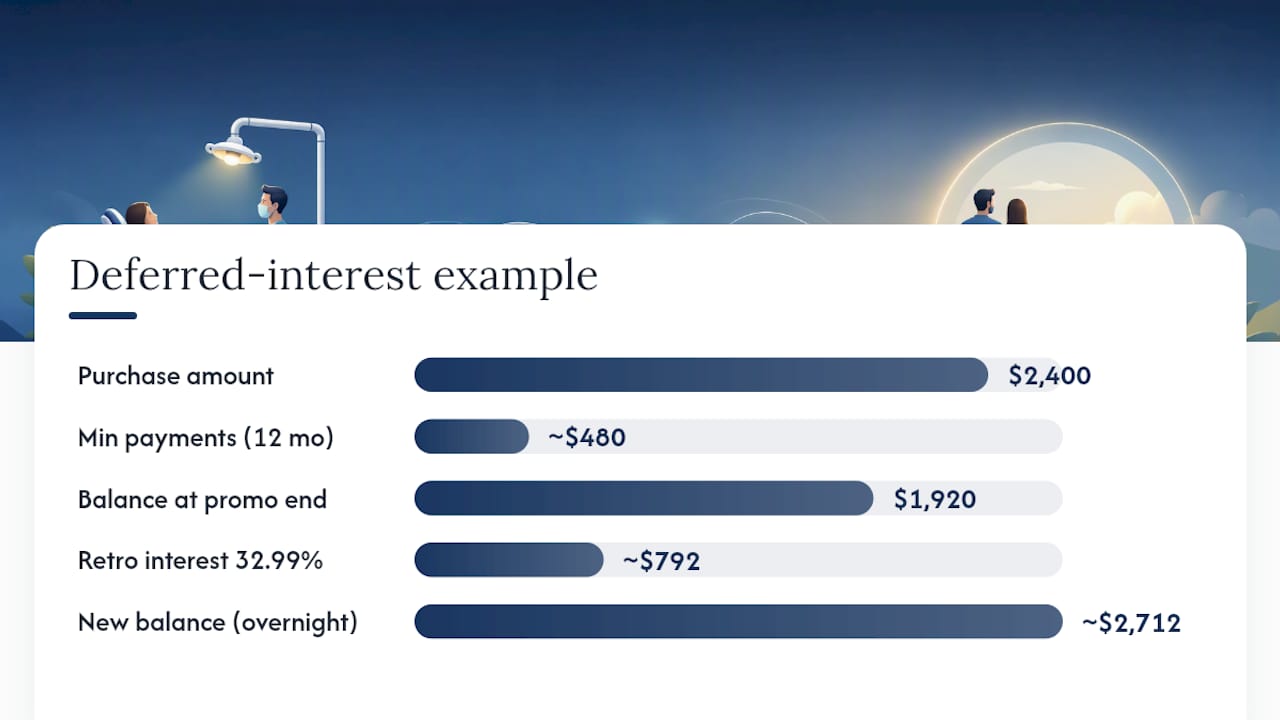
Say you charge $2,400 for dental work on a 12-month promo. You make minimum payments each month, totaling roughly $480 over the year. On month 12, you still owe $1,920. The promo ends. CareCredit now charges interest on the original $2,400 from the purchase date at 32.99% APR. That retroactive interest on $2,400 for 12 months is estimated to be roughly $792. Your remaining balance doesn't just stay at $1,920 — it jumps to approximately $2,712 overnight.
The deferred-interest cliff is not a penalty for late payment. It's a structural feature of the product. Any remaining balance at promo end triggers the full retroactive charge, regardless of how many on-time payments you made.
That 32.99% standard APR is notably high. For comparison, the average personal loan rate for borrowers with good credit sits well below that figure, and many credit unions offer medical financing at rates under 15%. Industry analysis confirms that CareCredit's deferred-interest model and higher merchant fees are the primary trade-offs relative to newer financing options.
Credit impact is another consideration. The formal application triggers a hard inquiry that can temporarily lower your score, and denial is possible for applicants with limited or damaged credit histories.
Pro Tip: Set a calendar alert 60 days before your promo end date and a second one 30 days out. Then set autopay for the full statement balance, not the minimum payment. These two steps eliminate the most common path to a retroactive interest charge, as ToothCostGuide's patient guide consistently recommends.
Realistic alternatives to CareCredit and when they beat it
CareCredit isn't the only path. MoneyLion's comparison of medical financing alternatives identifies several categories worth evaluating before you apply.
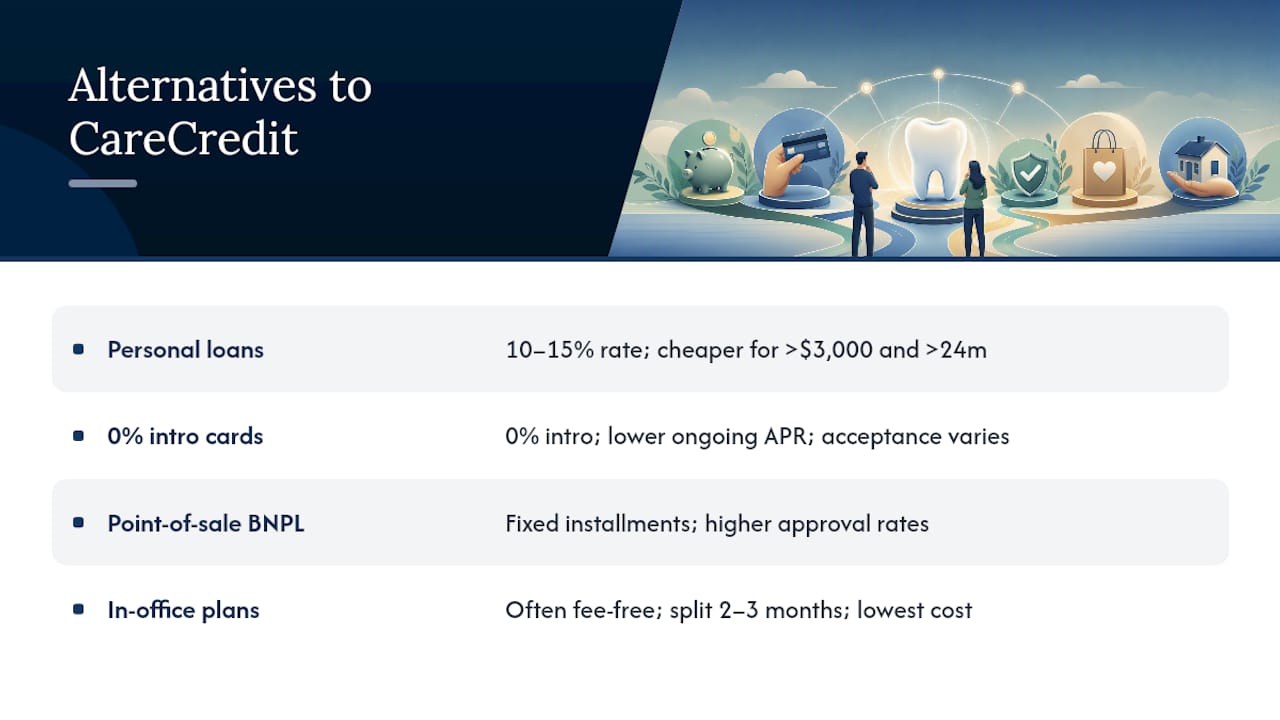
Personal fixed-rate loans from banks, credit unions, or online lenders give you a set monthly payment and a rate that doesn't change. No deferred-interest cliff. For procedures over $3,000 where you know repayment will take longer than 24 months, a personal loan at 10–15% is almost always cheaper than CareCredit's standard APR.
General-purpose 0% intro APR credit cards (Visa, Mastercard) work similarly to CareCredit's promo structure but often carry lower ongoing APRs if you carry a balance past the intro period. The trade-off: they're not always accepted at every dental office the way CareCredit is.
Point-of-sale BNPL and installment providers like Sunbit, Cherry, and Alphaeon use true-installment structures, meaning you pay fixed monthly amounts with no retroactive interest cliff. Sunbit and Cherry in particular advertise higher approval rates and softer credit requirements, which matters for patients with limited credit history. Alphaeon focuses specifically on elective healthcare and cosmetic procedures.
In-office payment plans vary by practice but can offer the lowest total cost when available. Ask directly — many offices will split a bill over 2–3 months with no fees at all.
Should you use CareCredit for this dental bill? A checklist
Run through these questions before you sign at the dental office.
- What is the total procedure cost? Write down the exact amount being charged to CareCredit.
- Which promo period is being offered for that amount? Ask the office: 6, 12, 18, or 24 months? Get it in writing.
- Is this a deferred-interest promo or a reduced-APR installment plan? These are different. Confirm which one.
- What is the required monthly payment to pay off the full balance before the promo ends? Divide the total by the number of promo months. Can you cover that amount every month without fail?
- Can you set autopay for that exact amount today? If the answer is no, stop and reconsider.
- What is your likelihood of missing a payment? Irregular income, upcoming large expenses, or job uncertainty all raise this risk.
- Have you compared a personal loan or BNPL option for this amount? For balances over $2,000 with repayment beyond 18 months, a fixed-rate loan may cost less in total.
- What is your credit score range? If it's below 640, approval odds drop and you may want to prequalify first to avoid a hard pull on a likely denial.
Questions to ask the dental office:
- "Which specific promo months are available for this procedure amount?"
- "Is this deferred interest or a reduced-APR installment plan?"
- "Can I see the written promo terms before you run the card?"
Red flags that should stop you:
- You can only afford the minimum monthly payment
- The office can't tell you whether the plan is deferred-interest or installment
- No written promo terms are provided before charging
- You have no clear plan for the final payoff month
A dentist's view: when our practice recommends CareCredit
At DC Implant & Cosmetic Dentistry, we recommend CareCredit most often for patients facing urgent restorative work or elective procedures where the cost would otherwise delay necessary care. A patient who needs a crown or a dental implant but doesn't have the full amount available today can use a 12-month promo to spread payments without paying interest, as long as they commit to the monthly payoff amount from the start. We always walk patients through the promo terms before processing the card, confirm whether the plan is deferred-interest or installment, and encourage prequalification so there's no surprise hard inquiry. Our goal is that patients leave with a clear number in their head: exactly what they owe each month and exactly when the promo ends.
Dr. Kambez Shukoor, a U.S. Navy veteran and lead dentist at DC Implant & Cosmetic Dentistry, brings that same precision to financing conversations that he applies to clinical care. The practice's financial information page outlines the full range of payment options available to patients, including CareCredit and other financing paths.
For patients with cost-related dental anxiety, having a clear financing plan before the appointment can reduce the hesitation that leads to delayed care. That delay is often what turns a manageable problem into a more complex one.
A short note from the practice
At DC Dentistry, we offer CareCredit alongside other financing options because no single product fits every patient's situation. Some patients do best with a short-term promo. Others benefit from a fixed installment plan or an in-office arrangement. We take the time during your consultation to walk through what each option actually costs, so you can make a decision based on real numbers rather than assumptions. If you're weighing financing for an upcoming procedure, bring your questions to your appointment and we'll work through the numbers together.
Financing at DC Implant & Cosmetic Dentistry
DC Implant & Cosmetic Dentistry accepts CareCredit for procedures ranging from routine restorations to full mouth implant reconstruction. Patients considering dental implants in Washington, DC often find that a 24-month reduced-APR installment plan makes a high-value procedure genuinely accessible without the deferred-interest risk.
Same-day appointments are available, and financing questions can be addressed during your initial consultation. Call the office or book online to discuss which payment option fits your specific procedure and budget. The team will confirm promo terms in writing before any charges are processed.
Sources
Before applying, read the issuer's cardholder agreement and confirm the exact promotional plan being offered for your specific procedure amount. The sources below are the primary references used in this article.
- Prequalify and Apply for a CareCredit Credit Card – CareCredit
- Paying for dental care with a credit card – NerdWallet
- CareCredit for Dental Work: How It Works and What to Watch Out For — ToothCostGuide
- How to Apply for CareCredit Card – WalletHub
- Best CareCredit alternatives: Compare medical financing – MoneyLion
This article provides general financial information about dental financing options. It is not a substitute for advice from a licensed financial professional. Confirm current terms directly with CareCredit and your dental provider before applying.